
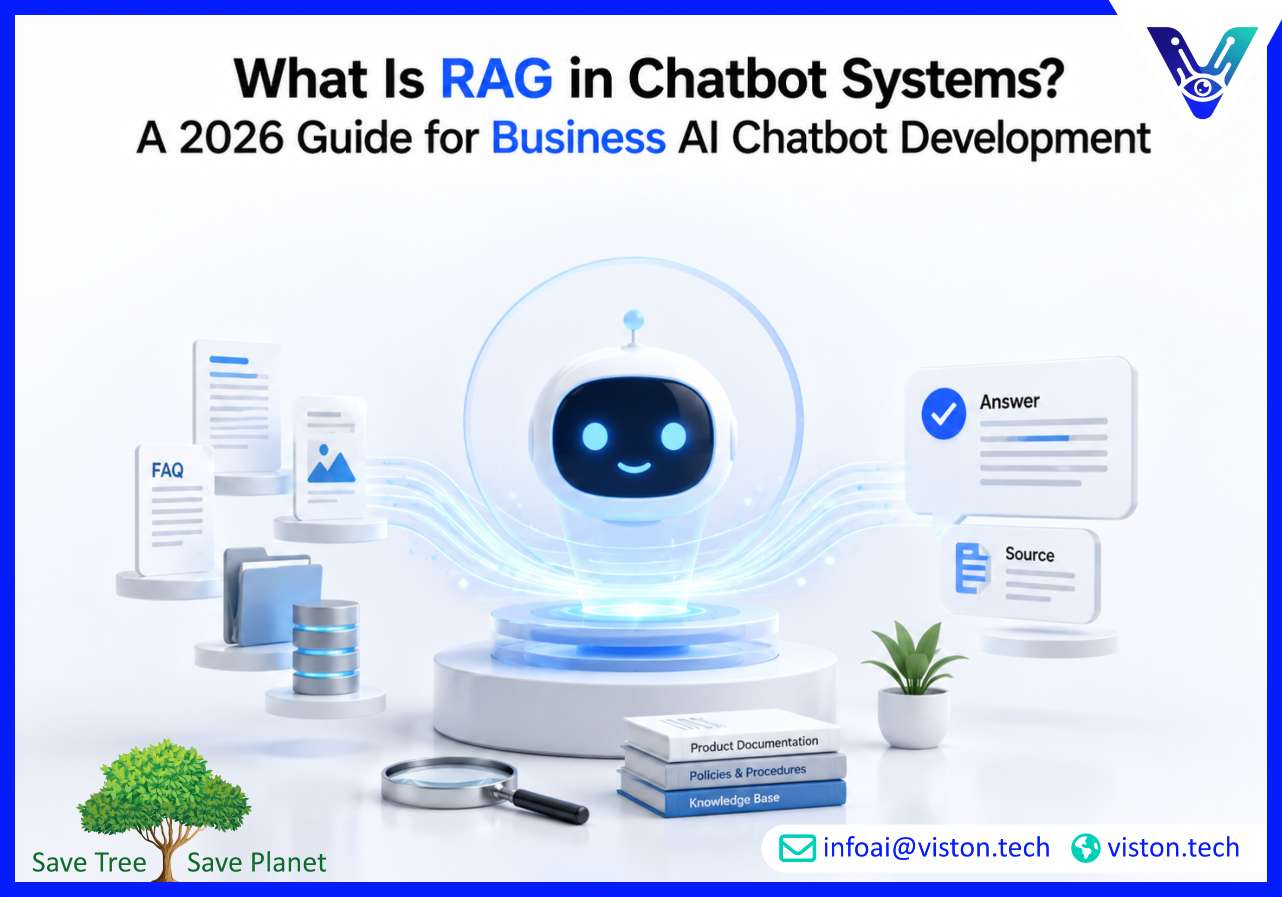
What is RAG in chatbot systems? For businesses investing in AI Chatbot Development, RAG is one of the most important techniques for making chatbot answers more accurate, current, and business-specific. It helps AI chatbots respond using trusted company knowledge instead of relying only on general model training.
RAG stands for retrieval-augmented generation. In chatbot systems, it is an AI architecture that allows a chatbot to retrieve relevant information from approved data sources before generating an answer. Instead of depending only on what a large language model already knows, the chatbot searches a connected knowledge base, finds the most relevant content, and uses that content to produce a grounded response.
This matters because standard AI models are trained on broad data and may not know a company’s latest products, pricing, policies, internal processes, technical documentation, or customer-specific workflows. A chatbot without RAG may give generic answers, outdated information, or confident responses that are not supported by the business’s real data.
A RAG-powered chatbot works differently. When a user asks a question, the system first interprets the intent of the query. It then searches relevant sources such as documents, FAQs, website pages, product manuals, CRM notes, helpdesk articles, internal policies, onboarding guides, or structured databases. The most useful information is retrieved and passed to the AI model, which generates a response based on that retrieved context.
For example, a customer might ask, “What is your refund policy for enterprise plans?” A basic chatbot may answer from a fixed script or general training data. A RAG chatbot can retrieve the current refund policy from the company’s approved documentation and generate a clear answer that reflects the latest terms.
In practical business terms, RAG connects conversational AI with enterprise knowledge. It gives chatbots access to the information they need to answer accurately, support users, reduce repetitive work, and operate more reliably across customer service, sales, operations, employee support, and technical assistance.
In 2026, businesses expect AI chatbots to do more than provide simple answers. They want chatbots that can support real workflows, handle nuanced questions, respect access permissions, integrate with business systems, and provide dependable responses across multiple channels. RAG is central to meeting these expectations because it improves the connection between AI capability and business reality.
One of the biggest advantages of RAG is that it helps reduce hallucinations. Hallucinations happen when an AI model generates information that sounds plausible but is incorrect or unsupported. In a business setting, this can create serious problems, especially when the chatbot discusses pricing, compliance, legal terms, service commitments, product specifications, or operational procedures.
RAG reduces this risk by grounding the chatbot’s answer in retrieved source material. The chatbot is not simply guessing from general model knowledge. It is responding with context from approved company information. While RAG does not remove every risk, it gives businesses a stronger foundation for accuracy, quality control, and trust.
RAG is also valuable because business information changes frequently. Product pages are updated, policies evolve, support articles are revised, regulations change, and internal workflows improve. Retraining a large AI model every time information changes is expensive and impractical. With RAG, businesses can update the knowledge base, and the chatbot can retrieve newer information without rebuilding the entire model.
This makes RAG especially useful for companies that need scalable AI chatbot systems. A business can start with a focused knowledge base, then expand into more departments, languages, systems, and use cases over time. As long as the data pipeline, retrieval logic, and governance process are well designed, the chatbot can grow with the organization.
RAG also supports better transparency. Many businesses want to know where chatbot answers come from. A well-designed RAG system can show source references internally, support audit reviews, and help teams improve weak answers by identifying which documents were retrieved. This is important for procurement teams, compliance teams, support leaders, and technology decision-makers evaluating chatbot reliability.
A RAG chatbot may feel simple to the user, but several technical components work together behind the interface. Successful AI Chatbot Development requires careful planning around data preparation, retrieval quality, prompt design, security, evaluation, and ongoing optimization.
The first step is identifying which information the chatbot should use. This may include website content, PDFs, support articles, product documentation, knowledge base pages, internal standard operating procedures, policy documents, training materials, sales enablement content, and customer support logs.
Raw documents are rarely ready for chatbot use. They may contain outdated details, duplicated sections, conflicting instructions, poor formatting, or missing context. Before building a RAG chatbot, businesses need to clean, organize, and structure their knowledge sources. This preparation directly affects answer quality.
Once the content is prepared, it is usually divided into smaller sections called chunks. Chunking helps the chatbot retrieve the most relevant parts of a document instead of sending entire files to the AI model. Good chunking improves response accuracy because the system can focus on the specific information needed for the user’s question.
After chunking, the content is indexed. Many RAG systems use embeddings, which convert text into numerical representations that capture meaning. These embeddings are stored in a vector database, allowing the chatbot to search by semantic similarity rather than only matching exact keywords.
When a user asks a question, the chatbot searches the indexed knowledge base for the most relevant chunks. Modern systems may use semantic search, keyword search, hybrid search, metadata filtering, and re-ranking to improve retrieval quality.
This step is critical. If the system retrieves weak or irrelevant content, the AI model may generate a poor answer. A strong RAG chatbot needs retrieval logic that understands user intent, prioritizes trusted sources, applies permissions, and selects the right context before generation begins.
After the system retrieves relevant information, the chatbot passes it to the language model with instructions on how to answer. The model then generates a response based on the retrieved context. The best systems include guardrails that tell the chatbot what to do when information is missing, uncertain, restricted, or outside scope.
For example, the chatbot may be instructed to say it does not have enough information instead of inventing an answer. It may also be configured to escalate complex issues to a human agent, create a ticket, ask a follow-up question, or route the user to the correct department.
RAG chatbot systems require ongoing review. Teams should monitor unanswered questions, low-confidence responses, retrieval failures, user feedback, escalation rates, and completion rates. This helps identify content gaps, poor document structure, weak prompts, or retrieval problems.
In 2026, businesses should treat RAG chatbot development as a continuous improvement process rather than a one-time implementation. The best results come from regular testing, content updates, performance reviews, and optimization based on real conversations.
RAG is useful because it improves how chatbots handle business-specific information. It is especially valuable when users ask questions that require accurate, current, or detailed answers. This makes it relevant across customer support, sales, employee enablement, technical service, operations, and knowledge management.
Customer support teams can use RAG chatbots to answer questions about orders, policies, setup guides, troubleshooting steps, service levels, billing processes, and product documentation. The chatbot can retrieve approved support content and provide consistent answers before escalating complex cases to human agents.
This can reduce repetitive support tickets, improve response speed, and help agents focus on higher-value work. It also supports better self-service, especially for businesses with large knowledge bases or high inquiry volumes.
In sales environments, RAG chatbots can help prospects understand services, compare solution options, answer implementation questions, qualify needs, and guide users toward the right next step. When connected to approved sales content, the chatbot can provide more useful answers than a generic assistant.
For B2B buyers, this is important because purchase decisions often involve detailed questions about features, integrations, timelines, pricing models, security, support, and expected outcomes. A RAG chatbot can support early-stage research without requiring a sales team to answer every repeated question manually.
RAG is also valuable for internal company workflows. Employees often waste time searching for policies, process documents, onboarding materials, IT instructions, HR guidance, or operational procedures. A RAG-powered internal chatbot can retrieve the right information quickly and present it in a conversational format.
This can support onboarding, internal helpdesks, IT support, compliance guidance, training, and operational efficiency. For larger organizations, access control is essential so employees only receive information they are authorized to view.
Businesses with complex products can use RAG chatbots to assist users with manuals, API documentation, release notes, configuration guides, known issues, and troubleshooting workflows. The chatbot can retrieve specific technical details and explain them in clear language.
This is useful for SaaS companies, technology vendors, manufacturers, logistics platforms, professional services firms, and other businesses where customers or employees regularly need accurate technical information.
RAG is powerful, but it is not automatically reliable. Poor implementation can create inaccurate responses, weak retrieval, duplicated information, access control failures, outdated answers, or unclear escalation paths. A chatbot may still produce bad answers if the knowledge base is poorly maintained or if the retrieval system selects the wrong context.
Businesses should also consider data privacy, security, and compliance. Chatbots may handle sensitive customer data, employee information, commercial documents, or regulated content. A RAG system should include permission controls, secure data handling, logging, monitoring, and clear rules for what the chatbot can and cannot answer.
Another important risk is over-automation. Not every conversation should be handled entirely by AI. Some issues require human judgment, empathy, negotiation, or approval. A well-designed RAG chatbot includes escalation logic, human handoff, and clear boundaries.
Building a reliable RAG chatbot starts with defining the business problem. Companies should avoid implementing RAG simply because it is a popular AI technique. The right question is: what information does the chatbot need to retrieve, for whom, and for what business outcome?
A strong implementation begins with use case selection. A focused first version may support customer FAQs, product documentation, sales qualification, employee onboarding, or internal process guidance. Starting with a narrow, high-value use case helps control complexity and gives teams measurable feedback before expanding.
The next step is data readiness. Businesses need to identify trusted sources, remove outdated content, resolve conflicting information, and define ownership for future updates. RAG performance depends heavily on source quality. If the knowledge base is weak, the chatbot will be weak.
Architecture decisions also matter. Teams must choose the right language model, embedding approach, vector database, retrieval method, integration layer, hosting environment, and analytics setup. For enterprise use, additional planning may be required for authentication, role-based access, audit trails, data retention, encryption, and system monitoring.
Prompt design is another key part of RAG chatbot development. The system prompt should explain how the chatbot should use retrieved context, when it should ask clarifying questions, when it should refuse to answer, and when it should escalate. These instructions help control tone, accuracy, safety, and business alignment.
Testing should include real user questions, edge cases, ambiguous queries, restricted information, outdated content, and failed retrieval scenarios. Businesses should evaluate whether the chatbot retrieves the right documents, answers clearly, avoids unsupported claims, and handles uncertainty properly.
After launch, optimization becomes ongoing. Teams should review conversation logs, identify knowledge gaps, improve source documents, adjust chunking, refine retrieval settings, test prompts, and measure business outcomes. Useful metrics may include answer accuracy, containment rate, escalation rate, ticket reduction, lead qualification rate, response time, user satisfaction, and unresolved query volume.
A reliable RAG chatbot is not just an AI feature. It is a managed knowledge system, a conversational interface, and a business workflow tool working together.
Viston AI is relevant for businesses exploring what RAG in chatbot systems means because RAG is closely connected to modern AI Chatbot Development. A RAG chatbot requires more than a chat interface; it needs thoughtful architecture, knowledge preparation, retrieval design, AI model integration, workflow planning, testing, and continuous optimization.
For organizations that want chatbot systems connected to real business knowledge, Viston AI can support the practical requirements behind conversational AI delivery. This includes building chatbot solutions that use company-specific information, support natural language interactions, and help businesses automate customer, sales, or internal workflows more effectively.
RAG is especially useful when a chatbot needs to answer questions from approved documents, product information, service pages, internal knowledge bases, or operational content. In these cases, the development partner must understand how to structure information, connect retrieval systems, guide AI responses, and reduce the risk of unsupported answers.
Viston AI’s relevance comes from its focus on AI chatbot development and business-oriented AI solutions. For companies evaluating RAG chatbot systems in 2026, that type of specialist support can help turn a broad AI idea into a practical implementation with clearer scope, stronger data foundations, better user experience, and more reliable business outcomes.
RAG in chatbot systems means retrieval-augmented generation. It allows a chatbot to search approved company knowledge sources before generating an answer, helping the response become more accurate, current, and relevant to the business.
RAG is important because it reduces reliance on general model knowledge. It helps chatbots answer using trusted business content such as policies, product documents, support articles, FAQs, and internal knowledge bases.
No. RAG can reduce hallucinations, but it does not eliminate them completely. Businesses still need strong data quality, retrieval testing, prompt guardrails, monitoring, and human escalation for uncertain or sensitive cases.
A RAG chatbot can use approved sources such as website pages, PDFs, helpdesk articles, CRM records, product manuals, internal documents, onboarding guides, technical documentation, and structured databases, depending on permissions and integration design.
No. RAG is useful for customer support, sales assistance, employee onboarding, internal knowledge search, IT helpdesks, technical documentation support, compliance guidance, and operational workflow automation.
Viston AI can support businesses exploring RAG-based AI Chatbot Development by helping plan chatbot scope, connect business knowledge sources, design practical conversational workflows, and build chatbot systems aligned with real operational needs.
What is RAG in chatbot systems? It is the method that allows AI chatbots to retrieve trusted business information before generating answers. For companies investing in AI Chatbot Development, RAG can improve accuracy, reduce unsupported responses, support current knowledge, and make chatbot systems more useful across customer, sales, and internal workflows. The key is not simply adding RAG technology, but implementing it with clean data, secure retrieval, strong prompts, testing, monitoring, and clear business goals. For organizations planning more reliable chatbot systems in 2026, Viston AI offers relevant expertise in building practical AI chatbot solutions around real business knowledge and outcomes.
