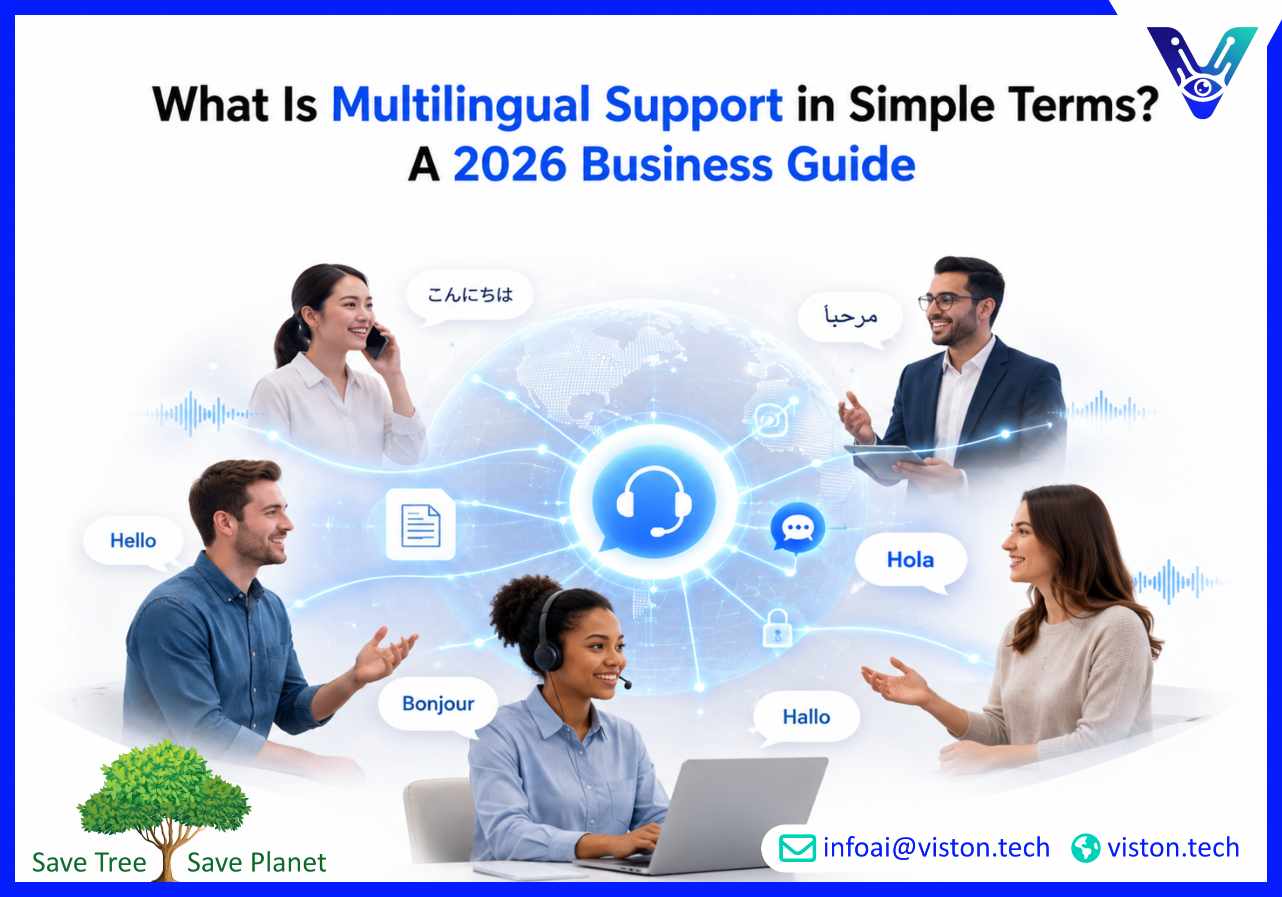
What Is Multilingual Support in Simple Terms? A 2026 Business Guide
What is multilingual support in simple terms? It means helping customers in the language they understand and prefer. For a business, this involves providing clear, consistent assistance across chat, email, phone, self-service content, mobile apps, and other channels without allowing language barriers to delay or weaken the customer experience.
What Is Multilingual Support in Simple Terms?
Multilingual support is the ability of a business to communicate with and assist customers in more than one language. Instead of requiring every customer to use the company’s primary language, the business allows people to ask questions, explain problems, receive instructions, and resolve issues in their preferred language.For example, an online store based in an English-speaking market may receive a delivery question from a Spanish-speaking customer. With multilingual support, the customer can write in Spanish and receive an accurate Spanish response. The business may provide that response through a fluent agent, an AI chatbot, real-time translation software, localized help content, or a combination of these methods.The important point is that multilingual support goes beyond translating individual words. The customer still expects the business to understand the actual problem, access relevant account or order information, apply the correct policy, and provide a useful resolution.
Multilingual support is not the same as basic translation
Translation converts content from one language into another. Multilingual customer support delivers the complete service experience in another language.A translation tool might convert “Where is my order?” into another language. A multilingual support system should also recognize that the customer is asking about delivery, locate the correct order, explain its current status, and provide the next step.Effective multilingual support therefore includes:
Understanding the customer’s language and intent
Using accurate product, service, and policy terminology
Providing culturally appropriate and natural responses
Accessing relevant customer or transaction information
Routing complex cases to the right human specialist
Maintaining consistent quality across every supported language
A response can be grammatically correct and still be unhelpful. The real purpose of multilingual support is not simply to produce translated text. It is to help the customer complete a task or solve a problem without language becoming an obstacle.
How Multilingual Support Works in Practice
Businesses can provide multilingual support through several delivery models. The right model depends on customer demand, conversation volume, risk, available resources, service channels, and the complexity of the questions being handled.
Multilingual human agents
A business can employ or outsource agents who speak particular languages. These agents manage conversations directly and can understand tone, cultural context, regional expressions, and sensitive situations.Human language specialists are particularly valuable for complaints, negotiations, high-value accounts, regulated services, unusual technical issues, and situations that require judgment. However, hiring separate teams for every language can become difficult and expensive as a business expands.
Real-time translation for support teams
Real-time translation tools allow a customer and an agent to communicate even when they do not speak the same language. The customer’s message is translated for the agent, and the agent’s response is translated back for the customer.This approach can expand language coverage without building a dedicated team for every market. It works best when the business uses approved terminology, reviews translation quality, protects sensitive information, and provides human oversight for complex cases.
Multilingual AI chatbots
A multilingual chatbot can identify a customer’s language, understand the request, retrieve approved information, and respond in that language. It can support common tasks such as:
Answering product or service questions
Providing order and delivery updates
Helping users access their accounts
Explaining subscription or billing processes
Guiding customers through onboarding
Collecting information before creating a support ticket
Booking appointments or demonstrations
Chatbots are useful for repetitive, well-documented enquiries and around-the-clock availability. They should not be expected to manage every situation independently. Reliable systems use confidence thresholds and escalation rules so uncertain, sensitive, or complicated conversations can be transferred to a person.
Localized knowledge bases and self-service content
Multilingual support also includes translated and localized help centres, FAQs, setup guides, troubleshooting articles, policies, and instructional content. This allows customers to find answers without opening a ticket.Localization is more than direct translation. It may require adjustments to currencies, measurements, dates, terminology, tone, legal wording, payment options, or regional processes. A translated article should feel relevant to the customer’s market rather than appearing to be a literal copy of the original.
Language-aware routing
Language-aware routing identifies the language of an incoming message and sends it to the most appropriate agent, chatbot, team, or workflow. The system may also consider the customer’s location, account type, issue category, urgency, and previous conversation history.Good routing reduces unnecessary transfers and prevents customers from repeating information. When a chatbot hands a case to an employee, the employee should receive the conversation, detected language, customer details, attempted solution, and a clear summary of the issue.
Why Multilingual Support Matters for Businesses in 2026
Businesses now reach international and linguistically diverse audiences through websites, apps, ecommerce platforms, marketplaces, social media, and digital advertising. A company can attract customers from several regions before it has established offices or support teams in those markets.This creates an important service gap. Customers may be able to discover and purchase a product in their language but receive support only in English or another company-defined language. That inconsistency can make onboarding, troubleshooting, billing, returns, and account management unnecessarily difficult.
It reduces misunderstanding
Customers can describe problems more clearly when they use a familiar language. Support teams can also provide more precise instructions, reducing repeated messages and avoidable mistakes.This is especially important when a conversation involves payments, refunds, delivery instructions, account security, technical configuration, healthcare information, financial products, or contractual terms. Small language errors can create significant operational or customer-experience problems.
It improves customer confidence
Customers are more likely to feel understood when a business communicates in their preferred language. Clear language can make an unfamiliar company appear more accessible and prepared to support customers after a purchase.Multilingual support can therefore strengthen trust during product evaluation, onboarding, problem resolution, and renewal. It shows that the business has considered the full customer journey rather than focusing only on the transaction.
It supports international growth
A company entering a new market needs more than translated marketing pages. Customers may need assistance with setup, product use, local payment methods, delivery, billing, returns, and regional policies.Multilingual customer support helps the business serve that demand without forcing every customer to communicate in an unfamiliar language. It can also reveal which markets, languages, and issues generate the greatest demand, helping leaders make better expansion decisions.
It helps teams scale recurring support
AI chatbots, translated knowledge bases, agent-assist tools, and automated workflows can handle repetitive multilingual questions while human employees focus on cases requiring judgment or specialist knowledge.The objective should not be to automate every conversation. It should be to automate suitable tasks while preserving reliable human support for exceptions. A balanced model can increase availability and consistency without sacrificing service quality.
It creates a more inclusive customer experience
Multilingual support enables people with different language abilities to access information, ask questions, and complete tasks more independently. This is relevant not only to international companies but also to businesses serving multilingual communities within a single country.Accessibility requirements and language-service obligations vary by country and industry. Organizations operating in regulated or public-facing environments should review the rules that apply to their services rather than assuming automated translation alone is sufficient.
How to Build Reliable Multilingual Support
A business does not need to support every language immediately. A focused rollout based on genuine customer demand is usually more effective than launching broad but unreliable coverage.
Start with customer and support data
Review website traffic, customer locations, browser-language settings, sales enquiries, support tickets, chat logs, and failed conversations. This information helps identify which languages matter most and which customer journeys should be prioritized.A business might begin with two or three high-demand languages and a limited set of repeatable use cases. Coverage can then expand after quality and operational performance have been tested.
Prepare approved source content
Translation quality depends on the quality of the original information. Before adding languages, businesses should review their product documentation, policies, troubleshooting guides, response templates, and knowledge-base articles.Outdated, duplicated, or conflicting source content will create inconsistent multilingual answers. Each important document should have an owner, review date, and clear status as an approved source.
Create a terminology guide
Product names, feature labels, technical terms, industry vocabulary, policy wording, and brand expressions should be translated consistently. A terminology guide helps agents, translators, chatbots, and content teams use the same approved language.This is particularly important for software, manufacturing, finance, healthcare, legal services, and other fields where a minor wording change can alter meaning.
Define what should and should not be automated
Routine questions with clear answers are strong candidates for automation. These may include opening hours, order tracking, account access, subscription guidance, appointment confirmation, and standard product information.Complaints, fraud concerns, unusual refunds, safety issues, legal requests, high-value negotiations, and complex technical cases often need human review. Escalation should be treated as part of good service design rather than as a chatbot failure.
Connect support to business systems
A multilingual assistant becomes more useful when it can securely access relevant systems. Depending on the use case, this may include CRM software, helpdesk platforms, ecommerce systems, order management tools, scheduling applications, subscription platforms, and knowledge bases.Integration allows the system to provide contextual answers rather than generic translations. It can also create tickets, update records, retrieve order details, schedule appointments, or trigger approved workflows.
Measure each language separately
Overall performance can hide problems in individual languages. Businesses should monitor response time, resolution rate, fallback rate, escalation rate, customer satisfaction, repeat contact, translation corrections, and workflow completion by language.Native-language testing is also important. A system that performs well on clean, translated test sentences may struggle with abbreviations, spelling errors, regional expressions, mixed-language messages, or the way real customers naturally describe problems.
How Viston AI Supports Practical Multilingual Customer Service
Viston AI provides multilingual AI chatbot support for businesses that need to manage customer conversations across different languages, channels, and operational systems. Its service offering combines natural language processing, language detection, translation and localization, multilingual chatbot development, intelligent routing, analytics, and business-system integration.These capabilities are relevant because effective multilingual support requires more than translating a chat message. A solution must understand customer intent, retrieve approved information, maintain context across a conversation, and escalate the issue when automation is not appropriate.Viston AI supports deployment across channels such as web chat, mobile applications, messaging platforms, SMS, voice assistants, and social channels. Its multilingual chatbot services can also connect with CRM platforms, helpdesk systems, knowledge bases, transaction data, appointment calendars, and other business applications.This integration-focused approach can help ecommerce companies, SaaS providers, financial services organizations, healthcare businesses, manufacturers, hospitality companies, and other global or linguistically diverse organizations deliver more consistent support. Language-specific analytics also enable teams to compare performance, identify content gaps, review escalation patterns, and improve responses over time.For businesses planning a phased rollout, Viston AI’s capabilities can support selected languages and use cases first, followed by broader coverage as customer demand and operational readiness increase.
Frequently Asked Questions
What is multilingual support in one sentence?
Multilingual support means helping customers ask questions, receive information, and solve problems in more than one language.
What is an example of multilingual support?
An example is an ecommerce chatbot that detects a customer writing in French, provides order information in French, and transfers a complex return request to an appropriate support agent with the full conversation context.
Does multilingual support require native-speaking agents?
Not for every conversation. Businesses can combine multilingual employees, AI chatbots, real-time translation, localized self-service content, and translated agent tools. Native or fluent human review remains valuable for sensitive, complex, or culturally nuanced cases.
How is multilingual support different from localization?
Multilingual support helps customers across different languages. Localization adapts content and experiences for a particular region, including terminology, tone, currency, dates, measurements, cultural expectations, and local processes. Strong multilingual support often uses localization.
How many languages should a business support?
The right number depends on actual customer demand. Businesses should start with the languages generating the most valuable traffic, sales, or support volume, establish reliable service quality, and then expand gradually.
Can Viston AI help automate multilingual support?
Viston AI offers multilingual AI chatbot support, language-aware intent recognition, translation and localization, routing, analytics, omnichannel deployment, and integration with business systems. These capabilities can support both automated resolution and contextual human escalation.
Conclusion
Understanding what multilingual support is in simple terms helps businesses focus on its real purpose: enabling customers to receive clear, useful assistance in the language they prefer. Reliable Multilingual Support combines language capability with accurate knowledge, suitable automation, contextual integrations, human escalation, and language-specific quality monitoring. In 2026, businesses should prioritize the languages and customer journeys that matter most rather than pursuing broad but inconsistent coverage. Viston AI provides relevant multilingual chatbot, routing, integration, and analytics capabilities for organizations seeking a practical and scalable approach to serving diverse or international audiences.