
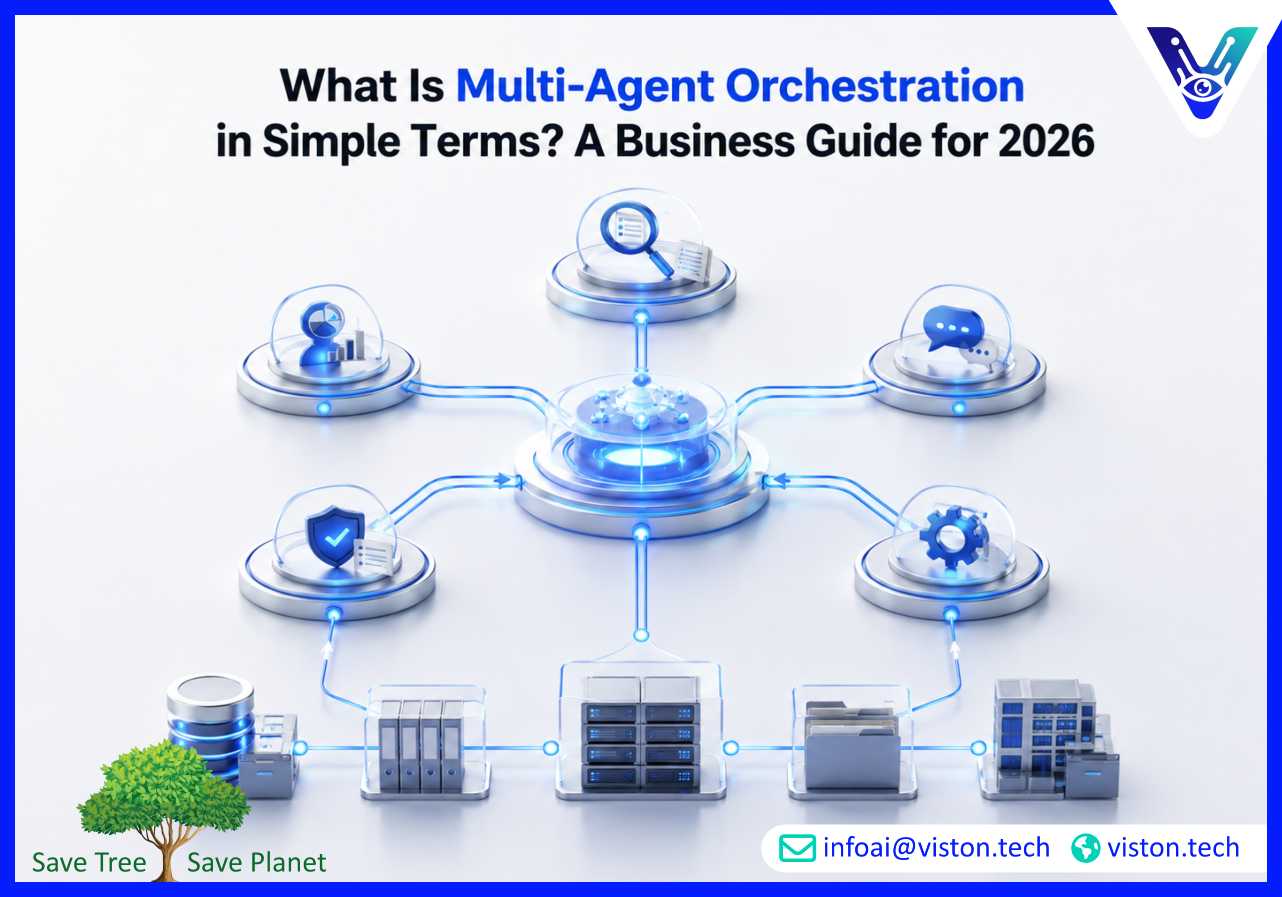
As businesses adopt AI to automate more complex tasks, many are discovering that a single AI agent is often not enough. Multi-agent orchestration allows multiple AI agents to work together in a coordinated way, helping organizations automate processes that involve research, decision-making, communication, validation, and execution. Understanding multi-agent orchestration is becoming increasingly important for companies looking to scale AI-driven operations in 2026.
In simple terms, multi-agent orchestration is the process of managing and coordinating multiple AI agents so they can work together to complete a task or business workflow.
Think of it like a team in an office. Instead of one employee trying to handle everything, different team members have specialized roles. One person gathers information, another reviews it, another communicates with customers, and another approves the final outcome. Multi-agent orchestration applies this same concept to AI systems.
Each AI agent is given a specific responsibility, and an orchestration layer ensures they collaborate efficiently, share information, and complete work in the correct order.
Without orchestration, multiple agents may operate independently. With orchestration, they function as a coordinated system designed to achieve a business objective.
Organizations today face increasing pressure to improve productivity, reduce manual effort, and manage growing volumes of data and customer interactions. While traditional automation handles repetitive rules-based tasks, many business processes require multiple actions, decisions, and system integrations.
Multi-agent orchestration helps bridge this gap.
Businesses are adopting orchestrated AI systems because they can:
As AI technology matures, organizations are moving beyond standalone chatbots and exploring coordinated AI teams that can perform meaningful operational work.
A multi-agent system typically consists of several specialized AI agents, each responsible for a different part of a workflow.
Imagine a company receiving a new sales inquiry.
Rather than one AI attempting every task, each agent specializes in a specific function. The orchestration layer controls how information moves between agents and ensures the workflow progresses smoothly.
This coordinated approach often produces more reliable and scalable results than relying on a single AI model.
Multi-agent orchestration offers several advantages for organizations implementing AI-driven automation.
Each agent focuses on a clearly defined responsibility. Specialized agents often perform better because they are optimized for specific tasks.
Validation agents can review outputs, catch errors, and verify information before actions are completed.
Organizations can add new agents as workflows grow more complex without redesigning the entire system.
Agents can connect with CRMs, ERP systems, helpdesks, databases, analytics platforms, and internal knowledge systems.
Businesses can implement approval processes, monitoring, audit logs, and escalation paths for sensitive actions.
These benefits make multi-agent orchestration particularly valuable for operational processes that involve multiple steps and stakeholders.
Multi-agent systems are increasingly being used across a variety of business functions.
The strongest implementations focus on measurable business outcomes rather than simply deploying AI for its own sake.
For organizations exploring Multi-Agent Orchestration, Viston AI’s expertise aligns directly with the design and implementation of coordinated AI systems. Building effective multi-agent environments requires more than connecting AI models. It involves workflow analysis, agent role definition, orchestration logic, system integration, governance controls, monitoring, and continuous optimization.
Viston AI helps businesses evaluate where orchestrated AI workflows can create genuine operational value. This includes identifying automation opportunities, designing specialized agent architectures, integrating business systems, and creating scalable workflows that align with business objectives.
Organizations implementing Multi-Agent Orchestration often need solutions that balance automation with control, security, and transparency. Viston AI’s focus on practical AI implementation helps businesses move beyond isolated AI experiments toward structured, business-ready automation systems that can support growth and operational efficiency.
Multi-agent orchestration is the process of coordinating multiple AI agents so they can work together to complete tasks, share information, and execute workflows efficiently.
A single AI agent performs multiple responsibilities alone. Multi-agent orchestration divides work among specialized agents, improving efficiency, scalability, and reliability.
Not every business requires it. It is most valuable when workflows involve multiple steps, decisions, systems, and stakeholders that can benefit from coordinated automation.
Yes. Modern multi-agent systems can connect with CRM platforms, ERP systems, databases, communication tools, helpdesks, and other business applications.
When implemented properly, organizations can apply access controls, approval workflows, monitoring, audit trails, and governance policies to maintain security and compliance.
Yes. Viston AI provides expertise related to Multi-Agent Orchestration, helping businesses design, integrate, and deploy coordinated AI workflows that support real operational objectives.
Multi-agent orchestration is essentially the coordination of multiple specialized AI agents working together to achieve a business goal. Instead of relying on a single AI system to handle every task, organizations can create structured workflows where different agents contribute their expertise at different stages. As businesses continue to automate increasingly complex operations in 2026, Multi-Agent Orchestration provides a practical framework for building scalable, reliable, and efficient AI-powered workflows. For organizations exploring these opportunities, Viston AI offers relevant expertise in designing and implementing coordinated AI systems that align with real business needs.
