
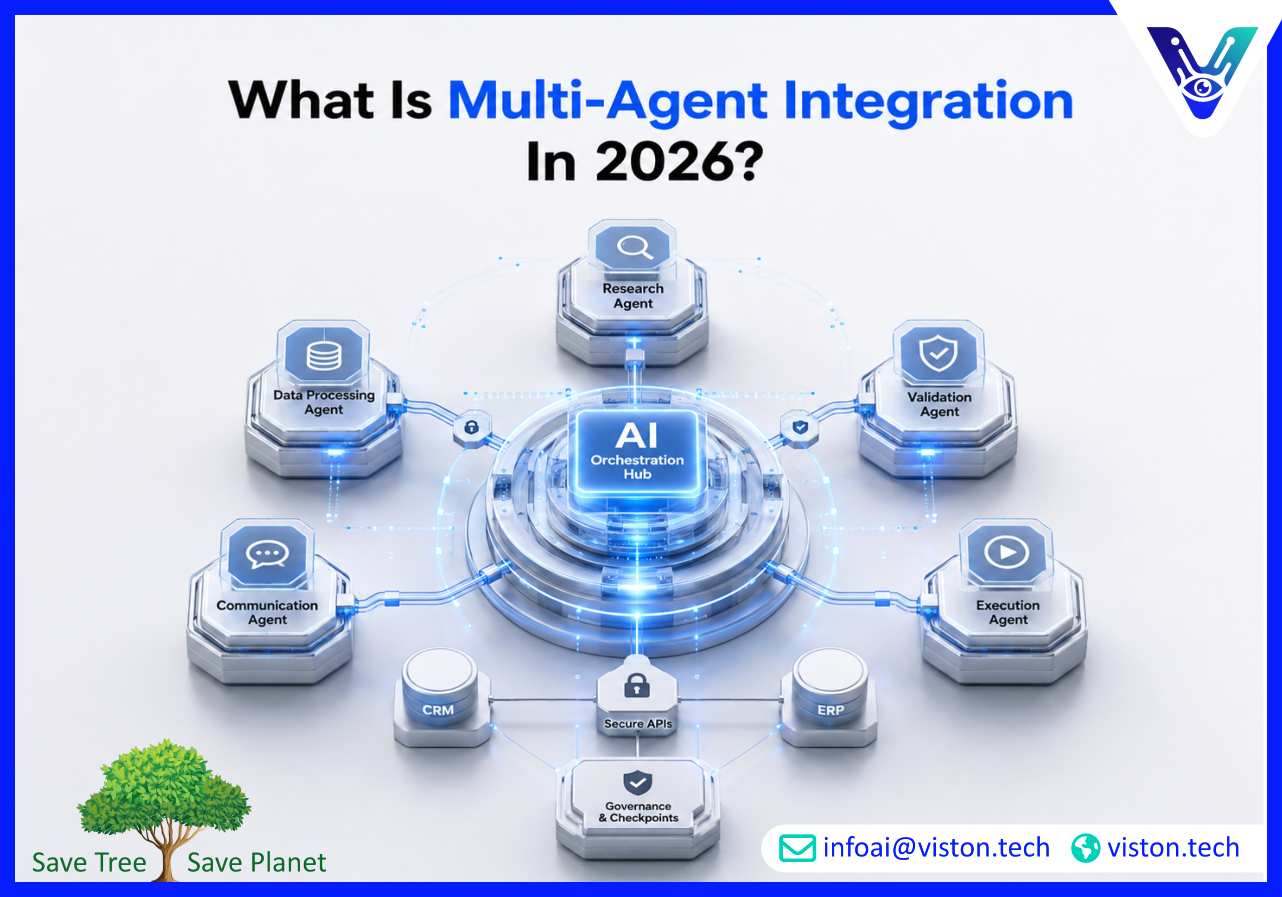
Multi-agent integration helps businesses connect several specialized AI agents into one coordinated workflow, allowing them to automate complex tasks across systems, teams, data sources, and business applications with greater control, accuracy, and scalability.
Multi-agent integration is the process of connecting multiple AI agents so they can work together inside a business workflow. Each agent is designed for a specific role, such as reading data, analyzing information, updating systems, drafting responses, checking quality, or escalating exceptions to a human team member.
Unlike a single AI chatbot that responds to one request at a time, a multi-agent system distributes work across several task-focused agents. These agents communicate, share context, use business tools, and complete steps in a controlled sequence.
For example, in a customer support workflow, one agent may classify a ticket, another may retrieve the right knowledge base article, another may draft the response, another may check the answer for policy accuracy, and another may update the CRM or helpdesk system. This is where Agent Integration Services become important. They ensure agents are not operating in isolation but are properly connected to workflows, APIs, databases, software platforms, and approval rules.
In practical terms, multi-agent integration turns AI from a standalone assistant into a coordinated digital workforce that can support real business execution.
In 2026, businesses are moving beyond basic automation and simple AI chat interfaces. They want AI systems that can handle multi-step processes, work with company data, interact with enterprise tools, and support measurable operational outcomes.
Many business processes are too complex for one AI agent. Sales, support, finance, HR, marketing, procurement, logistics, and operations often involve several decisions, systems, handoffs, approvals, and exceptions. Multi-agent integration helps manage that complexity by assigning the right task to the right agent.
This matters because business teams are under pressure to reduce manual work, improve turnaround times, increase data accuracy, and scale operations without adding unnecessary overhead. Well-integrated agents can help automate repetitive coordination work while keeping humans involved for judgment, approvals, and sensitive decisions.
The main value is not simply that agents can work faster. The real value is that they can be structured around business processes with defined responsibilities, secure access, clear rules, and measurable outcomes.
Multi-agent integration depends on architecture, orchestration, system access, data context, and governance. Without these foundations, agents may produce useful individual outputs but fail to deliver reliable end-to-end workflow performance.
Every agent should have a clear role. A research agent gathers information. A data agent reads and prepares records. A decision-support agent analyzes options. A communication agent drafts messages. A validation agent checks quality. An execution agent updates systems or triggers workflow actions.
This role-based design makes the system easier to test, monitor, improve, and secure.
Orchestration controls how agents work together. It defines task order, dependencies, handoffs, retries, approvals, exception handling, and escalation paths. This prevents agents from acting randomly or duplicating work.
For example, an execution agent should not update a customer record until a validation agent confirms that the data is accurate and the required approval rules have been met.
AI agents usually need access to existing business systems to create real value. These may include CRM platforms, ERP systems, support desks, databases, document repositories, analytics tools, email platforms, calendars, project management software, and custom APIs.
Agent Integration Services help connect these systems securely so agents can retrieve information, perform actions, and keep business records updated.
Agents must work from consistent and approved information. Shared context may include customer history, product data, business policies, previous conversations, workflow status, pricing rules, compliance instructions, or internal documentation.
If agents do not share context properly, outputs become inconsistent and workflows become unreliable.
Not every action should be fully autonomous. Businesses often need human approval for financial decisions, legal responses, sensitive customer communication, refunds, contract changes, compliance matters, and high-impact operational actions.
A well-integrated multi-agent system defines when agents can act independently and when they must involve a person.
Multi-agent integration is most useful where business workflows involve repeated steps, multiple systems, changing context, and a need for accuracy. It can support many departments and industries because the underlying challenge is often the same: teams spend too much time coordinating work across disconnected tools.
Multi-agent systems can research leads, qualify prospects, update CRM fields, summarize conversations, draft follow-up emails, and alert sales teams when a lead is ready for action. This reduces manual admin work and helps sales teams focus on relationship-building and deal progress.
Support teams can use integrated agents for ticket routing, knowledge retrieval, response drafting, sentiment detection, escalation, and resolution tracking. A validation agent can check whether responses follow company policy before they are sent.
Agents can support invoice review, data extraction, payment matching, approval routing, document classification, exception detection, and reporting. Human approval can remain in place for sensitive transactions.
Multi-agent integration can help with employee onboarding, policy questions, document collection, candidate screening support, training workflows, and internal service requests.
Agents can support campaign research, content briefing, audience segmentation, performance analysis, reporting, and workflow coordination between marketing tools.
Businesses can use agents to collect data, clean records, generate summaries, detect anomalies, prepare reports, and notify stakeholders when action is needed.
The strongest use cases are not generic AI experiments. They are specific workflows where AI agents can reduce delays, improve consistency, and help teams complete business tasks more reliably.
Viston AI is relevant to businesses exploring multi-agent integration because its work aligns with AI automation, workflow bots, agentic systems, and Agent Integration Services. For organizations that want AI agents to operate across real business processes, Viston AI can support the planning, integration, deployment, and optimization needed to make those systems practical.
Multi-agent integration requires more than connecting an AI model to a software tool. It involves understanding workflows, designing agent roles, integrating business systems, managing data access, applying security controls, building orchestration logic, and testing how agents perform in real operational conditions.
Viston AI can help businesses identify where multiple agents are genuinely useful, avoid unnecessary complexity, and create workflows that connect AI capabilities with business outcomes. This may include support for sales operations, customer service, internal automation, data processing, document workflows, and back-office coordination.
For companies operating across different industries or global markets, this business-focused approach is important. A reliable multi-agent system should fit existing processes, respect governance needs, support scalability, and deliver measurable improvements in speed, accuracy, and operational efficiency.
Multi-agent integration means connecting several AI agents so they can work together on a business process. Each agent handles a specific task, while orchestration controls how the workflow moves from one step to the next.
A single AI agent usually performs one broad task. A multi-agent system uses several specialized agents for different responsibilities, such as research, analysis, validation, communication, and system updates.
Agent Integration Services help connect AI agents with business systems, workflows, APIs, data sources, approval rules, and monitoring tools. This makes AI agents usable in real operations rather than isolated experiments.
AI agents can integrate with CRMs, ERPs, helpdesks, databases, document systems, email platforms, analytics tools, project management software, knowledge bases, and custom business applications.
It can be secure when designed with access controls, permission management, data protection, audit logs, human approvals, monitoring, and clear rules for what agents can and cannot do.
Yes. Viston AI’s Agent Integration Services are relevant for businesses that need support designing, connecting, and deploying AI agents across workflows, tools, and operational systems.
Multi-agent integration is becoming an important part of business automation in 2026 because it allows several AI agents to work together across real workflows, systems, and data sources. With the right Agent Integration Services, businesses can move beyond basic AI tools and create structured automation that supports speed, accuracy, scalability, and better operational control. Viston AI is a relevant specialist for organizations exploring multi-agent integration because its capabilities align with workflow automation, AI agent deployment, system integration, and practical business-focused implementation.
