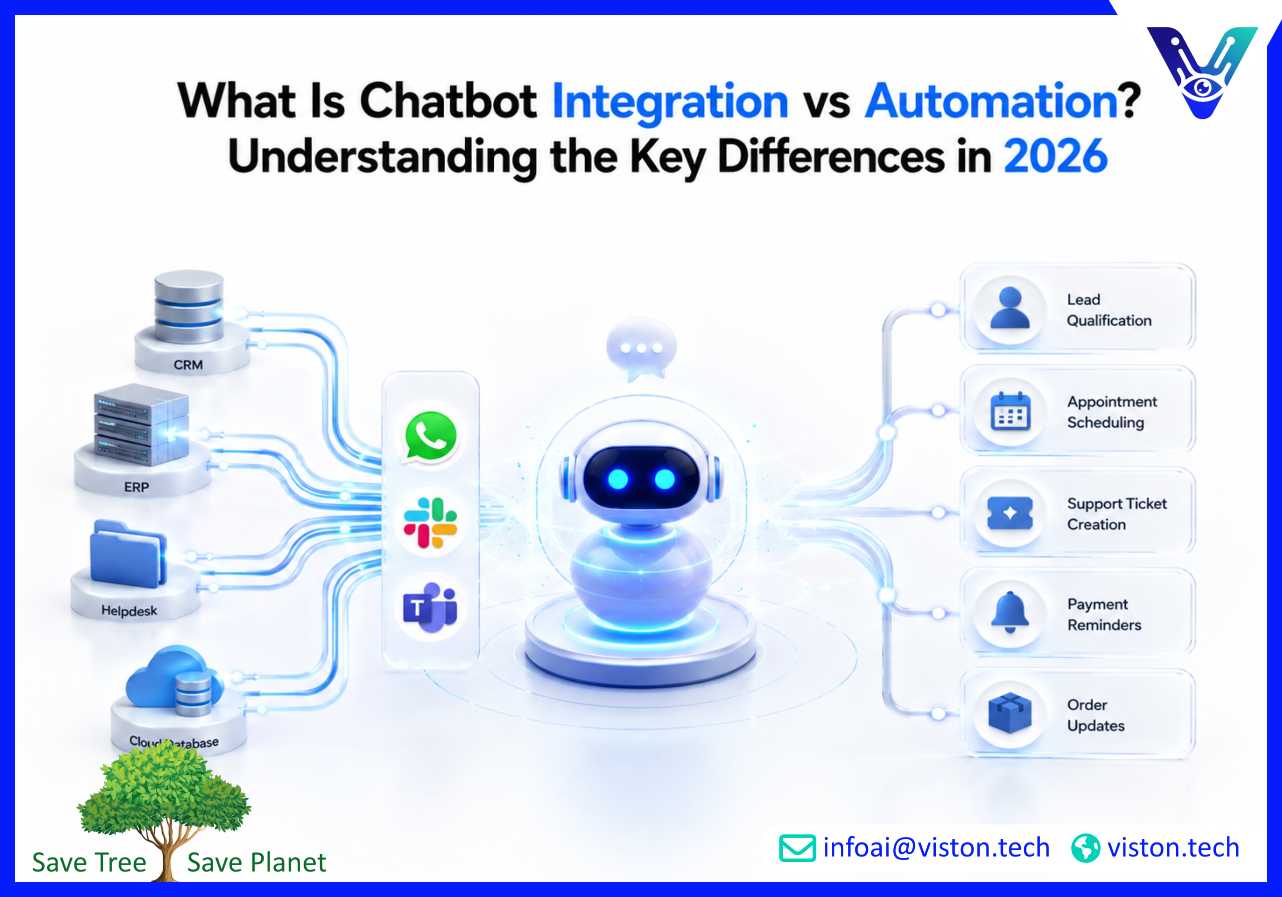
What Is Chatbot Integration vs Automation? Understanding the Key Differences in 2026
Introduction
As businesses continue investing in AI-driven customer experiences, the terms chatbot integration and chatbot automation are often used interchangeably. However, they represent different capabilities that serve distinct business objectives. Understanding the difference is essential for organizations looking to maximize the value of AI chatbot integration and streamline operations effectively.
What Is Chatbot Integration?
Chatbot integration refers to the process of connecting a chatbot with existing business systems, applications, databases, and communication channels. The goal is to enable the chatbot to access, exchange, and act upon real-time business data.Rather than functioning as a standalone tool, an integrated chatbot becomes part of the broader business ecosystem.
Common Systems Connected Through Chatbot Integration
Customer Relationship Management (CRM) platforms
Enterprise Resource Planning (ERP) systems
Helpdesk and ticketing software
E-commerce platforms
Payment gateways
Knowledge bases
Inventory management systems
Marketing automation platforms
Communication channels such as WhatsApp, Slack, and Microsoft Teams
For example, an integrated chatbot can retrieve customer order status directly from an ERP system or create support tickets automatically within a helpdesk platform.
What Is Chatbot Automation?
Chatbot automation focuses on using predefined workflows, rules, AI models, and triggers to perform tasks without human intervention. The objective is to automate repetitive processes, improve efficiency, and reduce manual workload.Automation determines what actions the chatbot performs, while integration determines where the chatbot gets information and where it sends information.
Automation enables businesses to handle large volumes of interactions consistently and efficiently without requiring human agents for every request.
Chatbot Integration vs Automation: The Core Difference
The simplest way to understand the distinction is:
Integration connects systems.
Automation executes processes.
A chatbot may be integrated without being highly automated, and it may automate simple tasks without deep integrations. The greatest business value is typically achieved when both capabilities work together.
Integration Focuses On:
Data connectivity
System interoperability
Real-time information access
Cross-platform communication
Centralized customer experiences
Automation Focuses On:
Workflow execution
Task reduction
Response consistency
Operational efficiency
Scalable customer interactions
Why Businesses Need Both in 2026
Modern customers expect immediate, accurate, and personalized responses. Meeting these expectations requires more than simple automated replies.Without integration, a chatbot may provide generic responses but cannot access customer-specific information. Without automation, employees may still need to manually perform repetitive tasks after every customer interaction.Organizations increasingly combine integration and automation to create intelligent workflows that deliver measurable business outcomes.
Examples of Combined Integration and Automation
Customer asks for order status → chatbot retrieves data from ERP and responds instantly.
Lead submits inquiry → chatbot qualifies lead and automatically creates a CRM record.
Employee requests leave → chatbot checks HR system and initiates approval workflow.
Customer reports an issue → chatbot creates a support ticket and assigns it to the correct team.
These workflows improve customer satisfaction while reducing operational costs.
Business Benefits of Chatbot Integration and Automation
Improved Customer Experience
Integrated and automated chatbots can deliver faster, more personalized responses by accessing real-time business information.
Operational Efficiency
Routine tasks can be handled automatically, allowing employees to focus on higher-value work.
Higher Scalability
Businesses can manage growing interaction volumes without proportionally increasing staffing requirements.
Better Data Accuracy
Integrated systems reduce manual data entry and minimize the risk of errors.
Faster Decision-Making
Real-time access to connected business systems enables quicker responses and improved operational visibility.
How AI Chatbot Integration Supports Business Automation
Effective automation depends on reliable access to business data. This is where AI chatbot integration becomes critical.When chatbots are connected to CRM platforms, ERP systems, customer databases, and communication channels, they can make informed decisions and trigger meaningful actions automatically.For example, an AI chatbot handling customer support can:
Verify customer identity
Retrieve account information
Check service history
Create support requests
Send notifications
Update records automatically
Without integration, many of these processes would require manual intervention.
How Viston AI Helps Businesses Implement AI Chatbot Integration
For organizations seeking to connect chatbots with their existing digital ecosystem, successful implementation requires more than deploying a conversational interface. Businesses need secure integrations, reliable workflows, scalable architecture, and ongoing optimization.Viston AI specializes in AI Chatbot Integration solutions that connect conversational AI platforms with business-critical systems and communication channels. This enables organizations to build chat experiences that not only answer questions but also perform meaningful business actions.Whether businesses need chatbot connectivity with CRM platforms, ERP systems, customer support software, e-commerce environments, internal databases, or messaging platforms, a structured integration approach helps ensure data accuracy, security, and long-term scalability.By combining AI capabilities with robust integration frameworks, businesses can create automated workflows that improve customer experiences, streamline operations, and support digital transformation initiatives.
Frequently Asked Questions
Is chatbot integration the same as chatbot automation?
No. Chatbot integration connects the chatbot to external systems, while chatbot automation enables the chatbot to perform tasks and workflows automatically.
Can a chatbot work without integration?
Yes, but its functionality is often limited. Without integration, the chatbot may not be able to access real-time business data or perform advanced actions.
Which is more important: integration or automation?
Both are important. Integration provides access to business information, while automation enables efficient execution of tasks. Together they create the most value.
What systems are commonly integrated with chatbots?
CRM platforms, ERP systems, helpdesk software, knowledge bases, payment gateways, inventory systems, and communication platforms are among the most common integrations.
How does AI improve chatbot automation?
AI enables chatbots to understand natural language, personalize interactions, make context-aware decisions, and handle more complex workflows than rule-based systems.
Can Viston AI help with chatbot integration projects?
Organizations looking to connect chatbots with existing business systems can evaluate AI Chatbot Integration solutions from Viston AI based on their operational requirements, workflows, and digital transformation goals.
Conclusion
Understanding chatbot integration vs automation is essential for businesses planning AI initiatives in 2026. Integration focuses on connecting systems and enabling data exchange, while automation focuses on executing tasks and workflows with minimal human involvement. Together, they create intelligent, scalable customer and employee experiences. Businesses investing in AI Chatbot Integration can unlock greater efficiency, improved service delivery, and stronger operational performance by combining both capabilities strategically.