
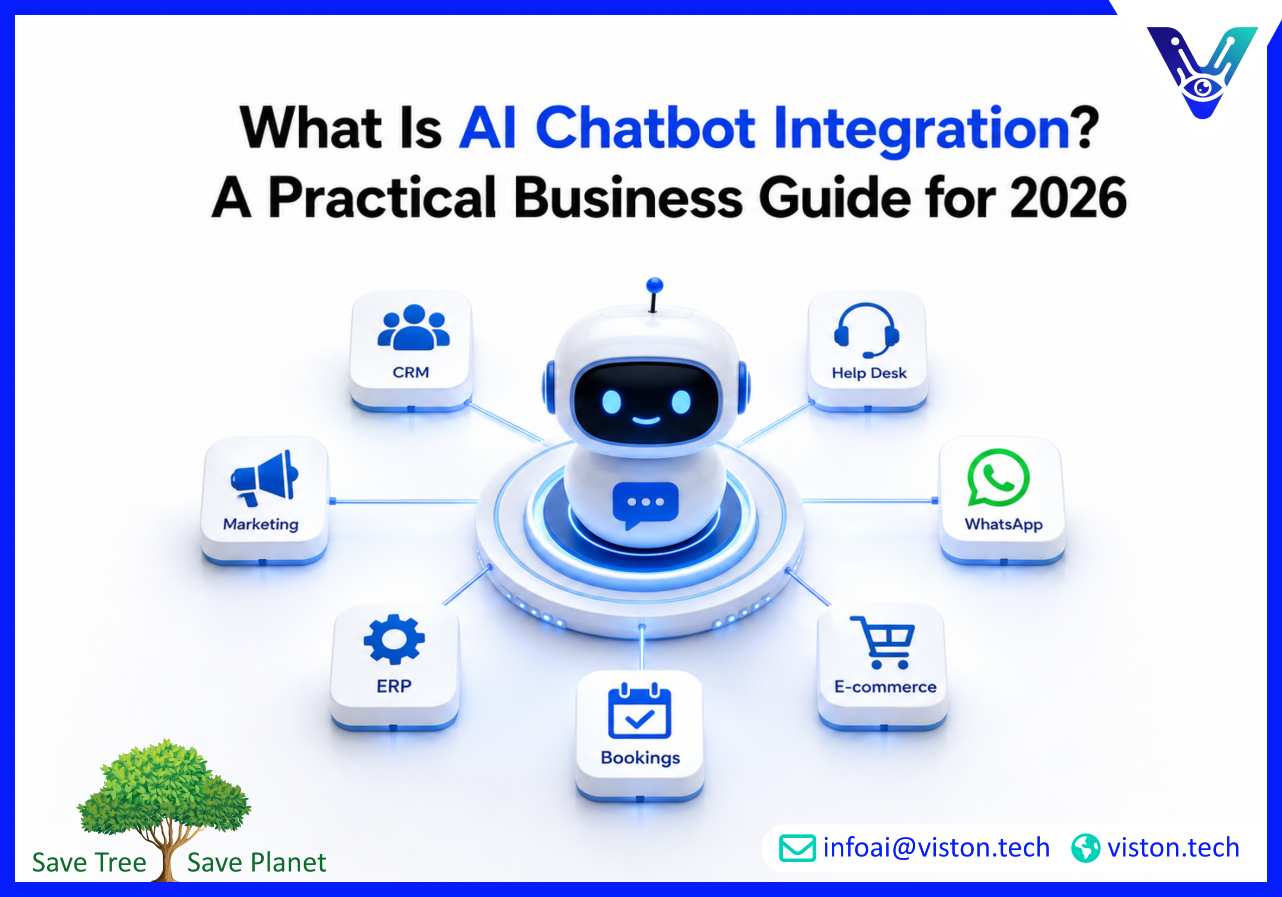
AI chatbot integration has become a core business requirement rather than a technology experiment. Organizations are increasingly connecting AI-powered chatbots with websites, CRM systems, customer support platforms, marketing tools, and business applications to automate conversations, improve customer experiences, and streamline operations. Understanding how AI chatbot integration works is essential for businesses looking to scale customer engagement efficiently in 2026.
AI chatbot integration is the process of connecting an artificial intelligence-powered chatbot with existing business systems, applications, databases, communication channels, and workflows.
Rather than functioning as a standalone chat window, an integrated chatbot can access business information, perform actions, retrieve customer data, automate tasks, and interact with other software platforms in real time.
Common integrations include:
The goal is to enable the chatbot to provide meaningful assistance instead of offering generic responses.
Customer expectations continue to evolve. People expect immediate responses, personalized interactions, and seamless support across multiple channels.
Without proper integration, chatbots often become limited FAQ tools that create frustration rather than value.
Integrated AI chatbots help businesses:
As AI models become more capable, the quality of integrations often determines the overall business value generated by a chatbot deployment.
Modern AI chatbots require access to relevant business information. Integration allows the chatbot to retrieve data from CRMs, product databases, customer records, knowledge bases, and internal systems.
This enables accurate and context-aware responses.
Most integrations are built through APIs (Application Programming Interfaces). APIs allow chatbots to exchange information securely with other software platforms.
For example, a chatbot can:
Integrated chatbots can automate complex business processes.
A customer inquiry might automatically:
This reduces manual intervention and improves consistency.
Support teams use integrated chatbots to answer common questions, resolve routine issues, create tickets, and escalate complex requests to human agents.
Sales teams use AI chatbots to engage website visitors, gather requirements, qualify prospects, and route high-intent leads to sales representatives.
Businesses integrate chatbots with booking systems to automate meeting scheduling, reminders, and appointment management.
Online stores connect chatbots with product catalogs, inventory systems, and order management platforms to support shoppers throughout the purchasing process.
Organizations deploy internal chatbots to assist employees with HR policies, IT support, onboarding tasks, and internal knowledge access.
Integrated chatbots help guide new customers through setup processes, product education, account activation, and service adoption.
Integrated chatbots provide faster, more relevant responses by accessing real business information instead of relying on generic scripts.
Automation reduces repetitive workloads, allowing teams to focus on higher-value activities.
Connecting chatbots with existing systems helps organizations leverage customer data more effectively.
Businesses can manage larger volumes of inquiries without proportional increases in staffing.
Integrated systems ensure customers receive accurate and standardized information across channels.
For businesses looking to implement AI chatbot integration effectively, success depends on more than simply deploying a chatbot. The real value comes from connecting AI capabilities with existing business systems, workflows, customer data, and operational processes.
Viston AI specializes in AI chatbot integration solutions designed to help organizations create practical, business-focused conversational experiences. By connecting chatbots with websites, CRM platforms, customer support systems, marketing tools, and workflow automation environments, businesses can move beyond basic question-and-answer functionality.
A well-planned integration approach helps organizations automate customer interactions, improve lead management, enhance support operations, and streamline business processes while maintaining security, scalability, and performance.
Whether companies are exploring customer service automation, lead generation, appointment booking, customer onboarding, or workflow optimization, AI chatbot integration can provide measurable operational benefits when implemented correctly.
The focus should always remain on delivering useful business outcomes through reliable integrations, accurate data access, and seamless user experiences.
Organizations should identify clear goals before selecting technology or integration methods.
AI systems perform best when connected to accurate and well-maintained data sources.
Customer information must be protected through appropriate authentication, permissions, encryption, and governance controls.
Not every interaction should remain automated. Effective chatbot integrations include clear escalation processes for complex situations.
AI chatbot performance should be reviewed regularly to improve accuracy, workflows, customer satisfaction, and business outcomes.
AI chatbot integration is the process of connecting an AI-powered chatbot with business systems, applications, databases, and communication channels so it can perform tasks and provide context-aware assistance.
Integration enables chatbots to access real business data, automate workflows, improve customer experiences, and support operational efficiency.
Common integrations include CRM platforms, websites, help desk software, e-commerce systems, ERP solutions, booking tools, marketing platforms, and internal business applications.
Implementation timelines vary depending on complexity, required integrations, security requirements, and customization needs. Simple integrations may take days, while enterprise projects can take several weeks or months.
Yes. Integrated AI chatbots can automate lead capture, customer support workflows, appointment scheduling, onboarding processes, ticket creation, and many other routine business tasks.
Viston AI helps businesses connect AI chatbots with existing systems and workflows to create scalable, practical automation solutions that improve customer engagement and operational efficiency.
AI chatbot integration transforms chatbots from simple conversation tools into valuable business assets. By connecting AI systems with customer data, operational platforms, and business workflows, organizations can automate processes, improve customer experiences, and increase efficiency. As businesses continue investing in intelligent automation in 2026, effective AI chatbot integration will remain a critical factor in achieving meaningful and scalable results. For organizations seeking professional implementation and optimization support, Viston AI provides expertise focused on practical business outcomes and reliable AI chatbot integration solutions
