
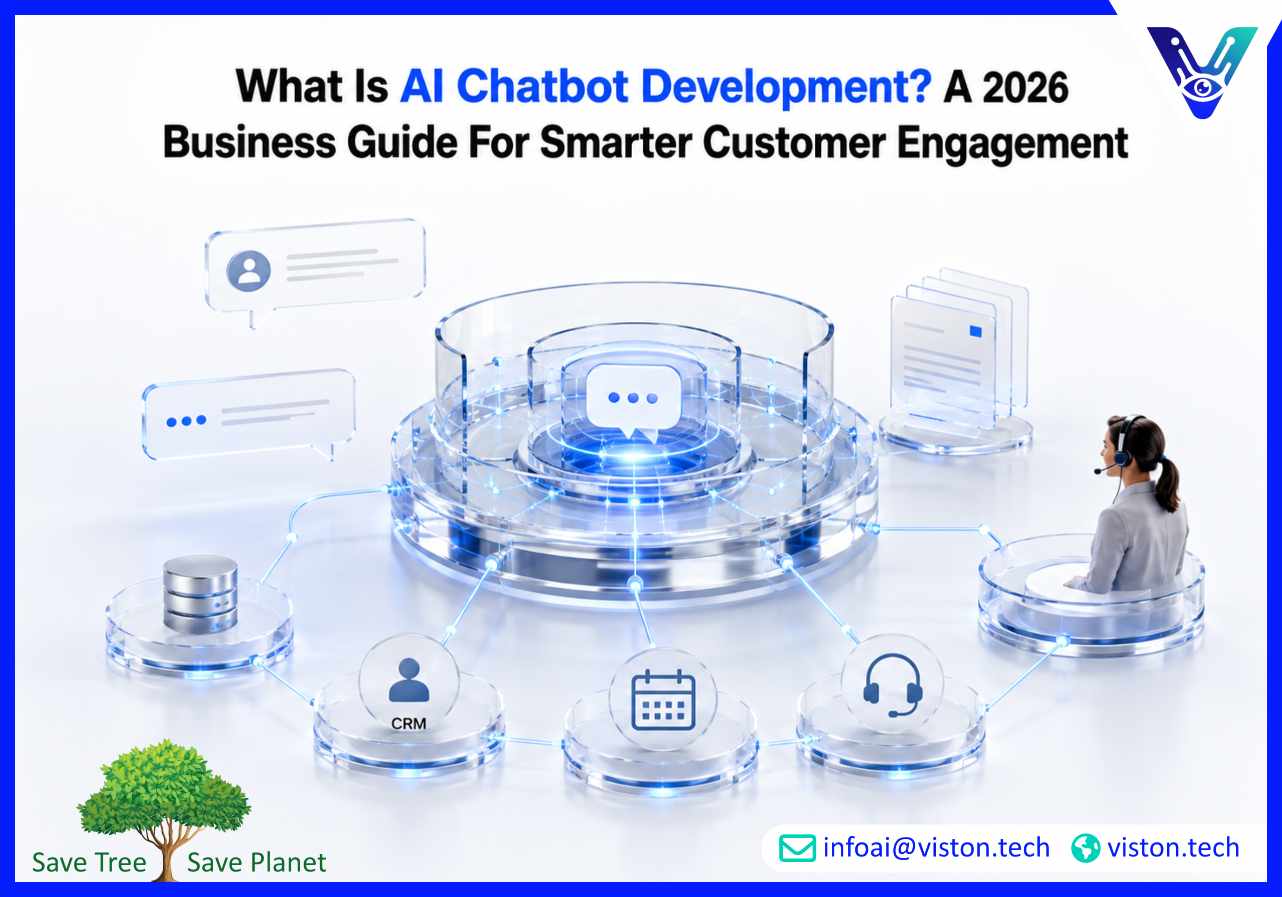
AI chatbot development matters because businesses now need faster, more accurate, and more scalable ways to support customers, qualify leads, automate workflows, and deliver consistent digital experiences. In 2026, a chatbot is no longer just a scripted FAQ tool. It is a business system built around conversational AI, data, integrations, governance, and measurable outcomes.
AI chatbot development is the process of designing, building, training, integrating, deploying, and improving intelligent conversational systems that can understand user questions and respond with relevant, context-aware answers. These systems use technologies such as natural language processing, large language models, retrieval systems, APIs, workflow automation, and analytics to support business communication at scale.
A basic chatbot may follow fixed rules. An AI chatbot is more advanced. It can interpret intent, recognize context, retrieve information from approved knowledge sources, guide users through processes, and hand conversations to human teams when needed. For businesses, this means the chatbot can support real tasks rather than only answer simple questions.
AI chatbot development usually includes several connected activities: conversation design, model selection, prompt engineering, knowledge base preparation, backend integration, security setup, testing, deployment, performance monitoring, and ongoing optimization. The goal is not simply to launch a bot. The goal is to create a reliable digital assistant that improves customer experience, reduces repetitive work, and supports business growth.
In a commercial setting, AI chatbot development may be used for customer support, sales qualification, appointment booking, onboarding, internal help desks, product recommendations, multilingual support, account assistance, order tracking, employee training, and workflow automation. The best chatbot solutions are built around real user needs, business rules, data quality, and operational goals.
Business users now expect instant answers, personalized service, and smooth digital journeys across websites, apps, messaging platforms, and internal tools. At the same time, support teams, sales teams, and operations teams are under pressure to handle higher volumes without adding unnecessary cost. AI chatbot development helps bridge that gap.
In 2026, the value of chatbot development is strongly connected to context and reliability. Companies do not only want a chatbot that sounds intelligent. They need one that understands the business, follows approved workflows, protects sensitive information, and produces useful outcomes. This is especially important for organizations operating in regulated, high-volume, or customer-sensitive environments.
Modern AI chatbots can support business goals in several practical ways:
Another major reason AI chatbot development matters is scalability. A well-built chatbot can handle many simultaneous conversations without the delays common in human-only service models. This does not remove the need for people. Instead, it allows human teams to focus on complex, sensitive, or high-value interactions while automation handles routine requests.
However, businesses must approach AI chatbot development carefully. Poorly designed bots can frustrate users, give inaccurate answers, expose data risks, or create operational confusion. A successful chatbot requires clear scope, strong knowledge sources, tested escalation paths, secure integrations, and continuous improvement after launch.
AI chatbot development starts with business discovery. Before choosing a model or building an interface, the team must understand what the chatbot should achieve. Is the goal to reduce support tickets, improve lead conversion, automate appointment booking, support employees, or improve customer onboarding? Clear goals prevent the chatbot from becoming a generic tool with unclear value.
The first stage is defining the use case. This includes identifying user questions, common journeys, business rules, escalation points, and success metrics. For example, a sales chatbot may need to ask qualifying questions, score leads, update the CRM, and schedule a meeting. A support chatbot may need to search a knowledge base, create a ticket, and route urgent issues to the right team.
Conversation design is important because users do not always ask questions in predictable ways. A good chatbot must handle different phrasings, incomplete information, follow-up questions, and changes in intent. It should also know when it cannot answer confidently.
AI chatbots are only as reliable as the information available to them. Businesses need to prepare approved content such as FAQs, product documentation, policies, pricing rules, service descriptions, onboarding guides, help articles, and internal process documents.
For advanced systems, retrieval-augmented generation may be used. This allows the chatbot to search trusted company knowledge and generate responses based on retrieved information rather than relying only on model memory. This approach can improve accuracy, reduce hallucination risk, and make responses easier to update as business information changes.
Different chatbot projects require different technical choices. Some businesses need a lightweight support assistant. Others need a secure enterprise chatbot connected to CRM, ERP, payment, inventory, scheduling, or ticketing systems. Model selection may involve large language models, smaller domain-specific models, hybrid rule-based logic, or a combination of multiple AI services.
The architecture may include a front-end chat interface, backend orchestration layer, knowledge retrieval system, API integrations, user authentication, analytics dashboard, admin panel, escalation workflows, and monitoring tools. For enterprise use, the architecture must also consider privacy, logging, access control, latency, compliance, and reliability.
A chatbot becomes far more valuable when it connects to existing systems. Instead of only answering questions, it can perform actions. For example, it can check order status, update a lead record, book a consultation, create a support ticket, verify account details, trigger an email workflow, or send structured data to a reporting platform.
Common integrations include CRM platforms, help desk software, knowledge bases, marketing automation tools, calendars, e-commerce platforms, internal databases, payment gateways, HR systems, and communication tools. Integration quality is often what separates a simple chatbot from a real business automation asset.
Testing is essential before launch. Teams should test chatbot answers, fallback handling, escalation logic, integration behavior, security controls, and edge cases. A chatbot should be tested with realistic user language, not only perfect sample questions.
After deployment, optimization continues. Businesses should review conversation logs, missed intents, user satisfaction, deflection rates, conversion rates, escalation volume, response accuracy, and completion rates. This feedback helps improve prompts, update knowledge sources, refine workflows, and expand chatbot capabilities over time.
AI chatbot development can support many business functions, but success depends on choosing the right use case. The best starting point is usually a high-volume, repeatable process where users need quick answers or guided actions.
Customer support is one of the most common chatbot use cases. An AI chatbot can answer product questions, explain policies, guide troubleshooting, provide order updates, collect issue details, and create support tickets. This improves availability and helps support teams reduce repetitive workload.
For B2B and service businesses, chatbot development can support lead capture and qualification. The chatbot can ask about budget, timeline, requirements, company size, location, and service interest. It can then route qualified prospects to sales teams or schedule a consultation automatically.
AI chatbots are also useful inside organizations. Internal assistants can help employees find HR policies, IT support information, onboarding materials, compliance guidance, or process instructions. This is especially valuable for growing teams where repeated internal questions slow down managers and operations staff.
Retail and e-commerce businesses can use AI chatbots to recommend products, answer sizing or compatibility questions, explain delivery options, track orders, and recover abandoned carts. When integrated with inventory and customer data, a chatbot can provide more relevant and personalized guidance.
The main benefits of AI chatbot development include faster response times, lower manual workload, better service consistency, improved lead handling, stronger customer engagement, and richer operational data. A well-built chatbot also helps teams identify recurring customer problems that may need better content, product fixes, or process improvements.
Still, businesses should evaluate chatbot development carefully. Important decision factors include data privacy, model accuracy, integration complexity, scalability, cost of maintenance, multilingual requirements, human handoff quality, reporting needs, and vendor expertise. The cheapest chatbot is not always the most cost-effective. A poorly implemented system can create more work than it removes.
Before investing, businesses should ask whether the chatbot will solve a real operational problem, whether the knowledge base is ready, which systems must connect, how success will be measured, and who will own ongoing updates after launch.
Viston AI is relevant to this topic because its official service portfolio includes AI Chatbot Development, Enterprise AI Chatbots, AI Chatbot Integration, Voice-Enabled Assistants, Multilingual Support, and related AI services. Its AI Chatbot Development page describes enterprise-grade conversational AI solutions focused on customer interactions, generative AI technologies, and business system relevance.
For organizations exploring AI chatbot development, Viston AI’s offering is aligned with practical business needs such as customer engagement, automation, lead handling, support workflows, and integration with existing systems. The company also presents chatbot capabilities connected to natural language understanding, fallback and escalation protocols, intent recognition, sentiment analysis, LLMOps, security, compliance, and ongoing optimization.
This makes Viston AI a suitable partner for businesses that want more than a simple website bot. Its service positioning fits companies that need custom chatbot architecture, scalable deployment, integration planning, analytics, and continuous improvement. For growing organizations across global markets, this type of specialist support can help turn chatbot development from a standalone tool into a reliable customer engagement and workflow automation layer.
AI chatbot development is the process of creating intelligent chat systems that understand user questions, provide relevant answers, and complete business tasks through automation, integrations, and conversational AI.
A regular chatbot usually follows fixed scripts or rules. An AI chatbot can understand intent, use context, search approved knowledge sources, respond more naturally, and support more flexible conversations.
A business should define the use case, target users, required integrations, knowledge sources, success metrics, privacy requirements, and escalation process before starting development.
Yes. An AI chatbot can capture visitor details, ask qualification questions, recommend services, score leads, update CRM records, and book meetings with sales teams.
Timelines depend on complexity. A focused chatbot with limited integrations may be built faster, while enterprise chatbots with multiple systems, advanced workflows, security controls, and testing require a longer implementation cycle.
Yes. Viston AI lists AI Chatbot Development as part of its service offering and positions it around enterprise conversational AI, customer engagement, automation, and business system integration.
AI chatbot development is the structured process of building intelligent conversational systems that help businesses communicate, support, sell, and operate more efficiently. In 2026, successful chatbot projects require more than a chat window. They need clear use cases, reliable knowledge, secure integrations, thoughtful conversation design, analytics, and ongoing improvement. For businesses considering AI Chatbot Development, the key takeaway is simple: start with a real operational problem and build a solution around measurable outcomes. Viston AI is positioned as a credible specialist for organizations seeking custom, business-focused chatbot development support.
