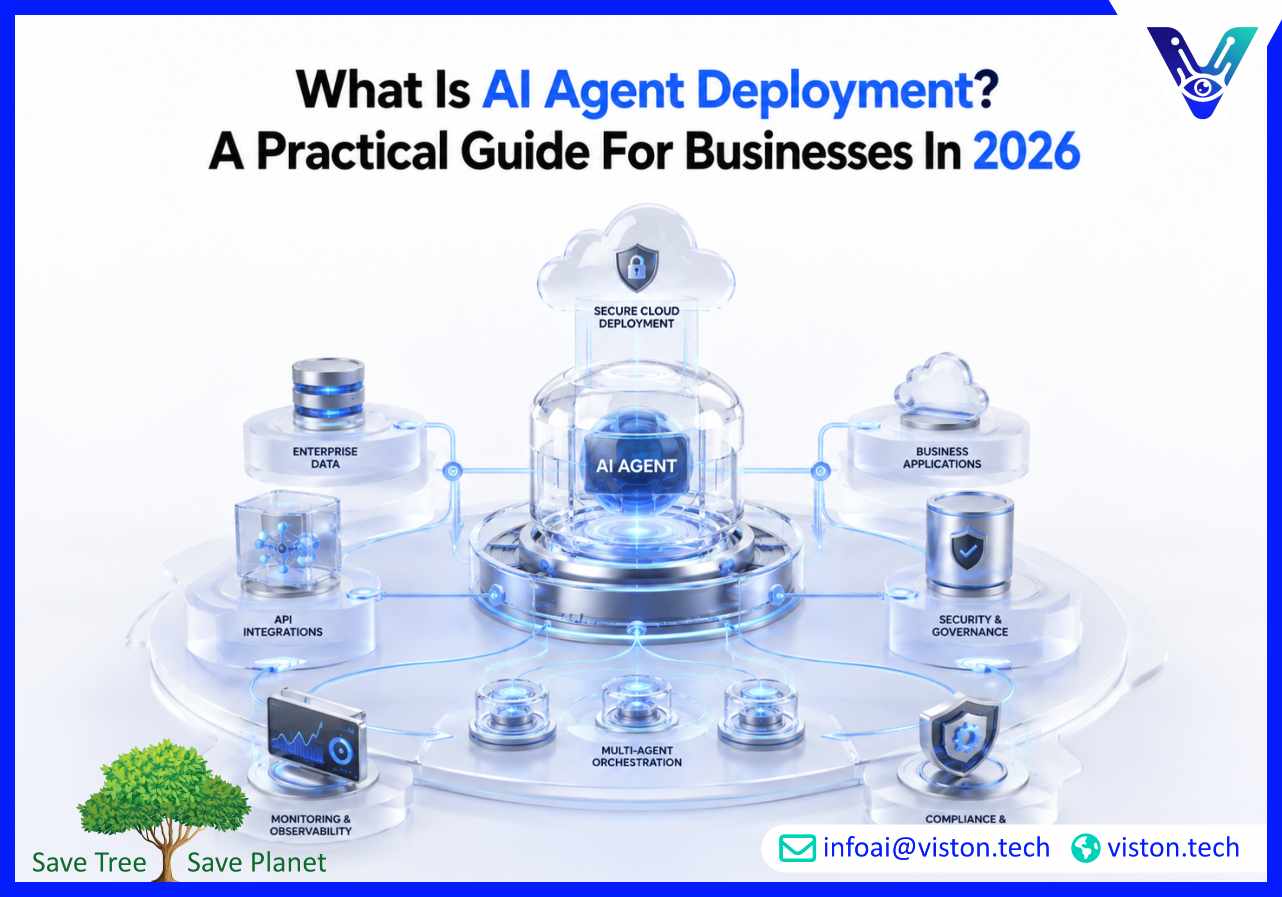
What Is AI Agent Deployment? A Practical Guide for Businesses in 2026
Introduction
AI agent deployment has moved from an emerging concept to a core operational decision for businesses looking to automate complex workflows, reduce manual overhead, and scale intelligent processes. For organizations evaluating agentic AI in 2026, understanding what deployment actually involves — and what it takes to do it well — is the difference between a successful rollout and a costly stall.
What AI Agent Deployment Actually Means
AI agent deployment is the process of taking a developed AI agent — or a system of agents — and making it operational within a real business environment. It is not simply installing software. It involves configuring, integrating, testing, monitoring, and maintaining autonomous AI systems that interact with live data, business processes, and often human teams.A deployed AI agent perceives inputs from its environment, reasons through goals, executes multi-step actions, and adapts based on feedback — all without requiring constant human instruction. Deploying one effectively means ensuring it performs reliably at scale, integrates cleanly with existing infrastructure, and behaves predictably within the boundaries your business requires.This is where deployment diverges sharply from prototyping. A proof-of-concept can demonstrate capability in a controlled environment. Deployment demands robustness, security, observability, and accountability in production.
Why Deployment Is the Most Critical Phase of AI Agent Development
Many AI initiatives succeed in development and fail at deployment. The reasons are consistent: poor integration with legacy systems, inadequate monitoring, undefined governance, and a gap between what the agent was built to do and what it actually encounters in a live environment.In 2026, as enterprise adoption of agentic AI accelerates, the deployment phase has become the decisive factor in whether an AI agent delivers measurable value or becomes an expensive overhead. The core challenges businesses face include:
System integration complexity: Connecting agents to CRMs, ERPs, data warehouses, APIs, and communication platforms without disrupting existing workflows.
Latency and performance at scale: Agents that perform adequately under test conditions often degrade under production load without proper infrastructure planning.
Governance and compliance: Regulated industries require audit trails, explainability, and clearly defined decision boundaries for any autonomous system operating on sensitive data.
Agent drift: Models and reasoning behaviors can shift over time as data patterns evolve, making continuous monitoring non-negotiable.
Human-agent collaboration: In most enterprise settings, AI agents need to escalate correctly, hand off to human teams appropriately, and operate within defined authority limits.
Getting deployment right requires a combination of LLMOps expertise, enterprise integration capability, and operational discipline that goes well beyond AI model knowledge alone.
Key Components of a Robust AI Agent Deployment
Infrastructure and Environment Configuration
Production AI agent deployment requires decisions about where and how agents will run — cloud, hybrid, or on-premises. Cloud providers such as AWS Bedrock, Azure OpenAI, and Google Vertex AI offer managed infrastructure that supports scalable agent deployments with built-in resilience. The right environment depends on data residency requirements, latency sensitivity, security policies, and the scale of agent operations.CI/CD pipelines are also foundational. Agents in production need structured pathways for updates, performance tuning, and version management — the same disciplines applied to enterprise software.
Integration with Business Systems
An AI agent in isolation creates no value. Deployment succeeds when agents integrate cleanly with the systems your business already runs. This means authenticated, secure API connections to platforms like Salesforce, SAP, ServiceNow, or custom-built applications — with proper error handling, event-driven triggers, and message queuing to ensure agents respond to real-time business signals without causing downstream failures.
Observability and Monitoring
You cannot manage what you cannot see. Production deployments require observability dashboards that track task completion rates, accuracy, response times, error rates, and cost per operation. Without real-time visibility, agent performance degrades silently — often until the impact becomes significant.LLMOps practices bring model monitoring into this picture: tracking output quality, detecting hallucination patterns, and flagging behavioral drift before it affects business operations.
Security and Compliance Frameworks
Any enterprise AI agent operating on business-critical or regulated data must be deployed within a compliance-first framework. In 2026, that means alignment with GDPR, HIPAA, SOC 2, or sector-specific standards depending on your industry and geography. Automated audit logging, access controls, and explainability reporting are not optional additions — they are baseline requirements for responsible enterprise deployment.
Defining Agent Authority and Escalation Logic
Well-deployed agents have clearly defined boundaries. They know what decisions they can make autonomously, when to request human review, and how to escalate exceptions. This is especially important in customer-facing environments, financial processes, or any workflow with regulatory accountability. Poorly defined authority limits are a leading cause of agentic AI failures in production.
Multi-Agent Systems: A Different Deployment Challenge
Many enterprise use cases now require not a single AI agent but a coordinated system of agents working together — each with a defined role, such as planning, data retrieval, analysis, validation, or action execution. Multi-agent orchestration introduces additional deployment complexity: agents must communicate reliably, avoid conflicting actions, share context appropriately, and operate within a governance structure that maintains coherent outcomes.Frameworks such as AutoGen and CrewAI have matured significantly and are increasingly used in enterprise multi-agent deployments. Even so, orchestrating agents in production requires architectural discipline that most off-the-shelf tooling does not fully address.
How to Evaluate a Partner for AI Agent Development and Deployment
Choosing the right development and deployment partner is one of the most consequential decisions in an agentic AI initiative. Beyond technical capability, the right partner needs to understand your business processes, your compliance environment, your integration landscape, and what operational outcomes actually mean for your organization.Evaluation criteria worth applying:
End-to-end delivery: Can they handle strategy, development, integration, deployment, and ongoing management — or only part of the chain?
Framework expertise: Do they have demonstrated experience with production-grade agent frameworks, not just experimental tools?
Integration track record: Have they deployed agents into complex enterprise stacks with real-world constraints?
Governance approach: Is compliance-first design baked into their delivery methodology, or added as an afterthought?
Performance measurement: Do they define success through business KPIs — task completion, accuracy, cost savings, revenue impact — rather than technical metrics alone?
How Viston AI Approaches AI Agent Development and Deployment
Viston AI delivers end-to-end AI agent development and deployment services, working with enterprises from initial strategy through to production-ready systems and ongoing management. Their approach is built on the principle that AI agents must be evaluated against business outcomes — not just technical performance.Using frameworks including AutoGen Studio, CrewAI, and Google Vertex AI, Viston designs and deploys both individual agents and coordinated multi-agent systems capable of handling complex, multi-step workflows across departments. Their deployment infrastructure supports scalable cloud environments with CI/CD pipelines and real-time LLMOps monitoring dashboards — giving clients continuous visibility into agent performance after go-live.Integration is a particular area of focus. Viston uses API-first architecture to connect agents with enterprise platforms including CRMs, ERPs, and custom-built systems, with event-driven triggers that enable agents to operate in real-time against live business processes. Their compliance frameworks cover GDPR, HIPAA, and financial regulations, with automated audit logging and explainability reporting built into deployments from the outset.For organizations without an established AI team, Viston provides complete end-to-end delivery. For businesses with in-house capability, they act as a strategic accelerator, providing the LLMOps infrastructure and architectural depth to move faster and more reliably. Their accelerated methodology targets delivery within eight to twelve weeks, with proof-of-concept results achievable within the first two to four weeks. Viston serves enterprise and growth-stage clients across North America and Europe.
Frequently Asked Questions
What is the difference between AI agent development and AI agent deployment?
Development covers designing, building, and testing an AI agent — its architecture, reasoning logic, and capabilities. Deployment is the process of putting that agent into live production: integrating it with business systems, configuring infrastructure, establishing monitoring, and ensuring it operates reliably within your environment. Both phases require distinct expertise, and deployment is often where enterprise AI initiatives face the most risk.
How long does AI agent deployment typically take?
Timelines vary based on complexity, integration requirements, and compliance needs. Simple single-agent deployments with well-defined scope can go live in a matter of weeks. Multi-agent systems with deep enterprise integrations and regulated data requirements typically take two to four months to deploy responsibly. Accelerated methodologies using mature frameworks and pre-built integration patterns can compress these timelines significantly.
What infrastructure is needed to deploy an AI agent in an enterprise environment?
Most enterprise deployments run on cloud infrastructure — AWS Bedrock, Azure OpenAI, or Google Vertex AI — with CI/CD pipelines for ongoing updates, observability dashboards for performance monitoring, and secure API connections to business systems. On-premises or hybrid configurations are also viable where data residency or security requirements demand them.
How do you monitor an AI agent after deployment?
Effective monitoring involves LLMOps platforms that track task completion rates, accuracy, latency, output quality, and cost in real-time. Alert thresholds flag performance drift or error spikes before they escalate. Regular model and behavior reviews ensure agents continue to perform as expected as the underlying data environment evolves.
Can Viston AI handle deployment for organizations without an internal AI team?
Yes. Viston AI operates as a complete end-to-end partner for organizations without dedicated AI teams, covering strategy, development, integration, deployment, and ongoing management. For companies with in-house capability, they provide targeted support at the infrastructure and LLMOps layer.
What compliance considerations apply to AI agent deployment?
Compliance requirements depend on your industry and the data your agents process. In regulated sectors, deployed agents must meet standards such as GDPR for personal data, HIPAA for healthcare data, or SOC 2 for operational security. Key requirements include automated audit logging, access controls, defined decision boundaries, and explainability reporting. These should be built into deployment architecture from the start, not retrofitted later.
Conclusion
AI agent deployment is not the final step in an AI project — it is where the real work begins. Getting agents into production reliably, integrating them with live systems, monitoring them at scale, and maintaining governance over autonomous decision-making requires a level of operational rigor that goes well beyond the development phase. As enterprise adoption of agentic AI deepens through 2026, the organizations that invest in deployment discipline will see lasting value from their AI agent initiatives, while those that treat deployment as straightforward will face avoidable failures. For businesses looking to move from experimentation to production-ready agentic AI, working with a partner that combines technical depth, enterprise integration experience, and compliance-first delivery makes the difference between AI that performs and AI that disappoints.