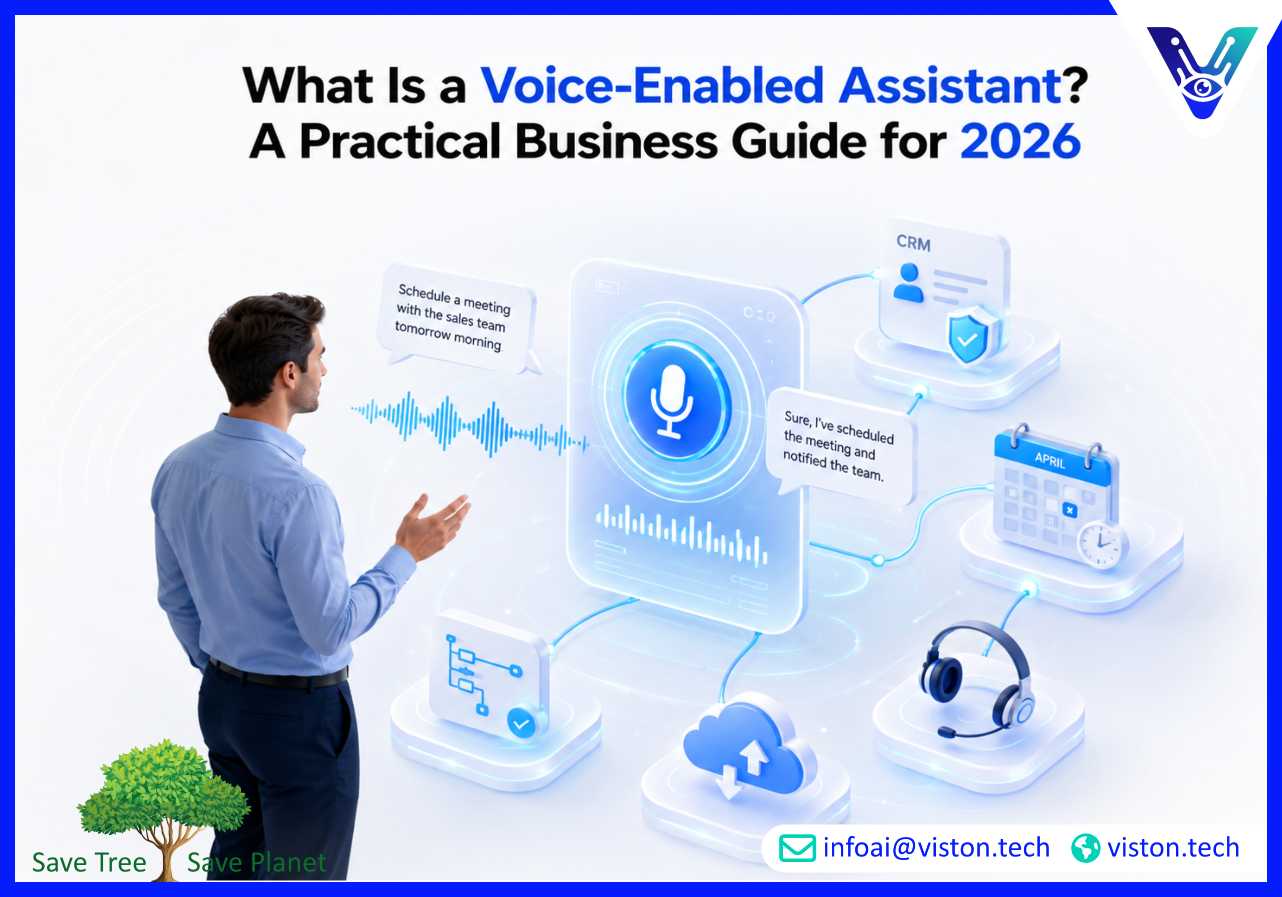
What Is a Voice-Enabled Assistant? A Practical Business Guide for 2026
A voice-enabled assistant allows people to interact with software, systems, and services through spoken language instead of typing, clicking, or navigating complex menus. In 2026, businesses are using voice-enabled assistants to improve customer support, automate workflows, support accessibility, and create faster, more natural digital experiences.
What Is a Voice-Enabled Assistant?
A voice-enabled assistant is a software-based assistant that listens to spoken input, understands the user’s intent, takes an appropriate action, and responds through speech or another connected channel. It can answer questions, guide users through tasks, retrieve information, update business systems, schedule appointments, process requests, or escalate issues to a human team when needed.At a simple level, a voice-enabled assistant turns conversation into action. Instead of asking a customer to press keypad options, search a website, fill out a long form, or wait for an agent, the assistant allows the user to speak naturally. The system then interprets the request and responds in a way that matches the business process.Modern AI voice assistants typically combine automatic speech recognition, natural language processing, decision logic, system integration, and text-to-speech technology to deliver real-time spoken conversations. This means they are not just audio versions of chatbots. A well-designed voice-enabled assistant must handle accents, interruptions, background noise, intent changes, multi-turn conversations, authentication, privacy requirements, and handoff to human teams when necessary.For businesses, the value is practical. A voice-enabled assistant can reduce repetitive work, improve response speed, support users who prefer speaking, and make digital services easier to access. It can be used in contact centers, websites, mobile apps, internal helpdesks, smart devices, kiosks, vehicles, healthcare systems, retail operations, logistics workflows, and enterprise software platforms.
Voice-enabled assistant vs chatbot vs IVR
A voice-enabled assistant is often confused with a chatbot or an IVR system, but each works differently. A chatbot usually communicates through text. An IVR system typically follows fixed menu paths such as “press 1 for billing” or “press 2 for support.” A voice-enabled assistant uses spoken language and can understand more flexible user requests.For example, a customer might say, “I need to reschedule my delivery for tomorrow afternoon.” A basic IVR may not understand that request unless it fits a preset menu. A voice-enabled assistant can identify the user’s intent, check delivery options, confirm availability, and update the order if it is connected to the right systems.
How Voice-Enabled Assistants Work Behind the Conversation
A successful voice-enabled assistant feels simple to the user, but the technology behind it must be carefully designed. Businesses should understand the main components because each one affects reliability, user experience, security, and scalability.
Speech recognition
Speech recognition converts spoken audio into text that software can process. This step must account for pronunciation differences, accents, speed of speech, background noise, and audio quality. In business environments such as call centers, warehouses, clinics, or field operations, speech recognition quality can determine whether the assistant is useful or frustrating.
Natural language understanding
Natural language understanding helps the assistant identify what the user wants. It detects intent, extracts useful details, and interprets context. For example, if a user says, “Can I change my appointment to Friday?” the assistant needs to understand that the intent is rescheduling and that “Friday” is a date reference requiring confirmation.This layer becomes more important when users speak naturally rather than using scripted commands. Real customers may pause, change their mind, use informal language, mix languages, or describe a problem indirectly. A strong voice-enabled assistant should be trained on realistic user phrases and business-specific terminology.
Conversation management
Conversation management controls the flow of the interaction. It determines what the assistant should ask next, when it should confirm information, when it should retrieve data, and when it should escalate. This is where voice assistant design becomes a business process challenge, not only a technical one.Good conversation management prevents common issues such as asking too many questions, repeating the same response, trapping users in loops, or failing to recognize when a human handoff is required. It also allows the assistant to manage multi-turn dialogue, such as confirming identity before discussing account details.
Business system integration
A voice-enabled assistant becomes more valuable when it connects with business systems. These may include CRM platforms, helpdesk tools, booking systems, payment systems, inventory databases, HR platforms, ERP software, ecommerce platforms, or knowledge bases.Without integration, the assistant may only provide general answers. With integration, it can complete useful tasks: create a support ticket, qualify a lead, check order status, book an appointment, update a customer record, send a confirmation message, or trigger an internal workflow.
Text-to-speech and voice response
Text-to-speech converts the assistant’s response into spoken audio. The quality of this layer affects trust and usability. The voice should be clear, natural, appropriate for the brand, and easy to understand. For sensitive or high-value interactions, tone and pacing matter because users need confidence that the assistant has understood them correctly.
Why Voice-Enabled Assistants Matter for Businesses in 2026
Voice-enabled assistants matter because customers and employees increasingly expect faster, more intuitive, and less effort-heavy ways to interact with businesses. In many situations, speaking is easier than typing. This is especially true when users are mobile, multitasking, visually occupied, physically busy, or navigating a complex service process.
They reduce friction in customer interactions
Customers do not always want to browse help articles or wait in a queue for simple questions. A voice-enabled assistant can handle routine requests such as appointment changes, account questions, delivery updates, product information, troubleshooting steps, order tracking, billing explanations, and service availability.When designed properly, the assistant gives customers a faster route to answers while allowing human teams to focus on complex, emotional, or high-risk cases. The result is not just automation. It is better routing of attention across the service operation.
They support hands-free workflows
Voice interaction is useful when employees need to work without stopping to type. In manufacturing, logistics, healthcare, retail, field service, and maintenance environments, employees may need to record updates, check instructions, complete checklists, or retrieve information while their hands are occupied.A voice-enabled assistant can help workers log incidents, confirm inventory, follow safety steps, request support, or retrieve procedures in real time. This can reduce administrative friction and help teams capture operational data more consistently.
They improve accessibility
Voice-enabled assistants can make digital services easier to use for people who struggle with screen-heavy interfaces, small keyboards, complex navigation, or text-based forms. Accessibility is not only a compliance consideration; it is also a customer experience and inclusion issue.Businesses that provide voice-based options can serve a wider range of users, including people with visual impairments, older customers, mobile users, and people who prefer conversational support over written instructions.
They create measurable service efficiency
For support and operations leaders, voice-enabled assistants can support measurable improvements when they are connected to the right KPIs. Useful metrics include call containment rate, average handling time, escalation rate, resolution rate, customer satisfaction, authentication completion, booking completion, abandoned interaction rate, and workflow success rate.These metrics help businesses understand whether the assistant is solving real problems or simply adding another layer to the customer journey. In 2026, voice automation should be measured by outcomes, not by conversation volume alone.
Where Businesses Use Voice-Enabled Assistants
Voice-enabled assistants can support many business functions, but the best use cases are clear, repeatable, and connected to real user needs. Businesses should avoid building a voice assistant simply because the technology is available. The strongest results come from matching voice interaction to workflows where speed, convenience, accessibility, or hands-free operation matters.
Customer support and contact centers
Customer support is one of the most common use cases. A voice-enabled assistant can answer routine questions, verify customer details, collect issue information, route calls, summarize requests, and escalate with context. This helps reduce repetitive agent workload while improving response times for common service needs.However, businesses should be careful not to over-automate sensitive conversations. Complaints, cancellations, urgent problems, complex billing disputes, and emotionally charged situations often require human judgment. A reliable assistant should recognize these cases and transfer the user smoothly.
Sales and lead qualification
Voice-enabled assistants can support sales by answering product questions, collecting lead details, qualifying buyer intent, booking demos, and routing prospects to the right sales team. This is useful when inbound inquiries happen outside business hours or when prospects prefer quick spoken interaction over filling out forms.For B2B teams, the assistant should capture structured information such as company size, use case, urgency, budget range, decision timeline, and preferred follow-up channel. When integrated with CRM software, it can create cleaner records and reduce manual data entry.
Internal employee support
Employees often need fast answers to HR, IT, finance, policy, onboarding, or operational questions. A voice-enabled assistant can help employees request leave information, reset passwords, find policy guidance, create internal tickets, check task status, or navigate procedures.This type of assistant must be carefully permissioned. Internal knowledge may include confidential information, role-specific policies, or sensitive employee data. Access control, authentication, audit trails, and approved knowledge sources are essential.
Industry-specific workflows
Voice-enabled assistants are also useful in specialized workflows. In healthcare, they can help with appointment scheduling and patient navigation. In retail, they can support product search and order updates. In manufacturing, they can assist with inspections and safety checklists. In logistics, they can support shipment tracking and warehouse operations. In finance, they can assist with secure account inquiries and guided service requests.The more specialized the workflow, the more important domain training becomes. A generic assistant may misunderstand industry terminology, compliance requirements, or operational steps. Businesses should build voice assistants around real processes, approved content, and tested user scenarios.
How Viston AI Helps Businesses Build Voice-Enabled Assistants
Viston AI is relevant to this topic because Voice-Enabled Assistants are a dedicated part of its AI service offering. The company describes its voice assistant services as combining natural language processing, speech recognition, and LLMOps infrastructure to support intelligent voice interactions at enterprise scale. Its service positioning includes context-aware conversations, multi-turn dialogue, business outcome measurement, and use cases across sectors such as financial services, healthcare, retail, manufacturing, and technology.For businesses evaluating a voice-enabled assistant, this matters because the real challenge is not just creating a voice interface. The assistant must understand intent, connect with business systems, support secure workflows, handle exceptions, and improve over time. Viston AI’s published capabilities include speech recognition and synthesis, NLP, real-time analytics, LLMOps orchestration, multilingual support, enterprise integration architecture, and responsible AI governance.This makes its Voice-Enabled Assistants service suitable for organizations that want practical voice automation rather than a basic voice response layer. Businesses can use this type of support to design assistants for customer service, internal operations, sales workflows, appointment handling, knowledge access, and voice-driven automation. A well-planned implementation can help reduce repetitive work, improve user access to information, and create more consistent service experiences.
Frequently Asked Questions
What is a voice-enabled assistant in simple terms?
A voice-enabled assistant is software that lets users speak naturally to ask questions, complete tasks, or interact with business systems. It listens to speech, understands the request, performs the right action, and responds through voice or another connected channel.
How is a voice-enabled assistant different from a normal chatbot?
A chatbot usually works through typed messages, while a voice-enabled assistant works through spoken interaction. Voice assistants also need speech recognition, text-to-speech, audio handling, conversation timing, and stronger support for interruptions, accents, and real-time dialogue.
What business problems can voice-enabled assistants solve?
They can reduce repetitive support calls, improve response speed, support hands-free work, capture lead information, help employees find internal answers, automate appointment handling, and make digital services easier to access for users who prefer speaking.
Do voice-enabled assistants need to integrate with business systems?
Yes, integration is important for most valuable use cases. A voice assistant connected to CRM, helpdesk, booking, payment, inventory, or HR systems can complete tasks rather than only provide general answers. Integration also improves reporting and workflow accuracy.
Are voice-enabled assistants suitable for small businesses?
Yes, if the use case is clear. Small businesses can use voice assistants for appointment booking, customer questions, after-hours support, lead capture, service reminders, or simple workflow automation. The scope should match the business’s volume, budget, and operational needs.
Can Viston AI help build voice-enabled assistants?
Yes. Viston AI offers Voice-Enabled AI Assistants as part of its AI services, with capabilities around speech recognition, NLP, multilingual support, analytics, integrations, LLMOps, and governance for business-focused voice automation.
Conclusion
Understanding what is a voice-enabled assistant helps businesses see voice AI as more than a convenience feature. A strong voice-enabled assistant can improve customer service, support hands-free operations, increase accessibility, and connect spoken requests to real business workflows. The most successful implementations in 2026 will be built around clear use cases, reliable speech recognition, strong natural language understanding, secure integrations, and measurable outcomes. For organizations exploring Voice-Enabled Assistants, Viston AI provides relevant capabilities for building practical, scalable, and business-focused voice automation.