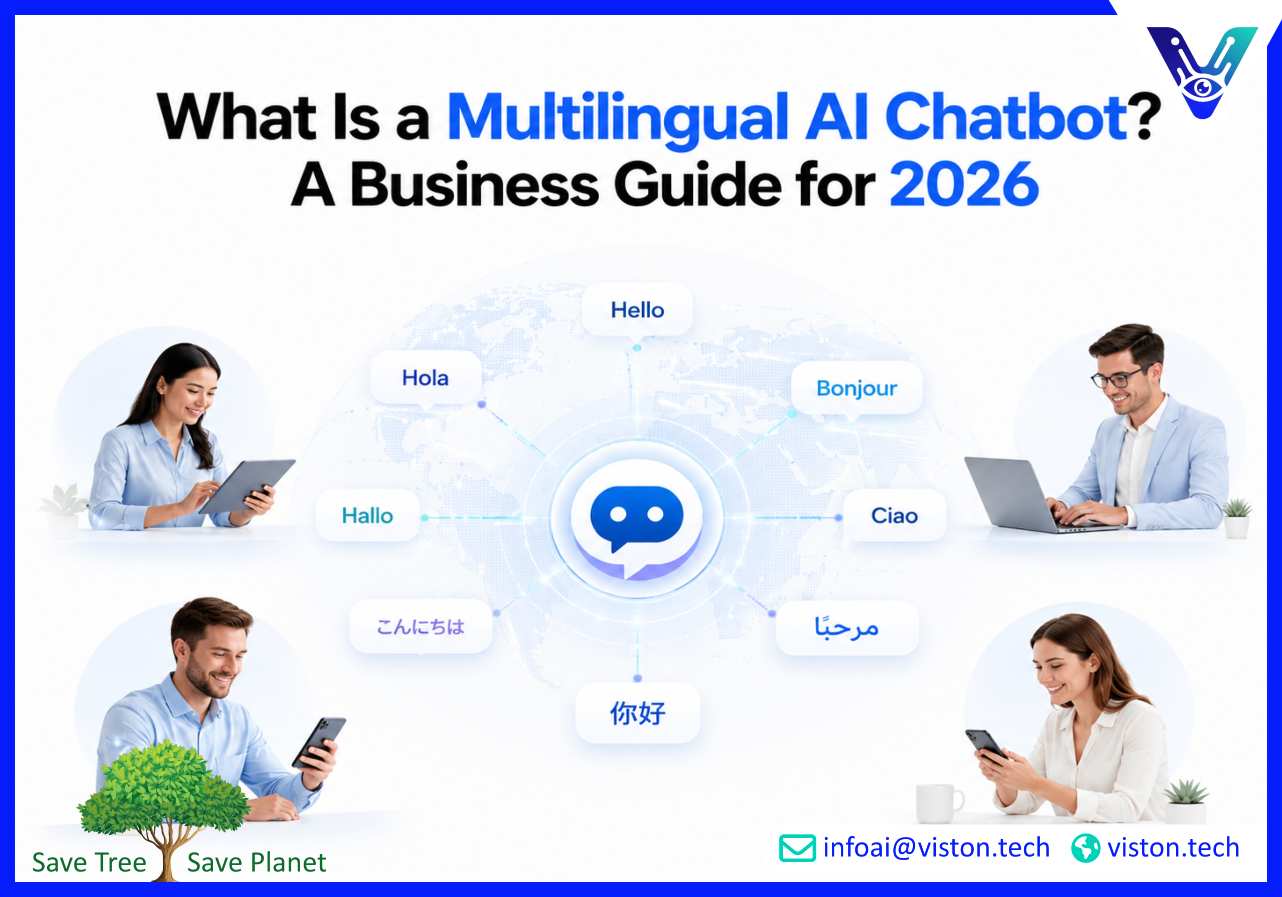
What Is a Multilingual AI Chatbot? A Business Guide for 2026
A multilingual AI chatbot is a conversational system that understands and responds to users in multiple languages. For businesses, it provides a practical way to serve international customers, automate repetitive enquiries, improve response availability, and deliver more consistent support without creating a separate service operation for every market.
What Is a Multilingual AI Chatbot?
A multilingual AI chatbot is an automated conversational assistant designed to communicate with users in two or more languages. It can identify the language being used, interpret the customer’s intent, retrieve relevant information, and provide an answer in the same language.Unlike a basic translation tool, a well-designed chatbot manages the complete conversation. It can ask follow-up questions, maintain context, guide users through a process, access approved business information, complete supported tasks, and transfer the conversation to a human when necessary.For example, a customer may ask about delivery times in Spanish, request a refund in French, or seek technical help in German. The chatbot should understand not only the words but also the purpose of each request. It must then apply the correct policy, retrieve the appropriate information, and respond clearly in the customer’s language.Modern conversational AI platforms can support language-specific intents, entities, training phrases, fulfilment logic, and knowledge content. However, language and feature availability can vary between technologies, so businesses must confirm that their chosen platform supports the required languages, regional variants, channels, and functions.
How it differs from a single-language chatbot
A single-language chatbot is normally trained and configured for one primary language. It may fail when a customer changes language, uses regional vocabulary, combines two languages, or writes a product name differently from the training examples.A multilingual chatbot is designed for linguistic variation. Depending on its architecture, it may use separate language models, multilingual natural language processing, real-time machine translation, or a combination of these approaches.The main difference is operational. A multilingual system must preserve meaning, terminology, tone, customer context, and business rules across every supported language. Translating the final sentence is only one part of the process.
Translation is not the same as multilingual support
Translation converts content from one language into another. Multilingual support creates an end-to-end service experience in which the customer can communicate, receive guidance, complete tasks, and obtain human assistance in an appropriate language.A chatbot may translate a sentence accurately but still provide poor support if it retrieves the wrong policy, misunderstands the user’s intent, ignores regional requirements, or fails to route the case correctly. Effective multilingual support therefore combines language capability with conversation design, knowledge management, system integration, workflow automation, and human escalation.
How a Multilingual AI Chatbot Works
A multilingual AI chatbot uses several connected technologies and processes. The exact architecture depends on the number of languages, conversation volume, business systems, security requirements, channels, and complexity of the tasks it must perform.
1. Language detection
The chatbot first determines which language the user is speaking or writing. Detection may be based on the first message, a selected language preference, browser settings, account information, telephone routing, or previous customer interactions.Some systems can detect a language automatically, while others require the business to create separate language experiences. Language detection should also account for code-switching, where users combine languages within the same conversation.
2. Intent and entity recognition
After identifying the language, the system determines what the user wants. This is known as intent recognition. Common intents include checking an order, booking an appointment, resetting a password, requesting a refund, comparing products, updating account details, or speaking to an agent.The chatbot may also identify entities such as order numbers, dates, locations, product names, account types, quantities, and contact details. Intent and entity recognition must be tested separately for each supported language because customer phrasing, sentence structure, abbreviations, and terminology can vary considerably.
3. Knowledge retrieval and response generation
The chatbot then searches an approved source for relevant information. Sources may include a help centre, product documentation, CRM platform, ecommerce system, booking application, internal policy library, or company database.Retrieval-based systems can use the customer’s message to find the most relevant approved content before generating an answer. This is usually safer than allowing the chatbot to respond without reliable business context.Businesses should maintain a clear source of truth for pricing, policies, product specifications, eligibility rules, and service procedures. Outdated or conflicting content can produce inaccurate answers in every language, even when the translation itself is fluent.
4. Translation or native-language processing
Some chatbots translate the user’s message into a primary operating language, process it, and translate the response back. Others use multilingual models that work directly with several languages. A hybrid model may use native processing for priority languages and translation for lower-volume languages.The best approach depends on quality requirements, language availability, cost, latency, and the importance of local terminology. High-risk or highly specialized conversations may require approved translations, controlled response templates, or human review.
5. Workflow execution and human handover
A business chatbot can do more than provide information. When integrated with operational systems, it may check an order, create a support ticket, schedule a meeting, update a CRM record, collect lead information, confirm a booking, or trigger a follow-up workflow.When the chatbot cannot resolve the issue safely, it should escalate the conversation. The receiving agent should receive the customer’s language, conversation history, identified intent, relevant account information, actions already attempted, and a translated summary where appropriate.
Where Businesses Use Multilingual AI Chatbots
Multilingual chatbots are useful wherever organizations communicate with customers, employees, partners, or prospects across different languages. Their value is strongest when language demand is frequent, response speed matters, and many enquiries follow repeatable patterns.
Customer service
Customer service teams use multilingual chatbots to answer frequently asked questions, explain policies, provide account guidance, retrieve order information, and collect details before escalation.This can improve availability outside normal working hours and reduce the number of routine enquiries handled manually. The chatbot should not be measured only by ticket deflection. Resolution accuracy, customer satisfaction, repeat contact, fallback rate, and handover quality are equally important.
Ecommerce and retail
Online retailers can use multilingual support for product questions, sizing guidance, delivery updates, payment information, return procedures, stock availability, and order tracking.The chatbot becomes more useful when connected to product catalogues, inventory systems, order-management platforms, and customer accounts. It must also distinguish between general information and customer-specific answers that require authentication.
Software and SaaS
SaaS companies frequently attract international customers before they build regional support teams. A multilingual chatbot can guide users through onboarding, account setup, subscriptions, integrations, billing questions, and common troubleshooting steps.Consistent product terminology is particularly important. Feature names, menu labels, error messages, and technical instructions should be aligned across the interface, documentation, and chatbot responses.
Travel, hospitality, and local services
Travel operators, hotels, clinics, education providers, property companies, and appointment-based businesses can automate questions about availability, locations, booking requirements, cancellations, schedules, documents, and service options.Time-sensitive instructions should be carefully controlled. A grammatically correct answer can still cause problems if it provides the wrong meeting point, date, cancellation condition, or booking detail.
Sales and lead qualification
A multilingual AI chatbot can engage prospects in their preferred language, identify their needs, answer initial questions, collect contact details, qualify opportunities, and route leads to the right sales team.When integrated with CRM and scheduling tools, it can create records, assign owners, book meetings, and preserve the original conversation. Consent, privacy notices, and data-capture rules should be localized rather than translated without review.
Internal employee support
Organizations with distributed workforces can use multilingual chatbots for HR policies, IT assistance, onboarding, training resources, leave processes, procurement guidance, and internal knowledge search.Internal deployments require role-based access. The chatbot must distinguish between public information, employee-only content, management guidance, and restricted personal or financial records.
How to Implement Multilingual Support Effectively
Successful multilingual support depends less on supporting the highest possible number of languages and more on providing dependable service in the languages that matter. A focused rollout is usually more effective than launching broad coverage without sufficient knowledge, testing, and operational ownership.
Prioritize languages using business evidence
Review customer locations, website analytics, browser languages, sales enquiries, support tickets, account registrations, abandoned conversations, and expansion plans. Select languages according to actual demand and commercial relevance.Businesses should also identify regional variants. Portuguese used in Brazil may require different terminology from Portuguese used in Portugal. Similar differences can appear in Spanish, French, Arabic, Chinese, and English-speaking markets.
Define suitable chatbot use cases
Begin with high-volume, well-documented, low-risk enquiries. Good starting points may include order tracking, booking confirmations, opening hours, product information, account access, lead capture, subscription guidance, and standard troubleshooting.Complaints, payment disputes, legal requests, medical matters, contract changes, fraud concerns, and complex technical issues generally need stricter controls and clearer human escalation.
Prepare approved multilingual knowledge
Create accurate source content before expanding language coverage. Product details, policies, return conditions, troubleshooting instructions, service descriptions, and escalation messages should have named owners and review dates.Build a terminology glossary for brand names, product features, technical terms, measurements, currencies, and words that should not be translated. Review high-priority content with native or fluent specialists, particularly where tone, legal meaning, safety, or contractual obligations matter.
Test every language independently
Performance in one language does not guarantee equivalent performance in another. Test natural customer questions, spelling errors, slang, mixed-language messages, regional expressions, incomplete sentences, emotional complaints, and uncommon intents.Teams should evaluate intent accuracy, factual correctness, translation quality, tone, task completion, fallback behaviour, response time, and escalation. Voice chatbots also require testing for accents, audio quality, speech recognition, and telephone conditions because language availability can differ by channel and speech model.
Measure performance by language
Reporting should be segmented by language rather than combined into one overall score. Useful measures include resolution rate, fallback rate, escalation rate, customer satisfaction, repeat contact, workflow completion, translation corrections, response latency, and human handover quality.Review failed conversations regularly. These conversations reveal missing intents, weak knowledge, confusing workflows, regional terminology, integration errors, and situations where human support should be offered earlier.
How Viston AI Supports Multilingual AI Chatbot Delivery
Viston AI is directly relevant to businesses exploring multilingual support because Multilingual AI Chatbot Support forms part of its published AI service portfolio. The company also offers enterprise AI chatbots, AI chatbot development, business-system integration, language translation services, NLP and text analysis, voice-enabled assistants, automation workflows, and model monitoring.This combination is important because a multilingual chatbot should not operate as an isolated translation layer. It needs accurate intent recognition, approved knowledge, customer context, workflow connections, language-aware routing, analytics, and reliable escalation.Viston AI’s capabilities are relevant to organizations that want to connect multilingual conversations with CRM platforms, knowledge bases, transactional applications, customer-service tools, and internal business systems. This can support use cases such as international customer service, multilingual lead handling, product guidance, employee assistance, booking support, and routine process automation.A practical implementation may begin with selected languages and clearly defined enquiries before expanding based on customer demand and performance data. Discovery, data preparation, conversation design, integration, testing, deployment, monitoring, and ongoing optimization all contribute to reliable delivery.For businesses serving multiple markets, Viston AI can support the technical and operational work required to turn multilingual AI into a structured customer or employee service capability rather than a collection of disconnected translated responses.
Frequently Asked Questions
What is a multilingual AI chatbot in simple terms?
It is an automated assistant that can understand and respond to people in more than one language. It may answer questions, guide users, retrieve information, complete supported tasks, or transfer the conversation to a person.
Can a multilingual chatbot detect a user’s language automatically?
Yes, many systems can identify the language from the user’s message. Businesses can also use language menus, account preferences, browser settings, or channel-specific routing when automatic detection is unreliable.
Does a multilingual chatbot translate every conversation?
Not always. Some chatbots translate messages into a primary language before processing them. Others use multilingual models that interpret languages directly. Hybrid systems may use both methods depending on the language and use case.
How many languages should a business support?
The right number depends on customer demand, revenue opportunity, support volume, available knowledge, platform capability, and quality-control resources. It is usually better to support a few priority languages well than many languages inconsistently.
Can multilingual AI completely replace human agents?
No. It can automate many repetitive and well-defined enquiries, but people remain important for sensitive complaints, complex problems, negotiations, exceptions, cultural nuance, quality review, and cases requiring judgment or authorization.
How can Viston AI help with multilingual chatbot implementation?
Viston AI offers multilingual chatbot support alongside chatbot development, NLP, system integration, translation, voice assistants, workflow automation, and monitoring capabilities. These services can help businesses design, connect, test, deploy, and improve multilingual conversational experiences.
Conclusion
A multilingual AI chatbot helps businesses communicate with customers and employees across languages through one structured conversational system. Its value extends beyond translation: it must understand intent, use trusted knowledge, connect with business workflows, protect sensitive information, and escalate appropriately. In 2026, effective Multilingual Support requires careful language prioritization, localized content, independent testing, system integration, and continuous performance review. Viston AI offers relevant chatbot, NLP, integration, translation, automation, and monitoring capabilities for organizations seeking a practical and scalable multilingual service approach.