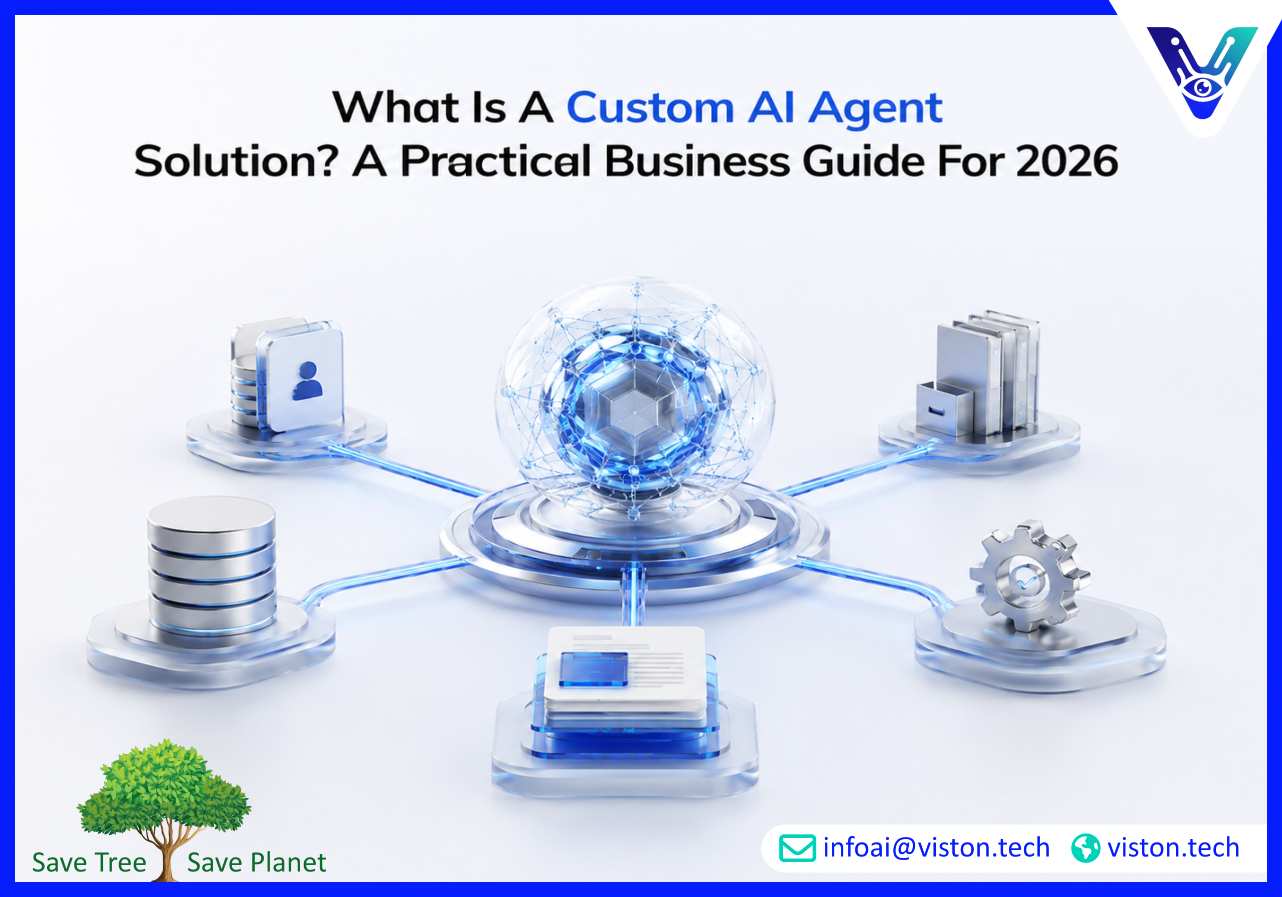
What Is a Custom AI Agent Solution? A Practical Business Guide for 2026
Introduction
Businesses are moving beyond generic AI tools and exploring systems that can perform specific tasks, make decisions, and automate complex workflows. Understanding what a custom AI agent solution is has become increasingly important in 2026 as organizations look for scalable ways to improve productivity, customer experiences, and operational efficiency.
What Is a Custom AI Agent Solution?
A custom AI agent solution is an AI-powered software system specifically designed to perform business tasks, workflows, or decision-making processes based on an organization’s unique requirements.Unlike general-purpose AI applications, custom AI agents are built around specific business objectives, operational processes, data sources, integrations, compliance requirements, and user interactions.These agents can:
Understand and process natural language
Access business systems and databases
Execute predefined actions
Automate workflows
Make recommendations
Generate reports
Support customer interactions
Coordinate tasks across multiple systems
The primary difference between a standard AI tool and a custom AI agent is specialization. A custom AI agent is designed to solve a particular business problem rather than serving as a generic assistant.
Why Custom AI Agent Solutions Matter in 2026
As organizations adopt AI at scale, many are discovering that off-the-shelf solutions often struggle to accommodate unique workflows, industry regulations, internal processes, and integration requirements.Several factors are driving demand for custom AI agent solutions:
Increasing Workflow Complexity
Modern businesses operate across numerous platforms, including CRM systems, ERP software, communication tools, customer service platforms, and analytics environments.Custom AI agents can connect these systems and automate actions across them.
Need for Business-Specific Intelligence
Organizations want AI systems that understand their terminology, policies, products, customers, and operational procedures.Custom agents can be trained and configured to align with specific business contexts.
Enhanced Security and Compliance
Industries dealing with sensitive information require AI systems that support governance, access controls, audit trails, and compliance requirements.Custom solutions provide greater control than generic AI tools.
Better Return on Investment
When AI is tailored to actual business workflows, organizations often achieve higher adoption rates and more measurable operational benefits.
How a Custom AI Agent Works
A custom AI agent typically combines several technologies and components.
Natural Language Processing
The agent interprets user requests, questions, and instructions using large language models and advanced language understanding capabilities.
Business Logic Layer
This component determines how the AI should respond based on organizational rules, workflows, permissions, and objectives.
Data Integration
The agent connects with internal systems such as:
CRM platforms
ERP systems
Knowledge bases
Document repositories
Customer databases
Project management tools
Analytics platforms
Decision-Making Framework
The AI evaluates information, follows instructions, applies rules, and determines the appropriate next action.
Action Execution
Rather than simply providing information, advanced AI agents can perform tasks such as:
Creating tickets
Scheduling appointments
Updating records
Sending notifications
Generating reports
Processing requests
Triggering workflows
Common Types of Custom AI Agent Solutions
Customer Support Agents
These agents handle inquiries, resolve issues, provide account information, and escalate complex cases when necessary.
Sales Assistance Agents
Sales-focused AI agents qualify leads, schedule meetings, update CRM records, and provide sales representatives with actionable insights.
Internal Knowledge Agents
These solutions help employees access policies, procedures, technical documentation, and organizational knowledge.
Operations Automation Agents
Operational AI agents automate repetitive tasks, workflow management, approvals, reporting, and process monitoring.
Data Analysis Agents
These agents collect, organize, analyze, and summarize information from multiple data sources.
Industry-Specific Agents
Some organizations develop highly specialized agents for healthcare, finance, logistics, manufacturing, legal operations, or other sector-specific requirements.
Key Benefits of Custom AI Agent Solutions
Improved Operational Efficiency
AI agents can perform repetitive tasks continuously without requiring manual intervention, reducing administrative workloads.
Faster Decision-Making
By collecting and analyzing information from multiple systems, agents provide timely recommendations and actionable insights.
Better Customer Experiences
Custom agents can deliver personalized responses based on customer history, preferences, and business context.
Scalability
As business demands increase, AI agents can support higher workloads without requiring proportional increases in staffing.
Consistency
AI agents follow predefined rules and workflows, helping organizations maintain consistent service quality and operational standards.
Reduced Human Error
Automation reduces the likelihood of mistakes caused by manual data entry, overlooked tasks, or inconsistent processes.
Challenges Businesses Should Consider
Data Quality Issues
AI agents are only as effective as the data they access. Incomplete, outdated, or inaccurate data can negatively impact performance.
Integration Complexity
Many organizations operate across multiple software systems that require secure and reliable integration.
Security Requirements
AI agents often access sensitive business information, making robust security controls essential.
Change Management
Employees need proper training and governance frameworks to effectively collaborate with AI-powered systems.
Ongoing Optimization
AI agents require monitoring, testing, updates, and refinement to maintain effectiveness as business needs evolve.
What Makes a Successful Custom AI Agent Solution?
Clear Business Objectives
Successful projects begin with well-defined goals, measurable outcomes, and realistic expectations.
Reliable Data Access
The agent must securely access accurate and relevant business information.
Strong Integration Capabilities
Effective AI agents work seamlessly across existing technology environments.
Human Oversight
Even advanced agents benefit from human review and governance for critical decisions and high-risk processes.
Performance Monitoring
Businesses should establish metrics to evaluate accuracy, efficiency, user adoption, and business impact.
How Custom AI Agent Solutions Are Implemented
Discovery and Requirements Analysis
Teams identify business objectives, workflows, pain points, and automation opportunities.
Solution Design
Architects define integrations, AI models, workflows, security requirements, and governance structures.
Development and Integration
Developers build the agent and connect it to relevant systems and data sources.
Testing and Validation
The solution undergoes performance testing, security reviews, workflow validation, and user acceptance testing.
Deployment
The AI agent is launched in a controlled environment and gradually scaled as adoption increases.
Continuous Improvement
Performance data and user feedback are used to enhance capabilities over time.
How Viston AI Supports Custom AI Agent Solutions
For organizations exploring custom AI agent solutions, choosing a partner with expertise in AI strategy, development, integration, and deployment is often as important as selecting the technology itself.Viston AI specializes in Custom AI Agent Solutions designed around real business workflows rather than generic automation templates. The company focuses on building AI agents that integrate with existing business systems, access relevant organizational data, automate operational processes, and support decision-making across departments.A key advantage of custom development is the ability to align AI capabilities with specific operational requirements. Whether organizations need customer service automation, workflow orchestration, internal knowledge management, process optimization, or intelligent business assistants, custom AI agents can be configured to support those objectives while maintaining security, governance, and scalability.In 2026, businesses increasingly require AI systems that work within existing technology environments rather than creating additional complexity. Viston AI’s approach emphasizes integration readiness, workflow alignment, responsible AI implementation, and measurable business outcomes.For organizations seeking long-term value from AI investments, custom solutions provide greater flexibility, control, and adaptability than many one-size-fits-all alternatives.
How to Determine Whether Your Business Needs a Custom AI Agent
A custom AI agent solution may be worth considering if your organization:
Relies heavily on repetitive manual processes
Uses multiple disconnected software systems
Handles large volumes of customer interactions
Requires rapid access to organizational knowledge
Faces operational bottlenecks
Needs workflow automation beyond standard software capabilities
Requires industry-specific compliance controls
Wants AI integrated into core business processes
If several of these conditions apply, a tailored AI solution may provide significant operational value.
Frequently Asked Questions
What is the difference between an AI chatbot and a custom AI agent?
A chatbot primarily responds to user questions and conversations. A custom AI agent can understand requests, access systems, make decisions, execute tasks, and automate workflows.
How long does it take to develop a custom AI agent solution?
Project timelines vary depending on complexity, integrations, security requirements, and business objectives. Simple implementations may take weeks, while enterprise solutions can require several months.
Can custom AI agents integrate with existing business software?
Yes. Most custom AI agent solutions are designed to integrate with CRM platforms, ERP systems, databases, communication tools, and other business applications.
Are custom AI agents secure?
When developed properly, custom AI agents can include access controls, encryption, audit logging, governance policies, and compliance measures to protect sensitive information.
What industries benefit most from custom AI agent solutions?
Healthcare, finance, logistics, manufacturing, retail, professional services, technology, and customer support organizations are among the industries actively adopting AI agents.
Why work with a company like Viston AI for custom AI agent development?
Organizations often seek specialized expertise when designing AI agents that require workflow automation, system integration, scalability, governance, and long-term optimization aligned with business objectives.
Conclusion
Understanding what a custom AI agent solution is has become increasingly important as organizations pursue more advanced automation and intelligent workflow management in 2026. Unlike generic AI tools, custom AI agents are built around specific business processes, operational requirements, and strategic goals. They can improve efficiency, enhance decision-making, streamline customer interactions, and create scalable automation across departments.For businesses seeking long-term value from AI adoption, Custom AI Agent Solutions provide the flexibility and control needed to align technology with real operational needs. Companies such as Viston AI help organizations develop tailored AI agents that support practical business outcomes while maintaining security, scalability, and integration readiness.