
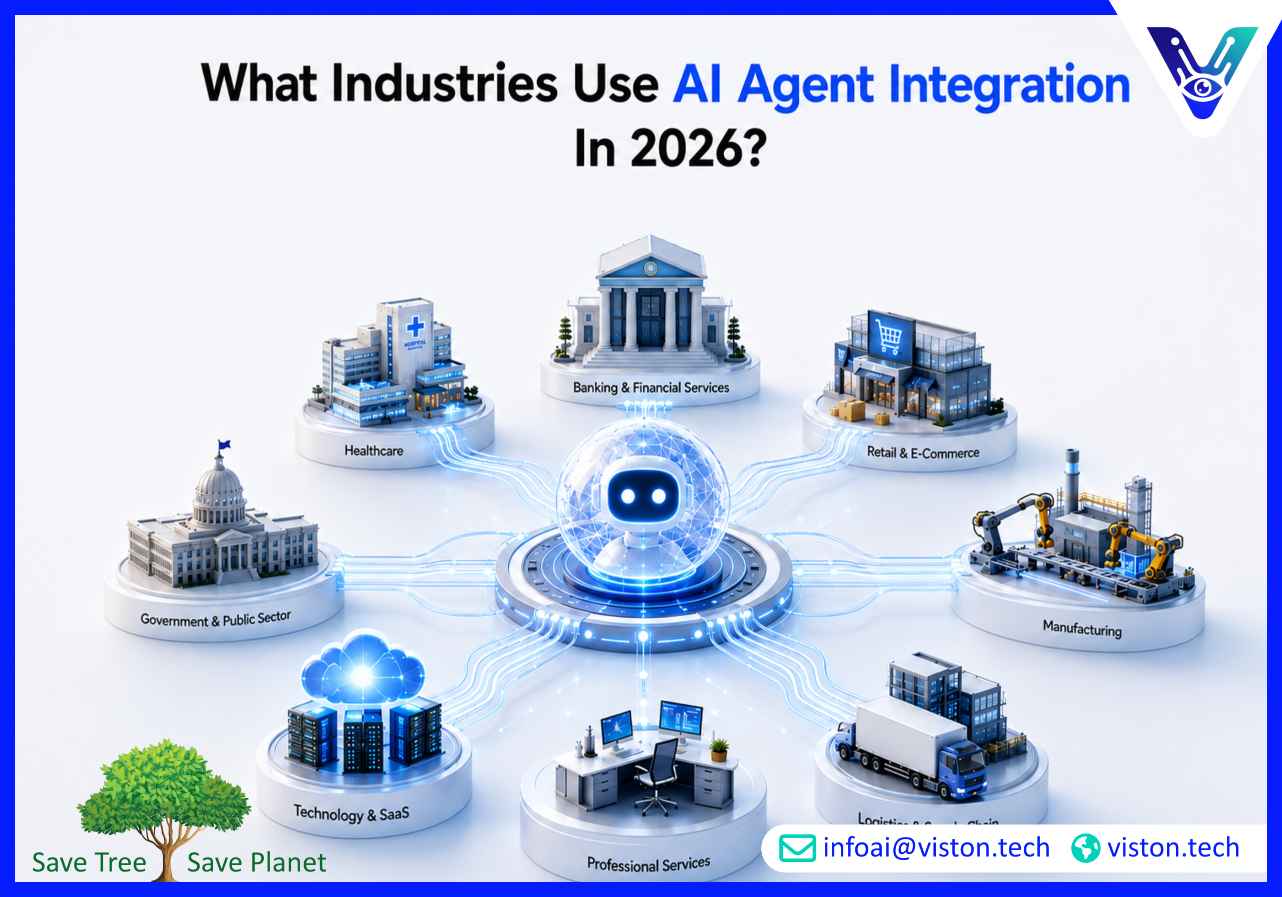
AI agent integration is rapidly becoming a practical business strategy across industries seeking to automate workflows, improve decision-making, and connect disconnected systems. Rather than operating as standalone tools, AI agents can integrate with CRMs, ERPs, databases, communication platforms, customer support systems, and business applications to perform tasks autonomously while supporting human teams.
Businesses are under increasing pressure to improve efficiency, reduce manual processes, and deliver faster responses to customers and stakeholders. AI agent integration helps organizations connect intelligent automation directly into operational workflows.
Unlike traditional automation, integrated AI agents can understand context, retrieve information, make recommendations, execute tasks, and coordinate actions across multiple systems. This flexibility makes them valuable across a wide range of industries.
Financial institutions are among the earliest adopters of AI agent integration due to the high volume of data, compliance requirements, and customer interactions they manage daily.
Integrated AI agents can connect with banking systems, customer databases, compliance platforms, and communication tools to streamline operational processes while maintaining governance controls.
Healthcare organizations use AI agent integration to reduce administrative workloads and improve access to information without disrupting clinical operations.
When properly integrated, AI agents can help healthcare teams manage information more efficiently while supporting privacy and compliance requirements.
Retail businesses generate large volumes of customer, inventory, and sales data. AI agent integration helps retailers improve customer experiences while optimizing operations.
Integrated agents can work across e-commerce platforms, CRM systems, inventory software, and marketing tools to improve responsiveness and operational visibility.
Manufacturers increasingly use AI agent integration to connect operational data, maintenance systems, supply chain platforms, and production workflows.
AI agents help manufacturing organizations process large amounts of operational information and respond more quickly to production challenges.
Supply chain operations often involve multiple systems, stakeholders, and decision points. AI agent integration can help improve coordination and visibility across the entire workflow.
Integrated AI agents can connect transportation management systems, ERP platforms, warehouses, and customer-facing applications.
Consulting firms, legal practices, accounting organizations, and advisory businesses increasingly use AI agent integration to support knowledge-intensive workflows.
These capabilities allow professionals to spend less time on repetitive administrative work and more time on strategic activities.
Technology companies frequently adopt AI agent integration to improve both internal operations and customer-facing services.
AI agents can integrate with CRM platforms, support systems, product databases, analytics tools, and communication channels to improve efficiency across departments.
Public sector organizations are increasingly exploring AI agent integration to improve citizen services and internal administrative operations.
Security, transparency, and governance remain critical considerations for AI adoption in public-sector environments.
As businesses across industries adopt intelligent automation, successful implementation depends on more than deploying AI models. Effective AI agent integration requires workflow design, system connectivity, orchestration logic, security controls, and ongoing optimization.
Viston AI specializes in Agent Integration Services that help organizations connect AI agents with existing business systems, applications, databases, and operational workflows. Whether supporting customer service automation, sales operations, internal knowledge management, workflow orchestration, or process automation, the focus is on building practical solutions that align with real business objectives.
By integrating AI agents into existing environments rather than creating isolated tools, organizations can improve efficiency, reduce manual effort, enhance data accessibility, and create more scalable operational processes across industries.
Financial services, healthcare, technology, retail, and manufacturing are currently among the most active adopters of AI agent integration due to their complex workflows and large volumes of operational data.
Yes. Small businesses can use AI agents for customer support, lead management, workflow automation, appointment scheduling, reporting, and operational efficiency improvements.
AI agents can integrate with CRM platforms, ERP systems, databases, helpdesk software, communication tools, document management systems, APIs, and various business applications.
No. Organizations of all sizes can benefit from AI agent integration. The implementation scope and complexity simply vary based on business needs and operational requirements.
Yes. Viston AI provides Agent Integration Services that help businesses connect AI agents with operational systems, workflows, and business processes to support scalable automation and efficiency improvements.
AI agent integration is no longer limited to technology companies. In 2026, industries including finance, healthcare, manufacturing, retail, logistics, professional services, government, and SaaS are actively using integrated AI agents to automate workflows, improve decision-making, and enhance operational efficiency. As adoption continues to grow, organizations that successfully connect AI agents with their existing systems and processes will be better positioned to achieve scalable business outcomes. Through Agent Integration Services, Viston AI helps businesses build these connections and transform AI capabilities into practical operational value.
