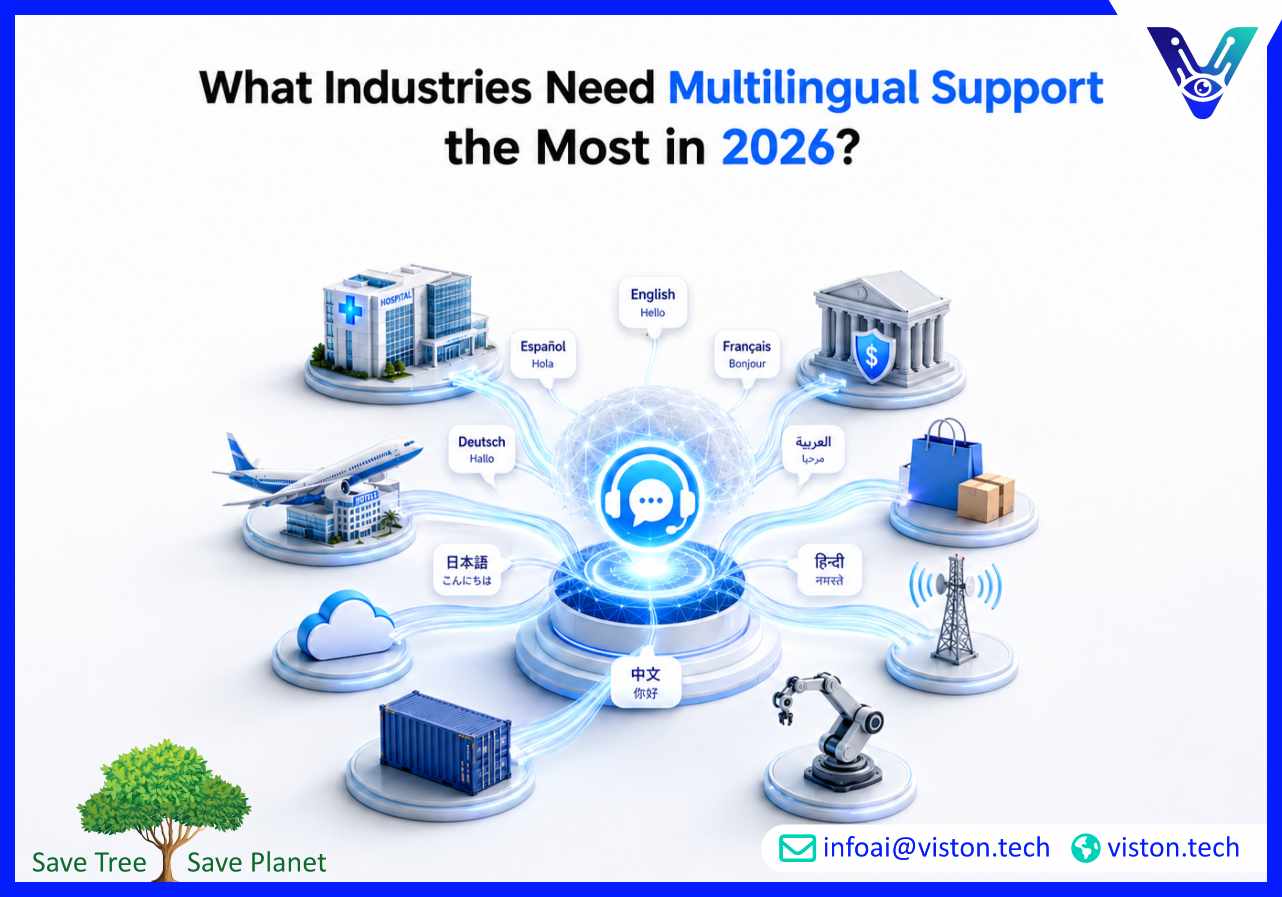
What Industries Need Multilingual Support the Most in 2026?
Industries that serve international, multicultural, mobile, or linguistically diverse customers need multilingual support the most. In 2026, the strongest demand comes from sectors where language affects safety, financial decisions, bookings, purchases, technical problem-solving, regulatory communication, or access to essential services.
What Determines Whether an Industry Needs Multilingual Support?
Multilingual support means providing customers with a dependable level of service in more than one language. It includes much more than translating individual messages. Businesses must ensure that answers remain accurate, contextually appropriate, consistent with company policies, and connected to the correct operational workflow.An industry has a particularly strong need for multilingual customer support when it combines several of the following characteristics:
A customer base spread across countries, regions, or language communities
Complex products, policies, contracts, or technical instructions
Time-sensitive questions that require immediate assistance
High consequences when information is misunderstood
Frequent transactions, bookings, claims, returns, or account changes
Strong regulatory, privacy, or documentation requirements
Customer journeys that cross websites, apps, email, chat, voice, and messaging platforms
Language demand should therefore be assessed through business data rather than assumptions. Customer locations, browser language, support tickets, sales enquiries, call recordings, abandoned conversations, complaints, refunds, and product usage can reveal which languages create the greatest service need.The industries with the highest need are not always those with the largest international presence. A regional healthcare network, bank, utility provider, or public-facing service may need multilingual support because the population it serves speaks several languages. A small software company or ecommerce store may need it because customers can discover and purchase its products from anywhere.
The difference between translation and operational support
Translation changes content from one language into another. Multilingual support ensures that the complete service process works in the customer’s preferred language.For example, translating a refund policy is useful, but the customer may also need to verify an order, submit evidence, receive status updates, and escalate a dispute. Effective multilingual support connects the translated conversation with customer records, business rules, human agents, and the systems required to complete the request.
Healthcare, Finance, Travel, and Hospitality Have the Highest Service Risk
Healthcare, financial services, insurance, travel, and hospitality are among the industries that need multilingual support the most because communication errors can have immediate personal, financial, or operational consequences.
Healthcare and patient services
Healthcare organizations serve patients from different cultural and linguistic backgrounds, often during stressful or urgent situations. Language barriers can affect appointment scheduling, insurance verification, medication instructions, consent processes, test preparation, discharge guidance, and access to appropriate care.Multilingual support in healthcare must prioritize accuracy, privacy, accessibility, and safe escalation. Automated systems may help patients find services, manage appointments, obtain approved administrative information, or navigate common processes. Clinical decisions, urgent symptoms, sensitive cases, and uncertain requests should be transferred to qualified people.Healthcare providers should also distinguish between general translation and professional interpretation. High-risk medical conversations may require trained interpreters rather than automated translation alone.
Banking, financial services, and insurance
Banks, lenders, payment providers, insurers, fintech companies, and investment platforms communicate about products that customers may find difficult even in their first language. Account access, identity verification, loan terms, payment disputes, fraud alerts, policy conditions, and claims processes require clear explanations.A poorly translated message can create financial loss, missed deadlines, incorrect consent, or regulatory exposure. Multilingual financial support therefore needs approved terminology, secure authentication, controlled access to customer data, reliable audit records, and well-defined escalation rules.Automation can assist with balance enquiries, application status, document collection, card activation, claim updates, and routine policy questions. Complex complaints, suspected fraud, financial hardship, disputed transactions, and regulated advice should receive appropriate human review.
Travel, aviation, and hospitality
Airlines, hotels, booking platforms, tour operators, car rental companies, and travel marketplaces routinely serve customers across languages and time zones. Their enquiries are often urgent because they involve departures, cancellations, missed connections, reservation changes, visas, baggage, refunds, or local instructions.Travel companies need multilingual support across websites, mobile apps, email, social channels, chat, voice, and messaging platforms. The support system must understand the customer’s booking, destination, travel date, loyalty status, and preferred language.Fluent translation without booking context is not enough. The response must also reflect current availability, fare conditions, cancellation rules, local time, and operational changes.
Ecommerce, SaaS, Marketplaces, and Telecom Need Multilingual Support to Scale
Digital businesses can enter new markets quickly, but customer service capacity does not always expand at the same speed. Ecommerce, SaaS, online marketplaces, telecommunications, and subscription businesses need multilingual support because customers can purchase, register, or subscribe without interacting with a local sales team.
Ecommerce and retail
Online retailers commonly receive multilingual questions about product specifications, sizing, compatibility, delivery, customs charges, payment methods, returns, warranties, and order tracking. Language gaps at these stages can lead to abandoned carts, avoidable returns, payment disputes, and negative reviews.Multilingual ecommerce support should connect with product catalogues, inventory, order management, payment systems, logistics providers, and return workflows. Common enquiries can be automated, but damaged products, disputed deliveries, unusual refunds, and high-value purchases may need human intervention.Retailers should localize product terminology and policies instead of translating isolated responses. Measurements, currencies, dates, taxes, regional availability, and legal rights may differ between markets.
SaaS and technology companies
SaaS companies often acquire international users through search, free trials, app stores, product-led growth, and online communities. Users then need help with onboarding, account access, integrations, billing, feature configuration, data migration, security settings, and technical errors.A multilingual interface without multilingual support creates an incomplete customer experience. Users may understand how to register but struggle to activate the product or resolve a problem.Technology companies need consistent glossaries for feature names, error messages, technical concepts, and subscription terms. A multilingual assistant can guide users through documented procedures, collect diagnostic information, recommend relevant knowledge articles, and prepare a structured handover for technical specialists.
Online marketplaces and platforms
Marketplaces frequently support several groups at once, including buyers, sellers, service providers, hosts, drivers, or contractors. Each group has different policies, permissions, and support journeys.Multilingual support must identify both the user’s language and role. A seller asking about verification should not receive the same workflow as a buyer reporting a missing order. Disputes, fraud concerns, identity checks, evidence submission, and payment holds require careful routing and accurate policy communication.
Telecommunications and utilities
Telecom operators, internet providers, energy companies, and other essential service providers often serve diverse regional populations. Customers contact them about activation, outages, billing, technical troubleshooting, contract changes, installation, and service cancellation.These industries typically manage high conversation volumes and repetitive enquiries, making them suitable for language-aware automation. However, vulnerable-customer cases, payment difficulties, prolonged outages, accessibility needs, and formal complaints require responsible escalation.
Other Industries Where Multilingual Support Creates Significant Value
Several additional industries may not always face the same level of immediate risk, but multilingual support can substantially improve access, adoption, operational efficiency, and customer trust.
Logistics and supply chain
Shipping companies, freight forwarders, delivery platforms, and supply chain providers coordinate customers, drivers, warehouse teams, customs brokers, and overseas partners. Multilingual communication supports shipment tracking, delivery instructions, customs documentation, damage reports, delays, and exception handling.Accuracy is particularly important when messages include addresses, quantities, handling requirements, deadlines, or regulatory documentation.
Education and online learning
Universities, training companies, education platforms, and learning applications serve international students and multilingual families. Support may cover admissions, enrolment, course access, payments, assessments, certificates, accessibility, and technical issues.Educational content may require full localization, while administrative support can often use multilingual knowledge bases, chatbots, and translated agent conversations. High-stakes academic, immigration, safeguarding, or financial matters should be handled by appropriate staff.
Manufacturing and technical services
Manufacturers selling equipment internationally need multilingual product documentation, maintenance guidance, parts support, warranty processes, and troubleshooting. Technical terminology must remain precise because an incorrect instruction can damage machinery, interrupt production, or create a safety risk.Support tools should recognize model numbers, components, error codes, maintenance history, and regional service arrangements before recommending an action.
Real estate and property services
Real estate platforms, property managers, developers, and accommodation providers frequently work with international buyers, tenants, investors, and contractors. Multilingual support can assist with property enquiries, viewing arrangements, maintenance requests, application requirements, payment information, and document collection.Contracts, legal disclosures, tenancy obligations, and financial commitments require qualified review rather than uncontrolled automated translation.
Gaming, entertainment, and digital communities
Gaming companies, streaming platforms, event providers, and online communities often build global audiences immediately. They need language support for account recovery, subscriptions, moderation, payments, technical performance, community rules, and content access.These businesses must consider slang, regional language, rapidly changing terminology, and moderation risks. Direct word-for-word translation may miss harassment, threats, sarcasm, or culturally specific expressions.
How Businesses Should Prioritize Multilingual Support
No business should select languages solely according to global population size. The right language strategy reflects actual customer demand, commercial priorities, service risk, and the organization’s ability to maintain quality.A practical prioritization process should evaluate:
Conversation demand: Which languages already appear in tickets, calls, searches, and sales enquiries?
Business opportunity: Which markets generate revenue, qualified leads, registrations, or expansion potential?
Customer risk: Where could misunderstanding cause financial, health, safety, legal, or reputational harm?
Content readiness: Are policies, knowledge articles, product data, and workflows accurate enough to localize?
Channel requirements: Do customers need language support through chat, email, voice, WhatsApp, apps, or self-service portals?
Human coverage: Which situations require fluent agents, interpreters, specialists, or quality reviewers?
Businesses should usually begin with priority languages and high-volume, well-documented use cases. Routine enquiries such as order tracking, appointment scheduling, account access, booking confirmation, subscription guidance, and standard troubleshooting are common starting points.Quality must then be measured separately for each language. Useful metrics include resolution rate, fallback rate, escalation rate, response time, repeat contact, customer satisfaction, translation corrections, and workflow completion. Strong performance in one language does not guarantee equal performance in another.
How Viston AI Supports Multilingual Operations Across Industries
Viston AI provides Multilingual AI Chatbot Support for organizations that need to manage conversations across languages, channels, and business systems. Its published capabilities include language-aware intent recognition, real-time translation and localization, omnichannel deployment, intelligent routing, performance analytics, and integration with CRM platforms, knowledge bases, transaction systems, and other business applications.These capabilities are relevant to industries such as healthcare, ecommerce, financial services, insurance, SaaS, telecommunications, manufacturing, logistics, travel, and hospitality. Each sector requires different terminology, workflows, risk controls, and escalation rules, so multilingual support must be configured around the operating environment rather than deployed as a generic translation layer.Viston AI’s delivery approach covers discovery, data preparation, model selection, testing, integration, deployment, monitoring, and continuous optimization. This can help businesses build multilingual experiences around approved knowledge, customer context, security requirements, and measurable service objectives.The practical value lies in connecting language capability with action. A multilingual assistant should not only understand a question; it should retrieve the correct information, complete an appropriate workflow, update relevant systems, or transfer the conversation to a qualified person with the necessary context.
Frequently Asked Questions
Which industry needs multilingual support the most?
Healthcare, financial services, travel, and hospitality have particularly strong needs because misunderstandings can affect health, money, safety, or time-sensitive plans. Ecommerce, SaaS, marketplaces, and telecommunications also need multilingual support to serve diverse customers at scale.
Do only international companies need multilingual support?
No. Regional businesses may serve communities that speak several languages. Healthcare providers, banks, utilities, retailers, government contractors, and local service companies can need multilingual support even when they operate in one country.
Which customer enquiries should be automated first?
Start with repetitive, low-risk, well-documented enquiries such as order tracking, booking confirmation, account access, opening hours, appointment scheduling, product information, subscription guidance, and standard troubleshooting.
When is human multilingual support still necessary?
Human involvement is important for medical concerns, financial hardship, fraud, legal matters, complex complaints, sensitive negotiations, safety issues, unusual technical cases, and conversations requiring cultural judgment or professional interpretation.
How many languages should a business support?
A business should support the languages justified by customer demand, revenue opportunity, service risk, and operational capacity. Reliable support in a few priority languages is usually more valuable than inconsistent coverage across many languages.
Can Viston AI support different industries with multilingual chatbots?
Viston AI’s multilingual support capabilities are designed for industry-specific workflows, including intent recognition, localization, routing, analytics, business-system integration, and continuous optimization. The deployment should be configured around each organization’s terminology, policies, customer journeys, and risk requirements.
Conclusion
The industries that need multilingual support the most are those serving diverse customers through complex, urgent, regulated, or high-volume interactions. Healthcare, finance, travel, hospitality, ecommerce, SaaS, marketplaces, telecom, logistics, education, and manufacturing all have strong use cases. Effective Multilingual Support requires more than translation: it needs trusted knowledge, customer context, workflow integration, quality measurement, and responsible human escalation. Viston AI offers relevant multilingual chatbot, localization, routing, integration, and analytics capabilities for businesses seeking a structured approach to serving customers across languages.