
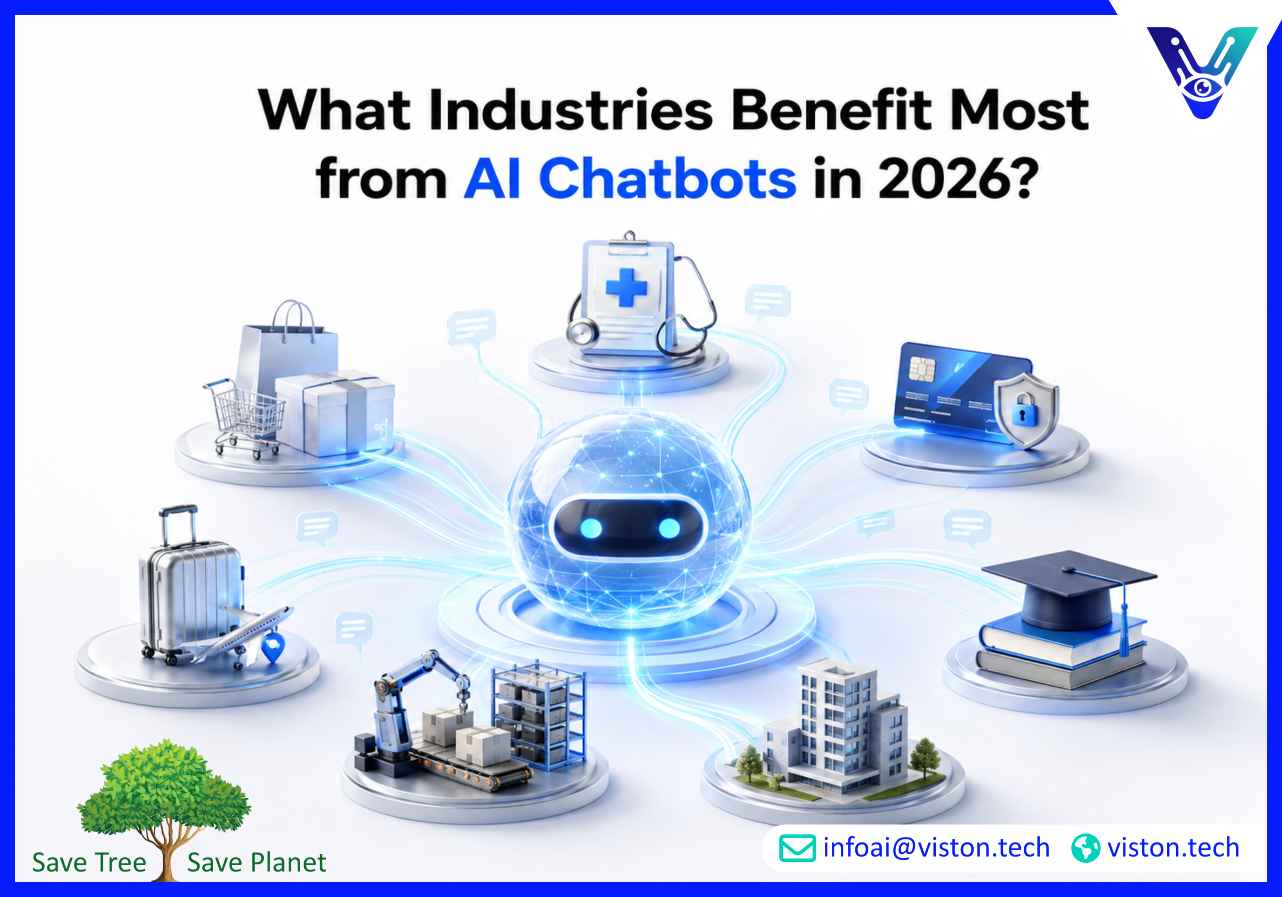
Understanding what industries benefit most from AI chatbots helps business leaders identify where conversational automation can create real operational value. In 2026, enterprise AI chatbots are most useful in industries with high inquiry volumes, complex customer journeys, repetitive workflows, multilingual needs, and strong demand for faster service.
AI chatbots can support almost any business, but they deliver the strongest returns in industries where communication is frequent, time-sensitive, and process-driven. A chatbot is not just a website assistant. In an enterprise environment, it can answer customer questions, qualify leads, retrieve internal knowledge, create support tickets, guide users through forms, trigger workflows, and connect with business systems such as CRM, ERP, helpdesk, ecommerce, booking, billing, and knowledge management platforms.
The industries that benefit most usually share several characteristics. They manage large volumes of customer or employee questions. They repeat the same explanations across support, sales, onboarding, or operations. They depend on quick response times. They need consistent answers across teams and channels. They also often have internal systems that can be connected to chatbot workflows for better automation.
In 2026, enterprise AI chatbots are expected to be more than simple scripted bots. Businesses want chatbot solutions that understand natural language, retrieve accurate information, support multilingual communication, escalate complex cases to humans, and maintain data security. This is why industries with complex service environments often gain the most value from well-designed chatbot implementation.
The value of AI chatbots depends on the quality of implementation. A chatbot that is trained on weak content or disconnected from business systems may only provide basic answers. A properly built enterprise chatbot can support measurable outcomes such as faster resolution, better lead handling, reduced manual work, and improved customer experience.
The industries that benefit most from AI chatbots are those where communication volume, customer expectations, and operational complexity are high. These sectors often use chatbots for both customer-facing and internal business functions.
Ecommerce and retail businesses benefit strongly from AI chatbots because customers often need fast answers before making a purchase. Chatbots can help users find products, compare options, check order status, understand return policies, track deliveries, receive recommendations, and get support after purchase.
For retail teams, AI chatbots can reduce repetitive questions about sizing, availability, discounts, shipping, refunds, and store policies. When connected to ecommerce platforms, inventory systems, and CRM tools, chatbots can provide more personalized and accurate support. This helps improve conversion opportunities while reducing pressure on customer service teams.
Healthcare organizations can use AI chatbots for appointment scheduling, patient intake, basic service information, insurance-related guidance, follow-up reminders, internal staff support, and administrative workflows. The main value is reducing front-desk workload while improving access to routine information.
Healthcare chatbot implementation must be handled carefully. Privacy, security, consent, escalation, and accuracy are critical. A chatbot should not replace clinical judgment or provide unsafe medical advice. Instead, it should support administrative efficiency, guide patients to the right resources, and escalate sensitive or urgent matters to qualified professionals.
Banks, fintech companies, insurance providers, lenders, and financial service firms benefit from chatbots because customers often need quick help with account information, documentation, application status, product eligibility, claims, payments, fraud reporting, and service requests.
In this industry, trust and compliance matter. Enterprise AI chatbots must follow strict access controls, authentication rules, audit requirements, and escalation policies. When designed properly, chatbots can improve customer service, reduce contact center pressure, guide users through complex processes, and support internal teams with policy or product information.
Insurance businesses manage many repetitive and document-heavy interactions. AI chatbots can assist with quote requests, policy questions, claim status updates, renewal reminders, document collection, coverage explanations, and agent routing.
The biggest benefit is process clarity. Customers often struggle to understand policy terms, exclusions, claim steps, and required documents. A chatbot can guide users through structured conversations, collect details, and create cleaner records for agents. This improves handoff quality and reduces delays caused by incomplete information.
Travel and hospitality companies deal with high inquiry volumes, changing schedules, booking questions, cancellations, refunds, upgrades, check-in information, local recommendations, and service disruptions. AI chatbots can support guests and travelers across websites, mobile apps, WhatsApp, and customer portals.
For hotels, airlines, travel agencies, logistics providers, and transport companies, chatbots are valuable because customers often need immediate answers. A chatbot can handle routine requests, escalate urgent issues, and provide consistent communication during busy periods.
Educational institutions and e-learning platforms benefit from AI chatbots for admissions support, course recommendations, enrollment guidance, fee information, student onboarding, learning support, internal helpdesk queries, and administrative communication.
Students, parents, and staff often ask similar questions repeatedly. Chatbots can reduce manual workload while improving access to information. In online learning environments, chatbots can also guide learners to resources, explain platform usage, and support course navigation.
Manufacturing and logistics companies may not always appear as obvious chatbot users, but they can gain strong operational value. AI chatbots can support internal knowledge search, supplier communication, order status checks, maintenance request routing, inventory inquiries, compliance documentation, shift support, and employee service desks.
In these industries, chatbots work best when connected to ERP, inventory, ticketing, warehouse, or knowledge systems. The goal is not casual conversation. The goal is faster access to operational information and better workflow execution across teams.
Real estate businesses can use chatbots for lead capture, property recommendations, viewing bookings, rental inquiries, document guidance, mortgage pre-screening, tenant support, maintenance requests, and follow-up automation.
AI chatbots are useful in real estate because buyers, renters, landlords, and investors often need fast answers before speaking with an agent. Chatbots can qualify prospects, collect preferences, route leads, and keep conversations active outside normal working hours.
Different industries benefit from AI chatbots in different ways, but the underlying business problems are often similar. Companies want to respond faster, reduce repetitive work, improve customer experience, and make service delivery more scalable.
Support teams across ecommerce, SaaS, finance, healthcare, travel, education, and telecom often handle the same questions every day. AI chatbots can answer routine questions instantly and allow human agents to focus on complex, emotional, regulated, or high-value cases.
A strong enterprise chatbot does not simply block users from reaching support. It identifies the intent, provides useful answers, gathers context, and escalates when needed. This improves both automation and human service quality.
Industries with long or competitive sales cycles benefit from chatbots that qualify leads in real time. A chatbot can ask about business needs, budget, timeline, location, product interest, and decision stage. It can then route qualified prospects to sales teams or book meetings automatically.
This is especially useful for B2B services, real estate, financial services, software, education, healthcare services, and high-ticket ecommerce. Instead of losing visitors who are not ready to call, businesses can capture structured lead information through conversation.
Enterprise AI chatbots are increasingly used inside organizations. HR, IT, finance, operations, compliance, procurement, and training teams can use chatbots to help employees find policies, submit requests, check procedures, and complete internal workflows.
This is valuable in large organizations where knowledge is spread across documents, portals, emails, and systems. A chatbot connected to approved knowledge sources can reduce search time and improve consistency.
The strongest chatbot implementations are connected to real workflows. A chatbot can create tickets, update CRM records, trigger notifications, schedule appointments, collect forms, check order status, retrieve account details, or route requests to the correct department.
This is where enterprise AI chatbots become more valuable than basic chat widgets. They help businesses move from answering questions to completing tasks.
AI chatbots can create value across many industries, but successful implementation requires planning. Businesses should first define the use case, user audience, required integrations, risk level, and performance goals.
The best starting point is usually a use case with high volume, clear rules, and measurable value. Examples include order tracking, appointment scheduling, lead qualification, FAQ automation, ticket creation, internal knowledge search, or onboarding support.
Trying to automate every conversation at once can create confusion. A focused chatbot scope helps businesses test performance, improve training, and expand gradually.
AI chatbots depend on trusted information. Outdated FAQs, inconsistent policies, poor product data, or unreviewed documents can lead to inaccurate responses. Businesses should prepare approved content, define source ownership, and create a process for ongoing updates.
For regulated industries such as healthcare, finance, insurance, and legal services, accuracy and escalation rules are especially important.
A chatbot becomes more useful when it connects with business systems. CRM integration supports lead management. Helpdesk integration supports ticket creation and escalation. Ecommerce integration supports order and inventory queries. ERP integration supports operational visibility.
Integration planning should happen early because it affects security, data flow, workflow design, reporting, and user experience.
Businesses should track chatbot performance through practical metrics such as resolution rate, fallback rate, escalation rate, completion rate, lead qualification rate, customer satisfaction, workflow success rate, and cost per resolved conversation.
AI chatbot optimization is ongoing. Conversation data, user feedback, failed queries, and business outcomes should guide future improvements.
Viston AI is relevant to this topic because its Enterprise AI Chatbots service aligns with the needs of industries that require scalable, integrated, and business-focused conversational automation. The company’s chatbot capabilities connect closely with common enterprise needs such as AI chatbot development, virtual assistant implementation, multilingual support, workflow automation, business system integration, natural language processing, and AI-driven customer engagement.
For industries such as ecommerce, healthcare, financial services, retail, manufacturing, education, real estate, and service businesses, chatbot success depends on more than a conversational interface. Companies need accurate knowledge integration, secure data handling, structured workflows, CRM or helpdesk connectivity, performance analytics, and ongoing optimization. Viston AI’s broader AI service portfolio supports these requirements through services connected to enterprise AI chatbots, AI chatbot integration, NLP and text analysis, AI automation workflows, AI strategy development, and MLOps or model monitoring.
This makes Viston AI a relevant partner for organizations that want chatbots designed around real business outcomes instead of generic scripted responses. Its service approach is especially useful for companies looking to improve customer support, automate repetitive interactions, qualify leads, support internal teams, and connect chatbot conversations with operational systems.
The industries that benefit most from AI chatbots include ecommerce, retail, healthcare, financial services, insurance, travel, hospitality, education, manufacturing, logistics, real estate, SaaS, and customer service-led businesses. These industries usually have high inquiry volumes, repetitive workflows, and strong demand for faster communication.
AI chatbots can help both small businesses and enterprises. Small businesses often use them for lead capture, appointment booking, FAQs, and customer support. Enterprises usually need more advanced chatbot features such as system integration, multilingual support, security controls, analytics, and workflow automation.
Ecommerce, retail, customer support, real estate, and service-based businesses often see fast value because chatbots can quickly handle common questions, capture leads, support buying decisions, and reduce repetitive manual responses.
Yes. Healthcare, finance, insurance, legal, and government-related organizations need stronger controls around privacy, compliance, authentication, access permissions, auditability, escalation, and approved knowledge sources. Chatbots in these industries should be designed with clear safety and governance rules.
AI chatbots can help employees find policies, submit IT requests, access HR information, check procedures, search internal knowledge bases, and complete workflow tasks. This improves productivity and reduces repetitive questions for internal support teams.
Viston AI’s Enterprise AI Chatbots service is relevant for multiple industries because it supports chatbot development, business system integration, NLP, multilingual support, workflow automation, and ongoing optimization. These capabilities can be adapted to customer support, sales, internal operations, and knowledge management use cases.
Understanding what industries benefit most from AI chatbots helps businesses decide where conversational automation can create practical value. In 2026, the strongest opportunities are found in industries with high customer interaction, repetitive service requests, complex workflows, and a need for faster, more consistent communication. Enterprise AI Chatbots can support customer service, sales, operations, internal knowledge access, and workflow automation when they are built with accurate data, secure integrations, and measurable goals. For organizations exploring industry-ready chatbot implementation, Viston AI offers relevant expertise in building business-focused chatbot solutions that connect automation with real operational outcomes.
