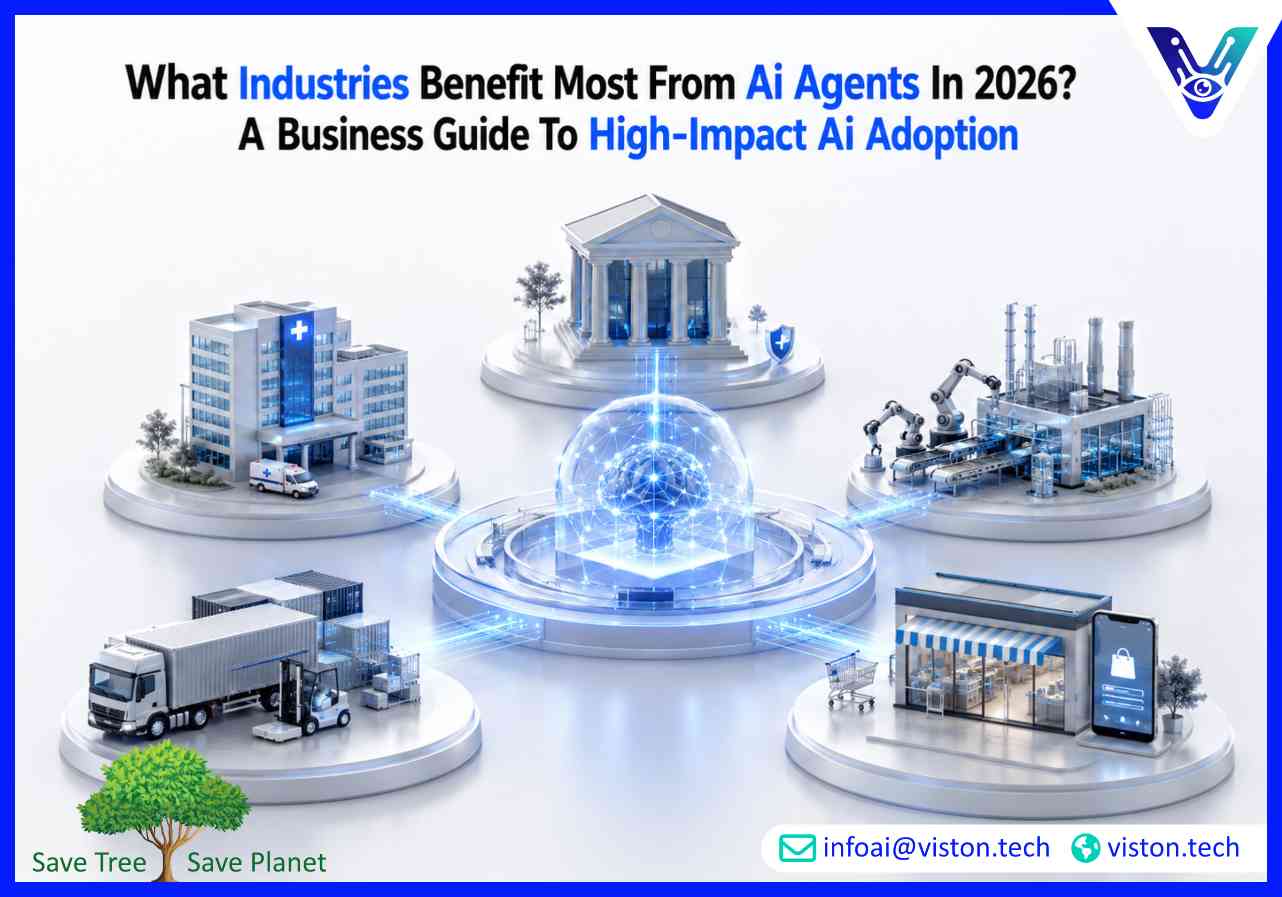
What Industries Benefit Most from AI Agents in 2026? A Business Guide to High-Impact AI Adoption
Introduction
AI agents are moving beyond experimentation and becoming operational tools that support decision-making, automation, customer engagement, and business efficiency. As organizations seek scalable ways to improve productivity and reduce manual workloads, understanding what industries benefit most from AI agents has become an important strategic question for business leaders evaluating AI investments.
What Industries Benefit Most from AI Agents?
The industries that gain the greatest value from AI agents typically share three characteristics:
Large volumes of repetitive or data-intensive work
Complex workflows involving multiple systems or teams
High demand for speed, accuracy, and operational efficiency
Modern AI agents can understand context, execute tasks, retrieve information, interact with software systems, and support human teams in ways that traditional automation tools cannot. As AI agent development and deployment capabilities mature in 2026, organizations across many sectors are using them to streamline operations and improve business performance.
Why AI Agents Are Becoming Essential in 2026
Businesses are facing increasing pressure to:
Reduce operational costs
Improve customer experiences
Accelerate decision-making
Manage growing volumes of data
Scale services without proportionally increasing headcount
Unlike basic chatbots or rule-based automation systems, AI agents can perform multi-step workflows, interact with enterprise software, analyze information, and respond dynamically to changing situations.This makes them particularly valuable in industries where efficiency, responsiveness, and accuracy directly impact business outcomes.
Healthcare and Medical Services
Healthcare remains one of the most promising sectors for AI agent adoption.
Common AI Agent Use Cases
Appointment scheduling and patient coordination
Medical record summarization
Insurance verification support
Clinical documentation assistance
Healthcare workflow automation
Internal knowledge management
Healthcare organizations often struggle with administrative burdens that consume valuable staff time. AI agents help reduce repetitive workloads while allowing medical professionals to focus on patient care.
Benefits for Healthcare Organizations
Faster patient service
Reduced administrative overhead
Improved information accessibility
Better staff productivity
Enhanced operational efficiency
As healthcare providers continue digitizing operations, AI agents are increasingly becoming part of broader healthcare technology strategies.
Financial Services and Banking
Financial institutions process large volumes of information, transactions, compliance requirements, and customer inquiries every day.
How AI Agents Support Financial Operations
AI agents can assist with:
Customer service automation
Loan processing support
Fraud detection workflows
Risk assessment assistance
Regulatory reporting support
Internal knowledge retrieval
Because financial services require accuracy and rapid access to information, AI agents can help teams make more informed decisions while reducing manual effort.
Key Business Outcomes
Faster response times
Improved operational efficiency
Better compliance support
Enhanced customer experiences
Reduced processing delays
Financial organizations that deploy AI agents strategically often see improvements across both customer-facing and back-office functions.
Manufacturing and Industrial Operations
Manufacturers increasingly use AI agents to optimize production environments and support operational decision-making.
High-Value Manufacturing Applications
Production monitoring
Supply chain coordination
Inventory management
Maintenance scheduling
Quality control assistance
Vendor communication workflows
Manufacturing organizations generate substantial operational data. AI agents can help transform this information into actionable insights while supporting faster responses to operational challenges.
Why Manufacturing Benefits
Manufacturing environments require continuous optimization. AI agents help organizations identify bottlenecks, coordinate resources, and improve productivity without disrupting existing operations.
Logistics and Supply Chain Management
Supply chain complexity continues to increase due to global sourcing, fluctuating demand, and customer expectations for faster delivery.
AI Agent Applications in Logistics
Shipment tracking
Route optimization support
Inventory forecasting
Supplier communication
Exception management
Warehouse workflow coordination
AI agents can continuously monitor logistics data and assist teams in addressing delays, inventory shortages, or transportation issues before they become larger problems.
Business Advantages
Improved visibility
Faster issue resolution
Better inventory planning
Reduced operational costs
Enhanced supply chain resilience
Retail and E-Commerce
Retail organizations operate in highly competitive environments where customer experience and operational efficiency are critical.
How Retailers Use AI Agents
Customer support automation
Product recommendation assistance
Inventory management
Order processing support
Demand forecasting
Marketing campaign optimization
AI agents help retailers manage customer interactions while improving internal workflows related to sales, inventory, and fulfillment.
Results Retail Businesses Seek
Higher customer satisfaction
Faster service delivery
Improved inventory control
Better personalization
Increased operational efficiency
As consumer expectations continue evolving, AI agents provide retailers with scalable tools to support growth.
Insurance Industry
Insurance organizations manage large amounts of documentation, customer communication, and claims processing activities.
Common Insurance Use Cases
Claims intake assistance
Policy information retrieval
Customer support automation
Underwriting support
Document analysis
Internal workflow coordination
AI agents can help insurers accelerate processes that traditionally require significant manual effort.
Benefits for Insurance Providers
Faster claims handling
Improved customer experiences
Reduced processing delays
Better document management
Increased employee productivity
Professional Services and Consulting
Consulting firms, legal practices, accounting firms, and business advisory organizations are increasingly exploring AI agents.
Valuable Applications
Research assistance
Knowledge management
Document drafting support
Client communication workflows
Data analysis assistance
Project coordination
Professional service firms often depend on knowledge-intensive work. AI agents help teams access information quickly and improve operational efficiency without replacing professional expertise.
Real Estate and Property Management
The real estate sector benefits from AI agents that support both customer engagement and operational workflows.
AI Agent Capabilities
Lead qualification
Property information management
Appointment scheduling
Tenant communication
Market research support
Document processing
Property managers and real estate professionals often handle large volumes of inquiries and administrative tasks, making AI agents valuable productivity tools.
Human Resources and Recruitment
Recruitment teams face growing pressure to identify qualified candidates efficiently while delivering positive candidate experiences.
AI Agent Use Cases
Candidate screening
Interview scheduling
Employee onboarding assistance
HR knowledge support
Internal employee services
Talent pipeline management
AI agents help HR departments automate routine tasks while allowing recruiters and HR professionals to focus on higher-value interactions.
Technology and Software Companies
Technology organizations are among the earliest adopters of advanced AI agents.
Typical Applications
Customer support
Software testing assistance
Technical documentation support
Internal knowledge retrieval
DevOps workflow coordination
Product support operations
Because technology companies often manage complex digital ecosystems, AI agents can provide substantial productivity gains across engineering, support, and operations teams.
What Makes an Industry a Good Fit for AI Agents?
Not every industry benefits equally from AI agent deployment. Organizations should evaluate several factors before investing.
Strong Indicators for AI Agent Success
Repetitive Knowledge Work
Industries that rely heavily on information processing often see rapid returns from AI agents.
High Transaction Volumes
Organizations handling large numbers of customer interactions, documents, or operational requests typically gain significant efficiency improvements.
Complex Workflows
AI agents excel when coordinating multi-step processes across multiple systems and departments.
Large Knowledge Bases
Companies with extensive documentation, policies, procedures, or technical information can improve accessibility through AI-powered knowledge agents.
Need for Scalability
Organizations experiencing growth often use AI agents to scale operations without dramatically increasing staffing requirements.
How AI Agent Development and Deployment Influence Success
Industry suitability alone does not guarantee positive outcomes. Success depends heavily on how AI agents are designed, integrated, monitored, and optimized.Organizations often encounter challenges such as:
Poor data quality
Weak system integrations
Limited governance
Inadequate testing
Security concerns
Lack of performance monitoring
Effective AI agent development and deployment requires careful planning, clear objectives, integration strategies, security controls, and ongoing optimization.
How Viston AI Supports Industry-Specific AI Agent Development
As organizations evaluate what industries benefit most from AI agents, they often discover that successful deployment requires more than selecting a use case. It requires designing agents that align with business workflows, operational goals, compliance requirements, and existing technology environments.Viston AI specializes in AI Agent Development & Deployment services that help businesses move from AI concepts to practical implementation. This includes developing custom AI agents that can automate workflows, support decision-making, improve customer interactions, and integrate with enterprise systems.Different industries have different requirements. A healthcare organization may need secure workflow automation and knowledge retrieval capabilities, while a logistics company may require shipment monitoring and operational coordination. Financial institutions often prioritize compliance, accuracy, and risk management, whereas retailers focus on customer engagement and operational efficiency.By taking a business-focused approach to AI agent deployment, Viston AI helps organizations identify suitable use cases, integrate AI agents into existing processes, establish governance frameworks, and support long-term scalability. This allows businesses to pursue measurable outcomes while reducing implementation risks commonly associated with enterprise AI initiatives.
Frequently Asked Questions
Which industry benefits the most from AI agents?
There is no single industry that benefits the most. Healthcare, finance, logistics, manufacturing, retail, and technology sectors are among the strongest adopters because they manage complex workflows, large datasets, and repetitive business processes.
Are AI agents only useful for large enterprises?
No. Small and mid-sized businesses can also benefit from AI agents, particularly for customer service, workflow automation, knowledge management, and operational efficiency.
How are AI agents different from traditional automation tools?
Traditional automation follows predefined rules. AI agents can understand context, adapt to changing inputs, make decisions within defined boundaries, and complete multi-step tasks more intelligently.
What are the biggest challenges when deploying AI agents?
Common challenges include integration complexity, data quality issues, governance requirements, security concerns, performance monitoring, and ensuring alignment with business objectives.
How long does AI agent implementation typically take?
Implementation timelines vary depending on complexity, integrations, security requirements, and business objectives. Simple deployments may take weeks, while enterprise-scale implementations can require several months.
Can Viston AI help businesses build custom AI agents?
Yes. Viston AI provides AI Agent Development & Deployment services that help organizations design, implement, integrate, and optimize AI agents for specific business use cases and operational goals.
Conclusion
Understanding what industries benefit most from AI agents helps business leaders identify where AI can deliver meaningful operational value. Industries such as healthcare, finance, manufacturing, logistics, retail, insurance, technology, and professional services are already leveraging AI agents to improve efficiency, automate workflows, and enhance decision-making. However, long-term success depends on thoughtful AI Agent Development & Deployment strategies, strong governance, and alignment with business objectives. For organizations exploring AI adoption in 2026, working with experienced specialists such as Viston AI can help transform AI opportunities into practical, scalable business outcomes.