
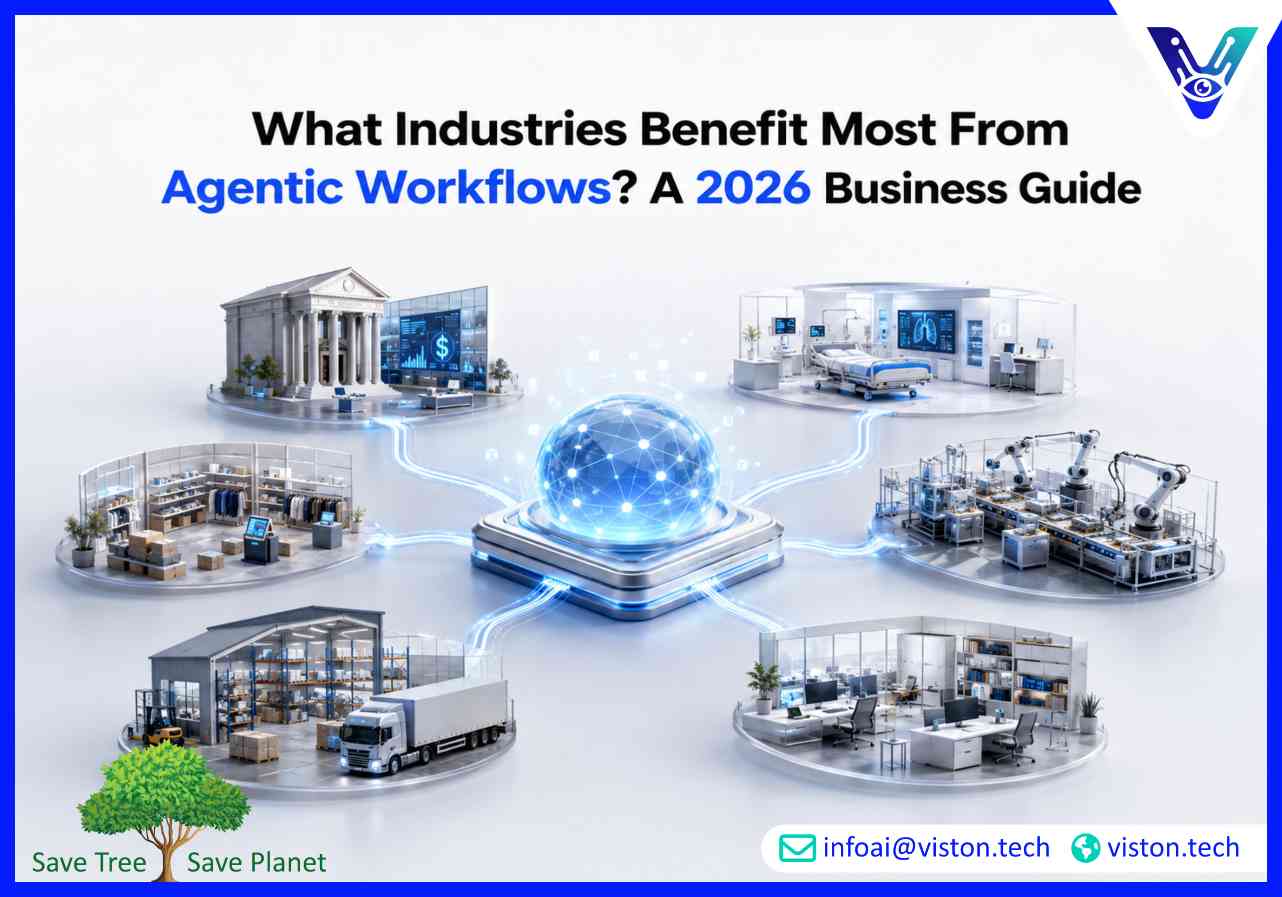
Agentic workflows are rapidly changing how businesses operate in 2026. Unlike traditional automation that follows predefined rules, agentic AI workflows use intelligent AI agents that can plan tasks, make decisions, coordinate actions, interact with software systems, and adapt to changing business conditions. As organizations seek greater efficiency, scalability, and operational intelligence, agentic workflows are becoming a strategic investment across multiple industries.
Businesses today face increasing pressure to reduce manual workloads, improve customer experiences, accelerate decision-making, and operate more efficiently without significantly increasing headcount. Traditional automation can automate repetitive tasks, but it often struggles when processes require context, judgment, coordination, and adaptation.
Agentic AI workflows address these challenges by enabling AI agents to perform tasks independently while collaborating with other agents, business systems, and human teams. These workflows can analyze information, retrieve data, execute actions, monitor outcomes, and continuously improve performance.
Organizations implementing agentic workflows are using them to automate complex operations, improve productivity, streamline communication, reduce errors, and create more agile business processes.
The industries seeing the greatest benefits are typically those with large volumes of data, repetitive operational tasks, complex workflows, customer interactions, compliance requirements, and multiple software systems that need coordination.
The financial sector is one of the strongest adopters of agentic AI workflows. Banks, investment firms, insurance providers, and financial institutions handle enormous volumes of transactions, documentation, compliance activities, and customer interactions daily.
Agentic workflows help automate:
Multiple AI agents can work together to collect documents, verify information, assess risk factors, update internal systems, generate reports, and escalate exceptions when human intervention is required.
This reduces processing times while improving consistency and operational visibility.
Healthcare organizations manage highly complex workflows involving patient records, scheduling, insurance verification, compliance requirements, administrative operations, and clinical documentation.
Agentic AI workflows can support healthcare providers by coordinating activities across multiple systems and departments.
Common use cases include:
By reducing administrative burdens, healthcare organizations can improve operational efficiency while allowing medical professionals to focus more on patient care.
Manufacturing companies operate highly interconnected environments where production planning, inventory management, quality control, procurement, logistics, and maintenance must work together seamlessly.
Agentic workflows provide significant value by coordinating operational processes across multiple systems.
Applications include:
AI agents can monitor production metrics, identify potential disruptions, coordinate corrective actions, and provide real-time visibility into manufacturing performance.
Retail businesses face constant pressure to meet customer expectations while managing inventory, fulfillment, customer support, pricing strategies, and marketing campaigns.
Agentic AI workflows allow retailers to automate customer-facing and operational activities simultaneously.
Key use cases include:
Multiple agents can collaborate to improve customer experiences while optimizing operational efficiency behind the scenes.
The logistics industry depends heavily on coordination, timing, communication, and operational visibility.
Agentic workflows help transportation providers automate decision-making and manage complex logistics operations.
Examples include:
Agentic systems can continuously monitor transportation networks, identify delays, recommend alternative routes, and coordinate responses across multiple stakeholders.
Consulting firms, legal practices, accounting organizations, and business advisory firms manage large amounts of information, research, documentation, and client communication.
Agentic workflows improve productivity by automating knowledge-intensive processes.
Common applications include:
By reducing administrative workloads, professionals can spend more time on high-value advisory work.
While industry-specific applications vary, the underlying benefits remain remarkably consistent.
Agentic workflows reduce manual effort by automating tasks that previously required multiple employees, departments, or software systems to coordinate activities.
This enables organizations to complete workflows faster while reducing operational bottlenecks.
AI agents can analyze large volumes of data, identify patterns, retrieve information from multiple systems, and provide recommendations that support informed decision-making.
Decision-makers gain access to timely insights without spending hours gathering and organizing information.
Customers increasingly expect faster responses, personalized interactions, and seamless experiences.
Agentic workflows help organizations respond more quickly while maintaining service quality across multiple customer touchpoints.
As businesses grow, operational complexity increases. Agentic workflows allow organizations to handle larger workloads without needing to expand teams at the same rate.
This creates significant opportunities for sustainable growth.
Manual processes often introduce inconsistencies and errors. Agentic workflows can follow predefined governance frameworks while continuously validating outputs and identifying exceptions.
This improves process reliability and operational quality.
Not every workflow requires agentic AI. However, certain characteristics make industries particularly suitable for adoption.
Industries benefit most when they have:
The more complex the workflow, the greater the potential value of intelligent orchestration using specialized AI agents.
As AI technologies continue to mature throughout 2026 and beyond, agentic workflows are expected to expand into nearly every major industry.
Organizations are moving beyond simple automation projects toward enterprise-wide orchestration strategies that connect people, systems, data, and AI agents into unified operational ecosystems.
Emerging adoption areas include:
The organizations that succeed will be those that focus on practical business outcomes rather than implementing AI solely for technology’s sake.
For organizations exploring Agentic AI Workflows, implementation success depends on more than simply deploying AI models. Businesses need workflow design, orchestration strategies, system integrations, governance frameworks, monitoring capabilities, and scalable deployment approaches.
Viston AI specializes in Agentic AI Workflows that help organizations transform manual and fragmented processes into intelligent, coordinated operational systems. By focusing on workflow orchestration, AI automation, business process optimization, and multi-agent collaboration, Viston AI supports businesses seeking practical AI adoption that aligns with real operational objectives.
Organizations across industries can benefit from agentic workflow solutions that connect data sources, business applications, customer interactions, and internal processes through intelligent automation frameworks designed for long-term scalability.
Financial services, healthcare, manufacturing, retail, logistics, and professional services are among the industries currently seeing the greatest value from agentic AI workflows due to their operational complexity and data-intensive processes.
Yes. Small businesses can use agentic workflows to automate sales operations, customer support, marketing activities, scheduling, reporting, and administrative tasks without large technology teams.
Traditional automation follows fixed rules, while agentic workflows use intelligent AI agents capable of making decisions, adapting to changing conditions, coordinating actions, and managing complex processes.
Yes. With proper governance, monitoring, audit trails, and human oversight, agentic workflows can support regulated industries such as healthcare, finance, insurance, and government services.
Agentic workflows often combine large language models, workflow orchestration platforms, APIs, databases, CRM systems, ERP platforms, analytics tools, vector databases, and monitoring systems.
Yes. Viston AI provides Agentic AI Workflow expertise focused on workflow design, AI orchestration, system integration, automation strategy, and scalable implementation for businesses across industries.
Understanding what industries benefit most from agentic workflows is becoming increasingly important as organizations seek new ways to improve efficiency, scalability, and operational performance. Industries such as finance, healthcare, manufacturing, retail, logistics, and professional services are already demonstrating how Agentic AI Workflows can automate complex processes, improve decision-making, and enhance customer experiences. As AI adoption continues to accelerate throughout 2026, businesses that strategically implement agentic workflows will be better positioned to streamline operations, reduce costs, and create sustainable competitive advantages. For organizations exploring intelligent automation, Viston AI offers specialized expertise in Agentic AI Workflows that support practical and scalable business transformation.
