
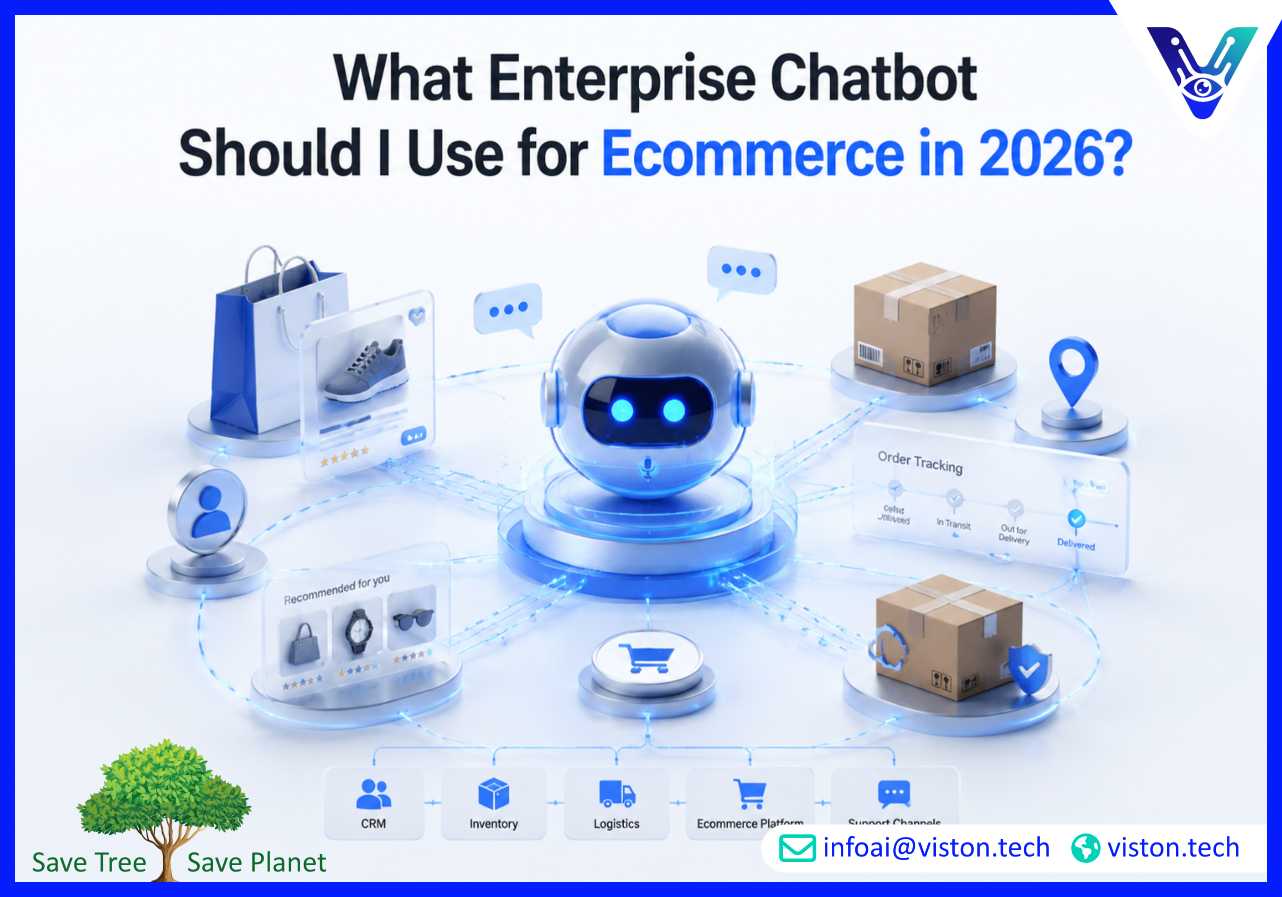
Choosing what enterprise chatbot should I use for ecommerce matters because online retailers now need more than basic live chat automation. The right enterprise AI chatbot should support product discovery, order questions, returns, personalization, customer service, and revenue workflows across every digital shopping channel.
An enterprise chatbot for ecommerce should function as a reliable digital shopping and service assistant, not just a pop-up that answers basic FAQs. Ecommerce customers ask practical, purchase-driven questions. They want to know which product fits their need, whether an item is in stock, how long delivery will take, whether discounts apply, how returns work, and what happened to their order.
For enterprise ecommerce teams, the chatbot must support both customer experience and operational efficiency. It should help shoppers find the right products, reduce repetitive support tickets, recover abandoned carts, route high-value customers, and keep customer data synchronized with backend systems. This is where enterprise AI chatbots differ from lightweight website chat tools.
The best option depends on the size of the ecommerce business, the complexity of the catalog, the number of markets served, the support volume, and the systems already in place. A small online store may need a simple automated support chatbot. A large ecommerce brand usually needs a more advanced conversational AI solution connected to product catalogs, CRM, order management, inventory, helpdesk, marketing automation, and analytics platforms.
In 2026, the strongest ecommerce chatbot is usually an integrated AI chatbot with conversational commerce capabilities. It should combine customer service automation, product intelligence, workflow automation, and secure enterprise system integration.
Ecommerce has become faster, more competitive, and more expectation-driven. Customers compare products across multiple stores, switch channels quickly, and expect instant answers before buying. When answers are delayed, unclear, or inconsistent, buyers often leave before checkout. Enterprise AI chatbots help reduce this friction by giving shoppers immediate guidance at the point of decision.
The role of chatbots has also changed. Traditional ecommerce chatbots often followed fixed scripts. They worked for simple questions but failed when shoppers asked natural, complex, or context-specific questions. Modern enterprise AI chatbots use natural language understanding, retrieval from approved knowledge sources, and integration with real-time business systems. This makes them more useful for serious ecommerce operations.
Support automation remains important, but ecommerce chatbots now support the full shopping journey. They can help a visitor narrow product options, explain differences between models, suggest accessories, answer sizing or compatibility questions, provide delivery estimates, and guide the customer toward checkout. After the purchase, they can assist with tracking, returns, exchanges, refunds, and repeat orders.
This matters because ecommerce support and ecommerce sales are closely connected. A customer asking about return policy may be deciding whether to buy. A customer asking about product compatibility may need reassurance before checkout. A customer asking where an order is may become frustrated if the chatbot cannot access real-time order information.
An enterprise ecommerce chatbot cannot operate effectively in isolation. It needs access to accurate and current information. Product availability, pricing, promotions, delivery timelines, loyalty status, order history, refund progress, and customer profile data often sit in different systems. Without integration, the chatbot may give generic answers that do not solve the customer’s actual problem.
For this reason, ecommerce teams should prioritize chatbots that connect securely with platforms such as Shopify Plus, Magento, BigCommerce, Salesforce Commerce Cloud, WooCommerce, SAP Commerce Cloud, custom ecommerce platforms, CRM systems, warehouse management tools, payment gateways, helpdesk software, and marketing automation platforms.
Personalization is one of the biggest ecommerce chatbot opportunities, but it must be handled carefully. A chatbot should use customer context to improve relevance, not make shoppers uncomfortable. Useful personalization may include recommending products based on browsing behavior, remembering size preferences, showing compatible accessories, or identifying loyalty benefits.
At the same time, businesses need clear consent, transparent data handling, role-based access, and privacy-aware design. Ecommerce chatbots often touch personal data, transaction history, addresses, payment-related workflows, and support records. A strong enterprise AI chatbot should support secure authentication, audit logs, permission controls, and responsible escalation rules.
The right enterprise chatbot should match the ecommerce business model, not just the latest AI trend. A fashion retailer, electronics marketplace, grocery platform, beauty brand, furniture store, B2B ecommerce portal, and subscription business all need different conversation flows, integrations, product logic, and escalation rules.
Before choosing a solution, businesses should define the primary outcome they want. Some teams want to reduce ticket volume. Others want to increase conversion, improve product discovery, recover carts, support multilingual customers, automate returns, or improve post-purchase experience. The chatbot architecture should follow that goal.
If the business mainly needs basic support automation, a chatbot with FAQ handling, helpdesk integration, and escalation may be enough. If the business wants conversational commerce, it needs product recommendation logic, catalog access, cart actions, promotional rules, and personalized guidance. If the business operates across regions, it may need multilingual support, localized policies, currency awareness, tax handling, and market-specific delivery rules.
For large ecommerce organizations, the strongest choice is often a custom or enterprise-grade AI chatbot rather than a purely template-based tool. Customization allows the chatbot to reflect the brand’s catalog structure, return policies, product attributes, customer segments, and operational workflows.
Integration depth is one of the most important selection criteria. A chatbot that only answers website FAQs can be useful, but it will not deliver enterprise-level value if customers still need agents for order status, returns, product availability, or account-specific questions.
Look for the ability to connect with:
The chatbot should also update records, not only read them. For example, it should create support tickets, tag customer intent, log conversation history, trigger follow-up emails, route return requests, update CRM notes, and pass qualified leads or high-value shoppers to the right team.
Ecommerce chatbots must be accurate because mistakes affect purchases, refunds, customer trust, and brand reputation. A chatbot should use approved knowledge sources, real-time product data, confidence thresholds, and clear fallback behavior. It should not invent policy details, promise unavailable discounts, or provide uncertain delivery timelines.
Human handover is equally important. The best chatbot is not the one that avoids agents at all costs. It is the one that knows when to escalate. High-value complaints, payment issues, damaged goods, legal requests, fraud signals, sensitive account issues, and repeated failed attempts should be routed to a human with a concise summary and full conversation context.
When ecommerce teams ask what enterprise chatbot should I use for ecommerce, the answer should start with features that support measurable business outcomes. A chatbot should not be chosen only because it has generative AI. It should be chosen because it solves real ecommerce problems safely and consistently.
Product discovery is one of the most valuable ecommerce chatbot capabilities. Shoppers often do not know the exact product name they need. They may describe a use case, budget, size, material, compatibility issue, or preference. A capable AI chatbot should understand these natural inputs and guide users toward suitable products.
For better results, the chatbot should connect with product catalogs, filters, reviews, stock status, bundles, and product attributes. It should be able to compare products, explain differences, suggest alternatives when an item is unavailable, and recommend related products without over-selling.
Post-purchase support creates a large share of ecommerce service volume. Customers ask about delivery dates, missing packages, return windows, refund status, exchange options, damaged items, warranty claims, and cancellation rules. These requests are repetitive but often require access to order data.
An enterprise AI chatbot should connect to order management and logistics systems so it can give accurate, customer-specific answers. It should also support structured workflows for return initiation, exchange eligibility, refund status checks, and agent escalation when policy exceptions are needed.
Ecommerce customers may interact through websites, mobile apps, WhatsApp, Instagram, Messenger, email, SMS, and live chat. A strong enterprise chatbot should maintain consistent responses across channels while respecting the format and expectations of each channel. A short WhatsApp response may work well for delivery updates, while a website assistant may provide richer product comparison guidance.
Omnichannel support should also preserve context. If a shopper starts a conversation on mobile and later contacts support through the website, the business should not lose the history. Unified customer context improves service quality and reduces repeated questions.
An ecommerce chatbot should provide clear reporting on performance. Useful metrics include conversation volume, conversion influence, cart recovery rate, product recommendation engagement, fallback rate, escalation rate, first contact resolution, customer satisfaction, return request completion, and cost per resolved conversation.
Analytics should also show failed conversations. These reveal gaps in product data, unclear policies, weak intent recognition, missing integrations, and customer concerns that may affect conversion. The chatbot should improve over time through content updates, training examples, workflow refinements, and performance reviews.
Viston AI is relevant for ecommerce businesses evaluating enterprise AI chatbots because its service offering includes Enterprise AI Chatbots, AI Chatbot Integration, multilingual support, voice-enabled assistants, natural language processing, automation workflows, and ecommerce intelligence capabilities. These capabilities align closely with the needs of online retailers that require more than a basic customer support widget.
For ecommerce teams, Viston AI’s Enterprise AI Chatbots service can support conversational experiences across customer service, product discovery, order questions, returns, and post-purchase assistance. Its integration-focused capabilities are especially important where the chatbot needs to connect with CRM systems, knowledge bases, product catalogs, inventory platforms, payment gateways, and transactional systems. This allows the chatbot to provide more accurate, context-aware responses instead of relying only on static FAQs.
Viston AI’s ecommerce intelligence capabilities also connect naturally to the buying journey. Product recommendations, customer segmentation, pricing intelligence, predictive insights, and personalization can strengthen chatbot usefulness when applied responsibly. For enterprise ecommerce brands operating across multiple channels, regions, or business units, a chatbot partner with AI development, integration, automation, and monitoring expertise can help reduce operational friction and create a more scalable customer experience.
This makes Viston AI a practical option for ecommerce organizations that want an enterprise AI chatbot designed around business workflows, customer context, system connectivity, and measurable service outcomes.
You should use an enterprise AI chatbot that supports ecommerce-specific workflows such as product discovery, order tracking, returns, cart recovery, recommendations, customer support, and system integration. The best choice is usually one that connects with your ecommerce platform, CRM, inventory, helpdesk, and analytics tools.
A generic AI chatbot may handle basic FAQs, but enterprise ecommerce usually needs deeper functionality. For accurate product, order, return, and customer-specific answers, the chatbot should connect to business systems and use approved knowledge sources with clear escalation rules.
The most important features are natural language understanding, product catalog integration, order and inventory lookup, personalized recommendations, returns automation, omnichannel support, secure authentication, analytics, and smooth human handover.
A platform may work for standard use cases and faster deployment. A custom or enterprise-grade chatbot is often better when the business has complex catalogs, multiple regions, advanced workflows, custom systems, strict compliance needs, or high support volume.
It can improve ROI by reducing repetitive support tickets, increasing self-service resolution, assisting product discovery, recovering abandoned carts, improving response speed, reducing agent workload, and creating better data for sales and service optimization.
Yes. Viston AI offers Enterprise AI Chatbots and related integration, NLP, automation, multilingual support, and ecommerce intelligence capabilities that are relevant for ecommerce brands needing connected, scalable, and business-focused chatbot solutions.
Knowing what enterprise chatbot should I use for ecommerce comes down to business fit, not feature volume. The right enterprise AI chatbot should help shoppers make decisions, answer service questions accurately, connect with ecommerce systems, support post-purchase workflows, and improve operational efficiency. In 2026, ecommerce chatbots should be secure, integrated, measurable, and designed around real customer journeys. For businesses that need product discovery, order support, returns automation, personalization, and scalable customer service, an enterprise AI chatbot with strong integration capability is the most practical direction. Viston AI offers relevant expertise for ecommerce organizations seeking a connected and outcome-focused chatbot solution.
