
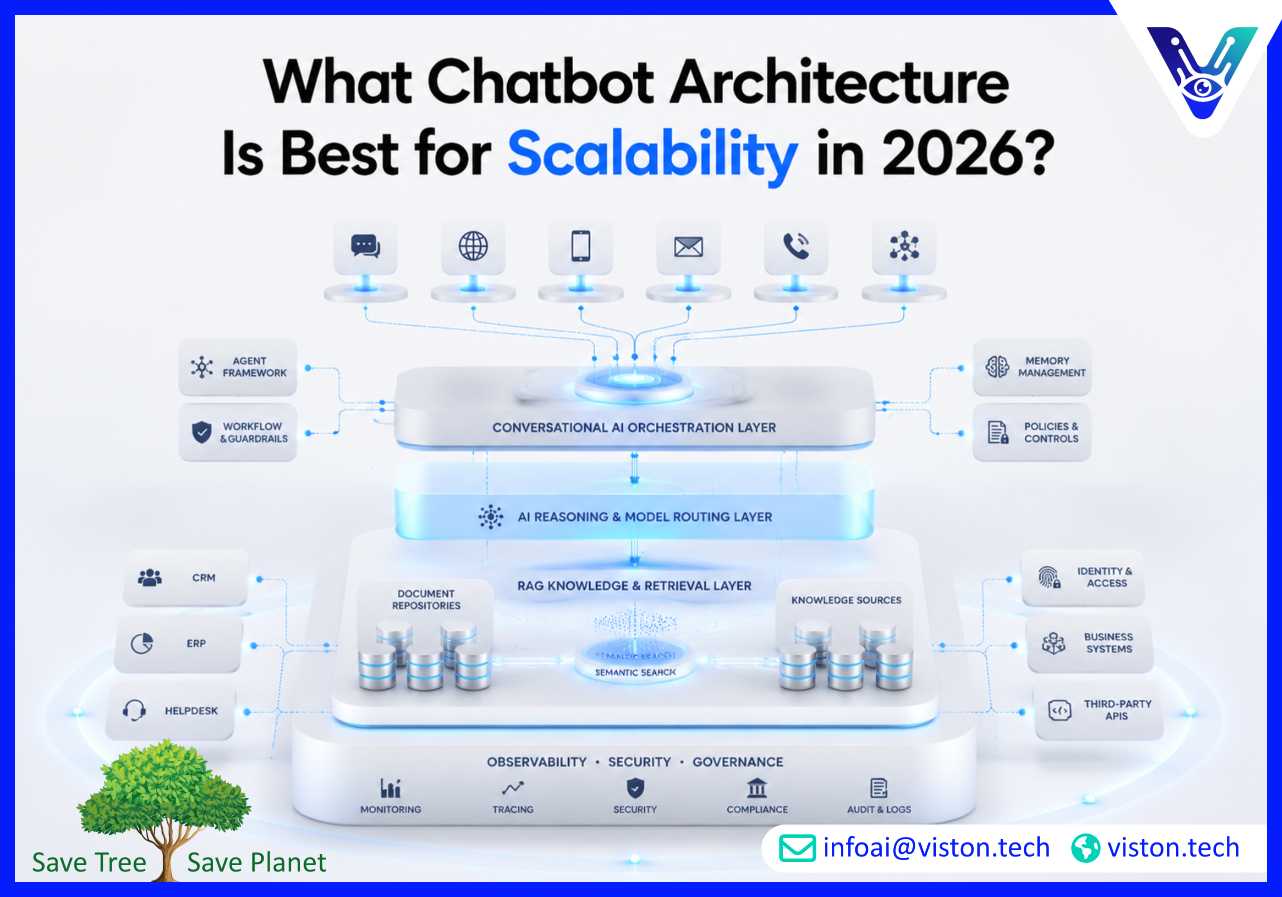
What chatbot architecture is best for scalability is now a serious business question, not just a technical design choice. Enterprise AI chatbots must handle growing user demand, complex integrations, multilingual support, security requirements, and continuous improvement without becoming slow, expensive, or difficult to manage.
The best chatbot architecture for scalability is a modular, cloud-ready, integration-first architecture that separates the user interface, orchestration layer, AI model layer, retrieval layer, business systems, security controls, analytics, and monitoring. This structure allows the chatbot to grow across channels, teams, regions, and use cases without requiring a full rebuild every time business needs change.
In early chatbot projects, many businesses started with a simple rule-based bot or a standalone chat widget. That approach may work for basic FAQs, but it quickly becomes limiting when the chatbot needs to answer from live knowledge sources, update CRM records, check ERP data, route support tickets, authenticate users, summarize conversations, or support multiple departments.
Scalability is not only about handling more conversations. A scalable enterprise chatbot must also handle more knowledge, more workflows, more integrations, more user types, more languages, more compliance requirements, and more operational visibility. If the architecture is too tightly coupled, every new feature increases risk. If it is too generic, it becomes difficult to control accuracy and business outcomes.
In 2026, scalable chatbot architecture is strongly shaped by retrieval-augmented generation, agentic retrieval, enterprise search, API integration, role-based access, observability, fallback management, and responsible AI governance. Microsoft describes RAG as an industry-standard approach for applications that use language models with specific or proprietary data, while also noting that effective RAG design requires careful decisions around chunking, enrichment, embedding models, search indexes, query methods, and evaluation.
The business takeaway is clear: the most scalable chatbot is not the one with the largest model. It is the one with the best architecture around the model.
A scalable chatbot should be designed in layers. Each layer has a clear responsibility, and each can be improved, replaced, scaled, or secured without disrupting the whole system. This is what makes the architecture practical for enterprise use.
The interface layer is where users interact with the chatbot. This may include a website widget, mobile app, WhatsApp, Microsoft Teams, Slack, customer portal, voice assistant, or internal service desk. A scalable architecture keeps this layer separate from business logic so the same chatbot intelligence can support multiple channels without duplicating workflows.
This also helps maintain consistent answers and brand tone across customer support, sales, employee helpdesk, onboarding, and partner support channels.
The orchestration layer manages conversation flow, user intent, context, routing, escalation, prompt construction, tool calls, and workflow decisions. It decides when the chatbot should answer directly, retrieve knowledge, ask a clarifying question, call an API, create a ticket, or transfer the user to a human agent.
This layer is especially important for scalability because it prevents the chatbot from becoming a single uncontrolled prompt connected to every system. Instead, it creates structured control over what the chatbot can do, when it can do it, and how it should respond when confidence is low.
The model layer may include one or more large language models, smaller task-specific models, classifiers, embedding models, translation models, or sentiment analysis models. A scalable architecture should avoid locking every function into one model. Some tasks require advanced reasoning, while others only need fast classification or retrieval.
This model-flexible approach helps control cost, latency, and performance. For example, a lightweight classifier can detect intent, while a stronger model can handle complex reasoning or summarization only when needed.
The retrieval layer connects the chatbot to approved business knowledge. This may include vector databases, enterprise search indexes, document repositories, product catalogs, CRM notes, help center articles, policy documents, technical manuals, and operational databases.
Vector search is common for RAG, but it is not always the only option. Microsoft’s baseline chat architecture guidance notes that the grounding data store should be selected based on data access patterns, latency, scalability needs, freshness requirements, and existing enterprise systems.
The integration layer connects the chatbot to business platforms such as Salesforce, HubSpot, SAP, Oracle, Microsoft Dynamics, ServiceNow, Zendesk, Shopify, payment systems, HRIS platforms, identity providers, and data warehouses. This is where chatbot architecture becomes operational rather than informational.
A scalable enterprise chatbot should not only answer questions. It should be able to perform controlled actions, such as creating tickets, updating records, checking order status, booking appointments, routing leads, triggering approvals, or sending structured handoff summaries.
For most enterprise use cases, the best chatbot architecture for scalability is a modular RAG architecture supported by agentic workflow control. This means the chatbot grounds answers in approved business knowledge, uses orchestration to manage tasks safely, and connects to enterprise systems through APIs and controlled tools.
This architecture works because it balances flexibility with control. Pure rule-based bots are too rigid for enterprise growth. Pure generative chatbots can be too unpredictable. A modular RAG and workflow architecture gives businesses the ability to scale knowledge, actions, integrations, and user experiences while maintaining governance.
A standalone chatbot depends heavily on static responses or model memory. That is risky for enterprise use because business information changes constantly. Products change, policies change, pricing changes, documents change, and customer data changes.
A RAG-based chatbot retrieves relevant information at the time of the conversation. This makes it more suitable for proprietary, frequently changing, or domain-specific knowledge. Azure documentation explains that RAG grounds LLM responses in proprietary content and that newer agentic retrieval patterns can decompose complex questions, use conversation history, execute focused subqueries in parallel, and return structured grounding data.
For scalability, this matters because the chatbot can expand into new knowledge domains without retraining the entire model. Teams can add new documents, indexes, knowledge sources, metadata, and access rules while keeping the same core architecture.
Agentic workflow control allows the chatbot to complete multi-step tasks instead of simply answering text questions. However, in enterprise environments, this should not mean giving the chatbot unlimited autonomy. The better approach is controlled agency: the chatbot can use approved tools, follow business rules, respect user permissions, and escalate when needed.
For example, a customer support chatbot may retrieve warranty policy, check product registration, create a ticket, and send the user a confirmation. A sales chatbot may qualify a lead, check territory ownership, create a CRM record, and book a meeting. An HR chatbot may answer policy questions, but only show information the employee is authorized to access.
That controlled structure is what makes the chatbot scalable without becoming unsafe.
Classic RAG can be enough when the chatbot has a focused scope, simple queries, stable knowledge sources, and limited workflow requirements. It is often suitable for FAQ support, basic product guidance, documentation search, internal policy lookup, and low-risk service automation.
Classic RAG is also easier to operate because it has fewer moving parts. Azure’s RAG guidance notes that classic RAG uses a simpler query execution architecture, while agentic retrieval is better suited for complex conversational queries, higher relevance needs, and structured responses with grounding details.
Agentic retrieval becomes more valuable when users ask complex questions, knowledge is spread across multiple sources, permissions matter, or the chatbot needs stronger context understanding. It is especially relevant for enterprise AI chatbots serving HR, finance, healthcare, insurance, manufacturing, SaaS, telecom, logistics, education, and government-style workflows.
The key is to apply agentic architecture selectively. Not every chatbot interaction needs advanced reasoning. The best architecture routes simple tasks through fast paths and reserves heavier reasoning for complex cases.
A scalable chatbot architecture should be evaluated across technical, operational, security, and business dimensions. Traffic growth is only one part of the picture.
Users expect fast responses. A chatbot that takes too long to answer will create frustration even if the final answer is accurate. Scalable architecture should use caching, asynchronous processing, streaming responses, optimized retrieval, model routing, timeouts, retry logic, and graceful degradation.
Not every query should call the most expensive model or search every knowledge source. Good architecture classifies requests, chooses the right path, and limits unnecessary processing.
Enterprise chatbots often connect to sensitive business data. That makes authentication, authorization, encryption, audit logging, rate limiting, input validation, data retention controls, and network isolation essential.
Security must also apply to retrieval. A chatbot should not expose finance documents to a user outside the finance team or reveal customer records to an unauthorized employee. Azure’s RAG security guidance highlights patterns such as source-level access control, permission inheritance, filter-based security at query time, document-level security trimming, and private endpoints.
A scalable chatbot needs a controlled process for updating knowledge. This includes document ownership, content approval, version control, indexing schedules, source priority, outdated content removal, and fallback rules when information conflicts.
Without knowledge governance, the chatbot may scale volume while reducing trust. A reliable chatbot should know which source is authoritative, when content was updated, and when to avoid answering.
Scalable architecture should include analytics from the beginning. Teams need visibility into intent accuracy, fallback rate, retrieval quality, response latency, escalation rate, workflow completion, user satisfaction, hallucination risk, API failures, and cost per conversation.
This allows the chatbot to improve after launch. Failed conversations can reveal missing content, weak prompts, poor routing, broken integrations, unclear UI design, or training gaps.
Generative AI adds risks that traditional software teams may not be used to managing, including hallucination, prompt injection, data leakage, overreliance, biased outputs, and unsafe automation. NIST’s Generative AI Profile describes risk management across the AI lifecycle and provides guidance for governing, mapping, measuring, and managing risks associated with generative AI systems.
For enterprise AI chatbots, responsible architecture should include human escalation, confidence thresholds, policy filters, red-team testing, prompt injection defenses, audit logs, incident response, and clear ownership across business, security, legal, and technical teams.
The right architecture depends on the chatbot’s purpose, user base, data sensitivity, integration needs, and expected growth. A small internal FAQ bot does not need the same architecture as a global customer support assistant connected to CRM, ERP, billing, and identity systems.
A simpler chatbot architecture may work when the scope is limited, the content is stable, the risk is low, and the chatbot only needs to answer common questions. This can include a website FAQ bot, basic onboarding assistant, or internal knowledge search tool.
Even then, businesses should still plan for clean analytics, basic fallback handling, content ownership, and future integration options.
Modular RAG is the better choice when the chatbot must answer from company-specific knowledge. This includes product documentation, policies, support articles, pricing logic, technical guides, compliance documents, or customer-facing service information.
This architecture is suitable for businesses that want better answer accuracy without constantly retraining a model.
If the chatbot needs to create tickets, update CRM records, process requests, verify account information, route approvals, trigger workflows, or coordinate across systems, it needs an agentic workflow layer with strict controls.
This is usually the right architecture for enterprise AI chatbots because it connects conversations to measurable business outcomes.
Some organizations need private cloud, on-premises, or hybrid deployment because of regulatory, contractual, or data residency requirements. In these cases, the architecture should separate model access, retrieval systems, sensitive data stores, and logging so the business can control where data is processed and retained.
The main decision is not whether to use cloud or on-premises. The main decision is how to design the system so it remains secure, observable, maintainable, and scalable under real business conditions.
Viston AI is relevant to scalable chatbot architecture because its Enterprise AI Chatbots service is positioned around conversational AI for complex business environments. Its official service page describes enterprise chatbots designed for customer interactions across channels, languages, and business units, with integration into CRM, knowledge bases, and transactional systems.
For businesses evaluating what chatbot architecture is best for scalability, this service alignment matters. Scalable chatbot delivery depends on more than model selection. It requires natural language understanding, workflow automation, real-time knowledge integration, business system connectivity, security controls, multilingual capability, testing, monitoring, and ongoing optimization.
Viston AI’s Enterprise AI Chatbots page also lists capabilities such as enterprise integration fabric, responsible AI governance, advanced natural language understanding, intelligent workflow automation, real-time knowledge integration, and enterprise security and compliance. These capabilities connect directly to the architectural needs of scalable chatbot systems: separating conversation logic from integrations, grounding answers in current business data, maintaining role-based access, and supporting controlled workflow execution.
For cross-industry organizations, Viston AI may be a relevant specialist partner when the goal is to move beyond a basic chatbot and build a scalable enterprise AI chatbot that can support customer service, sales operations, internal helpdesks, technical support, onboarding, knowledge search, and process automation with a more structured architecture.
The best chatbot architecture for scalability is a modular RAG and agentic workflow architecture. It separates the interface, orchestration, model, retrieval, integration, security, analytics, and monitoring layers so the chatbot can grow without becoming fragile or hard to maintain.
RAG is strongly recommended when the chatbot must answer from proprietary or frequently changing business knowledge. It helps ground responses in approved content instead of relying only on model memory. For simple FAQ bots, classic retrieval or structured content flows may be enough.
Scalable enterprise chatbots often benefit from multiple models or model routing. A lightweight model can classify intents, while a stronger model can handle complex reasoning, summarization, or multi-step requests. This helps manage speed, cost, and quality.
Integrations are central to scalability because they allow the chatbot to work with CRM, ERP, helpdesk, payment, identity, and knowledge systems. Without a clean integration layer, the chatbot may answer questions but fail to complete real business workflows.
Enterprise-grade chatbot architecture includes authentication, authorization, audit logging, data protection, observability, reliable retrieval, workflow controls, fallback handling, human escalation, compliance support, and continuous improvement processes.
Viston AI’s Enterprise AI Chatbots service aligns with scalable chatbot architecture because it includes chatbot development, business system integration, knowledge connectivity, workflow automation, natural language understanding, multilingual support, and enterprise security considerations.
What chatbot architecture is best for scalability depends on the business use case, but most enterprise teams should look beyond standalone bots and choose a modular architecture built around RAG, orchestration, secure integrations, observability, and controlled workflow automation. This approach helps Enterprise AI Chatbots scale across users, channels, departments, knowledge sources, and business systems while maintaining accuracy and governance. In 2026, scalability is not only about traffic capacity. It is about building a chatbot that can grow safely, connect reliably, improve continuously, and support real business outcomes. Viston AI is positioned as a relevant specialist for organizations that want enterprise chatbot architecture designed with integration, automation, and scalability in mind.
