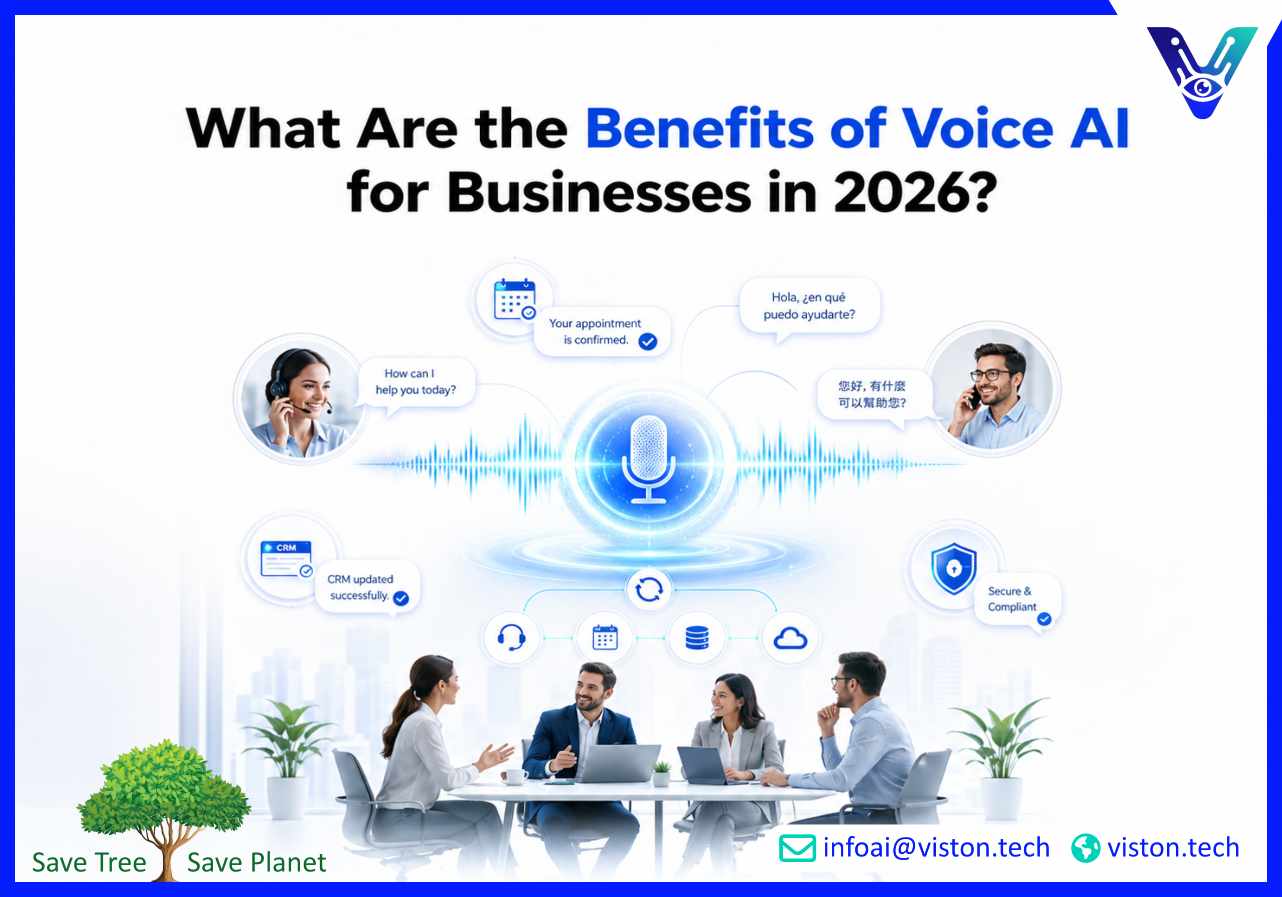
What Are the Benefits of Voice AI for Businesses in 2026?
The benefits of voice AI extend beyond answering telephone calls. A well-designed voice-enabled assistant can improve service availability, automate routine conversations, support hands-free workflows, capture structured information, and help customers complete tasks faster. For businesses, the value comes from combining natural conversation with reliable data, system integrations, and appropriate human oversight.
What Voice AI Does and Why Businesses Use It
Voice AI enables people to interact with software using spoken language. It typically combines automatic speech recognition, natural language processing, conversational AI, business logic, and text-to-speech technology. Together, these components allow a system to hear a request, understand its meaning, access relevant information, perform an approved action, and respond in a natural voice.A basic voice system may follow a fixed menu or script. A modern voice-enabled assistant can manage multi-turn conversations, retain relevant context, ask clarifying questions, retrieve information from approved sources, and trigger workflows in connected business systems.For example, a customer may call to reschedule an appointment. Instead of pressing several keypad options or waiting for an agent, the customer can explain the request naturally. The assistant can identify the customer, check available times, confirm the new appointment, update the scheduling platform, and send a confirmation message.This capability makes voice AI useful for customer service, sales, appointment management, order enquiries, internal support, field operations, healthcare administration, hospitality, financial services, logistics, retail, and other environments where spoken communication remains important.
Voice AI is different from traditional IVR
Traditional interactive voice response systems usually require callers to select numbered options from a predefined menu. Voice AI is designed to understand conversational requests such as “I need to change tomorrow’s booking” or “Can you tell me whether my order has shipped?”This reduces the need for callers to navigate long menus. It can also make automated service more flexible because users are not limited to a small set of rigid commands.
The business value depends on execution
Voice AI does not automatically create a good customer experience. Its benefits depend on speech recognition quality, conversation design, response speed, knowledge accuracy, workflow reliability, escalation rules, privacy controls, and integration with operational systems.In 2026, businesses evaluating conversational AI are increasingly expected to examine governance, integration failure handling, voice capability, deployment architecture, security, multilingual performance, and total production cost rather than judging a solution from a simple demonstration alone.
Core Benefits of Voice AI for Businesses
Faster responses for routine enquiries
Voice-enabled assistants can respond immediately to common questions about opening hours, order status, account information, appointment availability, product details, delivery updates, service eligibility, and basic troubleshooting.This immediate availability can reduce waiting time and help customers complete simple tasks without joining a support queue. Human agents can then spend more time on complex, sensitive, or high-value conversations that require judgment.
Round-the-clock service availability
A voice assistant can remain available outside normal business hours. This is valuable for organizations serving customers across time zones or receiving frequent enquiries during evenings, weekends, and seasonal peaks.Availability does not mean every issue should be fully automated. A responsible system should clearly explain its limitations, create a ticket when an agent is unavailable, and provide an appropriate route for urgent or sensitive cases.
More scalable customer service
Call volumes can change quickly because of promotions, service disruptions, billing cycles, product launches, weather events, or seasonal demand. Increasing human staffing at the same speed may be difficult and expensive.Voice AI can handle many simultaneous routine conversations, making service capacity easier to scale. Businesses can use it to absorb predictable demand while reserving human capacity for exceptions, complaints, negotiations, and situations where empathy matters.
Lower repetitive workload
Many service teams repeatedly answer the same questions, verify the same details, create similar tickets, and update the same fields. Voice-enabled assistants can automate suitable parts of this work.Reducing repetitive activity may improve agent productivity and make roles more focused. The strongest implementations support employees rather than simply attempting to replace them. They automate structured tasks while allowing staff to manage conversations that require discretion, reassurance, persuasion, or specialist knowledge.
Consistent service delivery
Voice AI can provide responses based on approved policies, knowledge bases, and workflows. This can improve consistency across routine interactions, especially when information changes frequently or teams operate across multiple locations.Consistency is particularly useful for appointment instructions, onboarding steps, order policies, standard eligibility questions, service updates, and internal process guidance. However, the knowledge source must be maintained carefully. An assistant connected to outdated information will deliver outdated answers consistently.
Improved accessibility and hands-free interaction
Speaking can be easier than typing for users who have difficulty using a keyboard or touchscreen. Voice interaction can also support people who are driving, working with equipment, moving through a warehouse, caring for a patient, or completing another task that makes screen-based interaction inconvenient.Businesses should still provide alternative channels. Voice is not suitable for every user, environment, or request, particularly when privacy, hearing ability, speech differences, or noisy surroundings affect the conversation.
Multilingual customer engagement
Voice AI can support customers in multiple languages and may help businesses extend service coverage without creating a separate team for every language. It can also recognize different accents, common expressions, and domain-specific terminology when configured and tested properly.Successful multilingual deployment requires more than translating scripts. Businesses need localized conversation design, native-speaker review, pronunciation testing, regional vocabulary, culturally appropriate responses, and clear escalation options when recognition confidence is low.
Better data capture and workflow automation
A voice assistant can convert spoken information into structured records. It may capture names, contact details, appointment preferences, enquiry categories, order numbers, qualification responses, and support symptoms before updating a CRM, helpdesk, scheduling platform, or other approved system.This turns the assistant into an operational interface rather than a standalone answering tool. It can create tickets, schedule appointments, route leads, update account information, trigger notifications, and prepare conversation summaries for human agents.
More natural customer interactions
Many customers find it easier to explain a situation in their own words than navigate a complex menu. Voice AI can make automated interactions feel more direct by allowing users to state their goal naturally.The conversation should still be efficient. An assistant that uses an expressive voice but asks unnecessary questions or fails to complete the requested task will create frustration. Natural speech must be supported by strong task design.
Where the Benefits of Voice AI Create Practical Value
Customer support and call handling
Voice AI can answer routine enquiries, authenticate users, collect initial details, provide status updates, guide troubleshooting, and transfer complex cases to a human agent. A useful handover should include the conversation history, detected intent, captured details, attempted resolution, and relevant customer record.This prevents customers from repeating information and helps the agent continue the interaction efficiently.
Sales and lead qualification
A voice-enabled assistant can respond to inbound enquiries, ask qualification questions, identify the requested service, collect contact information, and schedule a meeting with the appropriate sales representative.It may also support outbound workflows such as appointment reminders or follow-up calls, provided the business has appropriate consent and complies with applicable communication rules. The goal should be to improve relevance and responsiveness, not create high-volume unwanted outreach.
Appointments, bookings, and reservations
Service businesses can use voice AI to check availability, schedule appointments, change bookings, confirm attendance, answer preparation questions, and send reminders. This is useful for healthcare administration, professional services, hospitality, home services, education, property management, and other appointment-led operations.Connecting the assistant directly to the scheduling system reduces manual re-entry and helps prevent conflicting bookings.
Internal employee assistance
Voice assistants are not limited to customer-facing use cases. Employees can use them to find policy information, submit IT requests, check inventory, retrieve operational instructions, record field notes, or initiate approved workflows.Hands-free access can be particularly valuable in manufacturing, logistics, maintenance, healthcare, and field service environments. Role-based access controls remain essential so employees receive only the information and actions permitted for their responsibilities.
Order and account self-service
Customers may use a voice assistant to track an order, check a balance, update contact details, request a document, report a problem, or understand the next step in a service process.These use cases require reliable identity verification and secure integration. Sensitive information should not be revealed solely because a caller provides a name or account number.
Operational reporting and conversation insight
Voice interactions can reveal common customer questions, recurring complaints, product confusion, demand patterns, unresolved issues, and reasons for escalation. When conversations are categorized and analyzed responsibly, they can help businesses improve knowledge content, service processes, training, and product decisions.Teams should track more than call volume. Useful measures include task completion, first-contact resolution, transfer rate, fallback rate, customer satisfaction, recognition errors, workflow success, response latency, and the quality of human handovers.
How to Maximize the Benefits of Voice AI
Begin with focused, suitable use cases
The best starting point is usually a high-volume, clearly defined, low-risk process. Examples include order tracking, appointment scheduling, basic FAQs, lead capture, service status updates, and internal knowledge retrieval.Trying to automate every type of conversation at launch increases complexity and risk. A focused deployment makes testing easier and creates clearer performance measures.
Integrate with the right business systems
A voice assistant creates limited value when it can only provide generic information. Practical benefits increase when it can securely access the CRM, scheduling platform, helpdesk, knowledge base, order management system, or workflow engine required to complete a task.Each integration should include permission controls, error handling, audit trails, validation, and a fallback process. The assistant must not confirm that an action succeeded unless the connected system has actually completed it.
Design conversations for spoken interaction
Voice users cannot scan a long answer as they would on a webpage. Responses should be concise, clearly ordered, and easy to understand when heard once.The assistant should confirm important details, avoid listing too many choices, allow interruption where appropriate, and recover gracefully from silence or misunderstanding. It should also recognize when a caller needs a human rather than trapping the person in repeated automated prompts.
Protect privacy and sensitive information
Voice data may contain personal, financial, health, employment, or account information. Businesses should define what is recorded, why it is needed, how long it is retained, who can access it, and whether it may be used for quality review or system improvement.Appropriate measures may include consent notices, encryption, personal-data redaction, access controls, retention limits, authentication, audit logs, and human approval for sensitive actions. Compliance obligations vary by location, industry, communication channel, and use case.
Test real conversations, not only ideal scripts
Voice assistants should be tested with different accents, speaking speeds, background noise, interruptions, ambiguous requests, unexpected questions, and incomplete information. Testing should also cover integration outages, delayed responses, incorrect identifiers, duplicate actions, and failed transfers.Production readiness depends on how the system handles difficult situations, not only how well it performs during a controlled demonstration.
Maintain human escalation
Human support remains important for complaints, vulnerable customers, complex negotiations, unusual cases, emotionally sensitive conversations, and decisions with significant consequences.Escalation should be treated as part of the service design rather than as a failure. The objective is to automate appropriate tasks while ensuring users can reach a qualified person when automation is no longer suitable.
Measure outcomes and improve continuously
Voice AI performance changes as products, policies, user behaviour, integrations, and business priorities evolve. Teams should regularly review failed conversations, customer feedback, recognition issues, transfer reasons, workflow errors, and unresolved intents.Continuous optimization may involve updating knowledge content, adding training phrases, adjusting confidence thresholds, simplifying dialogue, improving API performance, or changing escalation rules.
How Viston AI Supports Business-Focused Voice-Enabled Assistants
Viston AI provides Voice-Enabled Assistants as part of its conversational and enterprise AI service portfolio. Its published service capabilities combine speech recognition, natural language processing, speech synthesis, contextual dialogue, analytics, system integration, and model lifecycle management. The company also describes support for multilingual interactions, business-system connectivity, role-based controls, auditability, personal-data redaction, and ongoing performance monitoring.These capabilities are relevant because the benefits of voice AI depend on more than generating realistic speech. A production solution must understand the user’s intent, retrieve accurate information, execute approved workflows, manage integration failures, protect sensitive data, and transfer conversations when human support is required.Viston AI’s approach is suited to organizations exploring voice automation for customer support, appointment management, lead handling, internal assistance, knowledge access, and operational workflows. Its broader capabilities in enterprise chatbots, multilingual support, AI integration, automation workflows, NLP, and model monitoring can help connect the voice experience to the systems and governance processes required for reliable delivery.For businesses evaluating Voice-Enabled Assistants, the practical priority is to select use cases that offer measurable value and then design the technology around real customer journeys, operational requirements, security expectations, and service-quality standards.
Frequently Asked Questions
What is the main benefit of voice AI?
The main benefit is that voice AI allows customers or employees to access information and complete suitable tasks through natural spoken interaction. It can improve response speed, availability, accessibility, and operational efficiency when connected to accurate data and reliable workflows.
Can voice AI reduce customer service costs?
Voice AI can reduce the workload associated with repetitive calls, data collection, appointment management, and routine enquiries. Actual savings depend on call volume, automation success, integration costs, maintenance, escalation rates, and whether the system genuinely resolves customer needs.
Can voice AI replace human agents?
Voice AI can handle structured and repetitive conversations, but it should not replace human judgment in every situation. Complex complaints, sensitive cases, negotiations, unusual requests, and emotionally difficult conversations often require a trained person.
Is voice AI suitable for small businesses?
Yes, provided the business has a clear use case and enough interaction volume to justify implementation. Small businesses may use voice-enabled assistants for booking, FAQs, lead capture, reminders, after-hours enquiries, and basic call routing.
How secure are voice-enabled assistants?
Security depends on how the assistant is designed and operated. Important controls include encryption, identity verification, access restrictions, data minimization, retention policies, audit logs, secure integrations, and clear rules for handling sensitive information.
How can Viston AI help with voice AI implementation?
Viston AI offers Voice-Enabled Assistants supported by conversational AI, speech technologies, multilingual capabilities, business-system integration, analytics, governance controls, and model monitoring. These services are relevant to organizations that need a customized voice solution connected to real operational workflows.
Conclusion
The benefits of voice AI include faster service, greater availability, scalable call handling, improved accessibility, consistent responses, structured data capture, and workflow automation. These advantages become meaningful only when Voice-Enabled Assistants are accurate, secure, integrated, and designed around genuine user needs. Businesses should begin with focused use cases, retain appropriate human escalation, and measure completed outcomes rather than conversation volume alone. Viston AI offers relevant voice, NLP, integration, multilingual, analytics, and monitoring capabilities for organizations planning practical business-focused voice automation.