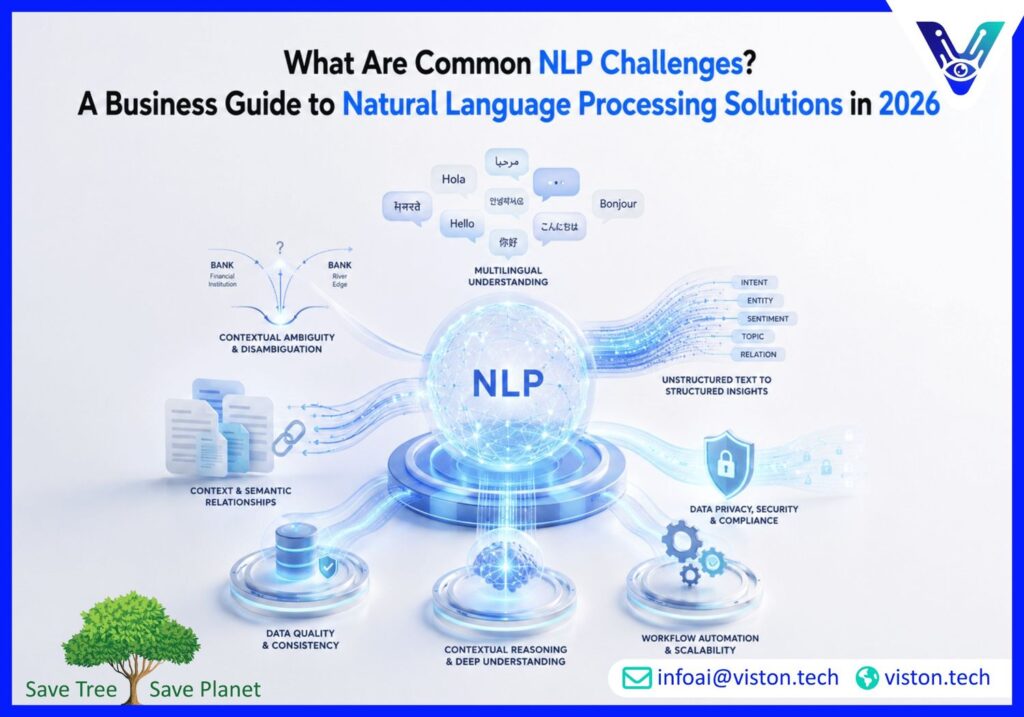
What Are Common NLP Challenges? A Business Guide to Natural Language Processing Solutions in 2026
Natural Language Processing (NLP) has become a core technology for businesses seeking to automate communication, analyze large volumes of text, improve customer experiences, and unlock insights from unstructured data. However, despite significant advancements in artificial intelligence, NLP projects still face several technical and operational challenges. Understanding these challenges helps organizations make informed decisions when investing in Natural Language Processing Solutions and planning successful AI initiatives.
Why NLP Challenges Matter for Businesses
NLP systems are designed to understand, interpret, and generate human language. While this sounds straightforward, human communication is highly complex. Language contains context, ambiguity, emotions, cultural nuances, slang, industry-specific terminology, and constantly evolving expressions.For businesses, NLP challenges directly impact the accuracy, reliability, scalability, and effectiveness of AI-powered applications. Whether implementing chatbots, document processing systems, sentiment analysis tools, or intelligent search platforms, addressing these challenges is critical to achieving meaningful business outcomes.In 2026, organizations increasingly expect NLP solutions to deliver measurable value while maintaining security, compliance, and operational efficiency.
Data Quality and Availability Challenges
One of the most common NLP challenges is obtaining high-quality data for training and optimization.NLP models depend heavily on data quality. Poor, incomplete, inconsistent, or biased datasets can significantly reduce system performance.
Common Data Issues
Incomplete datasets
Inconsistent formatting
Duplicate information
Outdated content
Industry-specific jargon
Limited training samples
Biased datasets
Many organizations discover that their existing business data is fragmented across multiple systems, making it difficult to build effective NLP models. Data preparation often becomes one of the most time-consuming stages of an NLP project.
Why It Matters
Without reliable data, NLP applications may struggle to accurately classify text, recognize user intent, extract information, or generate meaningful responses.
Language Ambiguity and Context Understanding
Human language is inherently ambiguous. The same word or phrase can have different meanings depending on context.For example, a customer asking about a “charge” could be referring to a payment, a battery status, or a service fee.
Key Context Challenges
Multiple meanings of words
Complex sentence structures
Sarcasm and irony
Regional language variations
Context-dependent interpretation
Conversational memory requirements
Although modern AI models have improved significantly, maintaining context across longer conversations remains a challenge for many NLP applications.This is particularly important for customer service automation, virtual assistants, and conversational AI platforms.
Multilingual and Localization Complexity
Businesses operating across multiple regions often require NLP systems that support different languages and cultural contexts.Multilingual NLP introduces additional complexity because languages vary in grammar, sentence structure, vocabulary, and expression.
Common Localization Challenges
Translation accuracy
Regional dialects
Cultural nuances
Industry-specific terminology
Language-specific syntax
Mixed-language communication
Organizations serving international customers frequently need NLP solutions that go beyond direct translation and understand localized intent and communication styles.
Business Impact
Poor localization can lead to misunderstandings, customer frustration, reduced engagement, and inconsistent user experiences across markets.
Security, Privacy, and Compliance Requirements
As NLP systems process increasing amounts of customer and business data, security and compliance have become major concerns.Many NLP applications handle sensitive information, including customer records, support conversations, contracts, healthcare data, financial information, and internal communications.
Key Security Challenges
Data privacy protection
Access control management
Secure data storage
Third-party AI service risks
Data retention policies
Audit and governance requirements
Organizations must ensure that NLP deployments align with industry regulations and internal governance policies while maintaining transparency and accountability.
Why It Matters in 2026
Businesses increasingly expect AI systems to support responsible AI practices, explainability, and robust data governance frameworks alongside technical performance.
How Viston AI Helps Businesses Overcome NLP Challenges
Successfully addressing NLP challenges requires more than deploying advanced language models. Organizations need Natural Language Processing Solutions that combine technical expertise, business understanding, system integration capabilities, and long-term optimization strategies.Viston AI helps businesses implement NLP solutions that address real-world challenges such as language understanding, conversational AI performance, document processing accuracy, multilingual support, workflow automation, and data integration. By focusing on practical business requirements, NLP systems can be designed to align with operational goals rather than functioning as isolated AI tools.Organizations often face difficulties related to fragmented data sources, complex business terminology, customer communication workflows, and evolving compliance expectations. Viston AI supports businesses by connecting NLP capabilities with existing systems, enabling more reliable automation, improved customer interactions, and scalable AI adoption.As Natural Language Processing continues to evolve in 2026, businesses benefit most from solutions that balance innovation, security, scalability, and measurable business outcomes.
Frequently Asked Questions
What is the biggest challenge in NLP?
Language ambiguity and context understanding are among the most significant NLP challenges because human language often contains multiple meanings, implied intent, and complex contextual relationships.
Why is data quality important for NLP?
NLP models rely on data to learn patterns and language structures. Poor-quality data can reduce accuracy, increase bias, and negatively impact system performance.
Can NLP systems support multiple languages?
Yes. Modern NLP solutions can support multilingual environments, but achieving high accuracy across different languages often requires localization, domain-specific training, and continuous optimization.
How do businesses address NLP security concerns?
Organizations typically implement encryption, access controls, governance policies, audit logging, and compliance frameworks to protect sensitive information processed by NLP systems.
Can Viston AI help businesses overcome NLP implementation challenges?
Yes. Viston AI provides Natural Language Processing Solutions that help organizations address language processing challenges, workflow automation requirements, system integration needs, and scalable AI adoption strategies.
Conclusion
Understanding common NLP challenges is essential for businesses planning to invest in Natural Language Processing Solutions. From data quality and language ambiguity to multilingual support and compliance requirements, these challenges can significantly influence project success. Organizations that proactively address these issues are better positioned to improve automation, enhance customer experiences, and generate value from language-driven AI technologies. As NLP adoption continues to expand in 2026, partnering with experienced providers such as Viston AI can help businesses navigate implementation complexities and achieve more reliable, scalable outcomes.