
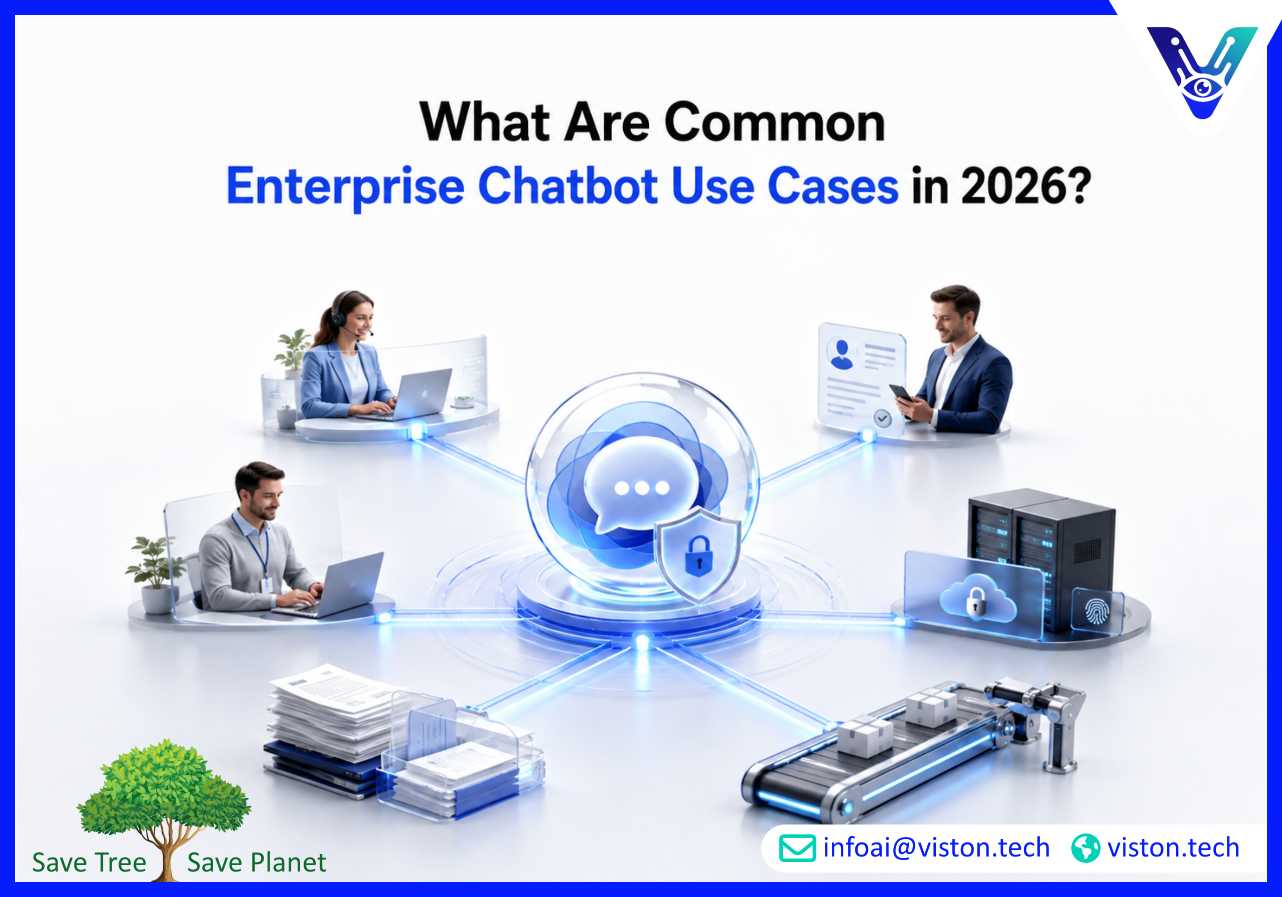
Understanding common enterprise chatbot use cases helps businesses identify where conversational automation can improve service quality, reduce repetitive work, support employees, and connect users with the right systems faster.
Enterprise AI Chatbots are no longer limited to answering basic website questions. In 2026, businesses use them as intelligent digital assistants that support customers, employees, partners, and internal teams across multiple channels. The most valuable chatbot use cases are not chosen because they sound innovative. They are chosen because they solve real operational problems.
For many organizations, the challenge is not whether chatbot technology is available. The challenge is identifying where it can create practical business value without adding risk, confusion, or poor user experience. A chatbot that only provides scripted replies may offer limited help. An enterprise-grade chatbot, however, can understand user intent, retrieve approved information, connect with business systems, trigger workflows, and escalate complex cases to human teams when needed.
Common enterprise chatbot use cases usually fall into a few major categories: customer service, sales support, employee assistance, IT helpdesk automation, knowledge management, workflow automation, onboarding, and operational reporting. Each use case requires different planning, training data, integrations, security controls, and performance metrics.
A strong chatbot strategy begins with use cases that are high-volume, repetitive, measurable, and suitable for automation. These may include order status requests, appointment scheduling, lead qualification, password reset guidance, policy questions, product recommendations, ticket creation, document search, or internal service requests.
The best use cases usually share three characteristics. First, users ask similar questions frequently. Second, the information needed to answer those questions already exists in approved systems or knowledge sources. Third, the business can define a clear successful outcome, such as a resolved support query, a qualified lead, a completed workflow, or a correctly routed ticket.
Customer-facing chatbot use cases are among the most widely adopted because they directly affect response time, service availability, customer satisfaction, and support team workload. Customers expect fast, accurate, and consistent answers across websites, mobile apps, customer portals, messaging platforms, and social channels.
Customer service is one of the most common enterprise chatbot use cases. Chatbots can answer frequently asked questions, provide troubleshooting steps, check account information, explain policies, assist with billing questions, and route unresolved cases to the right support team.
This use case is especially useful for organizations handling large volumes of repetitive inquiries. Instead of requiring agents to answer the same questions repeatedly, the chatbot can resolve routine issues instantly while human agents focus on complex, sensitive, or high-value cases.
For ecommerce, logistics, retail, SaaS, telecom, and service businesses, chatbots can help users check order status, delivery updates, subscription details, invoice information, renewal dates, service availability, and account changes. When integrated with CRM, ERP, ecommerce, or order management systems, the chatbot can provide real-time answers rather than generic instructions.
This improves customer convenience and reduces the need for users to search through emails, portals, or help pages. It also helps support teams lower ticket volume for simple account and transaction-related requests.
Enterprise AI Chatbots can guide users through product selection by asking questions about needs, preferences, budgets, use cases, or technical requirements. This is valuable for businesses with complex offerings, multiple plans, configurable products, or long buyer journeys.
A product guidance chatbot can explain features, compare plan suitability, suggest relevant services, share documentation, and route serious buyers to sales teams. The goal is not to replace expert consultation, but to help users move from confusion to a clearer next step.
Many businesses use chatbots to schedule demos, consultations, service visits, healthcare appointments, recruitment interviews, training sessions, or support calls. The chatbot can collect required details, check availability, confirm the appointment, send reminders, and update calendar or CRM systems.
This use case reduces back-and-forth communication and makes booking easier for both customers and internal teams. It is especially useful when users need quick action outside normal business hours.
Enterprise chatbot use cases are not limited to support. Sales and marketing teams increasingly use AI chatbots to engage website visitors, qualify leads, capture buyer intent, support campaigns, and improve conversion paths. When deployed correctly, a chatbot can become a useful front-line assistant for revenue teams.
A chatbot can greet visitors, understand what they are looking for, ask qualification questions, collect contact details, identify urgency, and determine whether the lead should go to sales, support, or a self-service resource. This is especially valuable for B2B companies where buyers may research services before speaking with a representative.
Instead of using static forms, businesses can use conversational lead qualification to capture richer context. The chatbot can ask about company size, project goals, budget range, timeline, current challenges, preferred solution type, and decision stage. When connected to CRM, the chatbot can create or update lead records automatically.
Enterprise AI Chatbots can help users book product demos or consultations based on their needs. The chatbot can identify whether the visitor is a decision-maker, partner, existing customer, job applicant, or support user. It can then route the person to the correct sales team, region, product specialist, or account owner.
This use case improves speed-to-lead and reduces missed opportunities. It also helps sales teams focus on conversations that already include useful context rather than starting from a blank form submission.
Marketing teams can use chatbots on campaign landing pages to answer questions, explain offers, recommend resources, share case-study-style content where approved, and help users take the next action. The chatbot can support webinars, product launches, event registrations, downloadable resources, and account-based marketing campaigns.
For campaigns with technical or service-led offerings, a chatbot can help visitors understand whether the solution is relevant to their needs before they commit to a call or submit detailed information.
Chatbots can support renewal journeys by reminding users about plan details, answering contract or subscription questions, explaining upgrade options, collecting feedback, and routing cancellation-risk conversations to customer success teams. This use case works best when the chatbot has access to reliable customer data and clear escalation rules.
The chatbot should not aggressively push offers or hide cancellation paths. It should help users understand options clearly and bring in human support when the situation requires judgment, negotiation, or account-specific context.
Many of the strongest enterprise chatbot use cases happen inside the organization. Employees often lose time searching for policies, submitting service requests, navigating tools, or asking repetitive questions across HR, IT, finance, operations, and administration. Internal AI chatbots can reduce this friction by giving employees a conversational interface to business systems and knowledge sources.
HR chatbots can answer questions about leave policies, benefits, onboarding steps, payroll timelines, internal procedures, training resources, company policies, and employee documentation. They can guide employees through request processes and escalate sensitive matters to HR professionals.
This use case is useful for growing companies, distributed teams, and enterprises with multiple departments or regions. It helps employees get consistent answers while reducing repetitive work for HR teams.
IT support is another common enterprise chatbot use case. Chatbots can help employees troubleshoot basic issues, reset passwords through approved workflows, request software access, report incidents, check system status, submit tickets, and find technical documentation.
When integrated with IT service management tools, the chatbot can create tickets, categorize issues, assign priority, and provide agents with conversation history. This reduces manual ticket intake and helps IT teams respond faster.
Enterprise knowledge is often spread across documents, portals, wikis, shared drives, CRM notes, product manuals, and internal systems. A chatbot can help employees find relevant information by asking questions in natural language instead of searching manually across multiple repositories.
This use case is valuable for sales enablement, customer support, product teams, legal operations, compliance teams, and technical departments. The chatbot should retrieve answers from approved sources and show clear boundaries when information is unavailable or restricted.
Enterprise AI Chatbots can support workflow automation by helping users complete routine tasks. Examples include submitting expense requests, requesting approvals, creating support tickets, updating CRM fields, checking inventory, starting procurement requests, generating internal summaries, or triggering follow-up actions.
This is where enterprise chatbots become more than question-answering tools. They act as conversational access points for business processes. However, workflow automation requires strong integration design, permission controls, audit trails, and clear fallback handling.
Not every chatbot idea should become a live deployment. Businesses should evaluate use cases based on user need, operational value, automation readiness, data availability, risk level, and integration complexity. A focused chatbot with a few high-value use cases is usually more effective than a broad chatbot that tries to handle everything from day one.
The best first use cases are usually repetitive and easy to measure. These include FAQs, lead capture, ticket intake, order tracking, appointment booking, HR policy questions, and IT support requests. These use cases provide clear performance signals such as resolution rate, completion rate, escalation rate, user satisfaction, and time saved.
A chatbot can only be reliable if it has access to accurate information. Before selecting a use case, businesses should confirm whether approved content, workflows, policies, system data, and escalation rules are available. If information is outdated, duplicated, or owned by different teams, the chatbot may produce inconsistent answers.
Enterprise chatbot use cases often require access to CRM, ERP, helpdesk, HR, ecommerce, analytics, or knowledge management systems. These integrations must be planned carefully. Businesses should define what data the chatbot can access, what actions it can perform, who can use each function, and how activity will be logged.
Security is especially important when chatbots handle customer records, employee data, financial information, healthcare information, contractual details, or internal policies. Role-based access, authentication, encryption, data minimization, and auditability should be considered early.
A successful enterprise chatbot does not need to solve every issue alone. It should know when to escalate. Complex complaints, legal questions, sensitive HR matters, high-value sales conversations, technical failures, and account-specific exceptions often require human expertise.
The chatbot should collect context, summarize the issue, route the request correctly, and make the handoff smooth. This improves user experience and helps human teams work more efficiently.
Viston AI is relevant to common enterprise chatbot use cases because its Enterprise AI Chatbots service focuses on building conversational AI solutions for business environments where automation, integration, scalability, and reliable user experience matter. Enterprise chatbot projects require more than a visible chat interface. They require intent design, knowledge integration, workflow planning, system connectivity, testing, monitoring, and ongoing optimization.
For businesses exploring use cases such as customer service automation, sales qualification, internal knowledge search, HR assistance, IT helpdesk support, or workflow automation, Viston AI’s capabilities align with the practical requirements of enterprise chatbot delivery. Its AI service portfolio includes enterprise AI chatbots, generative AI solutions, NLP and text analysis, AI automation and workflow bots, AI chatbot integration, MLOps and model monitoring, multilingual support, and custom AI solution development.
This makes Viston AI suitable for organizations that want chatbot use cases to connect with real business operations rather than remain limited to basic scripted responses. A well-designed implementation can help businesses reduce repetitive manual work, support faster user service, improve internal access to information, and create more consistent digital interactions across departments and channels.
The most common enterprise chatbot use cases include customer support automation, lead qualification, order tracking, appointment booking, HR self-service, IT helpdesk support, internal knowledge search, workflow automation, and employee onboarding.
A business should usually start with a high-volume, repetitive, low-risk use case that has clear data sources and measurable outcomes. Examples include FAQs, ticket intake, order status requests, demo booking, or HR policy questions.
Yes. Enterprise AI Chatbots can be designed for external users such as customers and prospects, as well as internal users such as employees, support teams, sales teams, HR teams, and IT departments.
For advanced use cases, integration is usually essential. Chatbots often need to connect with CRM, ERP, helpdesk, HR, ecommerce, analytics, calendar, or knowledge management systems to retrieve data, update records, and complete workflows.
Some use cases are common across industries, such as support automation and employee self-service. Others are industry-specific, such as appointment assistance in healthcare, policy servicing in insurance, inventory checks in manufacturing, or order tracking in ecommerce.
Yes. Viston AI’s Enterprise AI Chatbots service is aligned with use case planning, chatbot development, system integration, workflow automation, and ongoing optimization for businesses that want practical conversational AI solutions.
Common enterprise chatbot use cases show how Enterprise AI Chatbots can support customers, employees, sales teams, support teams, and operational workflows in practical ways. The strongest use cases are tied to real business needs: faster answers, reduced repetitive work, better lead handling, smoother internal support, and more consistent access to information. In 2026, businesses should choose chatbot use cases based on value, data readiness, integration requirements, security needs, and measurable outcomes. Viston AI offers relevant capabilities for organizations that want enterprise chatbot solutions designed around practical use cases, scalable automation, and business-focused implementation.
