What an AI Workflow Automation Agency Actually Does — and Why It Matters in 2026
Introduction
Manual processes are costing businesses more than they realise. In 2026, the gap between companies running intelligent automation and those still dependent on repetitive human-handled workflows is widening fast. For businesses serious about operational efficiency, understanding what an AI workflow automation agency delivers — and how to choose the right one — has become a genuine strategic priority.
What AI Workflow Automation Actually Means for Businesses
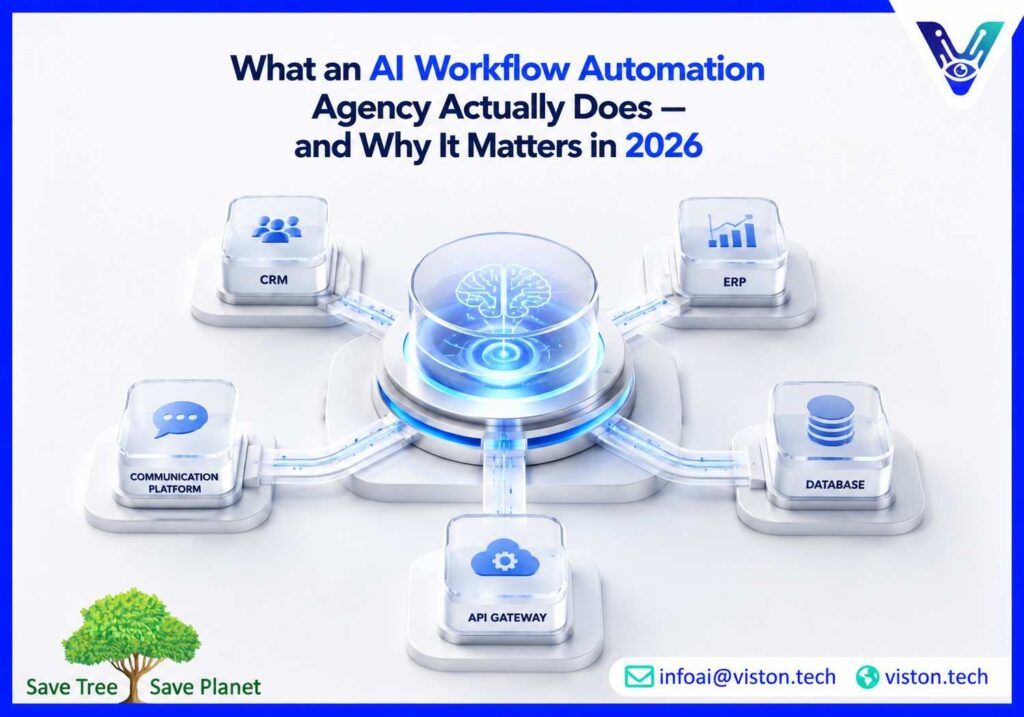
AI workflow automation goes beyond simple task scheduling or basic rule-based scripts. At its core, it involves deploying intelligent systems — typically in the form of AI-powered bots and integrated pipelines — that can handle multi-step business processes with minimal human intervention.These systems learn from data, adapt to changing conditions, and integrate across the tools your teams already use: CRMs, ERPs, communication platforms, databases, and third-party APIs. The result is not just faster execution of individual tasks but a fundamentally different way of operating — one where human effort is redirected toward decisions, creativity, and relationship-building rather than data entry, status updates, or manual approvals.For operations managers and technology leaders, this represents a meaningful shift in how capacity is allocated. For finance and procurement teams, it translates directly into measurable cost reduction and process consistency. For marketing and product teams, automation removes the friction between strategy and execution.
Why Businesses Are Turning to Specialist Agencies in 2026
The demand for AI automation has grown sharply, but so has the complexity of delivering it well. Many organisations have attempted internal automation projects, only to find them limited in scope, poorly integrated, or too dependent on technical resources they cannot sustain.A specialist AI workflow automation agency brings something different: the architecture knowledge, platform expertise, and delivery experience to build automation that actually holds up in production. This is not about handing a business a pre-built tool. It is about mapping existing workflows, identifying the highest-impact automation opportunities, building the right solution for the environment, and ensuring it integrates cleanly with live systems.In 2026, buyers are increasingly sophisticated about this. They are not looking for demos — they are looking for agencies that can handle the full lifecycle: discovery, build, testing, deployment, and ongoing optimisation. They want to know that the bots and pipelines they invest in will continue to perform as processes evolve, systems change, and volumes scale.
The Business Problems That Drive Automation Investment
Understanding what motivates businesses to engage an AI workflow automation agency is useful when evaluating whether automation is the right next step.The most common triggers include:
Process bottlenecks caused by volume. When a team’s manual workload grows faster than headcount can scale, errors increase and cycle times lengthen. Automation addresses this without adding overhead.
Inconsistency in execution. Where processes depend on individual judgement or memory, outcomes vary. Workflow bots apply logic consistently, reducing variation and improving output quality.
Integration gaps between systems. Many businesses run multiple platforms that do not communicate naturally. AI automation can act as the connective layer — pulling data, triggering actions, and synchronising records across systems that would otherwise require manual bridging.
Reporting and visibility delays. When data must be manually collated before decisions can be made, leadership operates on stale information. Automated pipelines can surface accurate data in real time, improving response speed and strategic clarity.
Compliance and audit requirements. In regulated environments, automation provides a consistent, logged execution trail that manual processes cannot reliably replicate.
What a Credible AI Automation Agency Delivers
The deliverables from a genuine AI workflow automation engagement should go beyond the bot itself. Businesses evaluating agencies should expect a clearly defined scope of work that includes process mapping and gap analysis, workflow design and logic documentation, bot or pipeline development, system integration, testing across edge cases, deployment support, and post-launch monitoring.Security and data handling deserve particular attention. Any automation that touches customer data, financial records, or operational systems needs to be built with appropriate access controls, encryption standards, and data residency considerations. In 2026, enterprise buyers increasingly include data governance requirements as part of their vendor evaluation.Scalability is another practical concern. A bot that works at current volumes needs to be designed to handle growth without requiring a complete rebuild. Agencies that deliver with long-term maintainability in mind save their clients significant rework costs downstream.The right agency will also be transparent about what automation can and cannot do. Not every process benefits from automation immediately. A credible partner will identify where value is genuinely highest and sequence the work accordingly rather than automating for its own sake.
How Viston AI Approaches AI Automation and Workflow Bot Delivery
Viston AI specialises in AI automation and workflow bots, working with businesses that need practical, production-ready automation rather than experimental prototypes.The core of Viston AI’s service is building intelligent workflow systems that connect to the tools and platforms businesses already depend on. This includes automation across lead management, client onboarding, internal approvals, data synchronisation, customer communications, reporting pipelines, and operational task handling — areas where manual effort is high and the case for automation is clear.What distinguishes this approach is the emphasis on business fit. Viston AI begins with a structured discovery process that identifies which workflows carry the most cost or risk and where automation investment will generate the strongest return. From there, builds are designed for real operational environments — not sanitised demos — with attention to integration reliability, exception handling, and long-term maintainability.For businesses that have struggled to move automation projects forward internally, or that have worked with generalist developers who lacked the domain knowledge to build properly, Viston AI offers a focused alternative. The team works across common enterprise platforms and communication tools, bringing the technical depth and automation architecture experience needed to deliver bots and pipelines that perform consistently at scale.
Evaluating an AI Workflow Automation Agency: What to Look For
Choosing the right partner for automation work is a decision that affects operational performance for years. The following evaluation criteria reflect what experienced buyers consider before committing to an engagement.
Demonstrated automation experience, not just technology familiarity. Many agencies know how to use automation platforms. Fewer know how to architect a process-driven solution that survives contact with real operational complexity. Ask to understand how they approach process mapping and exception logic, not just which tools they use.
Integration depth. The value of automation is almost always realised at the point of integration. An agency that can only automate within a single platform is limited. Look for proven experience connecting across the specific systems in your environment.
Post-deployment support and iteration. Automation is not a set-and-forget exercise. Processes evolve, volumes change, and edge cases emerge after launch. Understand what the agency offers after go-live before committing to a build.
Commercial transparency. Be cautious of vague pricing or scope creep-prone engagement structures. A strong agency will clearly define what is being built, how it will be tested, and what the ongoing support relationship looks like.
Alignment on business outcomes. Automation that does not connect to measurable business improvement is a cost, not an investment. The agency you choose should be able to articulate expected outcomes in operational terms — reduced handling time, improved accuracy rates, faster cycle times — not just technical deliverables.
Frequently Asked Questions
What types of processes are most suited to AI workflow automation?
Processes that are repetitive, rule-driven, high-volume, or dependent on data from multiple systems are typically strong candidates. Common examples include lead routing, invoice processing, customer onboarding, status notifications, data enrichment, and report generation. Processes with frequent exceptions or high judgement requirements may need phased automation or human-in-the-loop design.
How long does it take to deploy workflow automation bots?
Timeline depends on process complexity and integration requirements. Simple, well-defined workflows with clean data sources can be live within a few weeks. Multi-system integrations or processes with significant exception logic typically require more thorough discovery and testing, extending timelines accordingly. Any agency that quotes a fixed timeline without a discovery phase should be treated with caution.
What is the difference between RPA and AI workflow automation?
Traditional robotic process automation (RPA) replicates human interface actions and tends to be brittle in changing environments. AI workflow automation uses intelligent decision logic, natural language understanding, and adaptive models to handle more complex, variable, or judgement-adjacent processes. In practice, many modern automation builds combine elements of both, selecting the right approach for each workflow segment.
How does Viston AI handle integration with existing business platforms?
Viston AI builds automation that connects to the platforms businesses already use — including CRMs, ERPs, communication tools, and databases — using APIs, webhooks, and native integrations. The approach prioritises clean, maintainable integration architecture rather than surface-level connections that require constant maintenance.
What should a business prepare before engaging an AI automation agency?
A clear picture of the processes you want to automate, the systems involved, the volume and frequency of transactions, and the outcomes you are trying to achieve. The more specific you can be about current pain points and desired operational changes, the more effectively an agency can scope and price the work.
Is AI workflow automation suitable for small and mid-sized businesses, or only for large enterprises?
Automation is viable and valuable at a range of business sizes. The key is selecting the right scope. Mid-sized businesses often see faster returns than large enterprises because their processes are more contained and the speed from build to deployment is shorter. The right agency will design solutions appropriate to your scale rather than applying an enterprise framework to a smaller operation.
Conclusion
AI workflow automation is no longer a capability reserved for large enterprises with in-house technology teams. In 2026, businesses of all sizes are recognising the operational and competitive value of deploying intelligent bots and automated pipelines across their core processes. The challenge is not whether automation is worth pursuing — it is finding the right partner to build it properly.A specialist AI workflow automation agency brings the architecture depth, integration experience, and delivery rigour that generalist developers cannot replicate. For businesses ready to move beyond manual bottlenecks, Viston AI offers a focused service built around AI automation and workflow bots — designed to deliver real operational outcomes rather than technology for its own sake.