What AI Transformation Consulting Actually Delivers — And Why AI Agents Are at the Centre of It in 2026
Introduction
AI transformation consulting has moved well beyond strategy decks and proof-of-concept presentations. In 2026, business leaders expect a clear line between investment and outcome — and that line runs directly through intelligent agent systems built to operate inside real workflows, real infrastructure, and real business constraints.
The Gap Between AI Strategy and Operational Reality
Most organisations that have explored AI in recent years share a familiar story. The strategy session goes well. The roadmap looks compelling. The pilot shows promise. Then the results stall somewhere between the proof of concept and production.This is not a technology problem. It is an execution and architecture problem. AI tools are widely available. What remains genuinely scarce is the experience to deploy them in ways that integrate cleanly with enterprise systems, scale across departments, maintain governance standards, and deliver consistent ROI — not just in a controlled test environment, but under the pressures of daily business operations.This is precisely where AI transformation consulting earns its commercial value. A credible consulting engagement does not stop at identifying where AI could theoretically help. It defines precisely which processes are ready for agentic automation, what the integration requirements look like, which orchestration architecture best suits the organisation’s existing stack, and what governance and monitoring frameworks need to be in place before anything goes live.Businesses that skip this stage often deploy AI in fragmented ways — disconnected tools producing disconnected outputs with no coherent operational layer connecting them. The cost of rebuilding that architecture later is considerably higher than designing it correctly from the outset.
Why AI Agent Development Has Become the Core Deliverable
When decision-makers talk about AI transformation today, they are increasingly talking about agents — not standalone models, not basic automation, and not chatbots that answer FAQ-level queries.AI agents are systems capable of autonomous reasoning, multi-step task execution, dynamic API interaction, and decision-making across defined operational boundaries. A well-built agent does not simply respond to inputs; it acts, retrieves, evaluates, and executes within connected systems. At the more sophisticated end, multi-agent architectures allow individual agents to coordinate with each other — one agent handling data retrieval, another processing and validating that data, a third triggering downstream actions across CRM, ERP, or supply chain platforms.The business case is not abstract. A customer service agent that resolves tier-one inquiries across chat, email, and voice without human escalation compresses resolution times and reallocates human capacity to higher-judgement work. A procurement agent that monitors supplier data, flags anomalies, and initiates approval workflows removes manual overhead from a process that has historically been slow, error-prone, and dependent on individual attention. A financial services agent that performs real-time risk scoring, aggregates data across internal systems, and generates compliance-ready summaries replaces hours of analyst time with a response measured in seconds.These are not aspirational outcomes. They are production-level deployments that organisations with serious implementation partners are operating right now.
What a Credible AI Transformation Engagement Looks Like
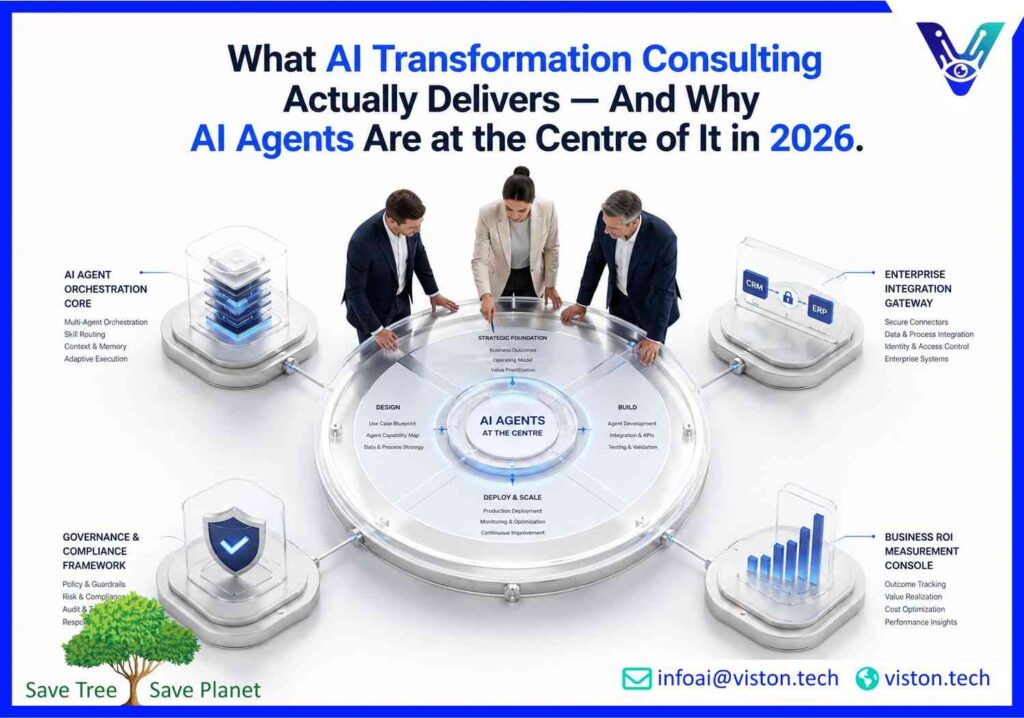
Not every engagement billed as AI transformation consulting delivers equivalent depth. Organisations evaluating providers should expect and demand several things before committing.Readiness assessment before architecture. A serious provider conducts an honest evaluation of the organisation’s data infrastructure, integration environment, workflow maturity, and team readiness before proposing solutions. Jumping to agent design without understanding what systems the agents need to connect with — and what quality of data they will be working from — is a common source of failed deployments.Use case identification grounded in business impact. The highest-value AI applications are rarely the most technically interesting. A methodical identification process examines operational friction points, decision bottlenecks, high-volume repetitive processes, and handoff failures — then prioritises based on implementation feasibility and measurable business value.Architecture designed for the production environment. Building for scale requires decisions about LLM selection, orchestration frameworks, retrieval-augmented generation where relevant, API design, and security architecture to be made deliberately — not defaulted to whatever is most familiar to the development team. This includes choices around agent memory, context management, fallback protocols, and human escalation design.Integration depth and system connectivity. An agent operating in isolation has limited value. The real leverage comes when agents connect to the systems the business already relies on — Salesforce, SAP, Microsoft Dynamics, internal data warehouses, communication platforms, and industry-specific tools. Integration quality often determines whether a deployment becomes embedded in daily operations or quietly abandoned.Deployment, monitoring, and ongoing optimisation. A responsible engagement does not end at launch. Agent performance degrades when the underlying data, processes, or business context shifts. Monitoring frameworks that detect model drift, output anomalies, and performance degradation — and services that act on those signals — are a meaningful differentiator between providers.
The Sectors Seeing the Clearest Returns
Across industries, certain categories of AI agent deployment are consistently producing measurable outcomes in 2026.In retail and e-commerce, multi-agent systems are handling customer service at scale, managing inventory intelligence, personalising recommendations in real time, and coordinating returns and fulfilment workflows across unified commerce platforms. Organisations that have deployed these architectures report significant reductions in average resolution time and escalation rates.In financial services, agents are accelerating credit and risk assessment, automating regulatory reporting processes, monitoring transactions for fraud signals, and generating compliant documentation across lending, insurance, and wealth management functions.In healthcare, AI agents are supporting clinical workflow automation, prior authorisation processing, patient communication, and diagnostic data aggregation — operating within the strict governance and data privacy frameworks the sector demands.In manufacturing and logistics, predictive analytics agents combined with operational workflow bots are reducing unplanned downtime, optimising procurement cycles, and improving demand forecasting accuracy across global supply chains.Across all these contexts, the common thread is not the technology itself. It is the quality of the consulting and engineering work that translated a business problem into a deployable, integrated, and governable solution.
How Viston AI Approaches AI Agent Development and Deployment
Viston AI operates as an AI transformation consultancy with a primary specialisation in AI agent development and deployment. Its service delivery covers the full journey from strategic assessment to production-grade implementation.The engagement model starts with AI readiness assessment and strategy development — establishing where agent-led automation creates genuine business value and where the integration and data foundations exist to support it. From there, Viston’s teams design and build custom AI agent solutions that range from task-level agents handling defined, repeatable processes to fully autonomous systems capable of managing complex, multi-step workflows with minimal human intervention.Multi-agent orchestration is a core capability — coordinating specialist agents across departments or systems so that connected workflows execute with the coherence of a unified operational layer rather than a set of isolated tools. Integration services extend these agents into the enterprise platforms organisations already use, covering CRMs, ERPs, e-commerce infrastructure, inventory management systems, and communication channels.Viston AI’s agentic workflow design emphasises practical deployment outcomes: agents that work reliably in production, connect cleanly to existing architecture, and deliver measurable business impact. Its accelerated delivery methodology is designed to move organisations from proof of concept to deployment efficiently — reducing the extended timelines that have made many enterprise AI initiatives commercially frustrating.For organisations at any stage of their AI transformation journey, Viston AI’s combination of strategic consulting depth and hands-on engineering capability positions it as a practical partner for turning AI investment into operational results.
Frequently Asked Questions
What is AI transformation consulting, and how does it differ from general IT consulting?
AI transformation consulting focuses specifically on identifying where artificial intelligence — particularly intelligent agent systems and automation — can be applied to drive measurable business outcomes. Unlike general IT consulting, it requires deep expertise in AI architecture, large language model selection, agentic workflow design, integration engineering, and change management. The goal is not technology implementation alone but a sustainable operating model that embeds AI into core business processes.
What kinds of processes are best suited to AI agent deployment?
High-volume, rule-governed processes with clear inputs and defined outputs are typically strong candidates: customer service and support, procurement and approval workflows, financial reporting, data validation, lead qualification, and compliance documentation. Processes that involve multi-system data retrieval, exception handling, or repetitive decision-making at scale are particularly well suited to agentic automation.
How long does a typical AI agent deployment take?
Timelines vary based on integration complexity, data readiness, and the scope of the agent architecture. A well-structured engagement can move from initial assessment to a working proof of concept within a few weeks, with production deployment typically ranging from two to four months. Organisations with fragmented data infrastructure or complex legacy systems should expect integration work to be the primary timeline factor.
What governance and security considerations apply to AI agent systems?
Agents operating within enterprise environments must be designed with data privacy, access controls, audit logging, and human oversight mechanisms built in from the start. This includes defining escalation thresholds — points at which the agent passes a decision to a human — and deploying monitoring systems that detect performance drift or unexpected outputs. Governance requirements in regulated industries such as financial services and healthcare introduce additional compliance considerations that should be embedded into the architecture, not added retrospectively.
How does Viston AI support organisations after deployment?
Viston AI’s engagement model includes ongoing MLOps and model monitoring services, covering performance tracking, drift detection, and optimisation as business conditions and data evolve. This continuous oversight function is important for maintaining agent reliability and ensuring that the ROI case that justified the initial investment continues to hold in production.
What should businesses look for when evaluating an AI transformation consulting partner?
Look for demonstrated experience in agentic AI architecture, not just general AI familiarity. Verify the provider’s ability to handle enterprise system integrations, its governance and monitoring capabilities, and its track record of moving deployments from pilot to production. Providers who begin with readiness assessment and use case prioritisation — rather than leading with a preferred technology — tend to deliver more sustainable outcomes.
Conclusion
AI transformation consulting in 2026 is defined by its ability to deliver working, integrated, production-grade agent systems — not strategy documents or sandboxed prototypes. Businesses that approach this with the right consulting partner will find that AI agents embedded in real workflows, connected to existing enterprise infrastructure, and governed with appropriate oversight frameworks can fundamentally change how operational capacity is deployed. For organisations ready to move from intention to execution, the quality of the implementation partner matters as much as the technology itself. Viston AI’s specialisation in AI agent development and deployment makes it a relevant partner for businesses serious about making that transition count.