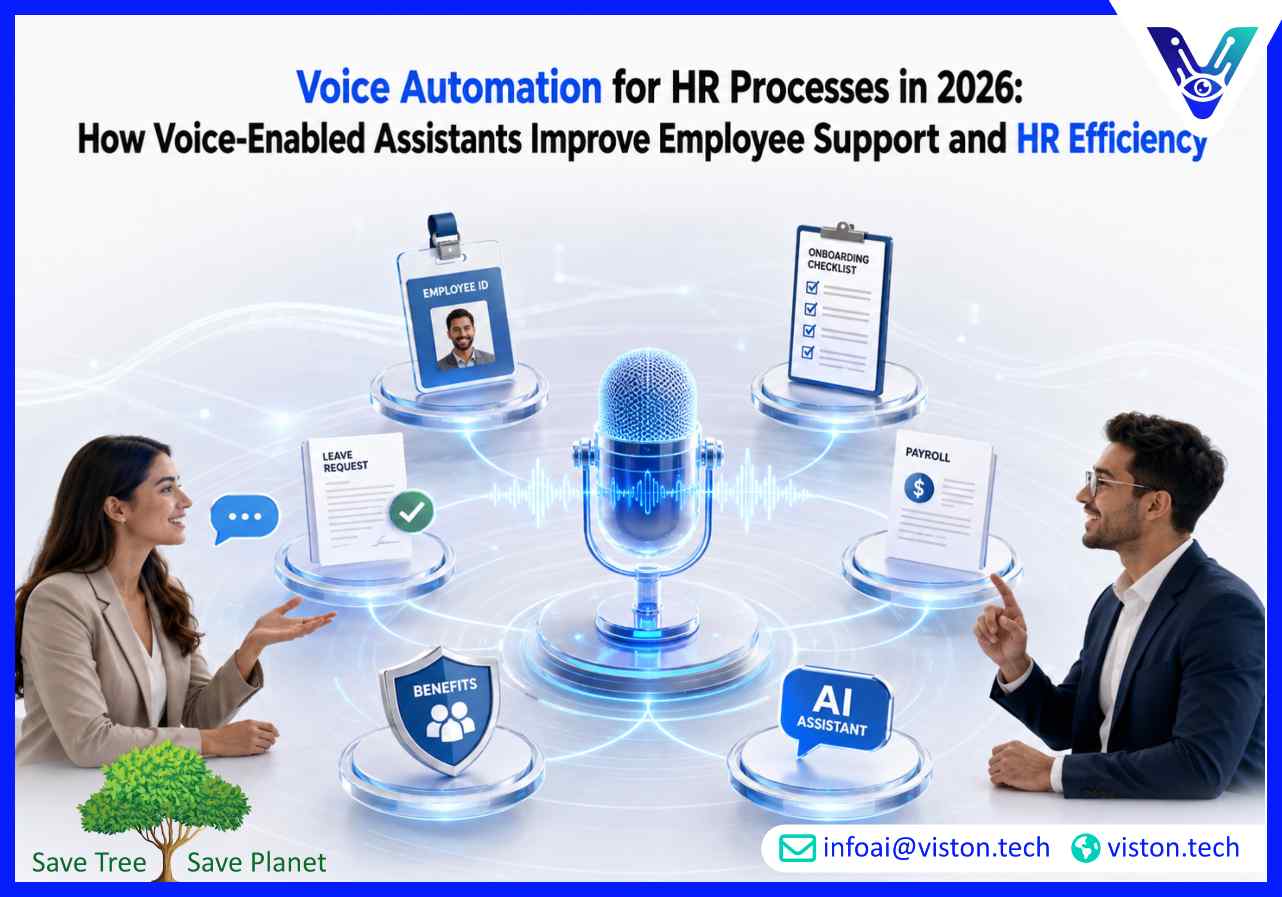
Voice Automation for HR Processes in 2026: How Voice-Enabled Assistants Improve Employee Support and HR Efficiency
Voice automation for HR processes is becoming a practical way for organizations to reduce repetitive HR workload, improve employee self-service, and make routine workforce support easier to access through secure, conversational voice interactions.
What Voice Automation for HR Processes Means
Voice automation for HR processes uses voice-enabled assistants to help employees and HR teams complete routine tasks through spoken conversations. Instead of searching through portals, sending emails, or waiting for a response from HR, employees can ask a voice assistant questions, request information, or trigger approved workflows.In practice, this can include asking about leave balances, benefits eligibility, onboarding tasks, payroll timelines, HR policies, training requirements, expense procedures, internal documents, or case status. More advanced systems can connect with HRIS, payroll, learning management systems, ticketing platforms, identity tools, and knowledge bases to retrieve information or initiate actions.A strong HR voice assistant is not just a speech layer on top of an HR system. It combines automatic speech recognition, natural language understanding, dialogue management, text-to-speech, workflow automation, security controls, and system integration. The assistant must understand employee intent, confirm sensitive requests, protect personal data, and escalate to HR when the situation requires human judgment.
How voice automation differs from basic HR chatbots
HR chatbots are useful for text-based self-service, but voice automation adds hands-free access and more natural interaction. This is valuable for employees who are mobile, working in the field, operating in warehouse or manufacturing environments, commuting, multitasking, or using accessibility-friendly interfaces.Voice-enabled assistants can support spoken questions, multi-turn conversations, clarifying prompts, guided forms, and real-time workflow updates. For HR teams, the value comes from reducing repetitive administrative demand while still giving employees a simple way to get help.
Why HR Voice Automation Matters in 2026
HR teams in 2026 are expected to deliver fast, consistent, secure, and employee-friendly service while managing increasingly complex systems and policies. Employees want quick answers, managers need reliable workforce information, and HR leaders need scalable operations that do not depend on manual follow-ups for every routine request.AI-powered HR automation is now moving beyond simple ticket deflection. Current HR tools increasingly focus on employee self-service, onboarding support, payroll guidance, compliance workflows, and case management automation. Industry sources also highlight the importance of role-based access, audit trails, and compliance controls when HR teams use AI-powered service delivery systems.Voice automation is especially useful because HR support often starts with simple but frequent questions. Employees may ask, “How do I apply for parental leave?”, “Where is my payslip?”, “How many PTO days do I have?”, “What documents do I need for onboarding?”, or “Can I update my emergency contact?” These questions may not require a senior HR specialist, but they still consume time when handled manually.
Employee expectations have changed
Modern employees expect workplace technology to feel as responsive as consumer technology. They want HR support that is available outside standard office hours, works across locations, and does not require them to understand complex system navigation. A voice assistant can make HR processes more approachable by allowing employees to ask questions naturally and receive guided support.
HR teams need better capacity management
HR departments often handle repeated questions across onboarding, payroll, benefits, leave, policies, and internal processes. When these questions arrive through email, chat, calls, and service desk tickets, HR teams can become reactive. Voice automation helps absorb repetitive demand, route requests correctly, and preserve human HR capacity for sensitive cases, employee relations, workforce planning, and strategic initiatives.
Responsible AI is now a core requirement
HR data is sensitive. Voice automation in HR must be designed with privacy, transparency, access control, consent, and human oversight in mind. The EU AI Act treats many employment-related AI systems as high-risk when they affect recruitment, worker management, performance evaluation, or employment-related decisions.This does not mean every HR voice assistant is automatically high-risk, especially when it performs narrow procedural tasks such as answering policy questions or guiding employees to approved forms. However, businesses should still apply careful governance, especially when automation touches employee records, eligibility, payroll, benefits, or case outcomes.
High-Value HR Processes That Can Be Automated with Voice Assistants
The best use cases for voice automation are repetitive, rules-based, well-documented, and low-risk when designed with proper guardrails. Businesses should start with HR processes where employees frequently need guidance and where HR teams spend significant time answering similar questions.
Employee self-service and policy support
Voice assistants can answer common HR policy questions using approved knowledge sources. Employees can ask about leave policies, work-from-home rules, expense guidelines, holiday calendars, benefits enrollment, probation periods, travel procedures, or internal request steps.The assistant should retrieve answers from controlled HR content rather than generating unsupported responses. It should also clarify when a policy depends on location, contract type, tenure, role, or local employment law. When a question is sensitive or ambiguous, it should route the employee to HR with the conversation context.
Onboarding and new hire support
Onboarding is one of the strongest HR voice automation use cases. New employees often need help with documents, system access, payroll setup, benefits registration, training modules, company policies, and first-week tasks. IBM notes that AI-powered chatbots can guide new employees through onboarding, answer questions, provide information, and send reminders about key documents.A voice-enabled onboarding assistant can make the experience more conversational. It can remind new hires about missing documents, explain next steps, answer practical questions, and guide them to the right portal or form. For HR teams, this reduces repetitive onboarding support while creating a more consistent new hire experience.
Leave, attendance, and PTO requests
Employees often need quick answers about leave balances, eligibility, approval status, holiday schedules, and absence policies. A voice assistant integrated with HRIS or workforce management systems can help employees check balances, understand policy rules, start a leave request, or confirm whether manager approval is required.For this use case, confirmation steps are important. The assistant should repeat key details before submitting a request, confirm the dates, and explain what happens next. It should also avoid making final eligibility decisions unless the business has defined clear rules and human review requirements.
Payroll and benefits guidance
Payroll and benefits questions are frequent, sensitive, and often urgent. A voice assistant can help employees understand pay dates, payslip access, tax document location, deduction categories, benefits enrollment windows, insurance documents, and dependent update procedures.Because this area involves personal and financial data, the assistant should use secure authentication, role-based access, and limited disclosure. It should avoid reading sensitive details aloud unless the user is verified and the interaction context is appropriate.
HR case intake and routing
Voice automation can improve HR case intake by capturing structured information from employees. For example, an assistant can collect the issue type, urgency, employee location, department, related documents, and preferred contact method before creating a case in a service desk or HR case management platform.This helps HR teams receive cleaner requests and reduces back-and-forth clarification. It also improves reporting because cases can be categorized consistently from the beginning.
Implementation Considerations for Reliable HR Voice Automation
Voice automation for HR processes should be implemented carefully because HR interactions often involve personal data, workplace rights, sensitive employee concerns, and business-critical records. A successful deployment depends on process design, data governance, integrations, testing, and continuous improvement.
Start with the right HR workflows
Not every HR process should be automated first. Good early use cases include policy FAQs, onboarding reminders, leave guidance, document navigation, benefits information, training reminders, and case intake. More sensitive areas such as performance management, disciplinary issues, complaints, compensation decisions, or employment status changes should include strong human oversight or remain human-led.
Use approved HR knowledge sources
The assistant should rely on approved HR policies, employee handbooks, HRIS data, benefits documents, payroll rules, and internal SOPs. Outdated or conflicting content can create employee confusion and compliance risk. HR teams should assign content owners and create a review cycle for policies, workflows, and voice responses.
Integrate with HR systems securely
For meaningful automation, a voice assistant often needs to connect with systems such as Workday, SAP SuccessFactors, Oracle HCM, BambooHR, ServiceNow, Microsoft Dynamics, payroll platforms, identity tools, and learning systems. Viston AI’s voice assistant service describes enterprise integration with systems including Salesforce, SAP, Microsoft Dynamics, ServiceNow, Epic, Workday, and custom APIs through connectors and real-time synchronization.Integration allows the assistant to retrieve employee-specific data, create tickets, update records, trigger workflows, and provide status updates. However, every integration should include authentication, authorization, logging, encryption, and data minimization.
Design for privacy, consent, and auditability
HR voice interactions may include personally identifiable information, payroll questions, health-related benefits details, or employee relations concerns. Businesses should define what can be spoken aloud, what must be masked, what requires authentication, and when the assistant must stop and escalate.Voice recordings, transcripts, and analytics should be governed by clear retention rules. If voice data is used for improvement or model evaluation, companies should apply consent management, anonymization where appropriate, and strict access controls.
Measure performance beyond call reduction
The goal is not simply to reduce HR tickets. A good voice automation program should also improve employee experience, answer accuracy, case routing quality, task completion, and HR productivity. Useful KPIs include self-service completion rate, containment rate, escalation quality, average response time, employee satisfaction, policy answer accuracy, workflow success rate, and system update accuracy.
How Viston AI Supports Voice Automation for HR Processes
Viston AI is relevant to voice automation for HR processes because its Voice-Enabled Assistants service focuses on enterprise-grade conversational AI that combines speech recognition, natural language processing, LLMOps infrastructure, multilingual capabilities, analytics, system integration, and responsible AI governance. Its service page specifically identifies HR employee support voice assistants as a use case for benefits inquiries, PTO requests, policy clarification, and onboarding support.For HR teams, this capability matters because successful voice automation requires more than a natural-sounding interface. The assistant must understand HR terminology, connect with systems such as Workday or ServiceNow, retrieve context securely, manage multi-turn conversations, and escalate sensitive requests to the right team. Viston AI also describes support for audit trails, role-based access controls, automated PII redaction, bias detection, and compliance frameworks, which are important when voice assistants interact with employee data.Its broader AI automation and workflow bot capabilities are also aligned with HR process automation. Viston AI describes AI Automation & Workflow Bots that can transform emails, tasks, accounting, and HR processes using rule-based and generative AI automation.For organizations exploring HR voice automation in global or multi-location environments, Viston AI’s multilingual support, enterprise integrations, monitoring, and continuous improvement approach can help build voice-enabled assistants that support employee self-service while keeping governance, scalability, and operational reliability in focus.
Frequently Asked Questions
What is voice automation for HR processes?
Voice automation for HR processes uses voice-enabled assistants to answer employee questions, guide HR workflows, retrieve approved information, and initiate routine tasks such as leave requests, onboarding reminders, benefits guidance, and HR case intake.
Which HR tasks are best suited for voice automation?
The best tasks are repetitive, well-documented, and rules-based. Common examples include policy FAQs, PTO guidance, onboarding support, payroll document navigation, benefits questions, training reminders, employee data update guidance, and HR ticket creation.
Can voice assistants replace HR teams?
No. Voice assistants should support HR teams by handling routine requests and improving self-service. Sensitive issues such as employee relations, disciplinary matters, conflict resolution, complex benefits questions, and employment decisions should remain human-led or include human oversight.
How can businesses protect employee data in HR voice automation?
Businesses should use secure authentication, role-based access, encryption, audit logs, consent management, data minimization, PII redaction, controlled retention, and clear escalation rules. Voice assistants should only access and disclose information that the user is authorized to receive.
What systems should an HR voice assistant integrate with?
An HR voice assistant may integrate with HRIS, payroll systems, benefits platforms, learning management systems, identity management tools, HR service desks, knowledge bases, collaboration platforms, and workflow automation tools. The exact integration stack depends on the organization’s HR operations.
Can Viston AI help with HR voice automation?
Yes. Viston AI’s Voice-Enabled Assistants service is aligned with HR voice automation because it supports enterprise voice AI, natural language processing, system integration, multilingual interactions, analytics, and governance capabilities for employee support workflows.
Conclusion
Voice automation for HR processes gives organizations a practical way to improve employee self-service, reduce repetitive HR workload, and make routine workforce support more accessible. In 2026, the strongest HR voice assistants are secure, integrated, policy-aware, measurable, and designed with human oversight for sensitive situations. Businesses should begin with clear use cases such as onboarding, leave guidance, benefits questions, payroll support, and case intake, then expand based on employee needs and performance data. With its Voice-Enabled Assistants and workflow automation capabilities, Viston AI is positioned as a relevant specialist for organizations building scalable, governed HR voice automation.