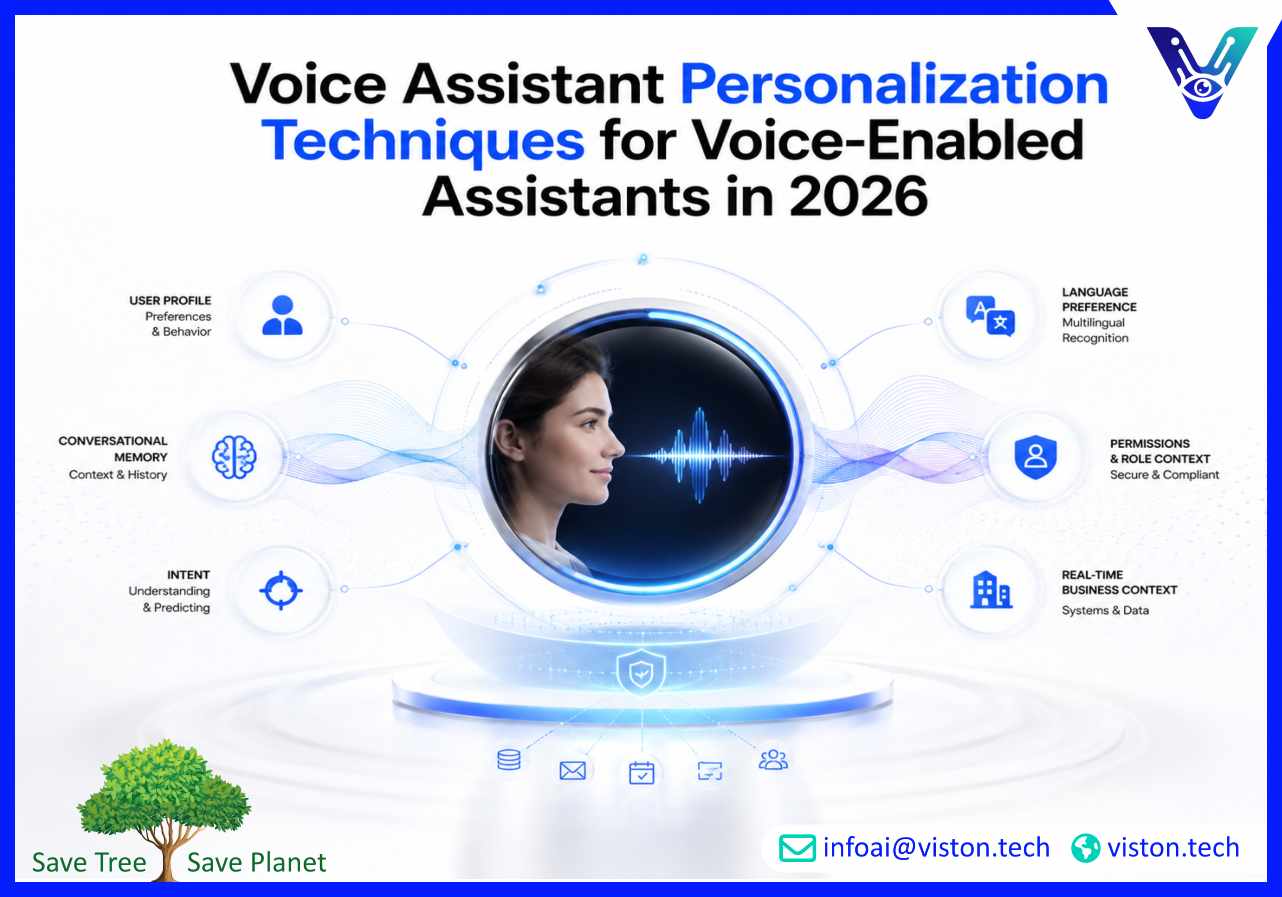
Voice Assistant Personalization Techniques for Voice-Enabled Assistants in 2026
Voice assistant personalization techniques help businesses make voice-enabled assistants more useful, relevant, and trusted. In 2026, personalization is no longer limited to greeting users by name. It involves context, intent, preferences, history, language, tone, permissions, and real-time business data.
What Voice Assistant Personalization Techniques Mean for Businesses
Voice assistant personalization is the process of adapting a voice-enabled assistant’s responses, workflows, recommendations, and conversational style to the user’s needs, context, and relationship with the business. For organizations using voice AI in customer support, sales, operations, employee service, healthcare, finance, retail, hospitality, logistics, education, or local services, personalization can directly affect whether users complete tasks or abandon the interaction.A generic voice assistant gives the same answer to every user. A personalized assistant understands who the user is allowed to be, what they are trying to do, what has happened before, and what response would be most helpful in that moment. This may include recognizing returning customers, remembering preferred language, adjusting tone for urgency, using account context, suggesting relevant next steps, or routing the user to the right department without repeated questions.For business leaders, personalization should not mean uncontrolled data use. The goal is to create better experiences using appropriate, consent-based, secure, and useful data. A well-designed voice assistant should personalize only where it improves clarity, convenience, accessibility, efficiency, or decision-making.
Personalization should support a business objective
Effective personalization starts with a clear purpose. A customer service voice assistant may personalize by account status, support history, product ownership, and escalation priority. A sales assistant may personalize by buyer intent, industry, company size, budget stage, and previous interactions. An internal business assistant may personalize by employee role, location, permissions, department, and workflow access.The best voice assistant personalization techniques are practical, measurable, and connected to outcomes such as faster resolution, higher self-service completion, better lead qualification, improved accessibility, reduced call handling time, cleaner CRM updates, and stronger customer satisfaction.
Core Voice Assistant Personalization Techniques Businesses Should Use
Voice-enabled assistants can be personalized in several ways. The right techniques depend on the use case, data availability, compliance requirements, system integrations, and user expectations. Businesses should avoid adding personalization for novelty. Every technique should make the interaction easier, safer, or more useful.
1. User profile personalization
User profile personalization adapts the assistant based on known information about the user. This may include customer type, subscription level, purchase history, preferred branch, service plan, language preference, communication consent, loyalty status, or employee role.For example, a returning customer calling about an order should not need to repeat basic information already available in the company’s systems. A personalized voice assistant can confirm identity, retrieve the relevant order, and move directly to delivery status, refund options, or support escalation.
2. Intent-based personalization
Intent-based personalization focuses on what the user is trying to achieve. The assistant identifies whether the user wants to book an appointment, change an order, request support, compare products, check account details, report an issue, or speak with a human.Once intent is understood, the assistant can adjust the conversation path. A billing issue may require verification and account lookup. A product inquiry may require guided recommendations. A complaint may require a calmer tone, faster escalation, and a concise handoff summary.
3. Context-aware responses
Context-aware personalization uses real-time signals to improve relevance. These signals may include channel, time of day, device type, location when appropriate, previous conversation state, active case status, recent website activity, CRM record, or inventory availability.For example, a restaurant voice assistant can recommend available booking slots based on date, party size, location, and previous dining preferences. A logistics voice assistant can provide shipment updates based on tracking status rather than giving a generic delivery policy.
4. Language, accent, and dialect adaptation
Voice assistants must work for real users, not ideal test conditions. Language and accent adaptation help the system recognize different pronunciations, regional terms, mixed-language speech, and industry vocabulary. This is especially important for multilingual businesses, global teams, customer support centers, and markets where users naturally switch between languages.Personalization may include remembering a user’s preferred language, offering localized terminology, adapting speech speed, and using culturally appropriate phrasing. For accessibility, the assistant may also provide slower responses, simpler wording, or repeated confirmations when needed.
5. Conversational memory
Conversational memory allows the assistant to retain relevant context within a session or across approved future interactions. In-session memory helps the assistant avoid asking the same question twice. Long-term memory, when consented and appropriate, can help the assistant remember preferences such as preferred appointment times, product interests, language, support history, or communication channel.Businesses should design memory carefully. Not every detail should be stored, and sensitive information should not be retained unless there is a clear business need, legal basis, and secure handling process.
6. Role-based personalization
Role-based personalization is essential for internal voice-enabled assistants and enterprise systems. An assistant used by employees should understand permissions. A sales manager, support agent, warehouse operator, HR employee, and finance executive may need different workflows, data access, and response depth.This technique improves security and usability. It prevents users from receiving information they should not access while allowing authorized users to complete tasks faster.
7. Emotion and sentiment-aware routing
Voice interactions contain tone, hesitation, urgency, and frustration signals. Sentiment-aware personalization can help identify when a user is confused, upset, rushed, or at risk of abandoning the interaction. The assistant can respond with shorter answers, simpler choices, apology language, or human escalation.This should be used carefully. Businesses should not overstate what emotion detection can know. It is better to treat sentiment as a signal for support quality, not as a final judgment about the user.
How Personalization Improves Voice-Enabled Assistant Performance
Personalization is valuable when it improves the user journey. A voice assistant that sounds human but cannot complete tasks is not effective. The strongest results come from combining personalization with accurate speech recognition, reliable intent detection, strong conversation design, backend integrations, and continuous monitoring.
Faster task completion
Personalized voice assistants reduce unnecessary questions. If the assistant already has the right context, it can move users toward the correct workflow faster. This is useful for appointment booking, order tracking, account support, claims intake, lead qualification, employee helpdesk requests, and service scheduling.
Better customer experience
Customers often become frustrated when they need to repeat details across channels. A personalized assistant can use previous interactions, CRM records, and active ticket data to create continuity. This makes the experience feel more joined up, especially when the conversation moves from voice AI to a human agent.
Improved lead qualification
For sales and marketing teams, personalization helps voice assistants ask more relevant qualification questions. Instead of using the same script for every caller, the assistant can adapt by industry, company size, service interest, urgency, budget stage, or previous campaign engagement. This helps sales teams receive cleaner, more actionable lead data.
Higher self-service resolution
When a voice assistant understands customer history, account type, and intent, it can resolve more queries without human support. This is useful for repetitive service needs such as checking balances, confirming delivery, resetting passwords, updating booking details, requesting documents, or answering policy questions.
More accurate human handoffs
Personalization does not eliminate the need for human support. In many cases, it improves escalation. A well-designed assistant can summarize the user’s issue, detected intent, authentication status, attempted steps, sentiment signals, and relevant records before transferring the call. This reduces repetition and helps agents respond faster.
Implementation, Privacy, and Optimization Considerations
Voice assistant personalization must be designed with governance from the beginning. Voice data can be sensitive because it may include identity, emotion, background context, account details, payment information, health information, or biometric signals. Businesses should treat personalization as both a user experience strategy and a data responsibility.
Start with high-value personalization use cases
Businesses should begin with the moments where personalization clearly improves the outcome. Good starting points include recognizing returning users, remembering language preferences, using order or case history, adapting workflows by user role, and improving escalation summaries.Avoid complex personalization before the core assistant works reliably. If speech recognition, intent classification, knowledge retrieval, or system integration is weak, personalization may amplify errors instead of improving experience.
Use consent-based data practices
Users should understand when they are speaking with a voice assistant, whether the interaction is recorded, what data is used, and how personalization improves the experience. Businesses should provide clear opt-in and opt-out options where appropriate, especially when using stored preferences, voice recordings, or biometric-style identity features.
Apply data minimization
Personalization should use only the data needed for the task. A support assistant may need product ownership and case history, but not unrelated marketing preferences. An employee assistant may need department and permission level, but not private HR details unless the workflow requires it.Data minimization reduces risk and improves user trust. It also makes the assistant easier to govern, audit, and maintain.
Integrate with trusted business systems
Personalization is strongest when the assistant connects securely with authoritative systems such as CRM, ERP, helpdesk platforms, scheduling tools, ecommerce platforms, knowledge bases, identity systems, and contact center software. Without integration, personalization is often limited to shallow scripting.Integrated voice-enabled assistants can retrieve real-time context, update records, trigger workflows, and create consistent customer journeys across voice, chat, email, and human support.
Measure personalization quality
Businesses should track whether personalization improves outcomes. Useful metrics include task completion rate, first contact resolution, fallback rate, escalation rate, average handling time, user satisfaction, repeat contact rate, lead qualification accuracy, language recognition success, and handoff quality.Teams should also review failed conversations. Personalization errors can be more damaging than generic failures because users may feel misunderstood or exposed. Regular audits help identify inaccurate assumptions, outdated data, poor routing logic, and privacy risks.
Keep human control where it matters
Personalized voice assistants should not make sensitive decisions without appropriate controls. High-risk actions such as financial changes, medical advice, account closure, legal requests, identity verification, refunds, or employee policy exceptions may require confirmation, escalation, audit logging, or human approval.
How Viston AI Supports Personalized Voice-Enabled Assistants
Viston AI is relevant to voice assistant personalization techniques because its Voice-Enabled Assistants service focuses on building conversational AI systems that combine speech recognition, natural language understanding, generative AI, analytics, multilingual support, and business system integration. These capabilities are important for businesses that want voice assistants to do more than answer static questions.Personalization depends on context. A voice assistant must understand user intent, retrieve relevant data, respect permissions, adapt language, and connect with systems such as CRM, helpdesk, scheduling, knowledge base, or workflow platforms. Viston AI’s service positioning aligns with these requirements by supporting voice AI infrastructure, NLP, real-time analytics, LLMOps-style monitoring, enterprise integration, and responsible AI governance.For businesses across general industries and global markets, this type of delivery approach can support customer service automation, employee helpdesk workflows, appointment handling, lead qualification, multilingual support, and context-aware self-service. The value is not simply in creating a voice interface; it is in designing a secure, scalable, and measurable assistant that can personalize interactions while maintaining business rules, data controls, and operational reliability.Organizations evaluating voice-enabled assistants can consider Viston AI when they need a partner capable of connecting personalization strategy with practical implementation, system integration, conversation design, analytics, and ongoing optimization.
Frequently Asked Questions
What are voice assistant personalization techniques?
Voice assistant personalization techniques are methods used to adapt a voice-enabled assistant’s responses and workflows based on user intent, profile, history, preferences, language, permissions, context, and real-time business data.
Why does personalization matter for voice-enabled assistants?
Personalization matters because it reduces repeated questions, improves relevance, speeds up task completion, supports better self-service, and creates smoother handoffs to human teams when automation is not enough.
What data is needed to personalize a voice assistant?
Common data includes user preferences, account type, interaction history, CRM records, support tickets, order status, language preference, role permissions, location where relevant, and workflow context. Businesses should only use data that is necessary, consented, secure, and appropriate for the task.
Can personalization work for multilingual voice assistants?
Yes. Multilingual personalization can remember preferred language, adapt terminology, support accents and dialects, handle code-switching, and provide localized responses. It requires strong speech recognition, language models, training data, and quality testing.
How do businesses avoid privacy risks in voice assistant personalization?
Businesses can reduce privacy risk by using clear consent, data minimization, encryption, access controls, retention limits, audit logs, role-based permissions, and human review for sensitive workflows.
Can Viston AI help with voice assistant personalization?
Yes. Viston AI’s Voice-Enabled Assistants service is aligned with personalization needs because it includes voice AI, NLP, multilingual support, business system integration, analytics, and governance capabilities for practical enterprise use cases.
Conclusion
Voice assistant personalization techniques are essential for businesses that want voice-enabled assistants to feel useful, efficient, and trustworthy in 2026. The strongest personalization strategies combine user context, intent detection, language preferences, system integrations, role-based access, and responsible data governance. Personalization should never be treated as a gimmick; it should improve task completion, service quality, accessibility, and operational outcomes. For organizations planning voice AI adoption, Viston AI offers relevant Voice-Enabled Assistants capabilities that can support personalized, integrated, and scalable conversational experiences.