
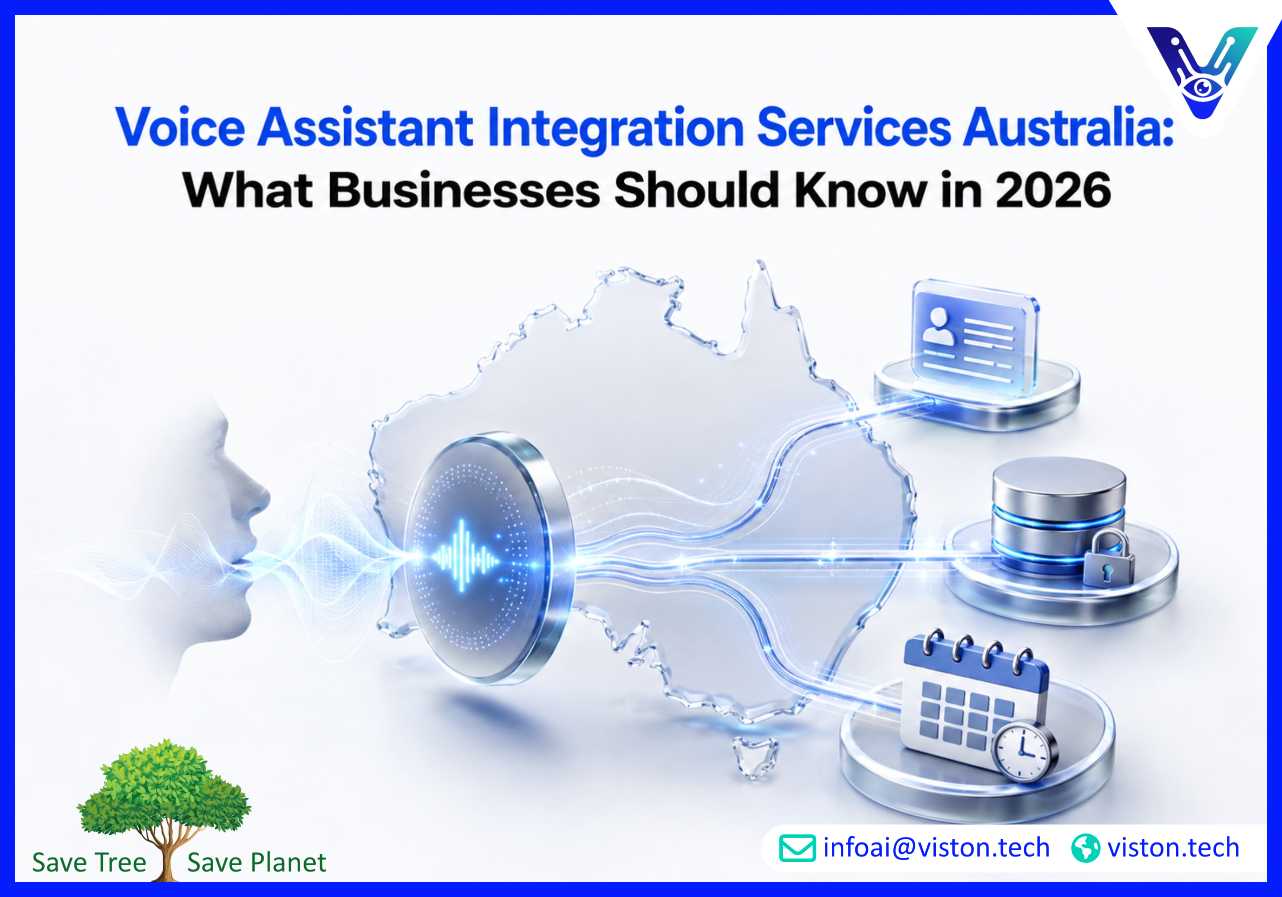
Voice assistant integration services Australia are becoming important for businesses that want faster customer support, hands-free workflows, multilingual service access, and more natural digital experiences. In 2026, voice-enabled assistants are no longer simple call-routing tools; they are connected business interfaces that must understand intent, access systems securely, and deliver reliable outcomes.
Voice assistant integration services Australia involve connecting speech-based AI assistants with the systems, data, workflows, and customer touchpoints that businesses already use. A voice assistant may sit inside a website, mobile app, call centre, smart device, internal helpdesk, CRM portal, field service tool, or enterprise software environment.
The purpose is not only to let users speak instead of type. The real value comes from allowing spoken requests to trigger useful business actions. A customer might ask for order status, a patient might confirm an appointment, an employee might request HR policy information, or a warehouse worker might update inventory hands-free. Behind the conversation, the assistant must understand the spoken request, identify the user’s intent, retrieve the right information, and complete the required process.
A well-integrated voice assistant usually combines automatic speech recognition, natural language understanding, dialogue management, text-to-speech, knowledge retrieval, authentication, analytics, and API connectivity. For Australian businesses, this also means designing for local accents, English language variations, privacy expectations, accessibility needs, and industry-specific requirements.
A basic voice bot may answer fixed questions or route calls through scripted menus. An integrated voice assistant goes further. It can manage multi-turn conversations, remember context within the session, connect to CRM or ERP systems, escalate to human teams, and produce structured records after the interaction.
This difference matters because businesses do not need another disconnected automation layer. They need a voice-enabled assistant that fits into their customer service, operations, sales, employee support, and reporting workflows. Without integration, even an advanced AI voice interface can become frustrating because it cannot act on the information it collects.
Australian organisations are under pressure to improve service availability, reduce repetitive manual work, support distributed teams, and create digital experiences that feel easier for customers and employees. Voice-enabled assistants can help when they are designed around real business processes rather than novelty use cases.
In customer-facing environments, voice assistants can reduce wait times by handling common inquiries before they reach human agents. In internal operations, they can make knowledge access faster for employees who need answers while moving between tasks. In field service, manufacturing, logistics, healthcare, retail, and finance, voice interaction can be valuable because users may not always be able to type, search, or navigate complex screens.
In 2026, expectations are also higher. Buyers now look for voice assistants that are accurate, secure, measurable, multilingual, scalable, and easy to integrate with existing systems. A voice assistant should not create more operational complexity. It should reduce friction, improve response consistency, and provide clear insight into user needs.
The best use cases are usually specific and measurable. Rather than starting with “build a voice assistant,” businesses should identify the exact conversations, tasks, and outcomes the assistant needs to support. This could include booking appointments, checking account information, qualifying leads, logging maintenance issues, retrieving policy details, updating service requests, or guiding users through troubleshooting steps.
Choosing voice assistant integration services in Australia requires more than selecting a speech engine or conversational AI platform. The provider must understand voice experience design, backend integration, security, data handling, testing, deployment, and continuous improvement. Voice interaction is highly sensitive to delays, misunderstandings, poor escalation, and unclear responses, so execution quality matters.
The assistant must convert spoken input into text accurately and then understand what the user wants. This requires speech recognition that can handle Australian English, background noise, industry terminology, names, numbers, and natural phrasing. Natural language understanding then identifies intent, extracts key details, and determines the next best action.
For business use, the assistant should not rely only on generic language understanding. It should be tuned around the organisation’s products, services, processes, customer vocabulary, and common support questions. This helps reduce incorrect answers and unnecessary escalation.
Voice assistant integration becomes valuable when the assistant can connect with CRM systems, helpdesk platforms, ecommerce systems, ERPs, HR tools, scheduling platforms, payment systems, knowledge bases, and custom applications. These integrations allow the assistant to retrieve real-time data, create records, update tickets, trigger workflows, and pass context to human teams.
For example, a retail customer asking about delivery status may need order management access. A finance customer asking about account support may require secure authentication. A field technician logging a repair may need the assistant to update a maintenance system. Each of these outcomes depends on reliable integration, not just conversational design.
Voice assistants often process personal information, customer records, account details, employee data, and conversation transcripts. Australian businesses must think carefully about data collection, consent, retention, access control, audit trails, and escalation boundaries.
Security should be designed into the assistant from the beginning. This may include role-based access, encryption, secure APIs, identity verification, data minimisation, PII redaction, logging controls, and human approval for sensitive actions. For regulated industries such as healthcare, financial services, insurance, education, and government-adjacent services, governance is not optional. It is central to whether the assistant can be safely deployed.
Voice conversations need a different design approach from text chat. Users cannot easily scan long menus or reread complicated answers. A strong voice assistant uses short prompts, clear confirmation steps, natural turn-taking, helpful fallback messages, and smooth handoff when the conversation becomes complex.
The assistant should also know when not to continue. If confidence is low, if a customer is frustrated, or if the request involves judgement, complaint handling, financial risk, medical sensitivity, or legal exposure, escalation should happen quickly with context transferred to the right human team.
The right provider should be able to translate business goals into a working voice solution that is secure, usable, scalable, and measurable. A strong technical demo is useful, but procurement teams should look deeper into delivery process, integration experience, operational support, and long-term optimisation.
Before choosing a partner, define the assistant’s role. Is it for customer support, sales qualification, employee service, appointment management, field operations, ecommerce, call centre automation, or knowledge search? Each use case has different requirements for data access, authentication, response style, compliance, and reporting.
A credible provider should help narrow the first deployment to high-value workflows. Starting too broad can lead to poor accuracy, unclear ownership, and weak adoption. A focused rollout makes it easier to test performance, manage risk, and prove business value before expanding.
Ask how the assistant will connect with existing systems. A provider should be comfortable working with APIs, webhooks, middleware, CRM platforms, ticketing tools, enterprise databases, cloud environments, and custom applications. Integration planning should include data mapping, permission design, failure handling, monitoring, and fallback processes.
It is also important to understand what happens when systems are unavailable. A reliable voice assistant should be able to explain delays, avoid unsafe assumptions, create follow-up tasks, or escalate gracefully rather than giving inaccurate information.
Voice assistants need rigorous testing before launch. This includes accent testing, noisy environment testing, edge-case testing, intent accuracy testing, escalation testing, latency testing, security review, and user acceptance testing. After launch, performance should be monitored through KPIs such as containment rate, completion rate, fallback rate, escalation quality, response latency, customer satisfaction, and workflow success rate.
The most successful implementations improve over time. Conversation logs, user feedback, failed intents, and escalation patterns should feed into regular optimisation cycles. This keeps the assistant aligned with changing products, policies, customer behaviour, and business priorities.
Australian businesses should also evaluate support model, implementation timelines, hosting options, data residency needs, documentation quality, training, maintenance responsibilities, and total cost of ownership. A low-cost build can become expensive if it lacks monitoring, governance, integration reliability, or improvement support.
The better question is not simply “How much does it cost?” It is “What business process will this assistant improve, how will success be measured, and what level of operational reliability is required?”
Viston AI is directly relevant to voice assistant integration services because its Voice-Enabled Assistants offering focuses on enterprise-grade conversational AI using speech recognition, natural language processing, and integration with business systems. For Australian organisations evaluating voice automation, this matters because the service is not limited to building a front-end voice interface. It connects voice interaction with operational workflows, data access, analytics, and scalable AI delivery.
Viston AI’s capabilities align with common buyer needs in Australia, including customer support automation, multilingual and accent-aware voice experiences, CRM and enterprise platform integration, real-time data access, workflow automation, and continuous performance monitoring. These capabilities are useful for sectors such as retail, financial services, healthcare, manufacturing, logistics, technology, and service-led businesses where voice interactions need to be accurate, secure, and outcome-driven.
Its broader AI service portfolio, including AI chatbot development, AI chatbot integration, NLP, AI strategy, automation workflows, and MLOps, also supports the wider requirements behind voice assistant deployment. For businesses that need a voice assistant to work reliably across customer service, internal support, or operational workflows, Viston AI can be positioned as a specialist partner for designing, integrating, testing, and improving voice-enabled assistants with practical business outcomes in mind.
Voice assistant integration services connect AI-powered voice assistants with business systems, workflows, databases, and customer channels. They allow users to speak naturally while the assistant retrieves information, completes tasks, updates records, or escalates to human teams when needed.
They help Australian businesses improve service availability, support hands-free workflows, reduce repetitive calls, and create more accessible digital experiences. Local requirements such as Australian English, privacy expectations, and industry compliance should be considered during implementation.
A voice assistant can integrate with CRM platforms, helpdesk systems, ecommerce platforms, ERP software, HR systems, scheduling tools, payment systems, knowledge bases, analytics platforms, and custom business applications through APIs and workflow connectors.
Useful KPIs include intent recognition accuracy, task completion rate, escalation rate, fallback rate, average response latency, customer satisfaction, containment rate, workflow success rate, and cost per resolved interaction.
Key risks include inaccurate responses, poor speech recognition, weak authentication, privacy exposure, unclear consent, disconnected workflows, slow integrations, and poor escalation design. These risks can be reduced through governance, testing, access controls, monitoring, and human-in-the-loop safeguards.
Yes. Viston AI provides Voice-Enabled Assistants and related AI integration capabilities that support speech recognition, NLP, business system connectivity, workflow automation, analytics, and scalable deployment for organisations serving Australian and global markets.
Voice assistant integration services Australia are most valuable when they turn spoken requests into secure, accurate, and useful business actions. In 2026, businesses need more than a voice interface; they need assistants that understand context, integrate with systems, protect data, support users naturally, and improve over time. The right approach starts with clear use cases, strong integration planning, careful governance, and measurable performance goals. For organisations exploring Voice-Enabled Assistants, Viston AI offers relevant expertise in building integrated voice AI solutions that can support customer service, internal operations, and scalable digital engagement.
