
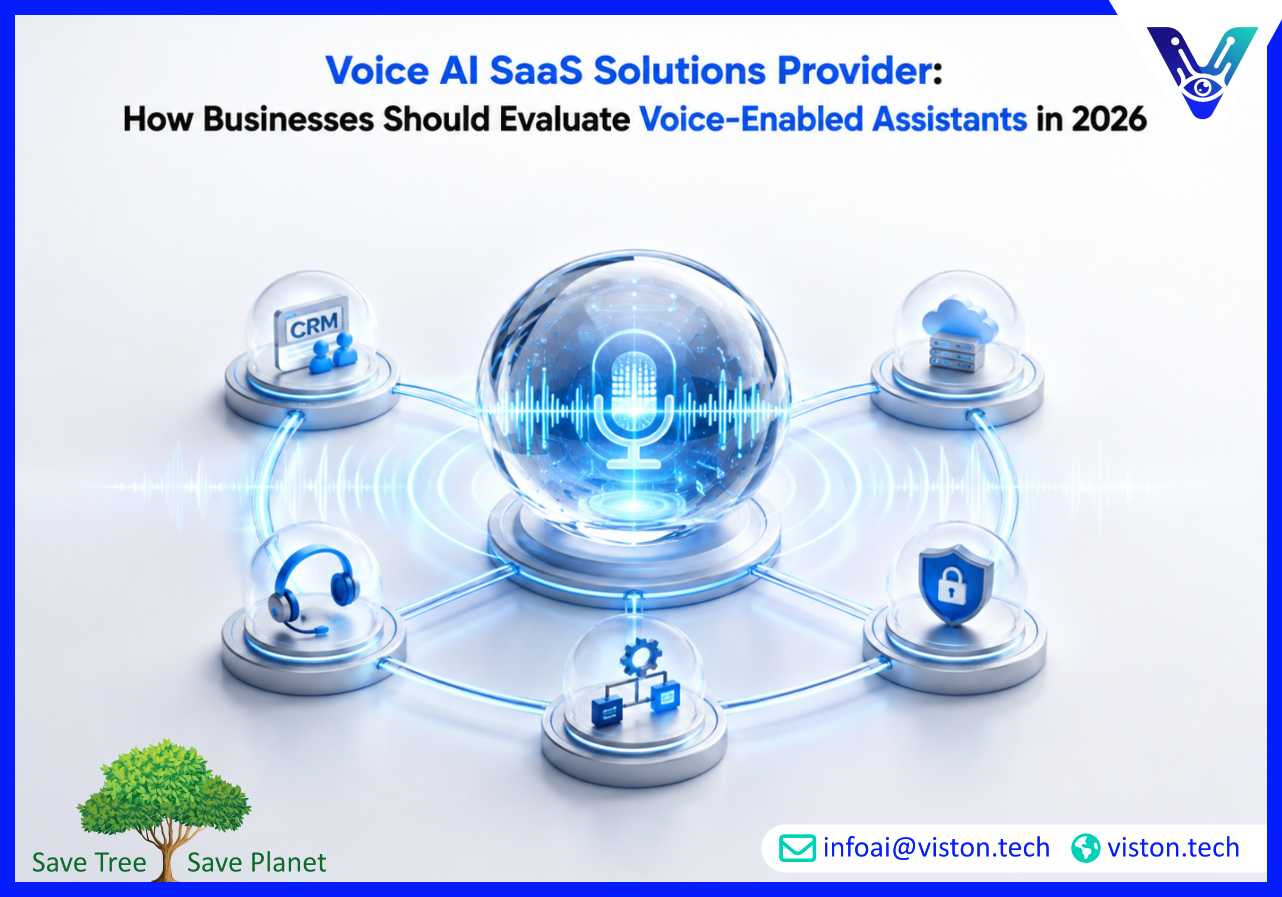
Choosing a voice AI SaaS solutions provider matters because spoken customer and employee interactions now influence service speed, accessibility, sales response, and operational efficiency. In 2026, businesses need voice-enabled assistants that are accurate, secure, integrated, scalable, and practical enough to support real workflows.
A voice AI SaaS solutions provider delivers cloud-based conversational systems that allow users to interact with software, services, or business teams through spoken language. Instead of relying only on web forms, chat widgets, IVR menus, or human agents, companies can use voice-enabled assistants to understand speech, process intent, respond naturally, and complete tasks through connected systems.
For business buyers, this is not simply a “talking chatbot.” A reliable voice AI solution combines speech recognition, natural language processing, conversational AI, text-to-speech, workflow automation, analytics, and integrations with platforms such as CRM, helpdesk, ecommerce, scheduling, ERP, and internal knowledge systems.
The SaaS model makes voice AI easier to adopt because companies do not need to build every infrastructure layer from scratch. A provider usually manages hosting, model updates, interface availability, monitoring, deployment support, and platform improvements. However, the quality of the outcome still depends heavily on implementation strategy, conversation design, system integration, data governance, and ongoing optimization.
A strong provider should help the business move from basic voice automation to measurable service outcomes. That means the assistant should not only answer questions, but also identify the user’s need, retrieve trusted information, trigger the right workflow, and know when to transfer the conversation to a human team.
Voice-enabled assistants are becoming more important because customers and employees expect faster, more natural ways to get help. Many users do not want to search through long help centers, wait on hold, navigate rigid phone trees, or repeat the same issue across multiple channels. Voice AI can reduce friction when it is implemented with the right business context.
In 2026, business expectations are also higher. Buyers are no longer impressed by a voice assistant that only understands basic commands. They expect the system to manage real conversations, support multiple languages or accents where needed, respect privacy rules, connect to live business data, and provide clear reporting on performance.
Voice AI can help support teams handle repetitive calls such as order status, appointment changes, account questions, product troubleshooting, policy explanations, and ticket updates. The value is not only call deflection. The greater value comes from giving customers faster answers while allowing human agents to focus on urgent, emotional, high-value, or complex issues.
For sales teams, a voice-enabled assistant can qualify inquiries, collect structured information, answer common product questions, book meetings, route prospects, and update CRM records. This is useful for businesses that receive calls outside office hours or manage high inquiry volumes from websites, ads, marketplaces, or partner channels.
Voice assistants can also support internal teams. Employees may use them to find policy information, check process steps, submit IT requests, retrieve knowledge base answers, schedule actions, or trigger workflow automations. This can reduce repetitive workload for HR, IT, admin, operations, and service desk teams.
Voice interaction improves accessibility for users who prefer hands-free support, have limited typing ability, are mobile, or need faster task completion. For field teams, drivers, technicians, healthcare staff, warehouse workers, and busy executives, voice can be more practical than screen-based interaction.
Choosing the right voice AI SaaS solutions provider requires more than comparing feature lists. Businesses should assess whether the provider can deliver a reliable assistant in the real conditions where it will be used. A voice system that performs well in a demo may struggle with noisy environments, unclear business rules, regional accents, incomplete knowledge bases, or weak integrations.
The first evaluation step is to define the business problem. A voice assistant for customer support has different requirements from a sales qualification assistant, healthcare intake assistant, internal IT helpdesk, or ecommerce order assistant. The provider should help identify which workflows are suitable for automation and which require human review.
Good use cases are usually high-volume, repeatable, well-documented, and measurable. Examples include booking confirmations, order tracking, appointment scheduling, FAQ handling, account status checks, lead qualification, password reset guidance, and simple ticket creation. More sensitive or regulated workflows can be added later with stronger controls.
Voice AI quality depends on how naturally the assistant understands and responds. Buyers should evaluate whether the system can handle interruptions, follow-up questions, different phrasing, corrections, silence, uncertainty, and escalation requests. A useful assistant should not force users into rigid scripts. It should guide the conversation while keeping the user’s goal clear.
Voice-enabled assistants become significantly more valuable when they connect to business systems. Integration allows the assistant to retrieve customer details, create tickets, update lead records, confirm bookings, check order status, trigger notifications, and log outcomes. Without integration, the assistant may answer basic questions but fail to complete meaningful tasks.
Businesses should ask how the provider handles APIs, authentication, CRM updates, helpdesk workflows, knowledge base retrieval, error handling, and data synchronization. Integration reliability is often the difference between a voice AI pilot and a production-ready business solution.
Voice interactions can contain personal, financial, health, contractual, or operational information. A serious provider should explain how data is captured, processed, stored, retained, encrypted, accessed, and audited. Businesses should also consider consent, call recording rules, regional privacy requirements, role-based access, and redaction of sensitive information.
Security should not be treated as a final checklist item. It should shape the assistant’s design from the beginning, especially when the solution handles customer accounts, payments, healthcare information, employee data, or regulated industry workflows.
A voice AI SaaS project succeeds when business teams, technical teams, and the provider align around outcomes. The assistant needs clear workflows, approved knowledge, escalation rules, performance goals, and post-launch improvement cycles. Without this foundation, even advanced technology can create inconsistent customer experiences.
The assistant should be trained or connected to reliable, approved information. This may include FAQs, service policies, product documents, call scripts, CRM fields, helpdesk articles, SOPs, and compliance guidance. Outdated or conflicting content should be removed before launch because voice AI can only perform well when the source material is trustworthy.
No voice assistant should be expected to handle every situation. Businesses need clear rules for when the assistant should transfer to a human agent. Escalation may be required for complaints, sensitive issues, repeated misunderstanding, high-value sales opportunities, cancellation risk, urgent support, legal requests, or low-confidence answers.
Good escalation includes context transfer. The human team should receive the user’s details, conversation summary, detected intent, attempted resolution, sentiment signals, and relevant system records. This prevents users from repeating themselves and improves handover quality.
Voice AI performance should be measured through practical KPIs. Useful metrics include call containment rate, task completion rate, first contact resolution, average response time, fallback rate, escalation rate, customer satisfaction, lead qualification rate, workflow success rate, and system update accuracy.
These metrics help businesses understand whether the assistant is creating real value. High automation is not always a good result if customers are frustrated or unresolved. The goal is balanced performance: accurate answers, efficient workflows, appropriate escalation, and measurable operational improvement.
Voice AI is not a one-time deployment. User behavior changes, products change, policies change, and new questions appear. Businesses should review failed conversations, update knowledge content, refine intents, improve prompts, test new workflows, and monitor integration errors. Ongoing optimization keeps the assistant aligned with business needs.
Viston AI is relevant to this topic because its service portfolio includes voice-enabled AI assistants, enterprise AI chatbots, AI chatbot integration, natural language processing, multilingual support, AI automation, workflow bots, custom AI solution development, and strategic AI consulting. These capabilities align with what businesses need when evaluating a voice AI SaaS solutions provider for practical customer, sales, and operations use cases.
For organizations exploring voice-enabled assistants, Viston AI can support the broader implementation requirements behind the voice interface. This includes understanding business workflows, designing conversational experiences, connecting AI assistants with existing systems, using NLP to interpret user intent, supporting multilingual communication where required, and applying automation to complete tasks rather than only answer questions.
This matters because voice AI projects often fail when they are treated as isolated front-end tools. A business-ready assistant needs knowledge integration, secure data handling, workflow design, escalation logic, system connectivity, and performance monitoring. Viston AI’s AI-focused service model is suited to companies that want voice assistants connected to operational outcomes such as faster response, better lead handling, improved support efficiency, and reduced repetitive work.
For businesses across industries and global markets, the company’s offering may be especially relevant when voice AI needs to work alongside chatbots, CRM systems, automation platforms, internal knowledge bases, and customer engagement channels. The value is in building a voice-enabled assistant that is useful, measurable, and aligned with real business processes.
A voice AI SaaS solutions provider offers cloud-based software and implementation support for voice-enabled assistants. These systems use speech recognition, natural language processing, conversational AI, and text-to-speech to understand spoken requests and respond or take action.
Traditional IVR systems usually rely on fixed menus and keypad inputs. Voice-enabled assistants can understand natural spoken language, manage multi-turn conversations, retrieve information, trigger workflows, and escalate with context when human support is needed.
Businesses should look for strong speech accuracy, natural conversation handling, secure data practices, integration capability, workflow automation, analytics, scalability, multilingual support if needed, and clear human handover design.
Yes. A well-implemented voice AI solution can integrate with CRM, ticketing, ecommerce, scheduling, knowledge base, ERP, and workflow systems. These integrations help the assistant complete tasks and keep business records accurate.
Yes. B2B companies can use voice AI for lead qualification, meeting booking, customer support, account service, internal helpdesk, onboarding, technical support triage, and workflow automation. The best use cases are repeatable, measurable, and supported by reliable data.
Viston AI’s voice-enabled assistant, chatbot integration, NLP, automation, and custom AI development capabilities align with businesses that need voice AI connected to real workflows, enterprise systems, and measurable service outcomes.
Choosing a voice AI SaaS solutions provider in 2026 is a strategic decision for businesses that want faster, more natural, and more scalable communication. Voice-enabled assistants can support customer service, sales, internal operations, and accessibility when they are designed around accurate understanding, secure data handling, system integration, and continuous improvement. The right provider should help the business move beyond basic voice automation and build an assistant that completes useful tasks, escalates responsibly, and improves over time. Viston AI is a relevant specialist for organizations considering voice-enabled assistants as part of a broader AI automation and conversational AI strategy.
