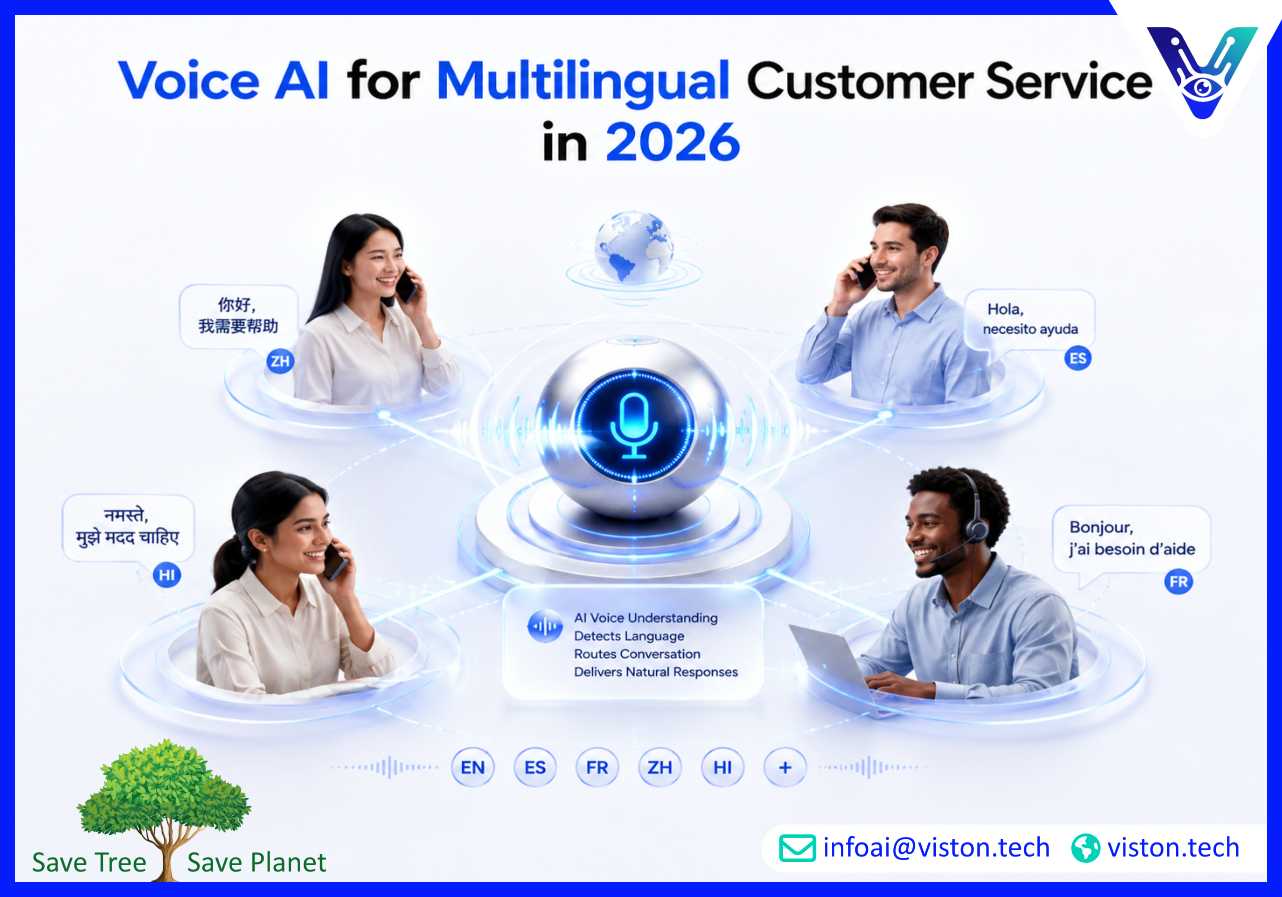
Voice AI for Multilingual Customer Service in 2026
Voice AI for multilingual customer service helps businesses support customers across languages without making every conversation depend on a human agent, call queue, or rigid phone menu. In 2026, the real value lies in combining natural speech, language understanding, secure integrations, and reliable escalation.
What Voice AI for Multilingual Customer Service Means
Voice AI for multilingual customer service refers to voice-enabled assistants that can understand spoken customer requests, detect or support different languages, respond naturally, and complete service tasks through connected business systems. Unlike traditional IVR systems, which rely on keypad options and fixed call flows, modern voice AI lets customers speak in their own words.A multilingual voice assistant may help customers check an order, update an appointment, ask billing questions, request technical support, confirm account details, submit a claim, book a service, or receive product guidance. The experience should feel conversational, but the underlying system must be carefully designed. It needs speech recognition, natural language understanding, text-to-speech, language detection, knowledge retrieval, conversation design, workflow automation, and handoff logic.The multilingual element is especially important for businesses serving diverse markets. Customers often switch between languages, use regional accents, mix local phrases with English, or describe problems in informal terms. A useful voice-enabled assistant must therefore handle more than direct translation. It must understand intent, context, tone, and service rules across languages.
Why language support is not just translation
Many customer service failures happen because language support is treated as a translation layer instead of a service design requirement. A translated answer may still be unhelpful if it ignores local terminology, account workflows, compliance wording, cultural expectations, or escalation rules. For example, a refund request, appointment change, insurance claim, or billing dispute may require different phrasing, verification steps, and documentation depending on the market.Effective multilingual voice AI should be trained around real customer intents, service categories, business policies, and regional language patterns. It should recognize when a customer is confused, angry, uncertain, or asking for something beyond the assistant’s authority. It should also know when to continue the conversation, ask a clarifying question, or transfer the customer to a human agent with full context.
Core capabilities businesses should expect
Speech-to-text and text-to-speech performance across supported languages
Natural language understanding for customer intents and service workflows
Language detection and controlled language switching
Integration with CRM, helpdesk, order, booking, payment, or internal systems
Secure authentication and access control for account-related requests
Human handoff with conversation summary and customer context
Analytics for resolution rate, containment, satisfaction, fallback, and escalation
Why Multilingual Voice AI Matters for Customer Service in 2026
Customer service expectations have changed. Customers want fast answers, but they also expect accuracy, privacy, and language accessibility. A business may operate in one country and still serve customers who speak several languages. It may also support tourists, migrant communities, regional markets, international buyers, distributed employees, or global partners.Hiring and training enough multilingual support agents can be difficult, especially when demand fluctuates across time zones or seasonal peaks. Voice AI helps by handling repetitive and structured conversations around the clock, while human teams focus on complex, sensitive, or high-value cases. This is not about replacing customer service teams. It is about reducing avoidable workload and improving access for customers who would otherwise wait longer or struggle with language barriers.
Customers expect natural voice support
People call support because they want speed, clarity, or reassurance. If they are forced through long menu trees or transferred between departments, the experience becomes frustrating. Voice-enabled assistants can improve the first interaction by identifying intent quickly and guiding the customer toward the right outcome.For multilingual service, this matters even more. A customer who cannot comfortably explain a problem in the company’s default language may abandon the call, repeat themselves, or accept the wrong answer. Voice AI can create a more inclusive service experience when it is designed with language coverage, accent variation, clear prompts, and escalation safeguards.
Support leaders need consistency across languages
One of the biggest challenges in multilingual customer service is consistency. A business may have strong support quality in one language and weaker quality in another because of limited staffing, inconsistent training, or fragmented documentation. Voice AI can help standardize approved answers, service steps, and routing logic across languages while still allowing localized phrasing.This consistency is valuable for industries where customers need accurate information, such as ecommerce, travel, healthcare administration, financial services, insurance, SaaS, logistics, utilities, education, and public-facing service operations. The assistant should provide the same policy accuracy and workflow reliability regardless of the language used.
Operational pressure is increasing
Customer service teams are under pressure to reduce wait times, control costs, improve satisfaction, and provide support across more channels. Phone support remains important because many customers still prefer speaking when the matter is urgent, emotional, complex, or inconvenient to type. A multilingual voice assistant can reduce the burden of repeated calls by resolving common tasks before they reach an agent.In 2026, buyers are no longer evaluating voice AI only as a novelty. They are looking for measurable outcomes: lower average handle time, fewer abandoned calls, better first contact resolution, higher self-service completion, cleaner data capture, improved escalation quality, and better coverage outside business hours.
How Voice-Enabled Assistants Improve Multilingual Support
Voice-enabled assistants improve multilingual customer service when they are connected to real business processes. A simple voice bot that answers FAQs may help with basic deflection, but a production-ready assistant should be able to verify customer needs, retrieve account or order data, complete structured tasks, and update records when permitted.
Faster triage and intent detection
A multilingual voice assistant can identify why the customer is calling and route the conversation accordingly. Instead of asking every caller to choose from a long list, it can detect whether the customer needs billing help, technical support, delivery updates, appointment scheduling, account access, product information, or complaint handling.Good triage reduces misrouting. It also helps agents because escalated calls arrive with a summary of the customer’s language, intent, issue history, and attempted resolution. This saves time and prevents customers from repeating the same details.
24/7 support for common service tasks
Many customer requests do not require a human agent if the assistant has the right knowledge and system access. Voice AI can help customers check status updates, confirm opening hours, reset simple access issues, book or reschedule appointments, collect required information, answer policy questions, or create support tickets.For multilingual service teams, this coverage is valuable because it extends support availability without requiring every language to be staffed at all hours. The assistant can handle routine conversations while preserving human escalation for complex or sensitive cases.
Better accessibility and inclusion
Voice support can be easier than text for customers who are driving, working hands-free, visually impaired, less comfortable with written forms, or using mobile devices in low-bandwidth situations. When multilingual voice AI is designed properly, it can reduce friction for customers who prefer speaking in their strongest language.Accessibility should be treated as a quality requirement. That means clear pronunciation, appropriate pacing, confirmation of important details, simple language, and the ability to repeat or rephrase answers. It also means the assistant should not trap customers in automation when they need human support.
Improved data quality across conversations
Human agents often collect information in different ways, especially across languages. Voice AI can standardize intake by asking consistent questions and capturing structured data. This helps downstream teams because tickets, leads, claims, bookings, and account notes become easier to process.When integrated with CRM or helpdesk systems, the assistant can create cleaner records, tag issues correctly, and reduce manual after-call work. This is particularly useful for businesses handling high call volumes or repetitive multilingual inquiries.
Implementation Considerations for Reliable Multilingual Voice AI
Successful voice AI for multilingual customer service depends on more than selecting a speech model. Businesses need a service strategy, technical architecture, language plan, data governance process, and performance measurement framework. Without these foundations, the assistant may sound impressive in a demo but fail in real customer conversations.
Start with high-value service use cases
The best implementation approach is to start with use cases that are frequent, structured, and safe to automate. These may include order tracking, appointment scheduling, support ticket creation, store or service information, basic troubleshooting, account status checks, delivery updates, or lead qualification.Complex use cases can be added later once the assistant proves accuracy, escalation quality, and integration reliability. Highly sensitive conversations, such as complaints, medical advice, financial decisions, legal issues, fraud, or vulnerable customer situations, should have strict boundaries and faster human escalation.
Design for real speech, not perfect scripts
Customers do not speak like training manuals. They interrupt, pause, change languages, use slang, speak with accents, give partial information, or explain problems out of order. Multilingual voice AI must be tested against realistic conversations, not only clean sample phrases.Conversation design should include confirmations for important actions, graceful recovery from misunderstood input, fallback paths, and simple prompts. The assistant should avoid long responses because spoken answers are harder to scan than text. Short, clear, step-by-step dialogue usually performs better.
Connect voice AI to business systems securely
For customer service, integration is where voice AI becomes operationally useful. The assistant may need to retrieve order data, update a ticket, schedule an appointment, check inventory, verify customer identity, or trigger a workflow. These actions require secure APIs, permission rules, audit logs, and careful data handling.Businesses should define what the assistant can access, what it can change, when human approval is needed, and how sensitive information is protected. Authentication, consent, encryption, role-based access, retention rules, and compliance review should be part of the implementation plan from the beginning.
Measure performance by language and intent
Overall performance metrics can hide language-specific problems. A voice assistant may perform well in English but struggle with regional accents, mixed-language phrasing, or specialized terminology in another language. Businesses should measure containment, resolution, fallback, escalation, satisfaction, latency, and accuracy by language, market, channel, and service intent.Regular review of failed conversations helps teams improve knowledge coverage, prompts, speech recognition, escalation rules, and training examples. Multilingual voice AI should be optimized continuously because products, policies, customer language, and support patterns change over time.
How Viston AI Supports Voice AI for Multilingual Customer Service
Viston AI is relevant to voice AI for multilingual customer service because its Voice-Enabled Assistants service focuses on enterprise-grade conversational AI that combines natural language processing, speech recognition, and operational integration. For businesses that need multilingual customer support, this matters because voice automation must understand speech, interpret intent, respond naturally, and connect with the systems that manage customer records and service workflows.Viston AI’s service offering includes voice-enabled assistants, multilingual support, AI chatbot integration, NLP and text analysis, AI automation workflows, strategic AI consulting, and enterprise AI chatbot capabilities. This combination supports the practical requirements behind multilingual service delivery: intent mapping, language coverage, knowledge integration, secure system connectivity, escalation design, testing, deployment, monitoring, and continuous optimization.For organizations serving customers across different languages, regions, or service channels, Viston AI can help design voice assistants that move beyond scripted call handling. Its approach is aligned with use cases such as customer service automation, appointment support, technical helpdesk flows, retail and ecommerce assistance, employee support, and service request intake. The value is not simply adding a voice interface; it is building a reliable multilingual customer service layer that can reduce repetitive workload, improve response speed, support agents with better context, and create more consistent customer experiences.
Frequently Asked Questions
What is voice AI for multilingual customer service?
Voice AI for multilingual customer service is a voice-enabled assistant that understands spoken customer requests across supported languages, responds naturally, and helps complete service tasks such as answering questions, routing calls, creating tickets, or retrieving account information.
How is multilingual voice AI different from a traditional IVR?
A traditional IVR usually depends on fixed menus and keypad inputs. Multilingual voice AI allows customers to speak naturally in supported languages, detects intent, manages multi-turn conversations, and can connect with business systems to complete service workflows.
Which customer service tasks are best suited for multilingual voice AI?
The best starting tasks are frequent, structured, and low-risk. Examples include order status, appointment scheduling, basic troubleshooting, account inquiries, delivery updates, support ticket creation, lead qualification, and general service information.
Can voice AI replace multilingual support agents?
Voice AI should not be viewed as a full replacement for multilingual support agents. It is most effective when it handles repetitive tasks, improves triage, and gives agents better context, while humans manage complex, emotional, sensitive, or high-value conversations.
What should businesses check before implementing multilingual voice AI?
Businesses should review language requirements, call volumes, service intents, data sources, CRM or helpdesk integrations, compliance needs, authentication rules, escalation paths, performance metrics, and post-launch optimization responsibilities.
Can Viston AI help build multilingual voice-enabled assistants?
Yes. Viston AI offers Voice-Enabled Assistants along with multilingual support, NLP, chatbot integration, business system integration, and automation capabilities that are relevant for businesses building multilingual customer service voice AI.
Conclusion
Voice AI for multilingual customer service is becoming a practical way for businesses to improve access, reduce repetitive support workload, and deliver more consistent service across languages. The strongest results come from treating voice-enabled assistants as part of the customer service operation, not as a standalone voice bot. Businesses should focus on real use cases, secure integrations, accurate language handling, clear escalation, and measurable service outcomes. With the right implementation approach, multilingual voice AI can help customers get faster answers while giving support teams more time for complex and relationship-driven work. Viston AI is well aligned with this need through its Voice-Enabled Assistants and related AI service capabilities.