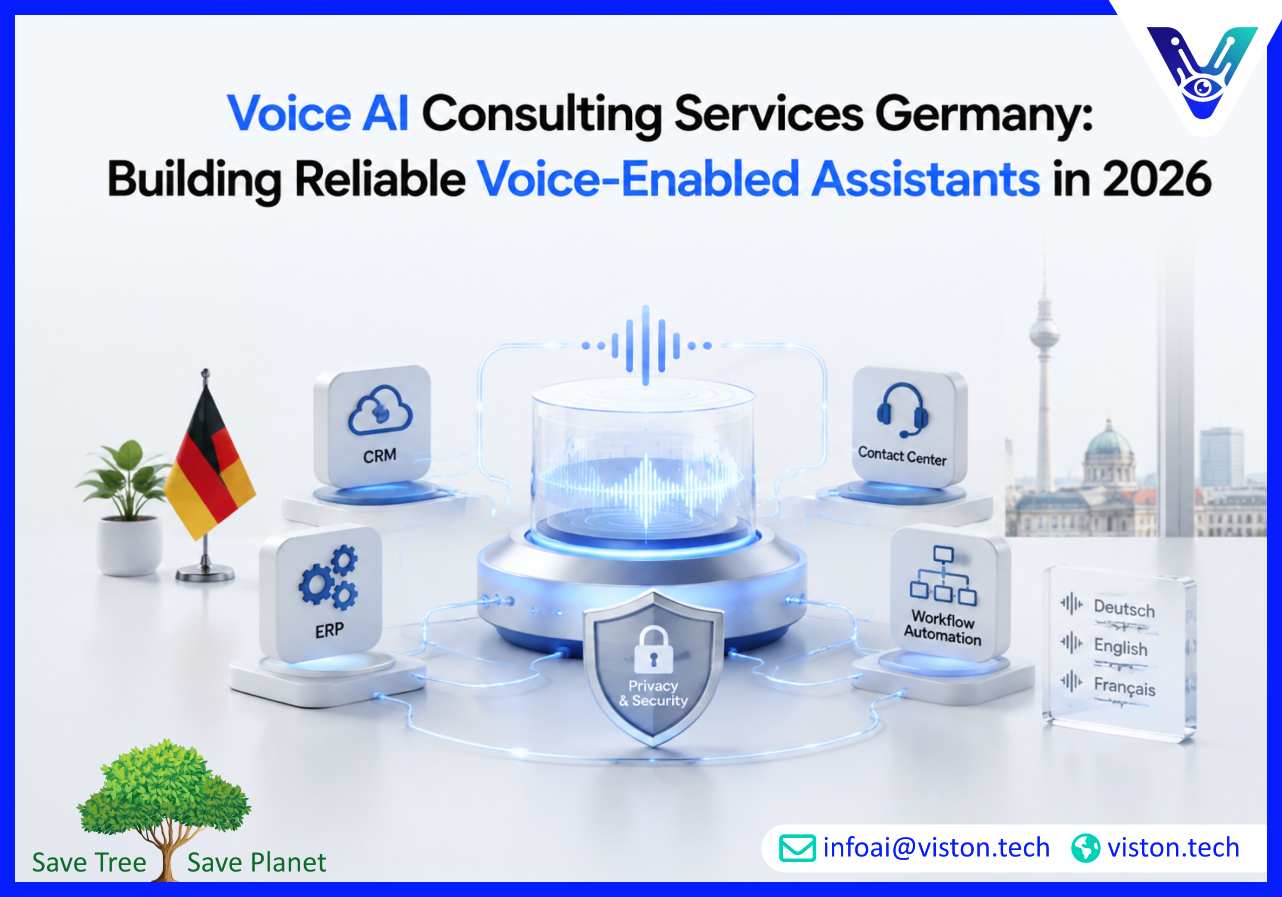
Voice AI Consulting Services Germany: Building Reliable Voice-Enabled Assistants in 2026
Voice AI consulting services Germany are becoming important for businesses that want faster customer support, safer automation, and more natural digital interactions. In 2026, voice-enabled assistants must combine speech technology, business integration, German-language accuracy, data protection, and measurable operational value.
What Voice AI Consulting Services Germany Mean for Businesses
Voice AI consulting services help organizations plan, design, build, deploy, and optimize voice-enabled assistants that can understand spoken language, respond naturally, and complete business tasks. For German businesses, this often means much more than adding a voice interface to an existing chatbot. It requires careful thinking about user intent, German language variation, privacy, integration, escalation, security, and long-term performance.A voice-enabled assistant may support customer service, sales qualification, appointment booking, order tracking, internal helpdesk requests, warehouse operations, field service workflows, or hands-free employee support. The consulting role is to determine which use cases are commercially valuable, technically realistic, compliant, and suitable for automation.Voice AI combines several capabilities. These include automatic speech recognition, natural language understanding, text-to-speech, conversation design, large language model orchestration, workflow automation, analytics, and integration with business systems. A consultant must understand how these components work together, where they can fail, and how to design a system that is useful in real business conditions.For companies in Germany, the consulting process should also consider local expectations around data privacy, consent, accessibility, language quality, and trust. A poorly designed voice assistant can frustrate users, misunderstand regional accents, record sensitive information unnecessarily, or create compliance concerns. A well-planned assistant can reduce repetitive manual work, improve response speed, support multilingual customers, and give teams better visibility into common service needs.
Where voice-enabled assistants create practical value
Businesses usually explore voice AI when they face pressure in high-volume communication or operational workflows. Common examples include contact centers handling repetitive calls, ecommerce teams managing order questions, manufacturers needing hands-free reporting, healthcare providers coordinating appointments, and service teams trying to reduce delays in routine requests.The value is strongest when the assistant can do more than answer basic questions. It should identify the user’s intent, retrieve trusted information, confirm details, complete a workflow, update a system, and escalate to a human when judgment is needed. This is why consulting is often necessary before development begins. The right strategy prevents the business from building a voice tool that sounds impressive but does not solve a real operational problem.
Why German Businesses Need a Voice AI Strategy in 2026
In 2026, voice AI is no longer treated as an experimental customer experience feature. Businesses expect AI systems to be secure, integrated, multilingual, measurable, and governed. German companies also operate in a market where reliability, privacy, precision, and process quality are especially important. A voice assistant must therefore be designed as a business system, not just a conversational interface.One major reason strategy matters is language complexity. German voice AI must handle formal and informal speech, compound words, industry terminology, regional accents, mixed English-German business language, and customer-specific vocabulary. In sectors such as manufacturing, finance, logistics, healthcare, and enterprise software, users often use technical terms that generic voice systems may not understand.Another reason is compliance. Voice interactions can involve personal data, call recordings, biometric identifiers, account details, health information, financial information, employee data, or customer complaints. Businesses must define what data is collected, how it is processed, how long it is retained, who can access it, and when users must be informed that they are interacting with an AI system.The EU AI Act also makes transparency and governance more important for AI deployments. Many business voice assistants may fall into lower-risk categories, but organizations still need clear disclosure, monitoring, and human oversight where appropriate. If the assistant is used in sensitive areas such as employment, healthcare, financial eligibility, biometrics, or safety-related operations, risk classification becomes more important and should be reviewed carefully before deployment.
Strategic questions to answer before development
A strong voice AI strategy should answer practical business questions before technology is selected. These questions include:
Which voice use cases are worth automating first?
Which German-language and multilingual requirements must be supported?
What systems must the assistant connect with, such as CRM, ERP, contact center, helpdesk, or SAP environments?
What information can the assistant access, and what should remain restricted?
When should the assistant escalate to a human agent?
How will consent, call recording, audit trails, and data retention be handled?
Which KPIs will prove whether the assistant is improving business outcomes?
These questions help businesses avoid common mistakes. Many voice AI projects fail because they start with a technology demo instead of a defined service model. Consulting helps connect the assistant to customer journeys, employee workflows, compliance obligations, and measurable results.
Core Capabilities to Expect from Voice-Enabled Assistants
A business-ready voice-enabled assistant should be evaluated through capability, reliability, integration depth, and governance. The quality of the spoken interaction matters, but it is only one part of the system. The assistant must understand context, complete tasks accurately, and operate safely inside the company’s environment.
Speech recognition and language understanding
Automatic speech recognition converts spoken language into text. For German businesses, this must perform well with German pronunciation, regional variation, background noise, industry-specific vocabulary, and mixed-language phrases. Natural language understanding then interprets what the user wants, identifies entities such as order numbers or appointment dates, and decides the next step in the conversation.
Natural and controlled speech responses
Text-to-speech quality affects trust and usability. The assistant should sound clear, professional, and appropriate for the brand. However, natural voice output must also be controlled. In business environments, the assistant should avoid uncertain claims, unsupported recommendations, or language that could create legal or customer service issues.
Business system integration
Voice AI becomes more valuable when it connects with operational systems. For German companies, this may include CRM platforms, SAP systems, ecommerce platforms, ticketing tools, contact center software, knowledge bases, scheduling systems, warehouse management systems, or internal databases. Integration allows the assistant to retrieve order status, create tickets, update records, book appointments, route leads, or trigger workflows.
Escalation and human handover
No voice assistant should be expected to resolve every situation. A reliable system knows when to escalate. Escalation rules may be based on low confidence, customer frustration, repeated failed attempts, sensitive topics, legal requests, complaints, or high-value sales opportunities. The handover should include conversation history, identified intent, customer details, and attempted resolution so the user does not need to repeat everything.
Analytics and continuous optimization
Voice AI performance should be measured continuously. Useful KPIs include intent recognition accuracy, containment rate, escalation rate, average handling time, completion rate, customer satisfaction, call abandonment, workflow success rate, and error patterns. Analytics help teams improve scripts, training data, knowledge content, integrations, and escalation logic over time.
Implementation Considerations for Voice AI in Germany
Implementing voice AI in Germany requires a disciplined delivery process. Businesses should begin with a focused use case rather than attempting to automate every voice interaction at once. A narrow but valuable deployment is easier to test, govern, improve, and scale.The first step is discovery. This includes reviewing current call volumes, customer journeys, support tickets, sales processes, employee workflows, system architecture, data flows, and compliance requirements. The goal is to identify where voice automation can reduce friction without increasing risk.The second step is conversation design. Voice conversations are different from text conversations. Users cannot scan a long answer, reread options easily, or copy information from a voice response. The assistant must use concise prompts, confirm important details, and guide users naturally through each step. German-language tone should also fit the audience, whether the assistant is supporting consumers, enterprise buyers, employees, patients, or partners.The third step is integration planning. Businesses should define which systems the assistant can read from, which systems it can write to, and which actions require human approval. This is especially important when the assistant handles account updates, bookings, payments, claims, employee requests, or operational logs.The fourth step is testing. Voice AI should be tested with real phrases, different accents, background noise, edge cases, failed inputs, and escalation scenarios. Businesses should test not only whether the assistant responds, but whether it completes the task accurately and safely.
Security and compliance should be designed from the start
Security cannot be added at the end of a voice AI project. Businesses should define authentication, access control, encryption, consent handling, transcript storage, data minimization, retention rules, audit logging, and vendor responsibilities early. If voice recordings are used for training or quality monitoring, the organization should be clear about lawful basis, user notice, and internal access controls.For German and EU-facing deployments, GDPR readiness is a practical requirement. The system should avoid collecting unnecessary personal data, protect sensitive information, and support accountable processing. If the assistant uses generative AI or connects to third-party models, the business should understand where data is processed and whether additional safeguards are needed.
Vendor evaluation criteria
When choosing a voice AI consulting partner, businesses should look for experience across speech technology, natural language processing, enterprise integration, data protection, analytics, and scalable deployment. The right partner should be able to explain not only what the assistant can do, but how it will be governed, monitored, improved, and connected to business outcomes.Evaluation should include questions about German-language performance, multilingual support, integration with existing systems, testing methodology, analytics dashboards, fallback handling, human escalation, security architecture, and post-launch optimization. A specialist provider should also be comfortable discussing what should not be automated.
How Viston AI Supports Voice AI Consulting and Voice-Enabled Assistants
Viston AI is relevant to voice AI consulting services Germany because its service portfolio includes Voice-Enabled AI Assistants, multilingual support, AI chatbot integration, NLP and text analysis, AI strategy development, LLMOps, model monitoring, and business system integration. These capabilities align closely with what organizations need when planning voice automation for customer, employee, and operational workflows.For businesses evaluating voice-enabled assistants, Viston AI’s approach is useful because voice AI requires both conversational intelligence and enterprise delivery discipline. A successful assistant must understand spoken intent, manage multi-turn dialogue, integrate with platforms such as CRM, ERP, helpdesk, or contact center systems, and provide analytics for continuous improvement. It also needs governance around privacy, consent, auditability, role-based access, and human escalation.Viston AI positions its voice assistant capabilities around natural language processing, speech recognition, speech synthesis, real-time analytics, LLMOps infrastructure, multilingual interaction, and integration architecture. This makes the company relevant for German businesses that want to explore voice AI without treating it as a standalone experiment. Its capabilities can support use cases such as customer service automation, retail voice commerce, internal helpdesk support, workflow automation, and hands-free operational assistance.For organizations in Germany or serving German-speaking markets, the practical value lies in building voice-enabled assistants that are not only conversational, but also secure, scalable, integrated, and aligned with measurable business outcomes.
Frequently Asked Questions
What are voice AI consulting services?
Voice AI consulting services help businesses assess, design, build, integrate, and optimize voice-enabled assistants. This includes use case planning, speech technology selection, conversation design, system integration, compliance review, testing, analytics, and ongoing improvement.
Why do German businesses need voice-enabled assistants?
German businesses can use voice-enabled assistants to reduce repetitive support workload, improve response speed, support multilingual users, automate routine workflows, and create hands-free access to business systems. The strongest value comes when voice AI is connected to real operational processes.
What should companies consider before launching voice AI in Germany?
Companies should consider German-language accuracy, GDPR compliance, user consent, call recording policies, system integration, escalation rules, security, data retention, accessibility, and measurable KPIs. A clear strategy helps reduce technical and compliance risk.
Can voice AI integrate with SAP, CRM, and helpdesk systems?
Yes. A well-designed voice-enabled assistant can integrate with SAP, CRM platforms, ticketing tools, contact center software, ecommerce systems, scheduling tools, and internal databases. Integration allows the assistant to complete tasks rather than only answer questions.
Is voice AI suitable for regulated industries?
Voice AI can be suitable for regulated industries when it is designed with strong governance, access controls, audit trails, data protection, human oversight, and clear escalation rules. Sensitive use cases should be reviewed carefully before automation.
Can Viston AI help with voice AI consulting services Germany?
Viston AI’s Voice-Enabled AI Assistants and related AI consulting capabilities are aligned with German businesses exploring secure, multilingual, integrated, and scalable voice AI systems for customer service, operations, and workflow automation.
Conclusion
Voice AI consulting services Germany are valuable for businesses that want to move beyond basic automation and create reliable voice-enabled assistants that support real workflows. In 2026, success depends on German-language performance, privacy-aware design, secure integration, clear escalation, analytics, and continuous optimization. Voice AI should be planned as part of the wider customer and operational experience, not as a disconnected tool. For organizations evaluating this opportunity, Viston AI offers relevant capabilities in voice-enabled assistants, NLP, multilingual support, integration, and AI strategy to help turn voice automation into a practical business capability.