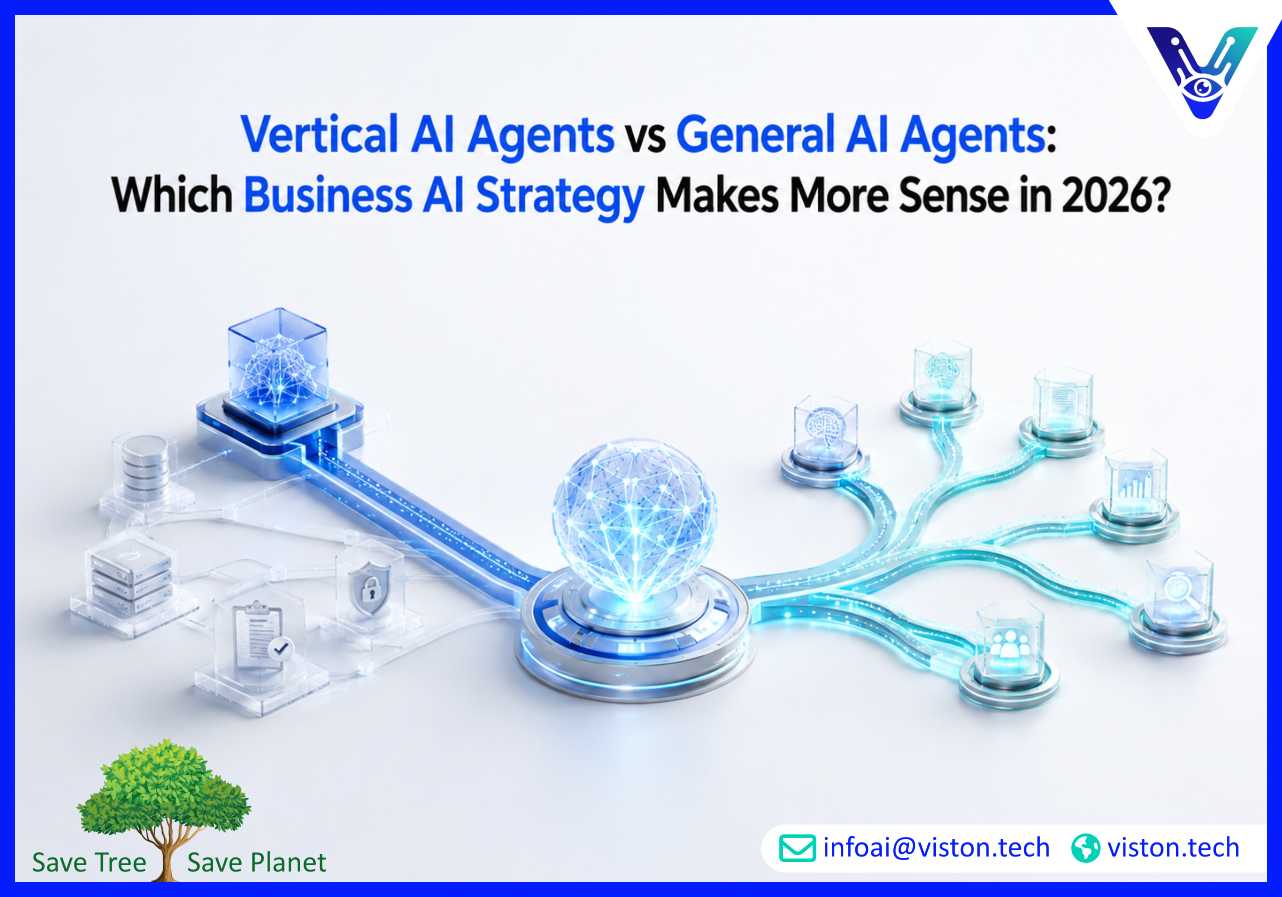
Vertical AI Agents vs General AI Agents: Which Business AI Strategy Makes More Sense in 2026?
Introduction
As organizations accelerate AI adoption, choosing the right type of AI agent has become a strategic decision. Businesses evaluating automation, customer support, operations, and decision intelligence often face a critical question: should they deploy a vertical AI agent built for a specific function or a general AI agent designed for broader capabilities? Understanding the differences can help organizations make smarter investments and achieve more reliable results.
Understanding Vertical AI Agents and General AI Agents
AI agents have evolved beyond simple chatbots and automation tools. Modern AI agents can reason, interact with systems, execute workflows, and assist with complex business processes.However, not all AI agents are designed the same way.
What Are Vertical AI Agents?
Vertical AI agents are specialized AI systems designed for a specific industry, business process, or operational function. They are trained, configured, and optimized to perform highly focused tasks within a defined environment.Examples include:
Healthcare patient intake agents
Financial compliance monitoring agents
Customer support automation agents
Logistics scheduling agents
HR recruitment screening agents
Insurance claims processing agents
These agents are built with domain-specific knowledge, workflows, regulations, integrations, and business rules.Their primary goal is operational efficiency and accuracy within a particular business function.
What Are General AI Agents?
General AI agents are broader systems capable of handling a wide variety of tasks across multiple domains.They typically provide:
Conversational assistance
Research support
Content generation
Workflow guidance
Data analysis
Knowledge retrieval
Multi-purpose automation
General AI agents are designed for flexibility rather than deep specialization.Instead of mastering one business process, they can assist across many different functions and departments.
Why This Decision Matters More in 2026
Businesses today expect AI systems to deliver measurable value rather than experimental outcomes.Decision-makers are evaluating AI initiatives based on:
Accuracy
ROI
Scalability
Security
Compliance
Integration capabilities
Operational impact
As AI budgets become more scrutinized, organizations are increasingly comparing vertical AI agents and general AI agents based on practical business performance rather than technological novelty.The right choice depends on the problem being solved.
Key Differences Between Vertical AI Agents and General AI Agents
1. Domain Expertise
The biggest distinction is specialization.Vertical AI agents are trained and configured around specific business domains. They understand industry terminology, workflows, compliance requirements, and operational procedures.For example, a healthcare-focused AI agent can understand medical scheduling, patient records, and healthcare regulations far better than a general-purpose system.General AI agents possess broad knowledge but may require additional prompting, validation, and supervision when dealing with specialized tasks.
2. Accuracy and Reliability
Businesses often prioritize accuracy over flexibility.Vertical AI agents generally achieve higher accuracy because they operate within a narrower scope.Benefits include:
Reduced hallucinations
Better contextual understanding
More predictable outputs
Improved workflow consistency
General AI agents can provide useful answers across many topics but may struggle when domain-specific precision is required.For regulated environments, this difference can be significant.
3. Implementation Complexity
General AI agents can often be deployed quickly because they require less customization initially.Organizations can start using them for:
Internal productivity
Knowledge management
Employee assistance
Content support
Vertical AI agents typically require:
Business process mapping
System integrations
Data preparation
Workflow configuration
Industry-specific training
While implementation may take longer, the resulting solution is often more aligned with business objectives.
4. Integration Requirements
Modern enterprises operate across multiple software platforms.Vertical AI agents frequently integrate with:
CRM systems
ERP platforms
Industry software
Customer databases
Compliance tools
Internal business applications
General AI agents often function as standalone assistants or knowledge interfaces unless customized further.Organizations seeking end-to-end process automation usually require deeper integration capabilities.
5. Compliance and Governance
Governance has become a major AI adoption factor in 2026.Vertical AI agents are often designed with industry-specific requirements in mind, including:
Data handling controls
Audit trails
Access management
Regulatory workflows
Risk mitigation measures
General AI agents can support governance initiatives but may require additional controls to meet specialized compliance requirements.
6. Cost Structure
General AI agents typically have lower initial deployment costs.Vertical AI agents may require higher upfront investment due to customization and integration work.However, organizations frequently find that specialized AI delivers stronger ROI when:
High-volume workflows exist
Labor-intensive processes need automation
Operational accuracy is critical
Business-specific knowledge is required
The total value depends on business goals rather than implementation costs alone.
When Vertical AI Agents Are the Better Choice
Vertical AI agents are often the preferred solution when organizations need deep operational support.They are particularly valuable for:
Process Automation
Businesses automating structured workflows benefit from AI agents that understand process rules and decision pathways.Examples include:
Claims processing
Customer onboarding
Vendor management
Compliance reviews
Document validation
Industry-Specific Operations
Specialized industries often require domain expertise that generic AI systems cannot easily provide.This includes:
Healthcare
Financial services
Manufacturing
Legal services
Logistics
Insurance
High-Accuracy Environments
When mistakes carry financial, operational, or regulatory consequences, specialized AI agents offer greater confidence.Organizations frequently choose vertical AI solutions for mission-critical workflows where reliability is essential.
When General AI Agents Make More Sense
General AI agents remain highly valuable for many organizations.They are particularly effective for:
Knowledge Assistance
Employees can use general AI agents for:
Information retrieval
Research
Documentation support
Internal knowledge access
Cross-Department Productivity
A single AI assistant can support multiple teams including:
Marketing
Sales
HR
Operations
Customer service
Early AI Adoption
Businesses beginning their AI journey often start with general AI agents to identify opportunities before investing in specialized systems.This approach allows teams to learn how AI fits into existing workflows.
The Rise of Hybrid AI Agent Architectures
One of the most important trends in 2026 is the emergence of hybrid AI ecosystems.Rather than choosing exclusively between vertical and general AI agents, organizations are combining both approaches.A typical architecture may include:
General AI agents for employee productivity
Vertical AI agents for operational workflows
Orchestration layers connecting multiple agents
Governance and monitoring systems
Centralized knowledge repositories
This model allows businesses to balance flexibility with specialization.Hybrid strategies are increasingly becoming the preferred enterprise approach because they support broader automation while maintaining operational accuracy.
Challenges Businesses Should Consider
Regardless of agent type, successful deployment requires careful planning.
Data Quality
AI performance depends heavily on data quality.Poor data can lead to:
Incorrect outputs
Reduced trust
Operational inefficiencies
Integration Complexity
AI agents must connect effectively with existing systems.Without proper integration, businesses may struggle to achieve meaningful automation outcomes.
Monitoring and Governance
AI systems require ongoing monitoring.Organizations should track:
Accuracy rates
User adoption
Workflow success
Risk indicators
Operational impact
Security Requirements
Businesses must protect:
Customer information
Internal knowledge
Sensitive records
Intellectual property
Strong governance frameworks are essential for sustainable AI adoption.
How AI Agent Development & Deployment Drives Better Results
Choosing between vertical AI agents and general AI agents is only one part of the equation.Successful outcomes depend on how AI systems are designed, implemented, integrated, and managed.AI Agent Development & Deployment typically includes:
Strategy assessment
Use case identification
Architecture design
Model selection
Workflow automation
Enterprise integrations
Security implementation
Performance monitoring
Continuous optimization
Organizations that invest in structured deployment methodologies often achieve faster adoption and more sustainable business value.The focus should be on solving operational challenges rather than simply implementing AI technology.
How Viston AI Supports AI Agent Development & Deployment
As businesses evaluate vertical AI agents versus general AI agents, implementation expertise becomes a critical success factor.Viston AI specializes in AI Agent Development & Deployment, helping organizations design, build, integrate, and optimize AI-driven solutions aligned with real business objectives. Rather than applying a one-size-fits-all approach, the focus is on identifying where specialized AI agents, general AI agents, or hybrid architectures can deliver measurable operational value.This includes evaluating business workflows, defining automation opportunities, integrating AI with existing systems, establishing governance controls, and creating scalable deployment strategies. Organizations often face challenges around data quality, system integration, monitoring, security, and long-term AI management. Addressing these areas early helps reduce deployment risks and improve adoption.For businesses exploring AI-powered automation, customer engagement, operational efficiency, or intelligent workflow management, a structured development and deployment approach helps ensure AI initiatives move beyond experimentation and into practical business outcomes. As AI ecosystems become more sophisticated in 2026, organizations increasingly benefit from implementation partners that understand both the technology and the operational realities of enterprise environments.
Frequently Asked Questions
What is the main difference between vertical AI agents and general AI agents?
Vertical AI agents specialize in specific industries or business processes, while general AI agents are designed to handle a broad range of tasks across multiple domains.
Are vertical AI agents more accurate than general AI agents?
In many business-specific scenarios, vertical AI agents achieve higher accuracy because they are trained and optimized for particular workflows, terminology, and operational requirements.
Can businesses use both types of AI agents together?
Yes. Many organizations now deploy hybrid AI environments that combine general AI agents for productivity with vertical AI agents for specialized operational tasks.
Which industries benefit most from vertical AI agents?
Industries with complex workflows, compliance requirements, or specialized knowledge requirements often benefit significantly from vertical AI agents, including healthcare, finance, insurance, logistics, and manufacturing.
How do companies choose between vertical and general AI agents?
The decision depends on business objectives, workflow complexity, accuracy requirements, integration needs, governance expectations, and expected ROI.
How can Viston AI help with AI agent deployment?
Viston AI provides AI Agent Development & Deployment services that help organizations evaluate use cases, build AI solutions, integrate systems, establish governance frameworks, and optimize long-term performance.
Conclusion
The debate around vertical AI agents vs general AI agents is not about which technology is universally better. It is about selecting the right approach for the business problem being solved. General AI agents offer flexibility and broad productivity benefits, while vertical AI agents deliver deeper specialization, accuracy, and operational value. As organizations continue investing in AI Agent Development & Deployment throughout 2026, many will adopt hybrid strategies that combine both models. With the right implementation approach and governance framework, businesses can turn AI from a promising technology into a reliable driver of efficiency, automation, and growth.