Translation vs Multilingual Support: What Is the Difference in 2026?
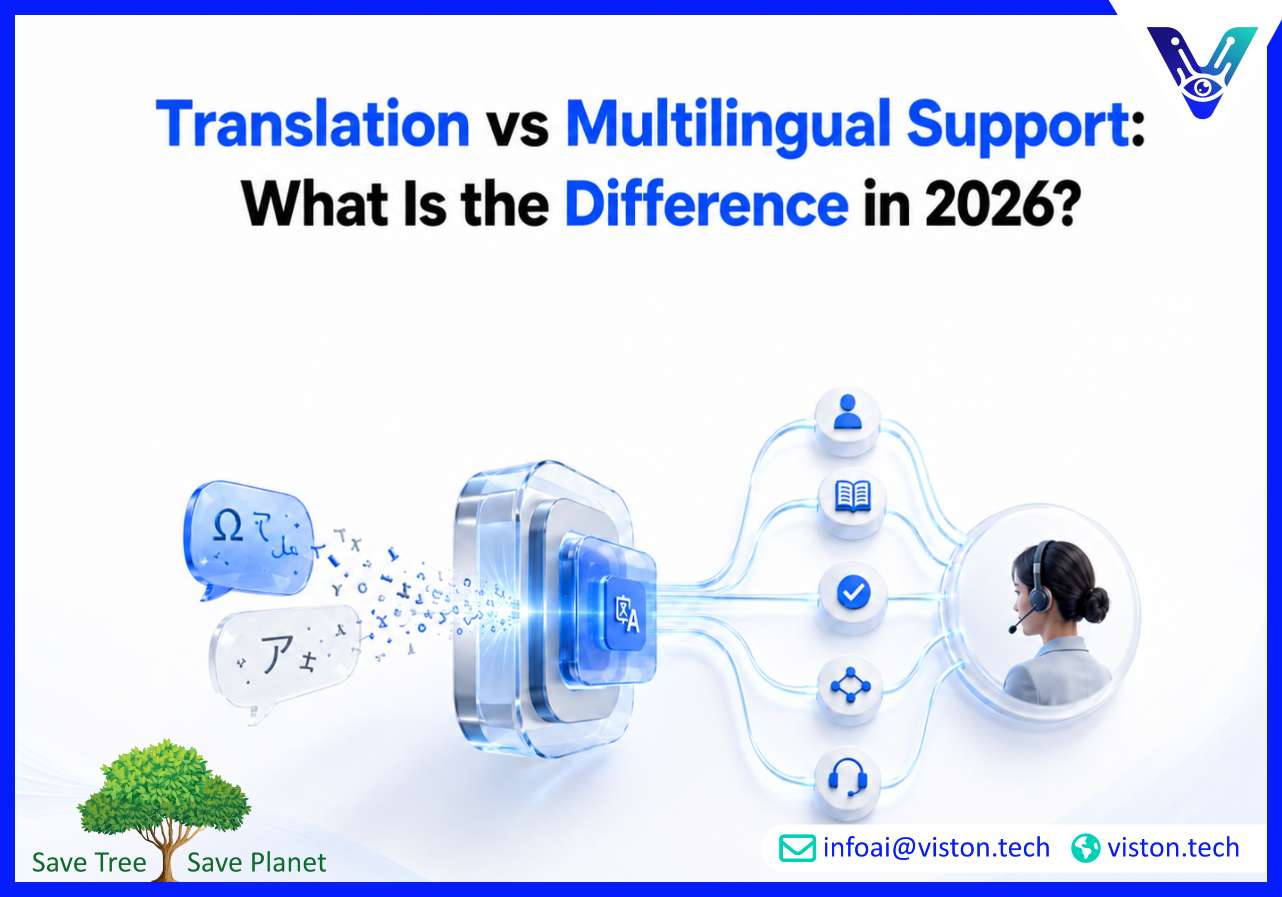
Businesses often use “translation” and “multilingual support” as if they mean the same thing. They do not. Translation converts content from one language into another, while multilingual support creates an end-to-end service experience that helps customers understand information, complete tasks, solve problems, and receive appropriate assistance in their preferred language.
What Translation and Multilingual Support Actually Mean
Translation converts meaning between languages
Translation is the process of changing written or spoken content from a source language into a target language while preserving its intended meaning. It may be completed by a professional linguist, machine translation system, AI model, or a combination of technology and human review.Businesses use translation for website pages, product descriptions, user manuals, contracts, marketing materials, emails, help articles, subtitles, chatbot messages, and internal documents. The work may be direct translation, or it may include localization so that terminology, currency, dates, measurements, examples, and tone fit a particular market.A translation task usually has a defined content item and output. A company supplies a document, message, or interface string in one language and receives an equivalent version in another. Quality is judged through linguistic accuracy, consistency, readability, terminology, and suitability for the target audience.
Multilingual support delivers service across languages
Multilingual support is an ongoing customer-service capability. It allows people to ask questions, explain problems, receive guidance, complete support workflows, and escalate issues in more than one language. It may combine multilingual agents, translated knowledge bases, real-time translation, language-aware routing, chatbots, voice systems, and human review.The key difference is that multilingual support must resolve a customer need, not merely convert words. A support interaction may require account data, order information, product knowledge, troubleshooting, policy interpretation, ticket creation, sentiment awareness, and handover to the right person. Industry definitions therefore describe multilingual support as the ability to provide customer service across multiple languages through integrated human and technology-based methods.Translation is one component of multilingual support, but it is not the complete operating model. A translated answer can be linguistically correct and still fail if it uses the wrong policy, ignores the customer’s account context, sends the case to the wrong team, or provides no way to escalate.
Translation vs Multilingual Support: The Key Business Differences
Scope: content output versus service outcome
Translation focuses on the quality of a piece of content. Multilingual support focuses on the outcome of an interaction. For translation, success may mean that a refund policy is accurately rendered in Spanish. For multilingual support, success means a Spanish-speaking customer can understand the policy, submit the required information, receive a decision, and get help if the case is unusual.
Direction: one-way communication versus two-way dialogue
Many translation projects are one-way: the business publishes information in several languages. Support is interactive. Customers use incomplete details, spelling variations, local expressions, and emotional language. The system or agent must interpret the request, ask useful questions, and adapt as the conversation develops.
Context: words versus business data
Translation can often be completed from the supplied text and reference materials. Multilingual support frequently needs live context from CRM, helpdesk, ecommerce, booking, billing, or account-management systems. An order-status answer is only useful when it identifies the correct customer, retrieves the current shipment information, explains it clearly, and protects personal data.
Coverage: selected assets versus connected channels
A company can translate its website without supporting customers in that language after purchase. Genuine multilingual support should define which languages are available across web chat, email, messaging, phone, mobile apps, social channels, and self-service content. Coverage does not have to be identical everywhere, but customers should know what is supported and how to reach the right channel.
People and workflow: linguists versus service operations
Translation requires language expertise, subject knowledge, terminology control, and quality review. Multilingual support adds conversation design, policies, routing, escalation, agent training, system integration, security, and ongoing management. Sensitive cases such as disputes, fraud concerns, legal requests, or technical failures may require specialist review rather than an automated translated response.
Measurement: language quality versus customer performance
Translation quality is measured through accuracy, terminology consistency, readability, and approval. Multilingual support must also track outcomes such as response time, first-contact resolution, customer satisfaction, fallback, escalation, repeat contact, and workflow completion by language. A system can produce fluent translations while delivering poor support, so businesses must evaluate whether customers actually solved their problem.
When Translation Is Enough and When Multilingual Support Is Needed
Translation may be enough for static or limited communication
Translation can be the right solution when the business need is clearly content-based. Examples include translating a brochure, product manual, policy document, landing page, training module, press release, or a fixed set of interface labels. It may also be sufficient when customer interaction is rare and a clear alternative support channel is available.For these projects, use approved terminology, version control, and synchronized updates. A translated help article becomes risky when the original policy changes but other language versions remain outdated.
Multilingual support is needed for ongoing customer journeys
A broader support model is necessary when customers need to interact with the business before, during, or after a transaction. Common examples include:
Product discovery, order tracking, returns, and payment questions
SaaS onboarding, account access, billing, and technical troubleshooting
Booking confirmations, schedule changes, and urgent travel assistance
Marketplace disputes involving buyers, sellers, payments, or delivery evidence
Financial, healthcare, insurance, or legal-service enquiries requiring controlled handling
Employee helpdesks, internal knowledge access, and IT service requests
In these situations, language is only one part of the problem. The support operation must recognize intent, retrieve trusted information, respect permissions, complete tasks, record outcomes, and escalate correctly.
Localization may be required in both cases
Neither basic translation nor a multilingual chatbot automatically creates a locally appropriate experience. Localization adjusts content and service behavior for regional expectations. It may change date formats, currencies, address fields, units, examples, level of formality, product availability, policy wording, and communication style.A business may therefore need translation for language conversion, localization for market suitability, and multilingual support for ongoing service delivery. These are connected capabilities, but each solves a different part of the customer experience.
How to Build Multilingual Support Beyond Basic Translation
Start with real language demand
Review customer locations, browser languages, support tickets, sales enquiries, failed searches, chat transcripts, and market plans. Prioritize languages based on actual demand, commercial opportunity, service risk, and the ability to maintain quality. Supporting three languages reliably is better than claiming broad coverage that cannot resolve real issues.
Create an approved source of truth
Multilingual support depends on accurate source knowledge. Product information, policies, troubleshooting steps, pricing rules, escalation instructions, and compliance language should have named owners and review dates. Translation cannot repair conflicting or outdated source content.Use a terminology glossary for product names, technical terms, legal phrases, and brand language. This improves consistency across human agents, AI systems, help articles, and customer-facing workflows.
Design complete workflows by language
Map what happens from the first customer message to final resolution. Define language detection, identity checks, information retrieval, automated actions, human handover, ticket updates, and follow-up. Decide which enquiries can be automated and which require fluent or specialist human review.Real-time translation can help an existing service team handle more languages, but it should be treated as an operational tool rather than a guarantee of quality. Agents need access to the original message, translated version, customer context, and a clear route for language review when meaning is uncertain.
Test with native customer language
Testing should include informal wording, spelling errors, mixed-language messages, regional vocabulary, and long-tail enquiries. A 2026 research preprint on logistics customer service found that machine-translated test sets could overstate multilingual intent-classification performance compared with noisy native queries. The practical lesson is to test support systems with realistic customer language rather than only clean translated examples.
Measure each language separately
Overall performance can hide weak results in lower-volume languages. Track resolution, satisfaction, escalation, fallback, repeat contact, and correction rates for each supported language and channel. Review failed conversations regularly, update knowledge, refine routing, and expand coverage only when the operating model is stable.
How Viston AI Helps Businesses Move from Translation to Multilingual Support
Viston AI’s Multilingual AI Chatbot Support service is relevant because it addresses the operational layer that sits beyond basic language conversion. Its published capabilities include real-time translation and localization, multilingual intent recognition, omnichannel deployment, intelligent routing and escalation, performance analytics, and integration with CRM platforms, knowledge bases, transaction systems, and other business applications.This approach supports businesses that need customers to do more than read translated content. A multilingual assistant can help users find information, check an order or account, follow a troubleshooting flow, submit details, create a support case, or transfer to a human agent with conversation context preserved.Viston AI also describes a delivery methodology covering discovery, data preparation, model development, testing, integration, deployment, monitoring, and continuous optimization. That lifecycle is important because multilingual support quality changes as products, policies, customer language, and business workflows evolve.For organizations serving global or linguistically diverse audiences, the practical value lies in connecting language capability with trusted knowledge and real operations. Rather than treating translation as an isolated task, Viston AI can help structure multilingual support around priority languages, customer intents, business systems, escalation requirements, and measurable service outcomes.
Frequently Asked Questions
Is multilingual support the same as translation?
No. Translation converts content from one language to another. Multilingual support enables customers to ask questions, complete tasks, resolve issues, and receive appropriate human or automated assistance across multiple languages.
Can machine translation provide multilingual customer support?
Machine translation can support multilingual service by translating messages in real time, but it is only one component. Reliable support also needs accurate knowledge, customer context, workflow integration, routing, security, quality monitoring, and human escalation.
What is the difference between localization and multilingual support?
Localization adapts content or experiences for a specific market, including language, tone, formats, cultural expectations, and regional rules. Multilingual support is the ongoing service capability that helps customers across languages and may use localized content within its workflows.
Does a business need native-speaking agents for every supported language?
Not always. AI translation, multilingual chatbots, localized knowledge bases, and agent-assist tools can handle many routine enquiries. Fluent human review remains important for sensitive, complex, culturally nuanced, regulated, or high-value interactions.
How should a company choose which languages to support?
Use customer demand, revenue opportunity, ticket volume, market strategy, operational risk, and available quality resources. Begin with priority languages and high-volume use cases, then expand based on measured performance.
How can Viston AI support a multilingual service strategy?
Viston AI provides multilingual chatbot capabilities that combine language processing, translation and localization, omnichannel delivery, system integration, routing, analytics, and continuous optimization. These capabilities can help businesses build support workflows rather than relying on isolated translated messages.
Conclusion
The difference between translation and multilingual support is the difference between converting language and delivering service. Translation makes content understandable; multilingual support helps customers achieve an outcome through accurate knowledge, connected workflows, suitable automation, and human assistance when needed. In 2026, businesses should use translation for defined content needs and adopt Multilingual Support when customers require ongoing interaction across channels. Viston AI offers relevant capabilities for organizations seeking to connect multilingual communication with business systems, escalation, analytics, and continuous service improvement.