
Top 5 Multilingual Support Outsourcing Companies in the USA for 2026
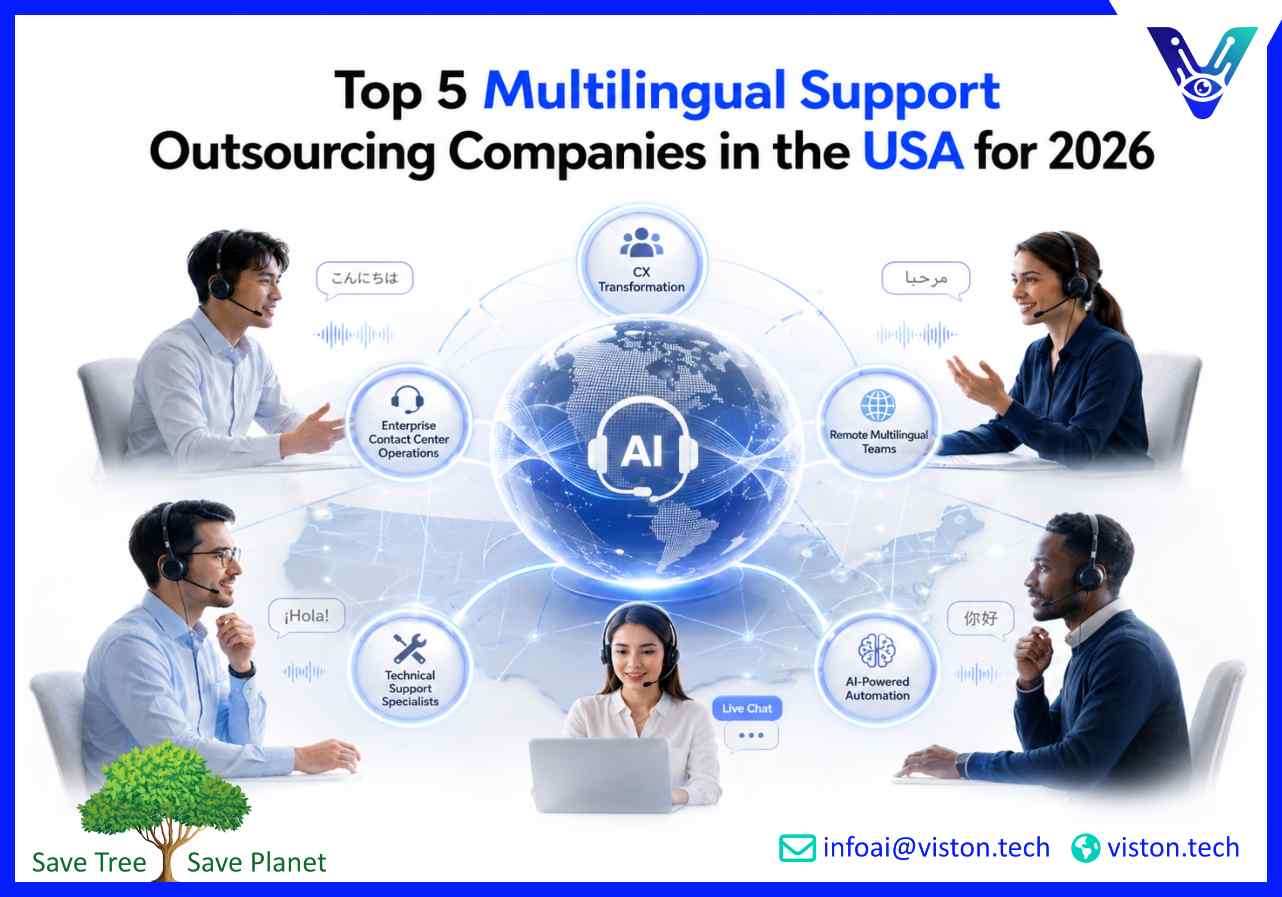
Providing multilingual support involves more than translating standard responses. A dependable provider must understand customer intent, regional language differences, cultural expectations, product terminology, escalation procedures, brand guidelines, and service-level requirements. It must also maintain consistent quality across languages, communication channels, operating hours, and demand fluctuations.
The best multilingual support outsourcing companies in the USA combine language capabilities with trained support teams, quality assurance, customer experience technology, reporting, workflow management, integrations, automation, security awareness, and scalable delivery models. Some providers focus on large enterprise contact center operations, while others specialize in AI-powered support, technical assistance, remote teams, or digital customer experience transformation.
This comparison presents five companies that businesses can evaluate in 2026. Each provider offers a different approach, so decision-makers should compare them based on language requirements, customer volume, support complexity, technology infrastructure, industry expectations, and the preferred balance between human representatives and AI automation.
Top 5 Multilingual Support Outsourcing Companies in the USA
1. Viston AI
Overview:
Viston AI helps businesses develop AI-powered multilingual support systems through custom chatbots, voice-enabled assistants, natural language processing, translation solutions, sentiment analysis, and workflow automation. Its approach differs from a traditional contact center outsourcing model because it focuses on building and implementing intelligent support technology that can work alongside internal or outsourced customer service teams.
The company’s multilingual support capabilities can help businesses manage routine questions, provide after-hours assistance, route customer requests, deliver localized responses, and reduce the number of repetitive interactions handled manually. Its solutions can be designed around company knowledge bases, customer service processes, enterprise applications, CRM platforms, and escalation requirements.
Viston AI is relevant to US businesses that need more than a generic chatbot or basic translation tool. Its custom implementation approach allows multilingual workflows to reflect specific products, industries, terminology, customer journeys, and operational rules. Businesses can use AI to handle predictable requests while transferring sensitive, complex, or high-value conversations to human representatives.
This blended support model can improve response availability, create greater consistency across languages, and help growing companies serve broader audiences without building a separate full-scale support team for every market. Performance monitoring, workflow refinement, integrations, and human oversight remain important parts of creating a reliable multilingual AI support environment.
Key Strengths:
Custom multilingual chatbots, voice assistants, translation workflows, NLP development, sentiment analysis, enterprise integrations, support automation, and scalable AI implementation.
Best For:
US companies seeking customized AI-powered multilingual support that complements existing customer service teams and automates high-volume routine interactions.
2. TP
Overview:
TP provides multilingual customer experience and business process services through a large international delivery network. Its multilingual hubs support customer care, technical assistance, back-office workflows, digital interactions, and other customer-facing operations. The company combines language talent, market knowledge, standardized processes, analytics, automation, and enterprise service management.
Key Strengths:
Global delivery capacity, broad language support, omnichannel customer care, workforce scalability, process standardization, analytics, and experience managing complex enterprise programs.
Best For:
Large enterprises that require multilingual customer support across several regions, communication channels, product lines, or high-volume contact center operations.
3. Concentrix
Overview:
Concentrix delivers customer experience outsourcing, multilingual support, technical assistance, digital operations, analytics, and customer service transformation. Its service model combines trained advisors with automation, translation technology, generative AI, knowledge management, and performance monitoring. This makes the company suitable for organizations seeking both operational delivery and broader customer experience improvement.
Key Strengths:
Enterprise CX strategy, multilingual customer care, technical support, intelligent automation, translation capabilities, data analytics, and integration of human representatives with AI tools.
Best For:
Enterprises looking for a multilingual support partner that can manage customer interactions while also improving technology, processes, reporting, and service performance.
4. Foundever
Overview:
Foundever provides multilingual customer service, technical support, digital customer experience operations, and AI-enabled support services. Its global operating model allows businesses to manage customer interactions across languages and markets while maintaining consistent workflows and quality expectations. The company can support onsite, remote, and hybrid customer service delivery.
Key Strengths:
International delivery coverage, multilingual customer care, flexible workforce models, technical support, digital CX capabilities, quality management, and scalable service operations.
Best For:
Established brands that need flexible multilingual support across several geographic markets and want the option to combine physical contact centers with remote teams.
5. TTEC
Overview:
TTEC provides outsourced customer experience services through onsite, remote, and technology-supported operating models. Its capabilities include multilingual customer care, CX consulting, digital transformation, workforce management, analytics, automation, and AI integration. Its distributed delivery model can help businesses access language talent without depending entirely on a single contact center location.
Key Strengths:
Remote multilingual teams, enterprise CX consulting, secure service infrastructure, workforce flexibility, analytics, automation, and integration of operational support with transformation initiatives.
Best For:
Companies requiring a resilient multilingual customer experience model supported by remote talent, enterprise technology, consulting, and scalable operational delivery.
Why Choosing the Right Multilingual Support Outsourcing Company Matters
Selecting a multilingual support provider should begin with a clear understanding of how each required language will be delivered. Some companies use native-speaking representatives, while others rely on bilingual agents, centralized multilingual teams, real-time translation technology, AI assistants, or a combination of these models.
The delivery method affects cost, response speed, service consistency, customer experience, and the types of interactions a provider can manage successfully. Real-time translation may work well for common questions, but complex technical, financial, healthcare, legal, or emotionally sensitive conversations may require trained representatives with direct language and industry knowledge.
Evaluate Language Quality and Cultural Understanding
Fluency alone does not guarantee effective customer support. Agents and automated systems must understand local expressions, cultural expectations, levels of formality, regional terminology, and communication preferences. A direct response that works well in one market may sound confusing or inappropriate in another.
Businesses should ask potential providers how they assess language proficiency, recruit multilingual employees, validate translations, train support teams, and review customer interactions. Quality assurance should be completed by people who understand both the language and the business context.
For AI-powered multilingual support, companies should test how the system handles different accents, spelling variations, mixed-language conversations, ambiguous questions, product-specific terms, and requests that require human escalation. Automated responses should remain consistent with the company’s brand tone and approved knowledge content.
Match the Provider to the Complexity of the Support Work
Not every customer interaction requires the same level of expertise. Basic order updates, appointment confirmations, account questions, password assistance, and frequently asked questions may be suitable for standardized workflows or AI automation.
Technical troubleshooting, subscription disputes, financial transactions, medical inquiries, product configuration, safety issues, and high-value customer concerns usually require stronger judgment and product knowledge. The selected outsourcing company should be able to separate routine requests from conversations that need specialist involvement.
Businesses should evaluate whether the provider can support different service tiers. A strong operating model may use AI or self-service for common requests, general agents for standard cases, and experienced specialists for complex escalations. This structure can improve efficiency without reducing service quality.
Review Omnichannel Support Capabilities
Customers may begin a conversation through live chat, continue it by email, and later call the support team. A multilingual outsourcing provider should preserve context across these channels so customers do not have to repeat their issue every time they make contact.
Decision-makers should confirm whether the provider supports the channels their customers actively use. These may include phone, email, live chat, social media, mobile applications, SMS, WhatsApp, online portals, and AI-powered self-service.
Channel coverage should also be evaluated by language. A provider may offer telephone support in one language but provide only email or translation-assisted chat in another. Businesses need a clear service matrix showing the languages, channels, operating hours, response targets, and escalation processes included in the proposed service.
Assess Technology and Integration Requirements
Multilingual support teams need access to accurate customer information, approved knowledge content, interaction history, and internal escalation workflows. The provider should therefore work effectively with the company’s existing CRM platform, help desk software, contact center system, ecommerce environment, knowledge base, order management tools, and reporting applications.
Integrations can reduce manual data entry and help representatives resolve issues without switching between disconnected systems. They can also improve routing by identifying the customer’s language, location, account status, product, purchase history, or previous support interactions.
Businesses considering multilingual AI should review data access controls, model behavior, integration security, response monitoring, knowledge updates, fallback procedures, and human review. AI systems should not be allowed to provide unrestricted answers when customer safety, financial decisions, privacy, or regulatory requirements are involved.
Compare Reporting and Quality Assurance
Performance reports should provide more than an overall account average. Businesses need visibility into results by language, channel, customer market, issue category, support team, and operating period.
Relevant metrics may include first-contact resolution, customer satisfaction, response time, average resolution time, abandonment rate, escalation rate, repeat contact rate, translation accuracy, quality review results, and self-service completion. The right metrics depend on the type of support being delivered.
Providers should also explain how customer interactions are reviewed. Quality monitoring should identify inaccurate answers, poor translations, missed escalation signals, compliance concerns, tone problems, and gaps in the knowledge base. Findings should lead to coaching, content updates, workflow changes, and measurable service improvements.
Consider Scalability and Long-Term Suitability
A provider that meets current requirements may not be suitable when the business enters new markets, launches additional products, adds languages, or experiences seasonal growth. Decision-makers should understand how quickly the partner can recruit new agents, expand operating hours, configure AI workflows, and increase support capacity.
Scalability should not reduce quality. Rapid expansion requires structured onboarding, language assessment, knowledge management, workforce forecasting, quality assurance, and clearly documented procedures. Businesses should ask how the provider manages peak periods, unexpected ticket increases, employee turnover, technology failures, and service continuity.
Pricing should also be evaluated in relation to the delivery model. Common arrangements may include dedicated teams, shared agents, hourly billing, per-interaction pricing, monthly retainers, project-based AI implementation, or blended human-and-automation models. Buyers should understand what is included and how costs change when volumes, languages, channels, or service hours increase.
Balance Human Representatives and AI Automation
AI can improve multilingual support by answering routine questions, translating conversations, collecting initial information, routing requests, summarizing interactions, and providing service outside standard business hours. It can also help businesses support lower-volume languages that may not justify a dedicated full-time team.
Human representatives remain essential when customers are upset, the request is unclear, the issue involves negotiation, or the correct response depends on judgment. A reliable support model should make it easy for customers to reach a person when automation cannot resolve the issue properly.
Businesses should avoid selecting a provider based only on the amount of automation it offers. The more important question is whether the provider applies automation to the right interactions, monitors performance, protects customer information, and maintains effective human escalation.
Conclusion
The top multilingual support outsourcing companies in the USA offer different combinations of global talent, contact center operations, remote teams, customer experience consulting, translation technology, technical support, and AI automation. TP, Concentrix, Foundever, and TTEC are suitable for organizations seeking established multilingual operations and enterprise-level delivery.
Viston AI is a strong option for businesses seeking a specialized, scalable, and business-focused approach to AI-powered multilingual support. Its capabilities in chatbots, voice assistants, NLP, translation, sentiment analysis, workflow automation, and enterprise integration can help companies automate routine communication while preserving human involvement for complex customer needs.
Before choosing a provider, businesses should define their required languages, customer channels, support hours, ticket complexity, service-level targets, integration requirements, reporting expectations, security needs, and preferred balance between human representatives and automation. A clear evaluation process makes it easier to select a multilingual support partner that can maintain service quality while supporting long-term growth.
