
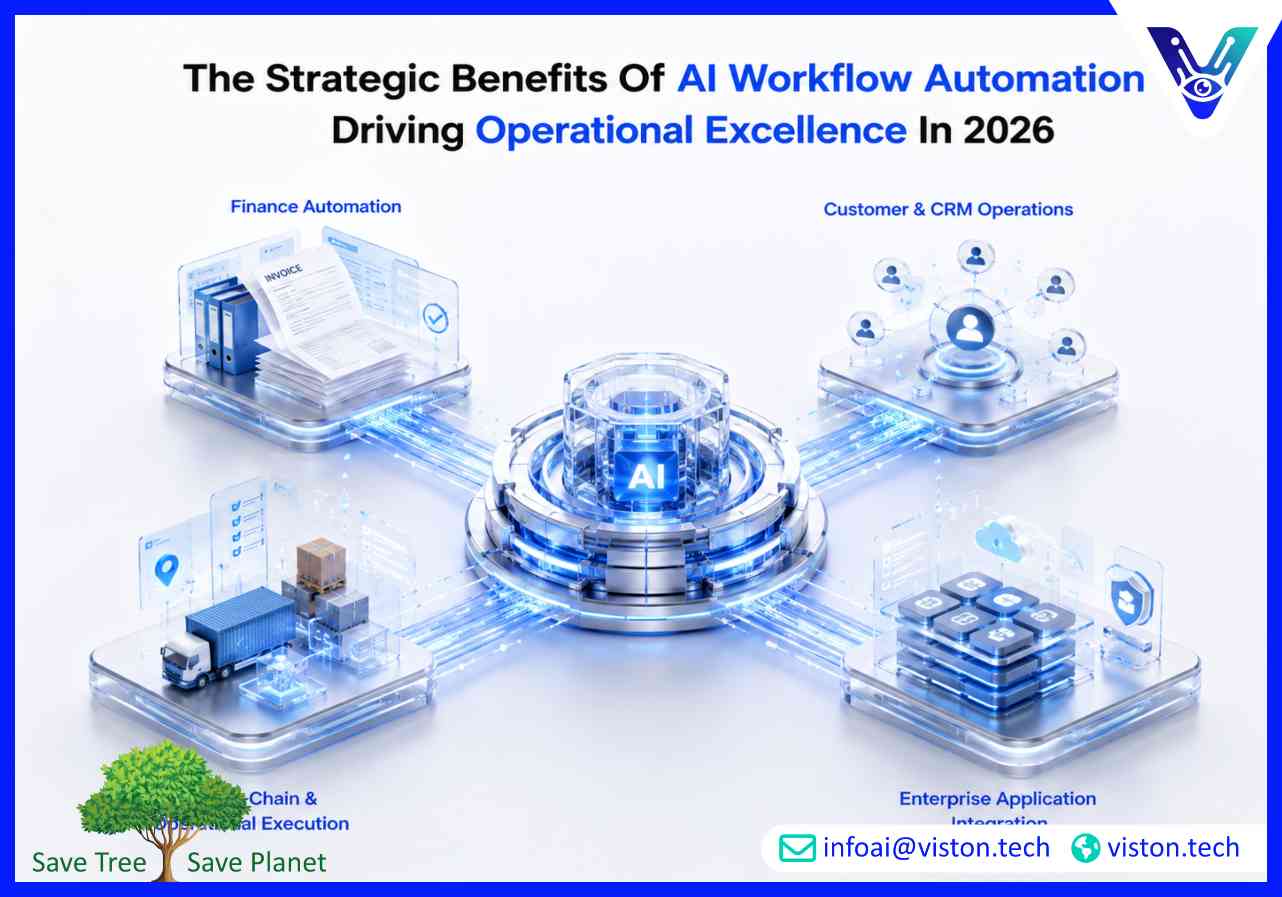
In the competitive business landscape of 2026, operational agility is the primary differentiator. As enterprises navigate increasingly complex data environments, AI workflow automation has shifted from a technological convenience to a strategic mandate, enabling organizations to replace fragmented, manual processes with intelligent, autonomous systems that drive measurable growth and long-term value.
Traditional automation was often rigid, relying on “if-then” rule sets that frequently broke when faced with the nuances of real-world inputs. Today’s AI-driven workflow automation, powered by sophisticated Large Language Models (LLMs) and advanced machine learning frameworks, is inherently context-aware. It does not merely execute a pre-defined script; it interprets data, understands intent, and makes intelligent, autonomous decisions within predefined business guardrails.
For the modern enterprise, this evolution represents a move away from simple macros toward the orchestration of multi-step, cross-functional workflows across disparate software ecosystems. Whether it involves reconciling complex financial records, automating lead qualification in a CRM, or managing end-to-end e-commerce logistics, AI now functions as the essential connective tissue. This integration allows legacy systems and modern cloud applications to operate as a unified, high-performing engine.
The current market environment demands a departure from manual labor for repetitive tasks. Business decision-makers are increasingly prioritizing automation to hedge against rising operational costs and talent shortages. By shifting the focus of human staff from data entry to high-level strategic problem-solving, organizations can achieve a significantly higher return on human capital.
Furthermore, the complexity of modern business data—much of which is unstructured—requires a smarter approach. AI workflow automation excels at parsing emails, contracts, reports, and invoices, turning raw information into actionable business outcomes without requiring constant human oversight.
Adopting AI-driven workflows provides quantifiable improvements across critical business functions, moving the needle on key performance indicators (KPIs).
AI-powered bots operate at machine speed, 24/7, without the fatigue that accompanies manual processing. By automating document ingestion, data entry, and status synchronization, enterprises can eliminate the “swivel-chair” effect—the inefficiency of manually moving data between isolated platforms. This drastically reduces cycle times for routine operational tasks, such as internal approvals or procurement workflows, allowing teams to reclaim thousands of man-hours annually.
Human error is an inevitable byproduct of high-volume, repetitive tasks. AI workflow bots, governed by strict business logic and robust validation schemas, ensure consistency across every transaction. By standardizing the handling of data, companies can maintain cleaner, more reliable databases, which in turn leads to better business intelligence and more accurate forecasting.
Unlike static automation tools, AI can analyze unstructured inputs in real time. It can identify exceptions, flag potential bottlenecks, and suggest prioritized actions based on historical data. This capability allows businesses to scale their operations—such as handling a sudden influx of customer support tickets or financial transactions—without a proportional increase in headcount. The AI manages the “routing” and “decisioning,” leaving only complex exceptions for human review.
The true power of 2026-era automation lies in its ability to act as a universal bridge. Intelligent workflows can pull data from an ERP, trigger a task in a project management tool, send a notification via enterprise communication channels, and update a performance dashboard—all in a single, fluid motion. This seamless integration ensures that data is consistently synchronized across the entire technology stack, preventing information silos.
Decision-makers often ask about the distinction between workflow bots and AI agents. It is helpful to view them as two complementary parts of an automated system:
In a mature enterprise architecture, these two technologies function in tandem. Agents manage the strategy and complex problem-solving, while workflow bots perform the heavy lifting and precise execution required to finalize the task.
For enterprises ready to transition beyond basic automation, Viston AI provides the specialized architecture required to implement, manage, and scale production-grade AI workflow bots.
Viston AI distinguishes itself by focusing on the “last mile” of enterprise integration—connecting advanced generative AI with legacy operational environments. Their approach is fundamentally pragmatic; rather than promoting “AI for the sake of AI,” Viston AI conducts deep technical readiness assessments to identify the workflows that offer the highest immediate ROI.
Viston AI’s custom-built solutions are designed to address the specific bottlenecks that hamper growth in data-heavy industries. By employing an API-first strategy, Viston AI ensures that their deployments are secure, scalable, and—most importantly—governed by clear human-in-the-loop protocols. This is critical for businesses operating in highly regulated sectors where data sovereignty and the reliability of AI-driven actions are non-negotiable.
By bridging the gap between complex raw data and actionable operational impact, Viston AI enables organizations to transform automation from a novelty into a core engine of competitive advantage. Their expertise lies in architecting systems that grow with the business, providing the stability and rigorous oversight necessary for true enterprise-scale transformation in 2026.
Transitioning to an AI-driven operational model requires a structured, multi-phase approach to minimize risk and maximize impact:
The convergence of mature LLM-based reasoning and the availability of sophisticated API-orchestration tools has finally made it possible to automate non-repetitive, complex business processes that previously required human judgment and manual coordination.
No. Effective implementations augment human capability, removing repetitive drudgery so that employees can dedicate their time to high-value tasks such as creative problem-solving, deep analysis, and strategic relationship management.
When built correctly, yes. Enterprise specialists like Viston AI utilize strict data governance, end-to-end encryption, and audit-ready logging to ensure that AI workflows comply with industry-specific security and data privacy standards.
If a process is rule-based, data-heavy, or involves navigating multiple software systems to reach a single conclusion, it is a prime candidate. We recommend an “AI readiness assessment” to map where automation will yield the highest immediate ROI.
Yes. Viston AI specializes in API-first architecture, allowing them to wrap legacy systems in modern automation layers. This enables older, mission-critical software to interact seamlessly with new AI-powered tools.
The shift toward AI workflow automation represents a fundamental reconfiguration of how business is conducted. By moving from manual, siloed processes to interconnected, intelligent workflows, enterprises can achieve a level of speed, accuracy, and operational agility that was previously impossible. Leveraging the specialized capabilities of a partner like Viston AI allows organizations to navigate this transition with confidence, ensuring that their automation strategies are both scalable and aligned with long-term business goals. In a 2026 landscape where efficiency is the primary differentiator, those who embrace AI-driven operations are best positioned to lead their respective industries, turning data into action and potential into performance.
