
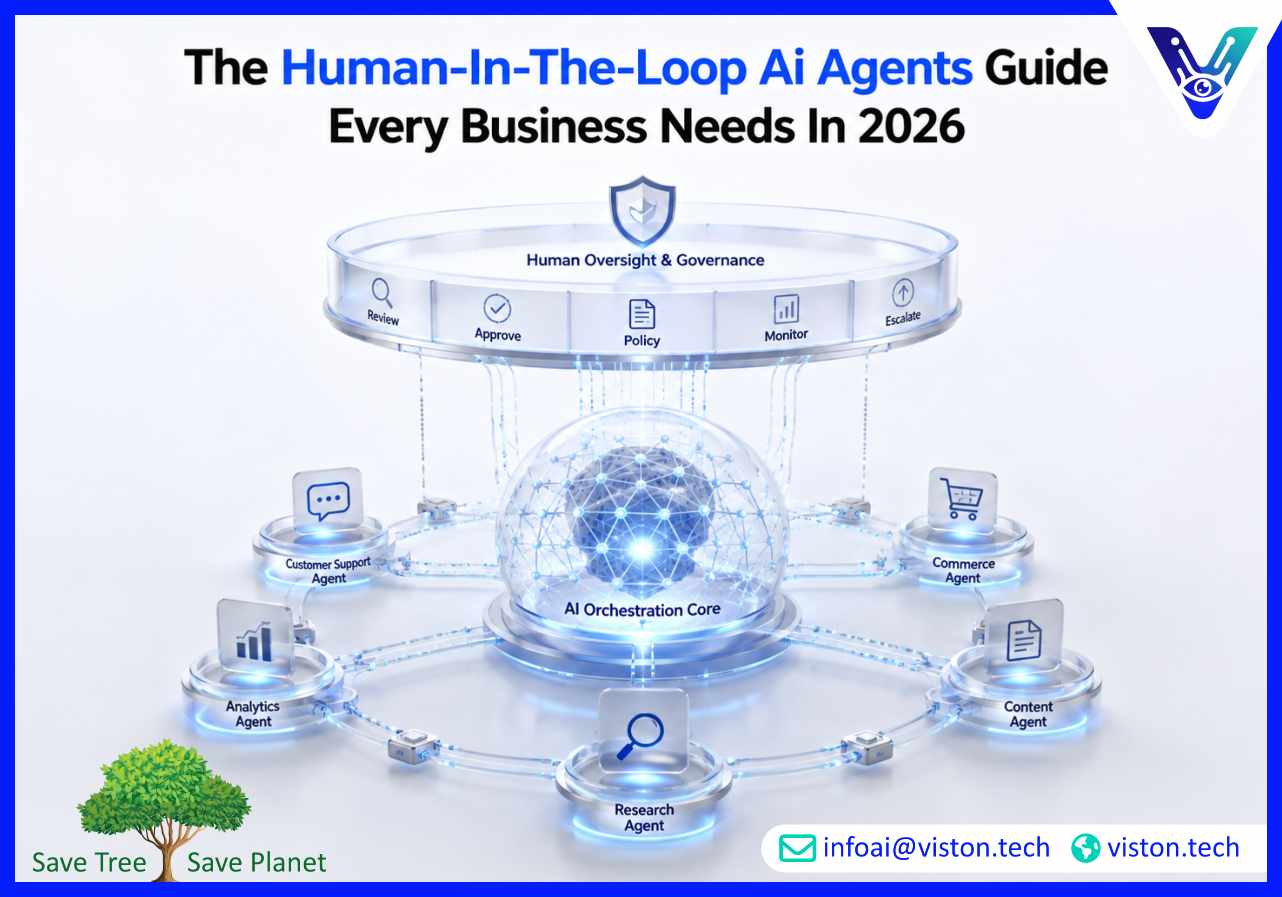
Autonomous AI agents are no longer an experiment. They are booking meetings, processing transactions, modifying infrastructure, and making operational decisions at speed and scale across enterprises worldwide. But speed without oversight is where deployments unravel. Understanding how human-in-the-loop design works — and how to implement it correctly — is now a foundational requirement for any serious AI agent strategy.
Human-in-the-loop (HITL) is not a reluctant compromise or a sign that your AI agents are underperforming. It is an architectural pattern — a deliberate design choice that embeds structured human decision points into autonomous agent workflows at the moments where the stakes are high enough to warrant them.
The practical definition matters here. HITL means a qualified person, with the right context, the authority to act, and a defensible rationale, is positioned at critical points in an AI workflow to review, approve, redirect, or override agent actions before they produce irreversible consequences.
That distinction — before consequences, not after — is what separates genuine oversight from a paper audit trail.
AI agents executing multi-step workflows can trigger real-world outcomes: moving money, sending customer-facing communications, modifying access controls, updating records across integrated systems. When those actions are wrong, the recovery cost is rarely limited to fixing a single data point. It compounds. HITL design is how development teams define and enforce the boundaries between what agents handle autonomously and what requires a human decision.
Three forces have converged to make human-in-the-loop design a non-negotiable component of enterprise AI agent deployment this year.
Regulatory pressure is now enforceable. The EU AI Act’s Article 14 requirements, enforceable from August 2026, mandate that high-risk AI systems include human-machine interface tools enabling qualified oversight, with the ability to intervene, stop, or override the system where appropriate. For any organization whose agents operate within EU markets, this is a legal architecture requirement, not a best practice recommendation. NIST’s AI Risk Management Framework similarly calls for human-in-the-loop checks tied to confidence thresholds and risk mapping. In the United States, the CFPB has made clear that AI-driven credit decisions require explainability — if a lender cannot demonstrate how a model generated a decision, that model cannot be used.
Agent capability has expanded faster than governance. Recent large language models have demonstrated strong performance in executing long-running, multi-step agentic tasks across financial analysis, code generation, research, and customer operations. Enterprise adoption is accelerating rapidly, with task-specific AI agents now appearing in a growing share of business applications. More capability without proportionate governance design creates compounding operational and reputational risk.
The cost of automation failures is now material. When an agent misclassifies a transaction, publishes incorrect customer-facing content, or escalates a low-risk event to a high-priority incident, the downstream cost is not abstract. HITL architecture is how organizations capture the efficiency of autonomous operation while protecting against the class of errors that agents, left unchecked, are structurally likely to make.
Most organizations believe they have human oversight because they have assigned someone to monitor an AI system. That is presence, not practice. Effective HITL architecture requires three specific components working together.
Context. The human reviewer must have access to the right information at the moment of review — not a summary, not a log viewed after the fact, but the source evidence, the agent’s reasoning path, and the expected outcome of the action under review. Without context, approvals are theater.
Authority. The reviewer must have the technical ability to pause, redirect, or override the agent action before it executes. Approval workflows that exist in documentation but are not technically enforced through the deployment architecture are not HITL. They are notifications with a human-shaped gap.
Rationale. Every approval or rejection must be recorded with enough information to reconstruct the decision. This is not bureaucracy — it is the audit trail that regulators require, that risk teams rely on, and that development teams use to improve threshold calibration over time.
Not every agent action requires a human decision. Effective HITL design is precise, not pervasive. Over-intervening defeats the operational purpose of agent deployment. Under-intervening creates governance gaps. The right approach is risk-calibrated checkpoint placement.
High-consequence, low-frequency actions — financial transactions above defined thresholds, access permission changes, external communications to regulated audiences, and modifications to production infrastructure — should require explicit human approval before execution. These actions are irreversible or difficult to remediate, and the cost of an incorrect agent decision outweighs the cost of a brief review delay.
Confidence-threshold escalations — situations where the agent’s output falls below a calibrated reliability score for a given task — should trigger a review queue rather than autonomous execution. Confidence thresholds must be set empirically against production data, not assigned based on generic assumptions.
Audit-only checkpoints — for lower-risk, high-volume agent operations — may not require live approval but should maintain complete logs for retrospective review. This satisfies regulatory traceability requirements without adding operational friction to routine automation.
The key engineering principle is state preservation. When a workflow pauses for human review, the agent must be able to resume from the same state after approval or redirect. Modern agent frameworks support this pattern natively, making it increasingly straightforward to implement at the infrastructure level.
Understanding where HITL implementations break down is as important as understanding the design principles themselves.
Automation complacency is one of the most consistent failure modes. When reviewers approve agent actions repeatedly without incident, they begin approving without genuine scrutiny. The review becomes a habit, not a judgment. Training reviewers on what approval actually means — including what questions to ask about source evidence and expected outcomes — is as important as the technical implementation.
Unclear ownership is another. When every agent action nominally belongs to “the AI team,” and no individual is accountable for specific decision categories, escalations stall and governance erodes. Effective HITL architecture maps every action category to a named owner, a defined threshold, and a documented escalation path.
Brittle guardrails that are hardcoded into individual agents rather than managed through centralized policy fail at scale. As agent systems grow in scope and complexity, hardcoded rules become a maintenance liability. Centralized policy management allows teams to update approval thresholds, escalation logic, and access controls across the entire agent estate without touching individual agent code.
Viston AI builds and deploys custom AI agent systems for enterprises across the USA, Europe, and Australia, working directly with Chief AI Officers, VPs of Digital Transformation, and Heads of Data Science. Their approach to AI Agent Development & Deployment is built around what they describe as Responsible AI at Scale — a framework that treats governance and oversight as architecture requirements, not afterthoughts.
For HITL specifically, Viston implements strict human-in-the-loop protocols alongside role-based access controls, ensuring that agents operate autonomously within defined boundaries while technical enforcement mechanisms — not just process documentation — govern what requires a human decision. Their use of advanced multi-agent frameworks allows them to design systems where individual agents within a workflow handle discrete tasks while a designated oversight layer manages review, escalation, and approval routing.
Their delivery record includes work across financial services, healthcare, logistics, and software development. In healthcare, for example, Viston has deployed monitoring agents that continuously audit data access, anonymize sensitive information, and generate compliance reports automatically — while preserving structured human approval for decisions that carry regulatory consequence. In financial services, their multi-agent risk architectures have supported significant reductions in false positives while maintaining the oversight checkpoints that regulators and risk teams require.
For organizations moving from proof-of-concept agent deployments into enterprise-scale production, Viston’s combination of technical depth and governance-first architecture makes them a considered choice for teams that need automation performance and accountability operating in parallel.
Human-in-the-loop means a human must review and approve a specific action before the agent executes it. Human-on-the-loop means the agent acts autonomously but a human monitors the process and can intervene if something goes wrong. HITL is used for high-consequence, irreversible actions. Human-on-the-loop is appropriate for lower-risk, high-volume operations where retrospective review is sufficient.
It does introduce latency at specific decision points, but the operational impact is manageable when checkpoints are placed correctly. Risk-calibrated HITL design means the vast majority of agent actions continue to execute autonomously. Only actions above defined risk or consequence thresholds require human review. Well-designed state preservation also means agents resume from their exact position after approval, eliminating redundant processing.
For high-risk AI systems as defined under the EU AI Act, Article 14 mandates human oversight capabilities, including the ability for qualified persons to interpret outputs and intervene or override the system. This requirement became enforceable in August 2026. Organizations deploying AI agents in high-risk categories — including systems affecting access to financial services, employment decisions, or critical infrastructure — need to verify that their architecture meets these requirements.
Thresholds should be calibrated empirically against production data for each task category, not assigned based on generic assumptions. Start with conservative thresholds, monitor escalation rates and rejection patterns, and adjust based on observed agent accuracy and the materiality of errors in each action category. Thresholds that are too low generate unnecessary review volume; thresholds that are too high allow low-confidence outputs to execute autonomously.
Yes. Viston’s AI Agent Development & Deployment services include integration of governance and oversight frameworks into existing agent architectures, alongside new builds. Their responsible AI framework covers monitoring agents, compliance guardrails, audit logging, and approval workflow design for enterprises at various stages of agentic maturity.
Financial services, healthcare, legal operations, and regulated manufacturing have the most immediate need for structured HITL design due to regulatory requirements and the materiality of agent errors in those environments. However, any enterprise deploying agents that take external-facing actions, modify access controls, or execute financial transactions should incorporate HITL architecture regardless of industry.
Human-in-the-loop AI agents represent the mature, enterprise-ready model for autonomous AI deployment in 2026. The organizations getting this right are not choosing between automation and oversight — they are building both into the same architecture from the start. With regulatory requirements now enforceable, agent capability expanding rapidly, and the operational cost of oversight failures clearly understood, HITL design has moved from a governance consideration to a core engineering discipline. For businesses evaluating or scaling AI Agent Development & Deployment, working with a specialist like Viston AI — one that treats responsible deployment as a technical commitment rather than a policy document — provides the foundation for automation that performs at scale without creating the liability that ungoverned agents consistently do.
