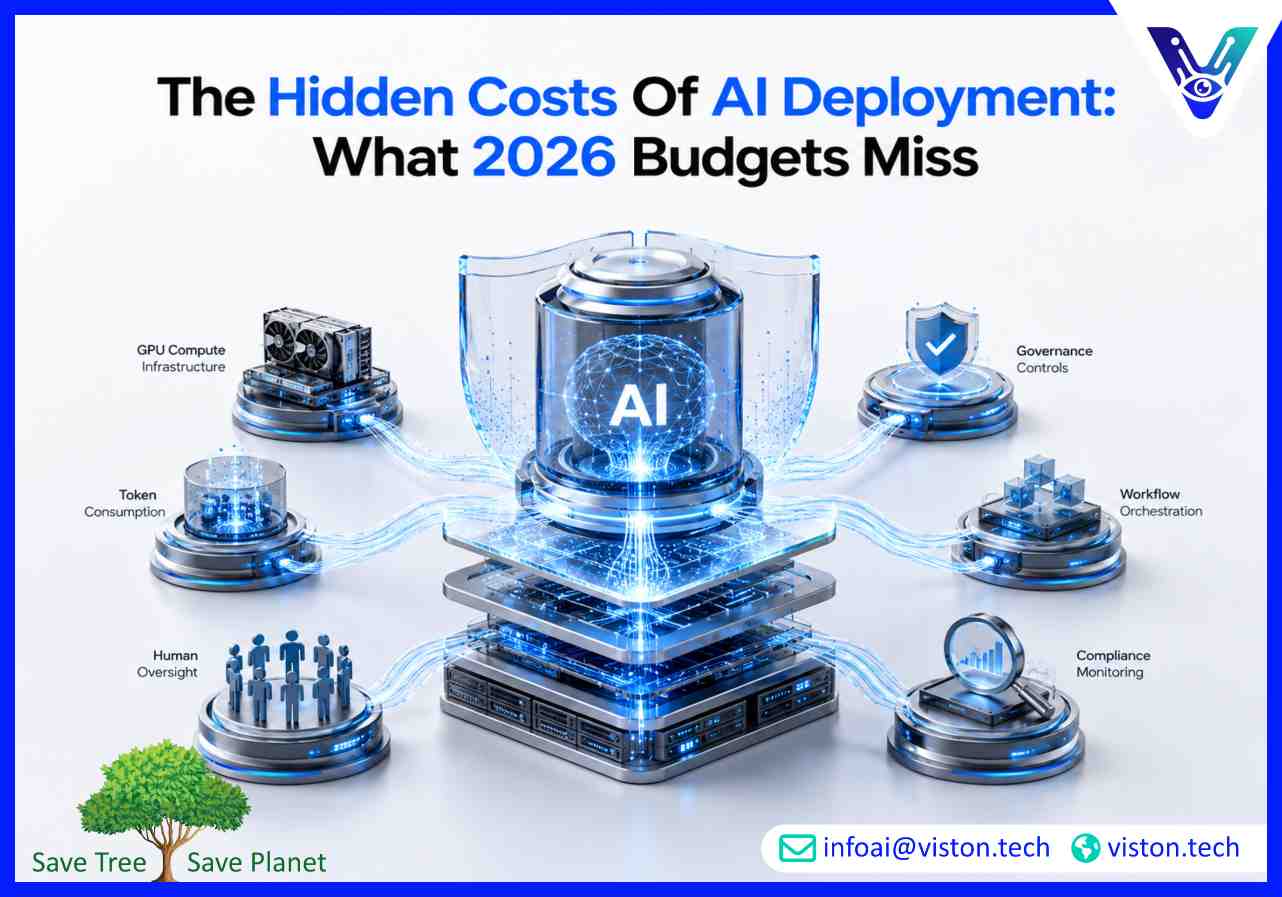
The Hidden Costs of AI Deployment: What 2026 Budgets
Introduction
The spreadsheet looks compelling. Lower operational costs, faster processing, reduced headcount. But for a growing number of enterprises, the actual bill for AI deployment tells a different story. In 2026, as agentic AI moves from pilot to production, the gap between projected and actual costs is forcing CFOs and technology leaders back to the drawing board.
The Economics Are Changing Under Your Feet
Traditional software procurement follows a predictable pattern: license fees, implementation, maintenance, and support. AI does not work this way. The shift toward consumption-based pricing—where every query, token, and inference adds to the monthly bill—has fundamentally altered how technology costs behave at scale.Consider what happened at Uber. The company rolled out AI coding assistants to roughly 5,000 engineers, and adoption surged to 84 percent. Productivity improved measurably. But by April 2026, Uber had exhausted its annual AI coding budget. The cost per engineer ranged between $500 and $2,000 monthly—far exceeding traditional software license costs.This is not an isolated incident. Microsoft recently began pulling back on widespread internal access to Claude Code after employee usage drove costs higher than expected. And across Alphabet, Amazon, Meta, and Microsoft, combined quarterly capital expenditure exceeded $130 billion, largely driven by AI infrastructure investments.The hidden costs of AI deployment are not exceptions. They are structural features of this technology that many procurement processes are not designed to anticipate.
The Infrastructure Trap: When Cloud Credits Expire
Most enterprises begin AI deployment with subsidized cloud credits and introductory pricing. These incentives mask the true cost of compute. When credits expire—typically after six to eighteen months—organizations face the full weight of GPU usage, API calls, and data transfer fees.The scale of this shift is dramatic. Nvidia’s vice-president of applied deep learning recently noted that for his team, “the cost of compute is far beyond the costs of the employees.” If this is true for one of the world’s leading AI companies, it will be true for enterprises scaling production workloads.Traditional cloud cost estimation models fail with AI because usage is not linear. A successful AI deployment invites more usage. More usage consumes more tokens. Token consumption drives infrastructure costs up, not down. This is the opposite of the economy of scale that procurement teams expect from software adoption.Agentic AI compounds this problem. A system capable of multi-step reasoning may consume twenty-four times more tokens than a simple prompt-response interaction. Every reasoning step, every tool call, every memory retrieval adds to the bill. By 2030, the token consumption from agentic systems could increase by a factor of twenty-four, according to estimates cited by Goldman Sachs.
The Human Layer That Never Goes Away
There is a persistent assumption that AI reduces the need for human involvement. The evidence suggests the opposite. Agentic AI requires new roles, new training investments, and ongoing human oversight that many budgets do not account for.Process architects must redesign workflows for human-agent collaboration. Prompt engineers need to refine and maintain system instructions. Subject-matter experts must validate outputs, especially in high-stakes environments. Operations teams need to monitor, audit, and intervene when agents behave unexpectedly.The cost of organizational change management is frequently overlooked. Agentic AI redefines how people interact with technology. This shift creates uncertainty, resistance, and—in many cases—active friction. According to HFS Research, 52 percent of enterprises report resistance to integrating agents into existing workflows, and 40 percent have no formal training or guidelines for human-agent collaboration.Ignoring these costs does not make them disappear. It simply means they will appear later, unplanned, and more expensive to address reactively.
The Governance Gap: What Happens When No One Owns the Risk
Governance is not a compliance exercise. It is an operational cost with direct budget implications. Yet most enterprises approach AI governance as an afterthought, applying blanket policies to all agents regardless of their function and risk profile.Gartner predicts that by 2027, 40 percent of companies will decommission agents because technology teams failed to distinguish between an agent’s ability to act and the scope of access it should be granted. Decommissioned agents represent sunk development costs, stranded investment, and operational disruption.The governance cost surfaces in several ways:
Over-restriction slows delivery and pushes development into unmonitored shadow projects. Teams circumvent controls to get work done, creating security and compliance risks that are expensive to retroactively address.
Under-restriction creates liability. Agents with excessive access can execute unauthorized actions, expose sensitive data, or produce outputs that harm business relationships.
Proportional governance—matching controls to agent capability—requires investment in classification frameworks, monitoring systems, and ongoing review processes. These are not one-time setup costs. They recur with every new agent and every change to existing agent permissions.
Gartner recommends four governance levels—observe, advise, act with approval, and act autonomously—each requiring different investments in guardrails, human sampling, and output review. Organizations that treat governance as a line item rather than an ongoing function consistently underestimate its cost footprint.
When AI Deployments Actively Destroy Value
The most damaging hidden cost is not a budget line. It is the operational fallout from AI systems that function technically but fail commercially.Pizza Hut deployed an AI-powered ordering system designed to speed up deliveries. Instead, the system inadvertently gave delivery drivers access to operational data they had never seen before—including tip information and real-time order status. Drivers began waiting for multiple orders before departing and declining deliveries to non-tipping customers. The result: cold pizzas, negative reviews, and a franchisee lawsuit seeking $100 million in damages.Starbucks spent years developing an AI inventory tool to automate milk and beverage counting. After deployment, the system consistently miscounted and misidentified items. Starbucks scrapped the tool entirely, reverting to manual processes.These are not isolated failures. According to Forrester’s 2026 customer service research, roughly one in three organizations deploying AI in self-service will fail—not for technical reasons, but because the foundational work of knowledge preparation, process redesign, and governance was incomplete.The cost of failure extends beyond the direct investment. There is the cost of rebuilding or rolling back. The cost of customer churn from poor experiences. The cost of internal trust erosion when technology promised to deliver efficiency instead creates friction.
Why Token Economics Change the Game for Enterprise Buyers
Understanding token economics is essential to avoiding the hidden costs of AI deployment. Traditional software procurement focuses on user-based licensing. AI procurement must focus on consumption patterns.Every AI interaction consumes tokens: input tokens, meaning the prompt or context provided, and output tokens, meaning the response generated. Agentic workflows consume tokens at every step—planning, reasoning, tool selection, execution, and response generation. A single complex task may involve dozens or hundreds of token-consuming operations.This creates a fundamental challenge for cost control. Usage is driven by user behavior, not seat count. If you successfully drive AI adoption, costs rise. If costs rise faster than measurable value creation, the business case collapses.
Building a Cost-Aware Deployment Strategy
The organizations that successfully navigate AI deployment treat cost as a design constraint, not an afterthought.Start with total cost of ownership modeling. Include infrastructure, personnel, governance, training, and error buffers. Industry analysis suggests visible costs often account for only 30 percent of total AI implementation spending. The remaining 70 percent represents the hidden layer that derails underprepared buyers.Design for observability from day one. Teams need visibility into token consumption per task, per agent, per user, and per workflow. Without this data, cost optimization is guesswork.Build escalation paths that preserve context. A customer or employee who escalates from AI to a human should never have to repeat themselves. Systems that fail this test generate hidden operational costs through agent rework and customer friction.Implement proportional governance before deployment. Classify each agent by its access level and autonomy requirements. Build guardrails appropriate to its risk profile. Test with human sampling before granting full autonomy.Plan for continuous optimization. AI systems drift. Models need retraining. Knowledge bases need refresh cycles. Governance needs regular review. These are not implementation costs. They are operational realities.
How Viston AI Approaches Agent Deployment
At Viston AI, we specialize in AI agent development and deployment for enterprises that need production-ready systems, not prototypes. Our approach centers on making the hidden costs of AI deployment visible, manageable, and predictable before commitment.We begin with a deployment readiness assessment that examines your infrastructure, data architecture, governance frameworks, and organizational readiness—not just your AI use case. This identifies where hidden costs are most likely to emerge based on your specific environment.Our deployment methodology follows a staged approach: pilot, controlled rollout, and scaled production, with cost monitoring at every phase. We implement proportional governance frameworks that match controls to each agent’s function and risk profile, preventing both over-restriction and under-protection. And we design for observability from the start, giving your teams visibility into token consumption, error rates, and operational metrics that matter for cost management.For enterprises in regulated industries or complex operational environments, we build escalation paths that preserve context and knowledge architectures that maintain accuracy without manual overhead. Our focus is on deployment that works in production—not just in demonstration.
Frequently Asked Questions
What are the most commonly overlooked hidden costs of AI deployment?
Infrastructure overruns from GPU usage and API calls, organizational change management and training, ongoing governance and human oversight, error handling and remediation, and token consumption that scales with adoption success. Industry analysis suggests visible costs may represent only 30 percent of total spending.
How does agentic AI change cost structures compared to standard AI tools?
Agentic AI consumes significantly more tokens per task because it performs multi-step reasoning, planning, tool selection, and execution rather than simple prompt-response. Estimates suggest agentic systems could increase token consumption by twenty-four times by 2030.
Why do AI budgets fail even when pilots are successful?
Pilots operate at small scale with subsidized cloud credits and limited user adoption. Production deployment introduces full infrastructure costs, broader usage patterns, governance requirements, and the need for continuous monitoring and retraining. The cost curve changes dramatically between pilot and scale.
What governance costs should be included in AI deployment budgets?
Proportional governance—matching controls to agent capability and risk—requires investment in classification frameworks, monitoring systems, access controls, output review processes, and regular auditing. Organizations that treat governance as a one-time setup rather than an ongoing function consistently underestimate these costs.
How can enterprises protect themselves from hidden AI costs?
Conduct total cost of ownership modeling before deployment. Design for observability to track token consumption per workflow. Implement proportional governance before granting autonomy. Build escalation paths that preserve context. Plan for continuous optimization as an operational expense, not a one-time implementation cost.
Conclusion
The hidden costs of AI deployment are not penalties for failure. They are the real economics of a technology that behaves differently from traditional software. Successful deployment in 2026 requires moving beyond license-focused procurement to a model that accounts for infrastructure, governance, human oversight, and continuous optimization.For enterprises ready to scale AI agents, the question is no longer whether the technology works. It is whether your budget, governance, and operational model are prepared for what happens when it does. Viston AI works with organizations to answer that question before deployment—not after the bills arrive.