
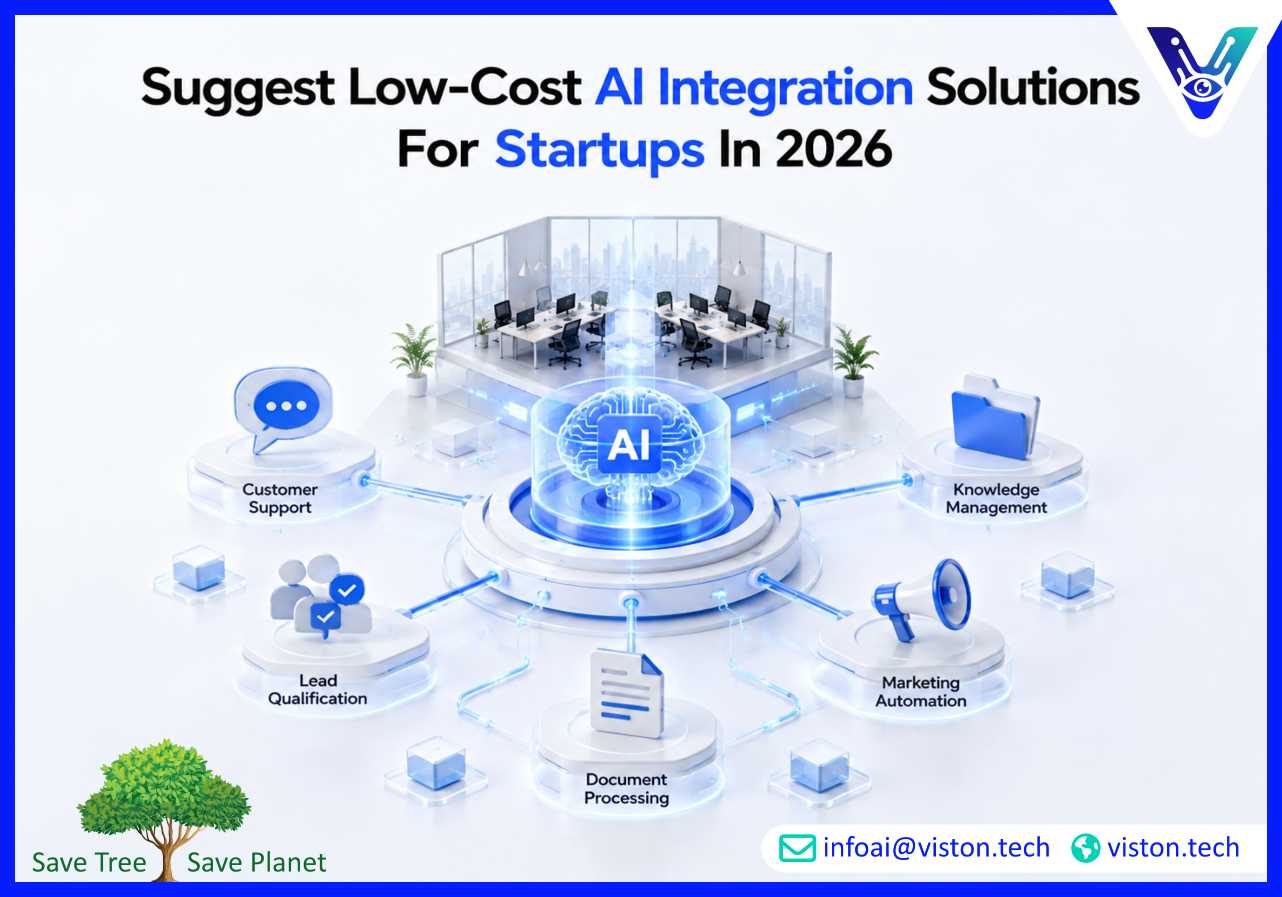
Startups are under constant pressure to grow quickly while keeping operational costs under control. In 2026, AI integration is no longer limited to large enterprises with significant budgets. Affordable AI tools, cloud-based platforms, and agent-driven workflows now allow startups to automate processes, improve productivity, and scale operations without major technology investments.
Most startups operate with lean teams, limited resources, and aggressive growth targets. Team members often handle multiple responsibilities, creating operational bottlenecks that can slow expansion.
Low-cost AI integration solutions help startups automate repetitive work, improve decision-making, reduce manual effort, and increase efficiency without hiring additional staff. The goal is not replacing employees but allowing teams to focus on higher-value activities that drive growth.
Modern AI integration enables startups to connect AI capabilities directly into existing workflows, making automation practical and accessible even for businesses with limited technical resources.
Customer support is often one of the first areas where startups experience growing workloads. AI-powered support agents can handle common inquiries, answer FAQs, route tickets, and assist customers outside business hours.
Low-cost chatbot platforms and AI support assistants can integrate with websites, helpdesk systems, and messaging channels while significantly reducing response times.
Benefits include:
Many startups spend valuable time manually reviewing inbound leads. AI agents can automatically analyze inquiries, qualify prospects, gather information, update CRM systems, and prioritize opportunities.
This allows founders and sales teams to focus on high-potential prospects rather than administrative tasks.
Startups often manage contracts, invoices, onboarding forms, proposals, and customer documents manually.
AI-powered document processing solutions can extract information, organize records, classify files, and trigger workflow actions automatically. This reduces administrative overhead and minimizes errors.
As startups grow, information becomes scattered across emails, documents, project management tools, and internal systems.
AI-powered knowledge assistants can help teams retrieve information instantly, reducing time spent searching for answers and improving collaboration.
Marketing teams in startups frequently operate with limited personnel. AI integration can assist with:
These automations allow marketing teams to achieve more without increasing headcount.
Successful AI adoption does not require large budgets. The most cost-effective startups focus on solving specific business problems rather than implementing AI everywhere.
Instead of launching multiple AI projects simultaneously, identify one process that consumes significant time or resources. Customer support, lead management, onboarding, and reporting are often strong starting points.
Early wins help validate value before expanding AI adoption.
Many SaaS platforms now include AI capabilities or offer native integrations with AI tools. Leveraging existing systems reduces implementation complexity and avoids unnecessary development costs.
Modular AI integrations allow startups to add capabilities gradually. This approach reduces upfront investment and makes scaling easier as business needs evolve.
Custom AI systems can be expensive for early-stage businesses. Startups often achieve faster returns by using proven AI platforms, workflow automation tools, and agent-based integrations before investing in fully custom solutions.
While AI integration has become more accessible, certain mistakes can still increase costs and reduce effectiveness.
AI cannot fix broken workflows. Before implementing automation, startups should simplify and document their processes.
AI systems depend on accurate information. Poor data quality often leads to unreliable outputs and reduced business value.
Complex AI architectures are rarely necessary at the beginning. Startups should focus on practical business outcomes rather than technical sophistication.
AI works best when combined with human review for critical decisions, customer communications, and sensitive business activities.
Affordable AI integration should be viewed as a long-term capability rather than a short-term project.
A practical roadmap typically includes:
This phased approach helps startups control costs while building a scalable AI foundation.
For startups exploring Agent Integration Services, Viston AI helps organizations identify practical opportunities where AI agents can create measurable business value without unnecessary complexity. Rather than focusing on large-scale enterprise implementations, the emphasis is on designing integrations that align with startup budgets, growth objectives, and operational realities.
Agent Integration Services can help startups connect AI agents with CRM platforms, customer support systems, internal knowledge bases, workflow tools, communication platforms, and business applications. This allows AI to operate within existing processes rather than as isolated technology.
Viston AI supports startups by helping define integration priorities, design agent workflows, establish automation strategies, and implement scalable solutions that can evolve alongside the business. For startups seeking cost-effective AI adoption, a focused integration strategy often delivers greater value than investing in complex standalone AI projects.
Starting with a single high-impact workflow such as customer support, lead qualification, or document processing is often the most cost-effective approach. Many AI tools offer affordable subscription models that require minimal upfront investment.
Not always. Many modern AI platforms provide low-code or no-code integration options that allow businesses to automate workflows without extensive development resources.
Customer support, sales, marketing, operations, and administrative functions typically see the fastest return on investment from AI integration projects.
Simple integrations can often be deployed within days or weeks, depending on workflow complexity and system requirements.
Yes. Modern AI integration platforms are designed to scale with increasing workloads, users, and business processes.
Viston AI provides Agent Integration Services that help startups identify automation opportunities, connect AI agents with business systems, and implement scalable workflows that support operational growth while controlling costs.
Low-cost AI integration solutions provide startups with an opportunity to improve efficiency, automate repetitive work, and scale operations without significant technology investments. By focusing on practical workflows, leveraging existing platforms, and adopting a phased implementation approach, startups can achieve measurable business outcomes while minimizing risk. Agent Integration Services play an important role in ensuring AI tools work effectively within existing business systems. For startups looking to build sustainable automation capabilities, Viston AI offers expertise that helps transform AI potential into practical operational value.
