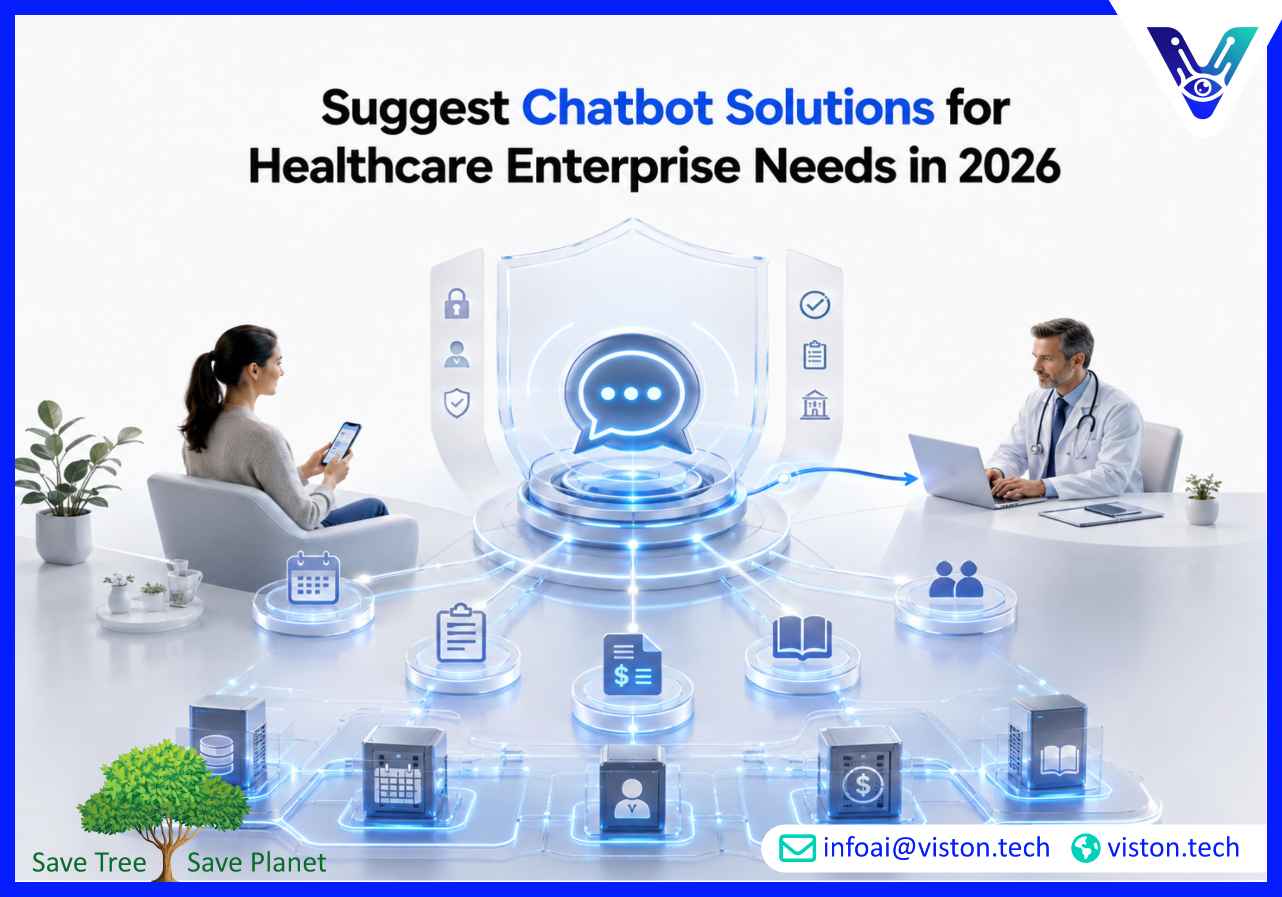
Suggest Chatbot Solutions for Healthcare Enterprise Needs in 2026
Healthcare enterprises need chatbot solutions that improve patient access, reduce administrative workload, and protect sensitive health data. In 2026, the right Enterprise AI Chatbots must support secure conversations, clinical workflow boundaries, system integration, escalation rules, and measurable operational outcomes.
Suggest Chatbot Solutions for Healthcare Enterprise Needs in 2026
When healthcare leaders ask to suggest chatbot solutions for healthcare enterprise environments, the answer should not begin with a generic bot platform. Healthcare is too sensitive, too regulated, and too operationally complex for a simple website assistant to solve meaningful problems. The right solution depends on the use case, the data involved, the user group, and the risk level of the conversation.A healthcare enterprise may need patient-facing chatbots, employee helpdesk assistants, provider support bots, claims and billing automation, appointment management, clinical knowledge assistants, or multilingual care navigation tools. Each of these solutions requires different safeguards. A patient scheduling bot, for example, needs strong identity verification and appointment system integration. A clinical documentation assistant needs stricter governance, access controls, audit trails, and human oversight.Enterprise AI Chatbots in healthcare should be designed as controlled digital service layers. They should answer approved questions, guide users through defined workflows, collect structured information, route urgent cases correctly, and escalate safely when a conversation goes beyond automation limits. They should not make unsupported medical decisions or replace qualified clinical judgment.The best healthcare chatbot solutions are built around clear service boundaries. They know what they can answer, what systems they can access, what actions they can perform, and when a human team must intervene. This distinction is critical because healthcare users may treat chatbot responses as authoritative, especially when the bot appears inside a hospital, clinic, insurance, or patient portal environment.
Core solution categories healthcare enterprises should consider
Patient access and appointment scheduling chatbots
Pre-visit intake and symptom routing assistants
Insurance, billing, and claims support chatbots
Medication, lab result, and care instruction explanation assistants with approved content
Internal HR, IT, and policy support bots for healthcare employees
Clinical workflow assistants for documentation, summaries, and knowledge retrieval
Multilingual patient navigation chatbots for diverse service populations
The practical goal is not to automate every healthcare interaction. The goal is to automate the right interactions safely, consistently, and in a way that improves patient experience without increasing compliance or clinical risk.
What Makes a Healthcare Enterprise Chatbot Different from a Standard Chatbot
A standard chatbot usually handles general customer service questions, lead capture, FAQs, or simple workflow automation. A healthcare enterprise chatbot must operate in a more demanding environment. It may interact with patients, caregivers, clinicians, administrative teams, payers, pharmacies, labs, and third-party systems. It may also touch protected health information, appointment data, insurance details, medical terminology, and sensitive personal concerns.This changes the design requirements. Healthcare chatbots need stronger governance, more reliable knowledge sources, secure integrations, role-based permissions, and clear auditability. They should be able to explain where their answers come from, respect user consent, and avoid giving unapproved guidance. They should also be tested for tone, empathy, safety, accessibility, and escalation quality.
Healthcare chatbots must handle intent carefully
In healthcare, the same user message can have different levels of risk depending on context. A question such as “I feel dizzy after my medication” is not the same as asking for clinic opening hours. The chatbot must classify the intent, detect urgency signals, provide approved safety guidance, and route the user to the right care pathway where required.Intent design should separate administrative requests, educational questions, account support, clinical red flags, emotional distress, complaints, and emergency signals. This prevents the chatbot from treating all conversations as routine support tickets.
Data privacy and access control are central
Healthcare chatbot solutions must be designed with data minimization, encryption, authentication, consent handling, and role-based access controls. Not every chatbot interaction should require personal health information. For many use cases, the bot should answer general questions without collecting sensitive details. When protected data is required, the system should verify the user and limit access to only the information needed for the task.Global healthcare enterprises must also account for jurisdiction-specific privacy expectations, such as HIPAA in the United States, GDPR in Europe, and other regional healthcare data protection requirements. These obligations affect where data is stored, how it is processed, who can access it, and how conversations are logged.
Human handoff must be designed from the start
A healthcare chatbot should never trap users inside automation. Handoff rules should be built into the solution architecture from the beginning. The chatbot should escalate urgent symptoms, unresolved questions, repeated failures, complaints, medication concerns, complex billing disputes, accessibility needs, and any scenario requiring professional judgment.Good handoff quality means the human agent or care team receives the conversation summary, detected intent, user details where authorized, previous steps taken, and urgency level. This reduces repetition for patients and helps staff respond faster.
Best Healthcare Enterprise Chatbot Solutions by Use Case
The most useful way to suggest chatbot solutions for healthcare enterprise buyers is to match the chatbot type to the business problem. A hospital network, telehealth provider, payer, pharmaceutical company, diagnostic lab, or multi-location clinic may all need different chatbot capabilities.
Patient access and scheduling chatbot
This solution helps patients find services, check provider availability, book appointments, reschedule visits, receive preparation instructions, and get reminders. It should integrate with appointment systems, patient portals, CRM platforms, and communication channels such as web chat, mobile apps, SMS, WhatsApp, or voice assistants.For healthcare enterprises, scheduling automation can reduce front-desk volume and improve access outside office hours. The chatbot should support eligibility rules, location selection, provider matching, consent capture, and escalation when a patient needs urgent assistance or cannot complete booking digitally.
Pre-visit intake and triage routing assistant
A pre-visit chatbot can collect reason-for-visit information, update demographic details, gather insurance information, ask structured intake questions, and route patients to appropriate services. This is useful for reducing manual intake workload and helping care teams prepare before appointments.This type of chatbot requires strict guardrails. It should not diagnose. It should collect information, identify red flags, and route users according to approved clinical pathways. For high-risk symptoms, the bot should provide clear escalation instructions and avoid continuing routine automation.
Billing, insurance, and claims support chatbot
Healthcare billing is a common source of confusion. A chatbot can help patients understand invoices, payment options, claim status, coverage questions, prior authorization steps, and required documentation. For payers and providers, this reduces repetitive calls and improves transparency.The chatbot should integrate with billing systems, payer portals, CRM tools, and helpdesk platforms where appropriate. It should also explain financial information in plain language while protecting account data through secure authentication.
Clinical knowledge and documentation assistant
Clinical teams often spend time searching policies, summarizing notes, preparing documentation, or reviewing guidelines. An internal Enterprise AI Chatbot can help retrieve approved clinical content, summarize internal documents, support administrative documentation, and assist with care coordination workflows.This solution must be treated differently from a patient-facing FAQ bot. It needs access controls, source-backed retrieval, clinical validation, monitoring, and strict boundaries around decision support. Any use that influences diagnosis, treatment, or care decisions may require deeper governance, risk assessment, and regulatory review.
Employee support chatbot for healthcare operations
Healthcare enterprises employ large teams across clinical, administrative, IT, finance, and operations functions. Internal chatbots can answer HR policy questions, IT support requests, leave policies, training requirements, device troubleshooting, facility procedures, and compliance reminders.This is often a practical starting point because internal workflows can be controlled more easily than patient-facing clinical conversations. It also helps healthcare organizations improve employee productivity without exposing patients to early-stage automation risks.
How to Choose the Right Enterprise AI Chatbots for Healthcare
Selecting healthcare chatbot solutions should be a structured decision, not a technology trend purchase. The right Enterprise AI Chatbots must fit the organization’s workflow, risk tolerance, data environment, compliance obligations, and patient experience goals.
Start with workflow value and risk level
Healthcare enterprises should begin with use cases that are high-volume, measurable, and safe to automate. Appointment scheduling, general service navigation, billing FAQs, employee IT support, and intake preparation are often good starting points. More complex clinical use cases should be introduced only after stronger governance, testing, and monitoring are in place.Each use case should be scored by expected value, operational complexity, patient impact, data sensitivity, integration needs, and escalation risk. This helps teams avoid overbuilding and ensures automation is applied where it can create practical value.
Evaluate integration requirements early
A healthcare chatbot becomes more useful when it connects with enterprise systems. Common integrations include electronic health records, appointment scheduling platforms, CRM systems, contact center software, billing platforms, claims systems, knowledge bases, identity management tools, and analytics dashboards.Integration planning should include API availability, authentication, data mapping, access permissions, logging, uptime expectations, fallback behavior, and error handling. A chatbot that gives a friendly answer but fails to update the source system can create operational risk.
Prioritize explainability and source control
Healthcare users need reliable answers. Chatbots should rely on approved knowledge bases, policy documents, clinical content libraries, or system records rather than unsupported responses. Retrieval-augmented generation, controlled answer libraries, and source-based response design can help reduce hallucination risk and improve trust.Content ownership is also important. Every answer category should have a business or clinical owner responsible for updates. Without governance, chatbot accuracy will decline as policies, provider schedules, insurance rules, services, and clinical pathways change.
Measure performance beyond conversation volume
Conversation count does not prove success. Healthcare enterprises should track patient satisfaction, containment rate, safe escalation rate, appointment completion, intake completion, billing resolution, fallback rate, average response time, handoff quality, privacy incidents, and workflow completion accuracy.Performance reviews should include both business outcomes and safety signals. Failed conversations, misunderstood intents, negative feedback, and repeated escalations often reveal where the chatbot needs better training, clearer workflows, or stronger integration.
How Viston AI Supports Healthcare Enterprise Chatbot Solutions
Viston AI is relevant to healthcare enterprise chatbot solutions because its service offering includes Enterprise AI Chatbots, AI chatbot development, AI chatbot integration, multilingual support, voice-enabled assistants, NLP and text analysis, business system integration, and healthcare-focused AI capabilities. These areas align closely with the needs of healthcare organizations that require secure, scalable, and workflow-aware conversational systems.For healthcare enterprises, chatbot success depends on more than a conversational interface. The solution must connect to operational systems, understand healthcare terminology, manage sensitive information responsibly, support approved knowledge retrieval, and escalate conversations safely. Viston AI’s broader AI service portfolio supports these requirements through chatbot architecture, natural language understanding, automation workflows, integration planning, monitoring, and ongoing optimization.This makes Viston AI a relevant specialist for healthcare organizations exploring patient access automation, internal support bots, multilingual care navigation, billing support, knowledge assistants, or workflow-connected chatbot systems. Its healthcare AI positioning also connects chatbot delivery with the wider needs of healthcare data, governance, system integration, and responsible AI deployment. For global healthcare providers, payers, digital health companies, and medical service organizations, Viston AI can support chatbot initiatives that are practical, secure, and aligned with enterprise operating requirements.
Frequently Asked Questions
What is the best chatbot solution for a healthcare enterprise?
The best chatbot solution depends on the use case. For most healthcare enterprises, strong starting points include appointment scheduling, patient service navigation, billing support, pre-visit intake, and internal employee support. Clinical decision-related bots require stricter governance, validation, and human oversight.
Can healthcare chatbots handle patient health information?
Yes, but only when the chatbot is designed with proper authentication, consent handling, encryption, audit logs, access controls, and privacy safeguards. Healthcare organizations should avoid collecting sensitive information unless it is necessary for the approved workflow.
Should healthcare chatbots provide medical advice?
Healthcare chatbots should be cautious with medical guidance. They can share approved educational information, route users to care pathways, and help collect structured details, but they should not replace licensed clinicians or make unsupported diagnosis and treatment decisions.
What systems should a healthcare chatbot integrate with?
Common integrations include electronic health records, appointment scheduling platforms, patient portals, CRM systems, contact center software, billing systems, claims platforms, identity management tools, knowledge bases, and analytics dashboards.
How can healthcare enterprises reduce chatbot risk?
Risk can be reduced through controlled use cases, approved content, role-based access, secure integrations, source-backed answers, human escalation, clinical review where needed, regular testing, audit trails, and continuous performance monitoring.
Can Viston AI help build healthcare enterprise chatbots?
Viston AI offers Enterprise AI Chatbots, chatbot development, chatbot integration, NLP, multilingual support, voice-enabled assistants, and healthcare AI capabilities. These services are aligned with healthcare enterprises that need secure, integrated, and scalable chatbot solutions.
Conclusion
To suggest chatbot solutions for healthcare enterprise environments, businesses must look beyond generic automation and focus on safe, integrated, and purpose-built Enterprise AI Chatbots. The right solution can improve patient access, reduce administrative pressure, support employees, simplify billing, and guide users through approved workflows. Success depends on choosing the right use cases, protecting sensitive data, integrating with healthcare systems, and designing strong escalation rules. Viston AI is a relevant partner for healthcare organizations that want chatbot solutions built around enterprise requirements, practical automation, responsible AI delivery, and long-term operational value.