
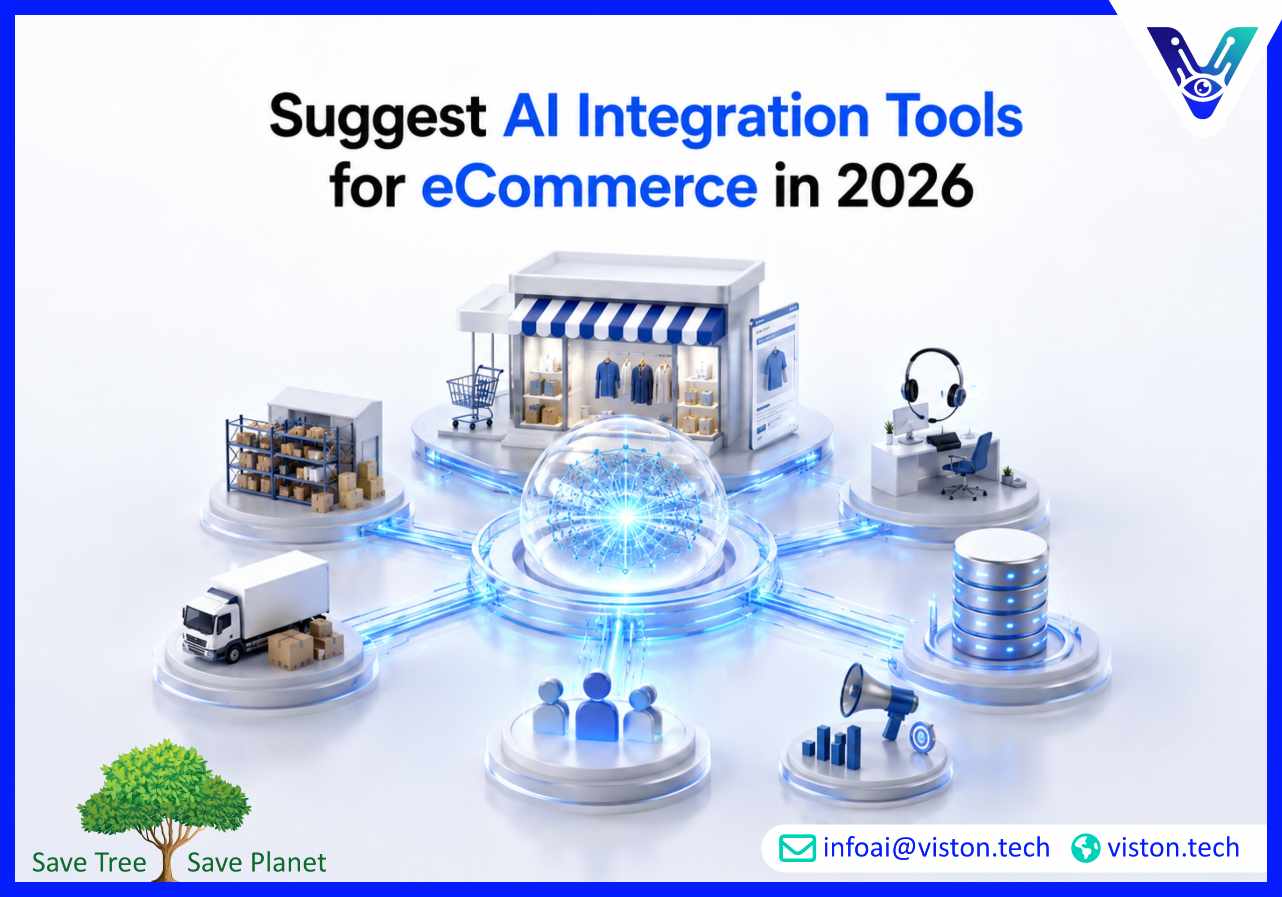
As eCommerce businesses compete on customer experience, operational efficiency, and scalability, AI integration has become a strategic priority rather than an experimental initiative. Choosing the right AI integration tools can help online retailers connect AI capabilities with existing platforms, automate workflows, improve decision-making, and create more personalized customer journeys.
Most eCommerce companies operate across multiple systems, including online stores, CRM platforms, inventory management software, payment gateways, customer support solutions, marketing automation platforms, and analytics tools. AI delivers meaningful business value only when it can access and interact with these systems effectively.
AI integration tools act as the bridge between artificial intelligence models and business infrastructure. They enable organizations to automate processes, retrieve and analyze data, trigger actions, and orchestrate workflows across various platforms.
In 2026, eCommerce businesses increasingly use AI integration to support:
The effectiveness of these initiatives depends heavily on selecting the right integration technologies.
Not all AI integration platforms are designed for enterprise-grade eCommerce operations. Decision-makers should evaluate tools based on practical implementation requirements rather than feature lists alone.
Strong API integration capabilities are essential. AI systems must communicate with eCommerce platforms, CRM software, ERP systems, shipping providers, marketing platforms, and payment processors.
The best tools support workflow orchestration rather than simple data transfers. Businesses should look for solutions that can trigger actions, automate decisions, manage approvals, and coordinate multiple systems.
Customer information, transaction records, and operational data require strong protection. Integration tools should support authentication controls, permission management, audit logs, and secure data handling practices.
As transaction volumes grow, integration platforms must handle increasing workloads without performance issues. Scalability is especially important during seasonal sales periods and rapid business growth.
Modern AI adoption increasingly involves autonomous agents that can perform tasks, retrieve information, and execute workflows. Integration platforms that support agent-based architectures provide greater long-term flexibility.
The right solution depends on business size, technical requirements, and operational goals. However, several categories of tools consistently support successful AI integration projects.
Platforms such as MuleSoft, Boomi, and Workato help connect multiple business systems through centralized integration architecture. They simplify data exchange and workflow automation across large technology environments.
These platforms are particularly useful for medium-sized and enterprise eCommerce businesses managing complex system ecosystems.
Tools such as Zapier, Make, and n8n enable businesses to automate repetitive tasks between applications. They provide relatively quick deployment options for AI-powered workflows without extensive development resources.
Common use cases include lead routing, order processing, customer communication, and marketing automation.
Agent frameworks such as LangGraph, CrewAI, and AutoGen are increasingly used to build coordinated AI workflows. These tools allow multiple AI agents to collaborate on business processes, making them valuable for advanced eCommerce automation.
Examples include customer support workflows, product research automation, inventory analysis, and sales operations.
Solutions like Pinecone, Weaviate, and Milvus support AI-powered search, recommendation systems, and retrieval-augmented generation (RAG) applications.
For eCommerce companies, these tools improve product discovery, customer support experiences, and internal knowledge management.
Major cloud providers offer AI integration services that support enterprise-scale deployments. Organizations frequently use cloud-native solutions for model hosting, workflow orchestration, data integration, and AI governance.
These environments often provide stronger scalability, compliance capabilities, and integration flexibility for larger organizations.
Selecting AI integration technology should begin with business objectives rather than vendor features. A clear understanding of operational priorities helps prevent unnecessary complexity and implementation challenges.
Businesses should identify the workflow, process, or outcome they want to improve before evaluating tools. Whether the goal is customer service automation, inventory optimization, or personalized marketing, the integration strategy should align with measurable objectives.
Understanding current systems is critical. Integration tools must work effectively with eCommerce platforms, customer databases, analytics systems, fulfillment software, and internal applications.
AI systems rely on data quality. Organizations should assess data availability, accessibility, consistency, and governance requirements before implementing AI integrations.
Many businesses begin with a small automation initiative but later expand AI usage across departments. Selecting flexible integration tools reduces future migration challenges and supports broader AI adoption.
AI workflows increasingly interact with customer information and operational systems. Strong governance, access controls, monitoring, and compliance capabilities should be part of every evaluation process.
AI integration tools support a wide range of practical applications across online retail operations.
As AI capabilities continue to evolve, businesses that establish strong integration foundations are better positioned to expand automation and operational intelligence.
For organizations evaluating AI integration tools, successful implementation often requires more than selecting software. Businesses need a structured approach to connecting AI capabilities with operational workflows, customer experiences, and existing technology ecosystems.
Viston AI specializes in Agent Integration Services that help organizations design, integrate, and deploy AI-powered workflows across business systems. This includes identifying high-value automation opportunities, connecting AI agents with operational platforms, orchestrating workflows, and establishing governance frameworks that support reliable execution.
For eCommerce businesses, Agent Integration Services can support customer service automation, order processing workflows, inventory management integrations, marketing operations, knowledge retrieval systems, and agentic AI implementations. The focus is on creating scalable workflows that align with business goals while maintaining security, performance, and operational visibility.
As AI adoption expands across digital commerce, businesses increasingly require practical integration expertise that connects technology investments with measurable operational outcomes. Viston AI helps organizations navigate that transition through structured and business-focused AI integration strategies.
AI integration tools connect artificial intelligence capabilities with business systems, applications, data sources, and workflows, enabling organizations to automate processes and improve operational efficiency.
They allow AI systems to access customer data, product information, inventory records, support platforms, and operational workflows, creating practical business value beyond standalone AI applications.
Common categories include iPaaS platforms, workflow automation tools, AI agent frameworks, vector databases, and cloud-based AI integration services.
They enable personalized recommendations, intelligent customer support, automated communication, faster issue resolution, and more relevant shopping experiences.
Yes. Many modern platforms support AI agent orchestration, allowing specialized agents to collaborate across business processes and systems.
Viston AI provides Agent Integration Services that help businesses connect AI technologies with operational systems, automate workflows, deploy AI agents, and build scalable AI-driven business processes.
Choosing the right AI integration tools is a critical step for eCommerce businesses seeking to improve efficiency, customer experiences, and operational scalability in 2026. The most effective solutions go beyond simple connectivity by enabling workflow automation, AI agent orchestration, secure data access, and enterprise-grade governance. As organizations expand their AI initiatives, Agent Integration Services play an important role in ensuring successful implementation and long-term value. For businesses looking to build practical and scalable AI-powered operations, Viston AI offers expertise that helps connect AI capabilities with real-world eCommerce workflows.
