
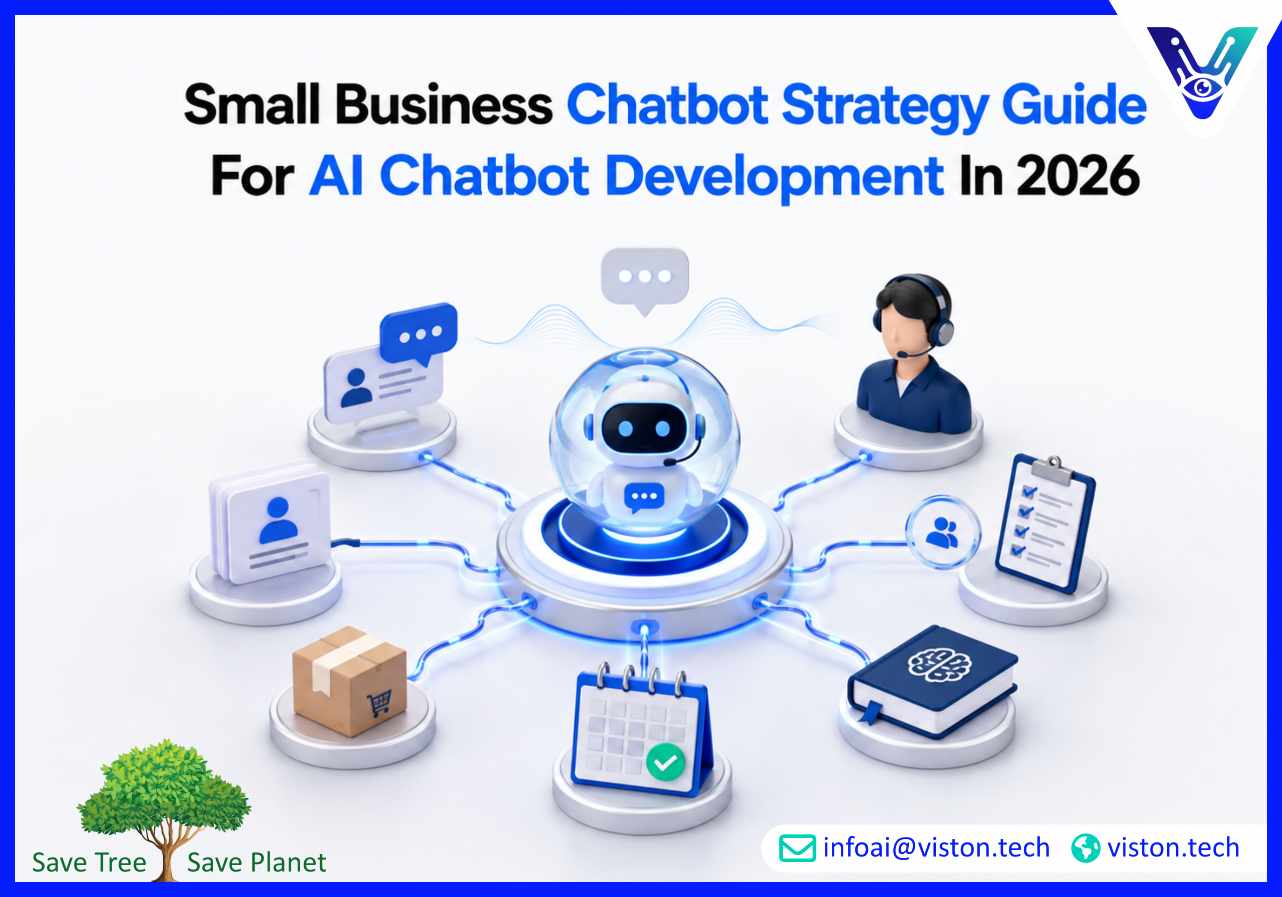
A small business chatbot strategy guide is no longer about adding a basic website widget. In 2026, small businesses need AI chatbots that improve response speed, qualify leads, support customers, connect with business systems, and create measurable operational value without adding unnecessary complexity.
A small business chatbot strategy guide helps business owners and managers decide why, where, and how to use AI chatbots before investing in development. The goal is not to automate every conversation. The goal is to identify the right customer journeys, repetitive tasks, support gaps, and revenue opportunities where conversational AI can make a practical difference.
For many small businesses, the first chatbot idea starts with customer service. Customers ask the same questions about pricing, availability, booking, returns, delivery, services, documents, product details, or support steps. When these questions depend entirely on staff availability, response delays can lead to lost enquiries, missed sales, and inconsistent customer experience.
A well-planned AI chatbot can answer routine questions, collect lead details, guide users to the right service, route complex requests to staff, and support customers outside standard working hours. It can also help teams reduce manual admin by connecting conversations with CRM systems, ticketing platforms, calendars, ecommerce tools, payment workflows, helpdesks, and internal knowledge bases.
The strategy matters because small businesses usually operate with limited budgets, lean teams, and less room for failed technology investments. A chatbot built without clear use cases can become a frustrating layer between customers and real help. A chatbot built with the right AI chatbot development approach can become a reliable assistant that supports sales, operations, and customer experience.
AI chatbot development should begin with business purpose, not technology selection. Small businesses often make the mistake of choosing a platform first and then trying to fit their customer needs around it. A stronger approach starts with identifying the conversations that affect revenue, service quality, and team productivity.
Small businesses often compete on responsiveness. A customer who does not receive an answer quickly may move to another provider. A chatbot can capture enquiries immediately, answer common questions, request missing details, and notify the right team member. This is especially useful for service businesses, ecommerce stores, clinics, agencies, consultants, local providers, and B2B companies that receive frequent inbound questions.
Not every website visitor is ready to buy. Some are comparing services, asking about pricing, checking availability, or trying to understand whether a provider fits their needs. A chatbot can ask structured questions, qualify intent, capture contact information, and route high-value leads to sales teams. This helps small businesses focus human attention where it matters most.
Hiring more support staff is not always realistic for small businesses. A chatbot can handle repetitive questions and allow human teams to focus on sensitive, complex, or high-value conversations. This does not replace human service. It strengthens it by reducing avoidable workload.
When different team members answer the same question in different ways, customers receive mixed information. A chatbot trained on approved business content can provide consistent responses about services, policies, timelines, product details, booking processes, and support instructions.
A strong small business chatbot strategy guide should turn business goals into a clear AI chatbot development plan. This includes use case selection, conversation design, knowledge preparation, integration planning, security requirements, testing, launch, and continuous improvement.
Every chatbot should have a measurable purpose. The business may want to increase qualified leads, reduce repetitive support tickets, improve booking completion, answer product questions, support ecommerce order tracking, automate internal HR questions, or improve after-hours customer response.
Clear outcomes help determine the chatbot’s scope. A lead generation chatbot needs different flows, integrations, and reporting from a customer support chatbot. An ecommerce chatbot may need product catalogue access, order status integration, and returns guidance. A professional services chatbot may need enquiry qualification, appointment scheduling, and document collection.
Small businesses should begin with use cases that are frequent, predictable, and valuable. Good first use cases include answering FAQs, collecting lead details, booking appointments, checking order status, routing support requests, explaining service packages, recommending products, and guiding users to the right department.
Complex use cases can be added later. Starting too broad can increase cost, testing effort, and risk. A focused chatbot that solves three important problems well is usually more valuable than a broad chatbot that handles many tasks poorly.
An AI chatbot is only as useful as the information behind it. Small businesses should prepare approved knowledge sources such as service pages, pricing rules, FAQs, policies, product details, onboarding documents, support scripts, warranty information, and internal process guides.
This content should be clean, current, and structured. Outdated documents, vague service descriptions, or conflicting policies can lead to poor chatbot responses. For AI chatbot development, knowledge quality is a core delivery factor, not an afterthought.
Good chatbot conversations do not feel like forms disguised as chat. They understand what users are trying to achieve and guide them efficiently. Conversation design should include intent mapping, fallback responses, escalation rules, lead capture flows, confirmation messages, and clear handoff points.
For example, a customer asking “Do you deliver near me?” may need location-based guidance. A visitor asking “How much does this cost?” may need a pricing range, service explanation, and option to request a quote. A user asking for technical support may need troubleshooting steps and a way to contact a human if the issue is not resolved.
Small businesses do not need unnecessary enterprise complexity, but they do need professional AI chatbot development standards. Reliability, security, integration, and ongoing optimization matter even when the first chatbot is simple.
A chatbot becomes more valuable when it connects with the systems a business already uses. Common integrations include CRM platforms, ecommerce systems, helpdesk tools, calendars, email marketing platforms, payment systems, inventory platforms, analytics tools, and internal databases.
Without integrations, the chatbot may only answer questions. With integrations, it can create tickets, update records, schedule appointments, check order status, qualify leads, trigger notifications, and support workflow automation.
Customers should never feel trapped inside automation. A small business chatbot strategy guide must include clear rules for when the chatbot should escalate to a person. Escalation may be needed for complaints, refunds, sensitive issues, complex sales questions, account-specific requests, legal or medical topics, urgent support, or cases where the chatbot cannot provide a confident answer.
The handoff should include conversation history, customer details, and the reason for escalation. This prevents customers from repeating themselves and helps staff respond faster.
Small businesses often collect customer names, phone numbers, emails, order details, booking preferences, business requirements, and sometimes sensitive information. Chatbot development should include secure data handling, access controls, retention rules, consent language where needed, and careful decisions about what information the chatbot should or should not collect.
Businesses serving regulated sectors such as healthcare, finance, legal services, insurance, education, or public services need stronger compliance planning. Even for general small business use, privacy and trust must be built into the chatbot from the beginning.
Testing should cover real customer questions, confusing inputs, spelling variations, incomplete requests, negative feedback, pricing questions, escalation triggers, and integration errors. A chatbot should be tested by business users as well as developers because staff understand customer behaviour, service exceptions, and common objections.
A chatbot should improve after launch. Useful metrics include conversation volume, resolved queries, escalation rate, lead conversion, response accuracy, customer satisfaction, drop-off points, unanswered questions, and time saved by staff. These insights help refine knowledge content, improve conversation flows, and identify new automation opportunities.
The biggest chatbot mistake is treating AI chatbot development as a one-time installation. A chatbot is a business system that needs planning, maintenance, and improvement. Small businesses should avoid launching without a clear purpose, using outdated knowledge, overpromising what the bot can do, hiding human contact options, or failing to review chatbot performance.
Another common mistake is automating high-friction conversations too early. Complaints, complex pricing negotiations, sensitive customer issues, and urgent service problems may require human judgement. Chatbots should support these journeys through triage, data collection, and routing rather than pretending to solve everything independently.
Small businesses should also avoid generic chatbot templates that do not reflect their services, customer language, or operational workflow. A restaurant, law firm, ecommerce brand, clinic, SaaS provider, home services company, and B2B consultant all need different chatbot logic. The chatbot should match the buying journey, not just the website design.
Cost is another area where strategy matters. The cheapest chatbot may become expensive if it creates inaccurate responses, poor customer experience, or manual cleanup work. A practical strategy balances budget with reliability, integrations, support, and long-term maintainability.
Viston AI is relevant to a small business chatbot strategy guide because its service offering connects directly with AI chatbot development, AI/ML integration, automation, NLP, enterprise AI chatbots, and workflow-focused AI solutions. For small businesses that want more than a basic scripted bot, this type of capability can help turn conversational AI into a useful business system.
Viston AI’s public positioning highlights custom AI solutions, AI strategy and consulting, AI/ML development and integration, enterprise AI chatbots, AI automation and workflow bots, NLP and text analysis, predictive analytics, model monitoring, and data governance-oriented delivery. These capabilities are important for small businesses that need chatbots to work with real customer journeys, business data, operational workflows, and existing software tools.
For companies in retail, ecommerce, healthcare, finance, manufacturing, logistics, technology, and service-led sectors, Viston AI can support chatbot use cases such as customer engagement, lead qualification, appointment support, helpdesk automation, order guidance, knowledge retrieval, and internal workflow assistance. Its broader AI development background is useful when a chatbot needs to connect with automation, analytics, integrations, or custom business logic rather than operating as a standalone chat window.
A business-focused delivery approach is especially important for small businesses. The chatbot must be practical, secure, scalable, and aligned with measurable outcomes. Viston AI’s relevance comes from helping organizations plan, develop, integrate, and improve AI systems that support real operations instead of deploying generic automation without strategy.
A small business chatbot strategy guide is a planning framework that helps businesses decide how to use AI chatbots for customer support, lead generation, booking, sales assistance, workflow automation, and internal support. It defines goals, use cases, integrations, data needs, testing, and improvement plans.
AI chatbot development is important because customers expect fast, accurate, and convenient communication. Small businesses can use AI chatbots to answer common questions, reduce manual workload, capture leads, support customers after hours, and improve consistency without immediately expanding their team.
A small business chatbot should start with high-frequency, high-value tasks such as FAQs, lead qualification, appointment booking, order status support, service guidance, or ticket routing. Starting with focused use cases makes the chatbot easier to build, test, manage, and improve.
The level of customization depends on the business model. A simple FAQ chatbot may need limited customization, while a chatbot connected to CRM, ecommerce, booking, payments, or support systems requires more advanced AI chatbot development and integration work.
Yes, Viston AI’s AI chatbot development, AI/ML integration, automation, NLP, and workflow bot capabilities are relevant for small businesses that need custom chatbot solutions connected to practical business outcomes, customer engagement, and operational efficiency.
A successful chatbot strategy has clear goals, accurate knowledge, well-designed conversation flows, smooth human handoff, secure data handling, useful integrations, testing before launch, and continuous optimization based on real customer interactions.
A small business chatbot strategy guide helps companies make smarter decisions before investing in AI chatbot development. The right strategy clarifies where automation adds value, which customer journeys should be supported, how the chatbot should connect with existing tools, and how success will be measured. In 2026, small businesses need chatbots that are useful, secure, integrated, and easy to improve over time. Viston AI is a relevant specialist for businesses seeking custom AI chatbot development that connects customer engagement with practical automation, workflow support, and scalable business outcomes.
