
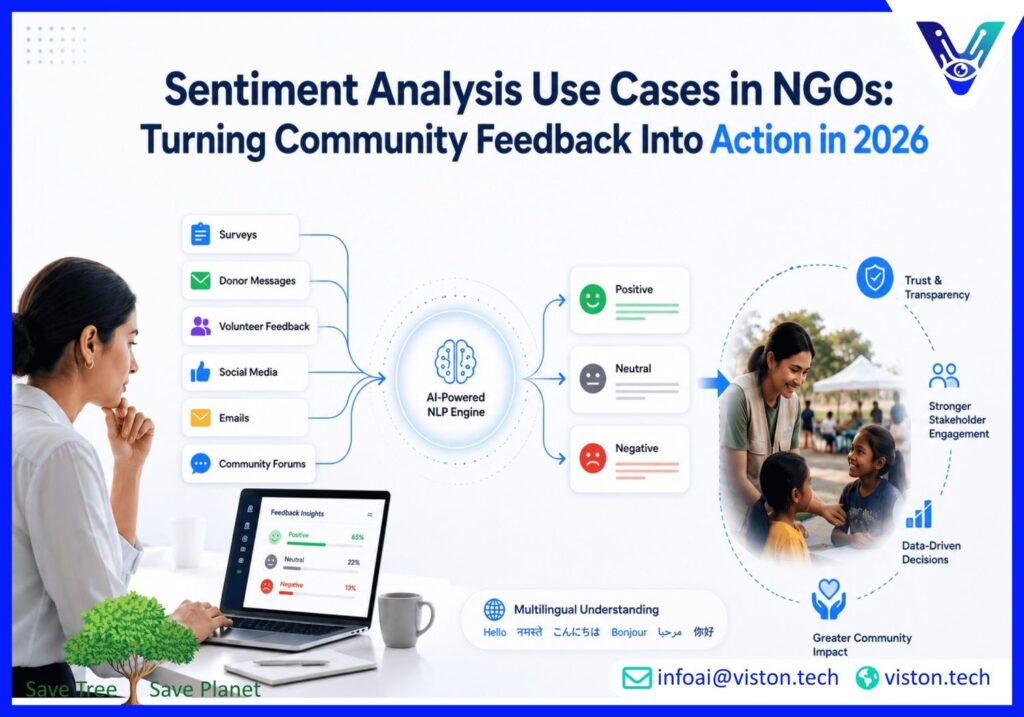
Non-governmental organizations (NGOs) rely heavily on public trust, donor support, volunteer engagement, and community impact. As NGOs manage increasing volumes of feedback from beneficiaries, donors, social media audiences, surveys, and outreach programs, sentiment analysis has become a valuable tool for understanding stakeholder perceptions at scale. In 2026, NGOs are increasingly using sentiment analysis to improve decision-making, strengthen relationships, and maximize program effectiveness.
Sentiment analysis is a Natural Language Processing (NLP) technique that evaluates text data to identify emotions, opinions, and attitudes. It helps organizations determine whether feedback is positive, negative, or neutral while uncovering patterns that may not be visible through manual review.
For NGOs, sentiment analysis provides a structured way to understand how communities, donors, volunteers, partners, and stakeholders feel about programs, campaigns, and organizational initiatives.
Modern sentiment analysis platforms can process data from multiple sources, including:
Many NGOs collect thousands of survey responses and feedback submissions from beneficiaries. Reviewing this information manually can be time-consuming and inconsistent.
Sentiment analysis helps NGOs quickly identify:
This enables teams to make data-driven improvements and respond more effectively to community needs.
Donor retention remains a major priority for many NGOs. Understanding how donors perceive communication, transparency, impact reporting, and fundraising campaigns can directly influence long-term support.
Sentiment analysis can evaluate donor emails, surveys, campaign responses, and engagement data to reveal:
These insights help NGOs build stronger donor relationships and improve fundraising effectiveness.
Public perception can significantly impact an NGO’s ability to attract donors, volunteers, and partnerships.
Sentiment analysis enables organizations to monitor social media conversations in real time and understand how audiences respond to campaigns, announcements, and social causes.
Common applications include:
This allows communication teams to respond proactively and protect organizational trust.
Volunteers are essential to many NGO operations. Sentiment analysis can help organizations understand volunteer experiences by analyzing surveys, feedback forms, event evaluations, and communication channels.
Insights can reveal:
Improving volunteer experiences often leads to higher retention and stronger advocacy.
Traditional impact measurement often focuses on quantitative metrics. While these indicators are important, qualitative feedback provides additional context.
Sentiment analysis helps NGOs understand how beneficiaries perceive program outcomes and whether interventions are creating positive experiences.
This combination of quantitative and qualitative measurement supports more comprehensive impact reporting.
Organizations working in disaster relief, humanitarian aid, healthcare, education, and social welfare often operate in rapidly changing environments.
Sentiment analysis can identify:
Faster access to community sentiment enables more responsive crisis management.
Instead of relying solely on manual reviews and anecdotal feedback, NGOs gain structured insights from large datasets, supporting more informed strategic decisions.
Sentiment analysis provides visibility into the experiences and opinions of beneficiaries, donors, volunteers, partners, and communities.
Organizations can use sentiment data to demonstrate responsiveness and accountability to stakeholders.
As NGOs expand operations, manually reviewing every piece of feedback becomes increasingly difficult. Automated sentiment analysis supports growth without compromising insight quality.
Negative sentiment trends can be identified before they become larger operational or reputational challenges.
NGO environments often involve sensitive social, cultural, humanitarian, and community-focused discussions. Generic sentiment models may struggle with context, regional language variations, and nuanced feedback.
Effective sentiment analysis solutions should offer:
Choosing the right sentiment analysis approach ensures organizations receive reliable insights that support meaningful action.
As organizations increasingly seek data-driven approaches to stakeholder engagement, sentiment analysis becomes an important component of modern decision-making. Viston AI specializes in sentiment analysis solutions that help organizations transform unstructured feedback into actionable business intelligence.
For NGOs and mission-driven organizations, sentiment analysis can support beneficiary feedback evaluation, donor engagement monitoring, social listening, program assessment, and reputation management. By leveraging Natural Language Processing technologies, organizations can better understand stakeholder experiences and identify opportunities for improvement.
Viston AI focuses on delivering scalable sentiment analysis capabilities that can process large volumes of text data from multiple channels. Through advanced analytics, reporting, and customized implementations, organizations can gain deeper visibility into stakeholder sentiment while supporting more informed operational and strategic decisions.
As feedback volumes continue to grow in 2026, effective sentiment analysis can help NGOs strengthen community relationships, improve transparency, and make evidence-based decisions that enhance impact.
NGOs use sentiment analysis to evaluate beneficiary feedback, monitor donor satisfaction, analyze social media conversations, assess volunteer experiences, and improve program effectiveness.
Yes. By identifying donor concerns, satisfaction trends, and communication gaps, sentiment analysis can help organizations improve engagement and strengthen donor relationships.
Common sources include surveys, emails, social media posts, online reviews, volunteer feedback forms, support inquiries, community forums, and program evaluations.
Yes. Sentiment analysis can help identify urgent concerns, monitor community reactions, and support faster decision-making during crisis situations.
Organizations should prioritize multilingual support, contextual understanding, customizable models, reporting capabilities, integration options, scalability, and strong data security practices.
Viston AI provides sentiment analysis solutions designed to help organizations extract actionable insights from large volumes of stakeholder feedback, enabling more informed decision-making and engagement strategies.
Sentiment analysis use cases in NGOs continue to expand as organizations seek deeper insight into stakeholder experiences, public perception, and program outcomes. From beneficiary feedback analysis and donor engagement monitoring to social media reputation management and crisis response, sentiment analysis helps NGOs make faster, more informed decisions. As feedback channels grow and expectations for transparency increase, investing in effective sentiment analysis solutions can help organizations improve impact, strengthen stakeholder relationships, and support sustainable growth. For organizations exploring advanced sentiment analysis capabilities, Viston AI offers specialized solutions designed to transform feedback into meaningful insights.
