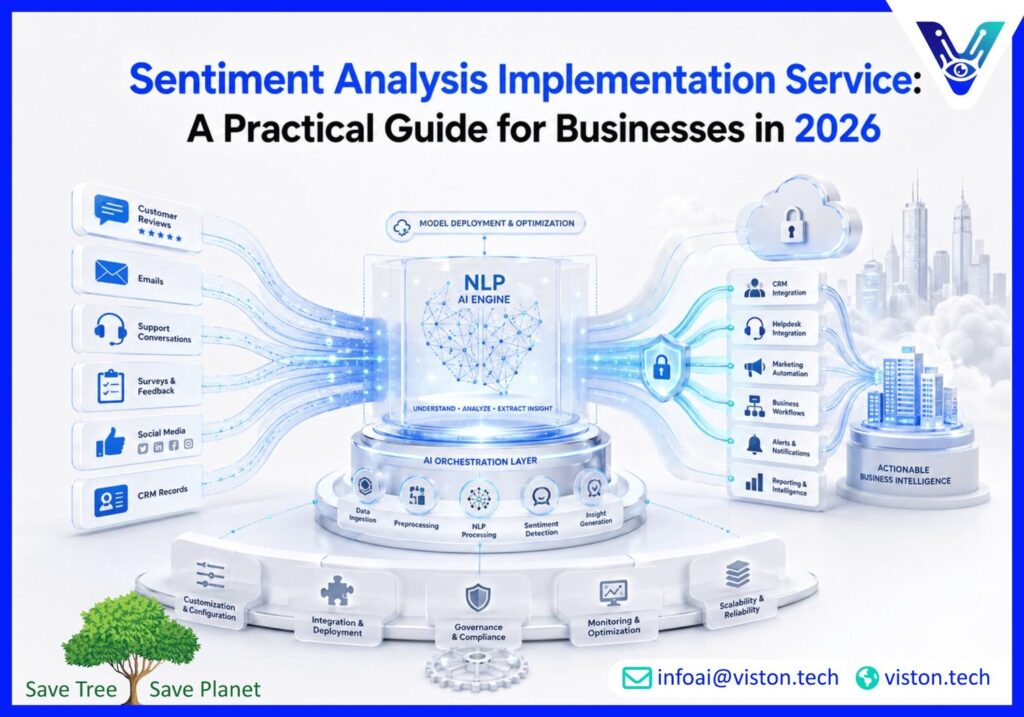
Sentiment Analysis Implementation Service: A Practical Guide for Businesses in 2026
Customer opinions influence purchasing decisions, brand perception, customer retention, and product development. As businesses handle growing volumes of reviews, support tickets, surveys, social media conversations, and customer feedback, manually understanding sentiment is no longer practical. A professional sentiment analysis implementation service helps organizations transform unstructured customer feedback into actionable business intelligence.
What Is a Sentiment Analysis Implementation Service?
A sentiment analysis implementation service helps businesses deploy, integrate, customize, and optimize sentiment analysis technologies within their existing workflows. The goal is to automatically identify whether customer opinions, comments, reviews, or messages express positive, negative, or neutral sentiment.Modern sentiment analysis solutions use Natural Language Processing (NLP), machine learning, and AI models to understand customer emotions and attitudes across multiple communication channels.Organizations typically implement sentiment analysis across:
Customer reviews
Social media monitoring
Customer support interactions
Survey responses
Email communications
Product feedback platforms
Community forums
Online reputation management systems
Implementation goes beyond deploying software. It requires data preparation, workflow integration, model customization, reporting design, testing, governance, and ongoing optimization to ensure meaningful business outcomes.
Why Sentiment Analysis Matters More Than Ever in 2026
Customer expectations continue to rise across industries. Businesses are expected to identify issues quickly, respond proactively, and make data-driven decisions based on customer experiences.Without sentiment analysis, organizations often struggle with:
Large volumes of unstructured customer feedback
Delayed identification of customer dissatisfaction
Limited visibility into customer experience trends
Inefficient manual review processes
Difficulty measuring brand perception
Slow response to emerging issues
Sentiment analysis implementation enables organizations to continuously monitor customer attitudes and detect patterns that would otherwise remain hidden.
Key Business Benefits
Faster customer issue detection
Improved customer experience management
Better product and service improvements
Enhanced brand reputation monitoring
More informed business decisions
Reduced manual analysis workloads
Improved operational efficiency
Real-time customer insight generation
Organizations that successfully implement sentiment analysis gain a deeper understanding of customer needs and market perception, helping them remain competitive in rapidly changing environments.
Key Components of a Successful Sentiment Analysis Implementation
Effective implementation requires more than selecting a sentiment analysis platform. Several technical and operational factors influence project success.
Data Collection and Integration
The first step involves identifying and connecting relevant data sources. Businesses often collect sentiment-related data from multiple channels, including CRM systems, help desks, survey platforms, social networks, review websites, and communication tools.Reliable integrations ensure sentiment insights are generated from complete and accurate datasets.
Data Preparation and Quality Management
AI models perform best when data is clean and properly structured. Implementation teams typically establish processes for:
Removing duplicate records
Handling incomplete data
Language normalization
Text preprocessing
Data categorization
Quality validation
High-quality data directly improves sentiment detection accuracy.
Model Selection and Customization
Different industries use specialized terminology that generic models may not fully understand. A successful implementation often involves customizing sentiment models to recognize industry-specific language, customer behavior patterns, and business context.For example, terminology used in healthcare, finance, ecommerce, SaaS, or telecommunications may require tailored sentiment classification approaches.
Dashboard and Reporting Development
Decision-makers need actionable insights rather than raw sentiment scores. Reporting systems should provide:
Sentiment trends over time
Customer satisfaction indicators
Topic-based sentiment analysis
Product-specific sentiment tracking
Brand perception monitoring
Operational performance insights
Well-designed dashboards help teams act on insights quickly and effectively.
Common Challenges During Sentiment Analysis Implementation
While sentiment analysis offers significant benefits, implementation projects can encounter several challenges if not planned carefully.
Understanding Context and Nuance
Human language is complex. Sarcasm, slang, cultural references, abbreviations, and context-dependent expressions can affect sentiment classification accuracy.Organizations should expect ongoing model refinement and validation as part of implementation.
Multi-Channel Data Complexity
Customer feedback often comes from multiple platforms with different formats and structures. Integrating these data sources into a unified sentiment analysis framework requires careful planning.
Scalability Requirements
As businesses grow, sentiment analysis systems must handle increasing data volumes without sacrificing performance. Scalability planning is an essential part of implementation strategy.
Compliance and Data Governance
Organizations handling customer information must consider privacy regulations, data retention requirements, security controls, and responsible AI practices.Modern implementations typically include governance frameworks that support secure and compliant processing of customer data.
How Businesses Can Maximize ROI from Sentiment Analysis
Simply implementing sentiment analysis technology does not guarantee business value. Organizations achieve the strongest returns when insights become part of operational decision-making.
Align Sentiment Analysis with Business Objectives
Successful projects begin with clearly defined goals such as:
Improving customer satisfaction
Reducing customer churn
Enhancing brand reputation
Optimizing support operations
Improving product development
Increasing customer retention
Automate Actionable Workflows
Businesses can connect sentiment analysis outputs to operational systems. For example, highly negative customer feedback can automatically trigger support escalation workflows.This enables faster responses and improved customer experiences.
Monitor Performance Continuously
Sentiment models should be evaluated regularly to maintain accuracy as customer language, market conditions, and business offerings evolve.Continuous optimization ensures long-term value from the implementation.
How Viston AI Supports Sentiment Analysis Implementation
For organizations looking to operationalize customer intelligence, Viston AI provides specialized sentiment analysis solutions designed to help businesses transform unstructured text into meaningful insights.The company’s capabilities align closely with modern sentiment analysis implementation requirements, including NLP-driven text analytics, automated sentiment classification, customer feedback analysis, and business intelligence integration.Rather than focusing solely on sentiment scoring, effective implementation requires connecting sentiment insights with business processes, reporting systems, and decision-making workflows. This allows organizations to move beyond monitoring customer opinions and begin acting on them.Viston AI’s sentiment analysis expertise can support organizations seeking scalable solutions for customer experience improvement, reputation monitoring, operational optimization, and data-driven strategy development. By combining NLP technologies with practical implementation approaches, businesses can better understand customer behavior patterns and respond to changing market expectations.As customer communication channels continue to expand in 2026, organizations increasingly require sentiment analysis solutions that are reliable, adaptable, scalable, and capable of delivering measurable business value across multiple touchpoints.
Frequently Asked Questions
What is a sentiment analysis implementation service?
A sentiment analysis implementation service helps organizations deploy, integrate, customize, and optimize sentiment analysis technologies to automatically evaluate customer opinions and emotions from text-based data sources.
How long does sentiment analysis implementation take?
Implementation timelines vary depending on project complexity, data sources, integration requirements, customization needs, and organizational objectives. Simple deployments may take weeks, while enterprise implementations may require several months.
What data can be analyzed using sentiment analysis?
Businesses can analyze customer reviews, surveys, support tickets, emails, social media posts, chat conversations, product feedback, and other text-based communications.
Can sentiment analysis work across multiple languages?
Yes. Modern NLP solutions can support multilingual sentiment analysis, although accuracy depends on language coverage, training data quality, and implementation approach.
How accurate is sentiment analysis?
Accuracy depends on model quality, domain customization, language complexity, and data quality. Well-implemented solutions typically achieve significantly better consistency and scalability than manual analysis.
How can Viston AI help with sentiment analysis implementation?
Viston AI offers sentiment analysis solutions that help organizations analyze customer feedback, automate sentiment detection, generate business insights, and integrate sentiment intelligence into operational workflows.
Conclusion
Sentiment analysis implementation has become an essential capability for organizations seeking deeper customer understanding in 2026. By transforming unstructured feedback into actionable insights, businesses can improve customer experiences, strengthen decision-making, and respond more effectively to market demands. A successful sentiment analysis implementation service combines technology, integration expertise, governance, and continuous optimization. For organizations exploring advanced sentiment analysis capabilities, providers such as Viston AI can help bridge the gap between raw customer data and meaningful business intelligence that supports long-term growth.