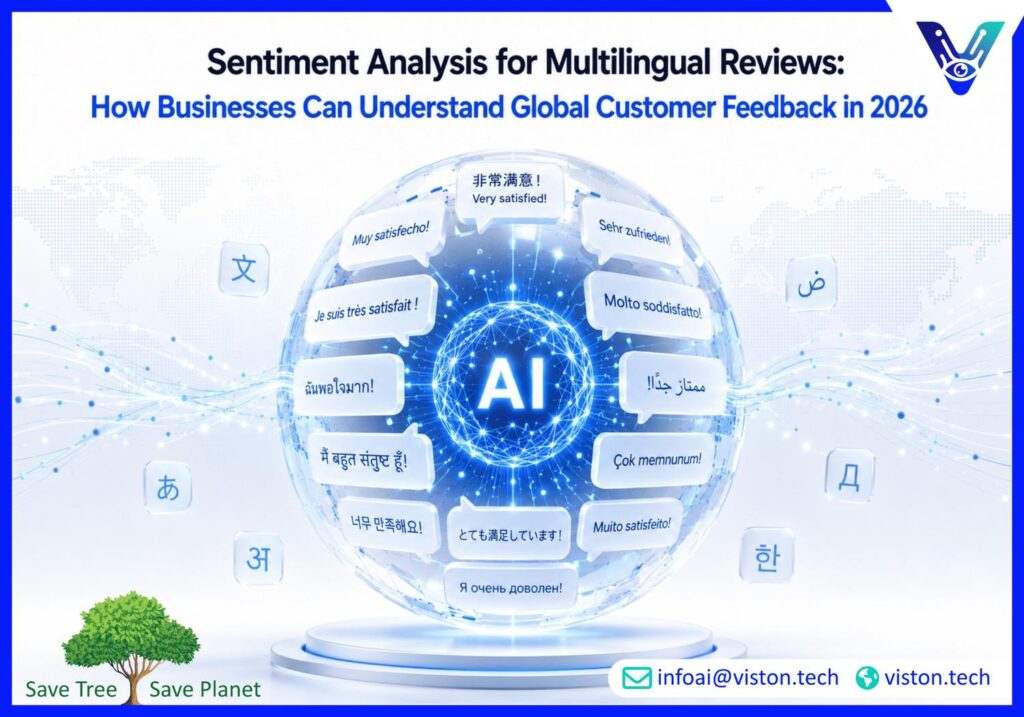
Sentiment Analysis for Multilingual Reviews: How Businesses Can Understand Global Customer Feedback in 2026
Customer reviews now come from multiple countries, languages, and digital channels. For businesses serving international markets, understanding customer sentiment across languages is no longer optional. Sentiment analysis for multilingual reviews helps organizations identify customer satisfaction trends, uncover service issues, and make data-driven decisions from feedback generated worldwide.
What Is Sentiment Analysis for Multilingual Reviews?
Sentiment analysis for multilingual reviews is the process of using natural language processing (NLP) and artificial intelligence to evaluate customer opinions expressed in different languages. The goal is to classify feedback as positive, negative, or neutral while preserving the original meaning and context.Unlike traditional sentiment analysis that focuses on a single language, multilingual sentiment analysis must account for:
Language-specific vocabulary and grammar
Cultural differences in communication
Regional expressions and slang
Mixed-language content
Industry-specific terminology
Contextual meanings across markets
As businesses expand globally, customer reviews may originate from websites, marketplaces, social media platforms, mobile applications, customer surveys, and support channels. Analyzing this feedback manually becomes increasingly difficult at scale.Modern sentiment analysis solutions help organizations convert multilingual feedback into actionable business intelligence.
Why Multilingual Review Analysis Matters in 2026
Global commerce has made customer experience a competitive differentiator. Businesses frequently receive reviews in multiple languages from customers located across different regions and markets.Without multilingual sentiment analysis, organizations risk overlooking valuable customer insights simply because feedback is written in a language their teams do not understand.
Improved Customer Experience Visibility
Customer concerns often appear first in reviews before they become major operational issues. Multilingual sentiment analysis enables businesses to identify recurring complaints, service gaps, and product-related concerns regardless of language.
Better Market Intelligence
Different regions may respond differently to products, pricing, delivery experiences, or customer support. Understanding sentiment across languages helps organizations compare customer perceptions between markets.
Faster Response to Emerging Issues
Real-time sentiment monitoring allows businesses to identify negative trends early and respond before they affect brand reputation.
Scalable Feedback Processing
Large organizations often receive thousands of reviews each month. Automated sentiment analysis makes it possible to process vast volumes of multilingual customer feedback efficiently.
Key Challenges of Analyzing Multilingual Reviews
While multilingual sentiment analysis offers significant value, it presents several technical and operational challenges.
Language Complexity
Words that express positive sentiment in one language may not translate directly into another. Literal translation can sometimes distort meaning and affect sentiment accuracy.
Cultural Context
Customer expressions vary across regions. Certain phrases may indicate dissatisfaction in one culture while appearing neutral in another.
Mixed-Language Reviews
Customers frequently combine multiple languages within a single review. Effective sentiment analysis systems must recognize and process multilingual content accurately.
Industry Terminology
Technical products, healthcare services, financial solutions, and e-commerce platforms often involve specialized vocabulary that generic language models may not fully understand.
Sarcasm and Nuance
Even advanced AI models can struggle with sarcasm, irony, humor, and subtle emotional cues. High-quality sentiment analysis solutions require sophisticated contextual understanding.Organizations evaluating sentiment analysis platforms should assess how effectively a solution handles these real-world challenges.
How Sentiment Analysis Solutions Process Multilingual Reviews
Modern sentiment analysis systems combine machine learning, natural language processing, and large language models to evaluate customer feedback across multiple languages.
Data Collection
Reviews are gathered from relevant sources such as:
E-commerce platforms
App stores
Customer surveys
Review websites
Social media channels
Support interactions
Language Detection
The system automatically identifies the language used in each review before applying appropriate language models.
Text Normalization
Review content is cleaned and prepared for analysis by handling spelling variations, emojis, abbreviations, and informal language patterns.
Sentiment Classification
AI models determine whether the review expresses positive, negative, or neutral sentiment.
Aspect-Based Sentiment Analysis
Advanced solutions go beyond overall sentiment by identifying opinions related to specific topics such as:
Product quality
Pricing
Customer service
Delivery experience
Usability
Technical support
Reporting and Visualization
Insights are presented through dashboards, reports, and alerts that help decision-makers monitor customer sentiment trends across regions and languages.
Business Benefits of Multilingual Sentiment Analysis
Organizations investing in multilingual sentiment analysis often seek measurable business outcomes rather than simply collecting customer feedback.
Enhanced Customer Retention
Understanding customer dissatisfaction early enables businesses to address concerns before customers switch to competitors.
Better Product Development
Customer reviews often contain valuable suggestions for product improvements. Multilingual analysis helps organizations capture these insights from global markets.
Stronger Brand Reputation Management
Monitoring sentiment across languages provides greater visibility into public perception and emerging reputation risks.
More Effective Decision-Making
Business leaders can use sentiment trends to guide investments, prioritize improvements, and allocate resources more effectively.
Operational Efficiency
Automated sentiment analysis significantly reduces the time required for manual review analysis while increasing insight coverage.
How Viston AI Supports Multilingual Sentiment Analysis Initiatives
Organizations seeking to extract meaningful insights from multilingual customer feedback often require more than basic text classification. Effective sentiment analysis requires robust natural language processing capabilities, scalable data processing, contextual understanding, and business-focused reporting.Viston AI specializes in Sentiment Analysis solutions designed to help businesses transform large volumes of customer feedback into actionable intelligence. By leveraging advanced AI and NLP technologies, sentiment analysis workflows can be tailored to support multilingual review environments where customer opinions originate from diverse markets and languages.For businesses managing reviews across global platforms, multilingual sentiment analysis can help identify emerging trends, customer concerns, service quality issues, and regional differences in customer expectations. This enables decision-makers to move beyond raw review volumes and focus on measurable customer experience improvements.Organizations evaluating sentiment analysis capabilities typically look for scalability, reporting accuracy, integration flexibility, automation, and actionable insights. A specialized approach to sentiment analysis can help businesses better understand customer sentiment across languages while supporting informed operational, product, and customer experience decisions.As customer feedback ecosystems continue to expand in 2026, businesses increasingly require solutions capable of analyzing multilingual reviews efficiently while maintaining contextual accuracy and business relevance.
Frequently Asked Questions
What is multilingual sentiment analysis?
Multilingual sentiment analysis is the process of evaluating customer opinions expressed in multiple languages to determine sentiment and extract actionable insights.
How accurate is sentiment analysis for multilingual reviews?
Accuracy depends on the quality of language models, training data, contextual understanding, and the system’s ability to handle cultural and linguistic variations.
Can sentiment analysis identify specific customer concerns?
Yes. Advanced solutions use aspect-based sentiment analysis to identify opinions related to specific topics such as product quality, pricing, delivery, and customer support.
Which industries benefit most from multilingual sentiment analysis?
E-commerce, travel, hospitality, SaaS, retail, telecommunications, healthcare, financial services, and global consumer brands commonly benefit from multilingual sentiment analysis.
Can multilingual sentiment analysis process reviews in real time?
Many modern sentiment analysis platforms support real-time or near-real-time monitoring, allowing businesses to identify customer sentiment trends as feedback is received.
How can Viston AI help with multilingual review analysis?
Viston AI provides sentiment analysis capabilities that help organizations analyze customer feedback, identify sentiment trends, and generate actionable insights from multilingual review data.
Conclusion
Sentiment analysis for multilingual reviews has become an essential capability for organizations operating in increasingly global markets. As customer feedback grows across languages, channels, and regions, businesses need reliable methods for understanding customer sentiment at scale. Effective Sentiment Analysis enables organizations to uncover actionable insights, improve customer experiences, strengthen decision-making, and respond proactively to emerging concerns. For businesses seeking to maximize the value of multilingual customer feedback, specialized sentiment analysis capabilities offered by Viston AI can support more informed and data-driven business outcomes in 2026.