Sentiment Analysis CRM Integration Services: Turning Customer Feedback into Actionable Business Intelligence in 2026
Customer relationships are increasingly driven by data, but data alone does not reveal how customers truly feel. Businesses today receive feedback through emails, support tickets, reviews, social media conversations, surveys, and sales interactions. Sentiment analysis CRM integration services help organizations connect emotional insights with customer records, enabling smarter decisions, improved customer experiences, and more effective business strategies.
What Are Sentiment Analysis CRM Integration Services?
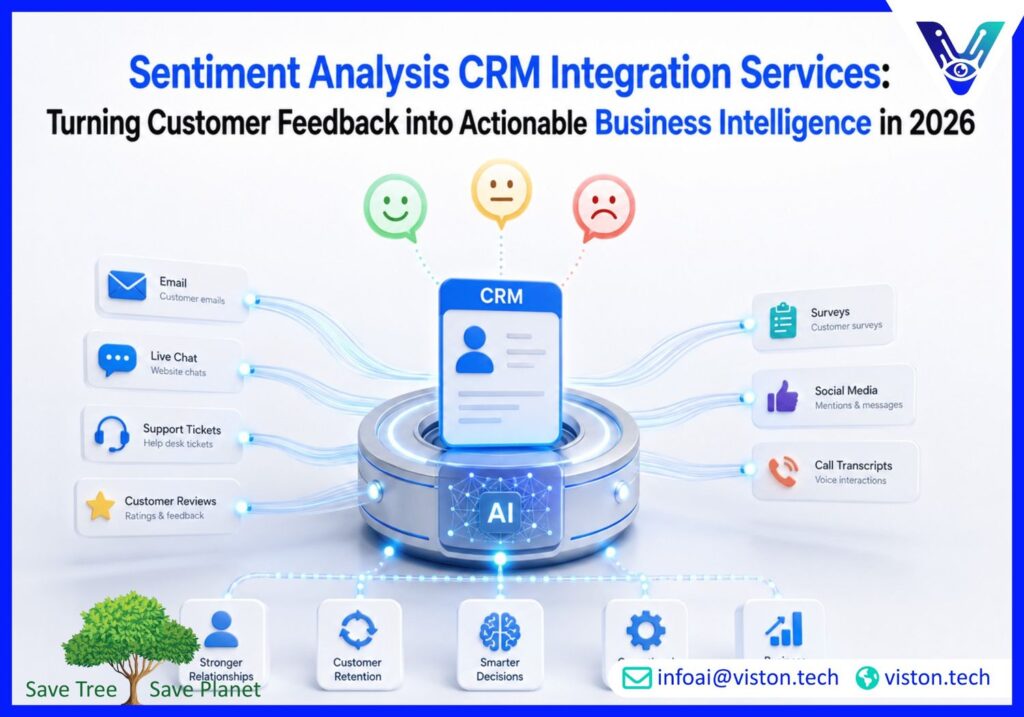
Sentiment analysis CRM integration services combine artificial intelligence-powered sentiment analysis with Customer Relationship Management (CRM) platforms. The objective is to automatically analyze customer communications and classify them as positive, negative, or neutral while linking those insights directly to customer profiles and business workflows.Rather than manually reviewing thousands of interactions, businesses can automatically understand customer emotions across multiple touchpoints and use those insights to improve engagement, retention, and operational efficiency.Common data sources integrated into sentiment analysis systems include:
Customer support tickets
Email communications
Live chat conversations
Call center transcripts
Customer surveys
Social media interactions
Product reviews
CRM notes and sales conversations
When integrated correctly, sentiment scores become part of the customer record, allowing teams to identify opportunities and risks in real time.
Why Sentiment Analysis CRM Integration Matters in 2026
Modern customers expect personalized experiences and rapid responses. Businesses that fail to recognize customer dissatisfaction early often experience increased churn, declining loyalty, and lost revenue opportunities.In 2026, organizations are moving beyond basic customer data management and focusing on customer intelligence. Sentiment analysis provides an additional layer of context that traditional CRM systems often lack.
Improved Customer Retention
Negative sentiment can act as an early warning indicator. Organizations can proactively engage customers showing signs of frustration before they decide to switch providers.
More Effective Sales Strategies
Sales teams can prioritize leads based on engagement quality and sentiment trends rather than relying solely on demographic or behavioral data.
Enhanced Customer Support
Support teams can automatically escalate high-risk interactions, ensuring urgent issues receive immediate attention.
Better Decision-Making
Business leaders gain visibility into customer satisfaction trends, product perception, and service quality across different markets and customer segments.As AI adoption grows globally, sentiment-driven customer intelligence is becoming a competitive advantage rather than a luxury.
Key Business Benefits of Sentiment Analysis CRM Integration
Organizations implementing sentiment analysis CRM integration services often seek measurable business outcomes rather than standalone AI functionality.
Unified Customer View
CRM systems typically store customer history, transactions, and interactions. Sentiment analysis enriches these records with emotional insights, creating a more complete understanding of customer relationships.
Automated Customer Prioritization
Businesses can automatically identify:
At-risk customers
High-value advocates
Escalation candidates
Customers requiring immediate intervention
Potential upsell opportunities
Scalable Customer Experience Management
Manual review becomes impractical as customer volumes increase. Automated sentiment analysis allows organizations to monitor thousands or millions of interactions efficiently.
Faster Response Times
Real-time sentiment detection enables teams to respond quickly to negative experiences before issues escalate.
Data-Driven Marketing Optimization
Marketing teams can evaluate customer reactions to campaigns, products, and brand messaging, helping improve future initiatives.
Operational Efficiency
Automation reduces manual analysis efforts while improving consistency and accuracy across customer engagement processes.
Important Considerations When Implementing Sentiment Analysis CRM Integration Services
Successful implementation requires more than connecting AI models to a CRM platform. Businesses should evaluate several factors before deployment.
Data Quality and Availability
Sentiment analysis outcomes depend heavily on the quality of customer communication data. Organizations should ensure data sources are structured, accessible, and properly governed.
CRM Compatibility
The integration solution should work seamlessly with existing CRM platforms, including custom workflows, APIs, and reporting environments.
Industry-Specific Language Understanding
Different industries use specialized terminology. Effective sentiment analysis solutions should be capable of understanding domain-specific language, customer intent, and contextual meaning.
Multilingual Support
Global businesses often interact with customers across multiple regions and languages. Multilingual sentiment analysis capabilities help maintain consistency across international operations.
Security and Compliance
Customer communications frequently contain sensitive information. Integration solutions should support strong security practices, access controls, data governance, and regulatory compliance requirements.
Workflow Automation
The most valuable implementations connect sentiment insights directly to business actions such as alerts, ticket routing, customer success workflows, and sales prioritization.Organizations that focus on both technology and operational processes typically achieve better long-term outcomes.
How Viston AI Supports Sentiment Analysis CRM Integration Initiatives
For organizations seeking to transform customer communication data into actionable business intelligence, Viston AI provides specialized sentiment analysis capabilities designed to support modern customer engagement strategies.Sentiment analysis CRM integration projects often require more than simply deploying an AI model. Businesses need reliable data processing, scalable architecture, workflow integration, reporting capabilities, and ongoing optimization. Viston AI helps organizations bridge these requirements by enabling sentiment-driven insights that can be incorporated into existing customer relationship management environments.Across industries, customer-facing teams increasingly require visibility into customer emotions, satisfaction trends, service quality indicators, and engagement patterns. By integrating sentiment analysis into operational workflows, organizations can identify risks earlier, improve customer experiences, and support data-informed decision-making.For global businesses managing large volumes of customer interactions, scalable sentiment analysis solutions can help uncover patterns that may otherwise remain hidden within unstructured data. Whether the objective is improving customer retention, enhancing support operations, optimizing sales engagement, or gaining deeper customer intelligence, sentiment analysis integration can play a significant role in achieving measurable business outcomes.As customer expectations continue to evolve in 2026, organizations increasingly benefit from solutions that combine AI-driven language understanding with practical business workflows and CRM-based decision-making.
Frequently Asked Questions
What is sentiment analysis in CRM systems?
Sentiment analysis in CRM systems involves using AI and natural language processing to evaluate customer communications and determine whether sentiments are positive, negative, or neutral, helping businesses make better customer engagement decisions.
Which CRM platforms can be integrated with sentiment analysis tools?
Many modern CRM platforms support integrations through APIs and middleware solutions. Integration capabilities depend on the CRM architecture, customization requirements, and business objectives.
Can sentiment analysis improve customer retention?
Yes. By identifying negative customer sentiment early, businesses can proactively address concerns, improve service quality, and reduce the likelihood of customer churn.
Is sentiment analysis suitable for global businesses?
Yes. Modern sentiment analysis solutions increasingly support multilingual processing, making them valuable for organizations operating across international markets.
How accurate are sentiment analysis systems?
Accuracy depends on factors such as data quality, language complexity, industry-specific terminology, model training, and ongoing optimization. Well-designed solutions generally deliver significantly better scalability than manual analysis.
How can Viston AI support sentiment analysis CRM integration projects?
Viston AI helps organizations leverage sentiment analysis capabilities within customer engagement workflows, enabling businesses to gain actionable insights from customer interactions and improve CRM-driven decision-making processes.
Conclusion
Sentiment analysis CRM integration services help businesses move beyond traditional customer data management by incorporating emotional intelligence into everyday decision-making. As organizations continue investing in customer experience, retention, and operational efficiency in 2026, sentiment-driven insights are becoming an increasingly important component of CRM strategies.By connecting customer feedback, conversations, and interactions directly with CRM workflows, businesses can identify risks earlier, respond more effectively, and create stronger customer relationships. For organizations exploring advanced sentiment analysis capabilities, Viston AI offers relevant expertise in helping transform customer communication data into meaningful business intelligence.