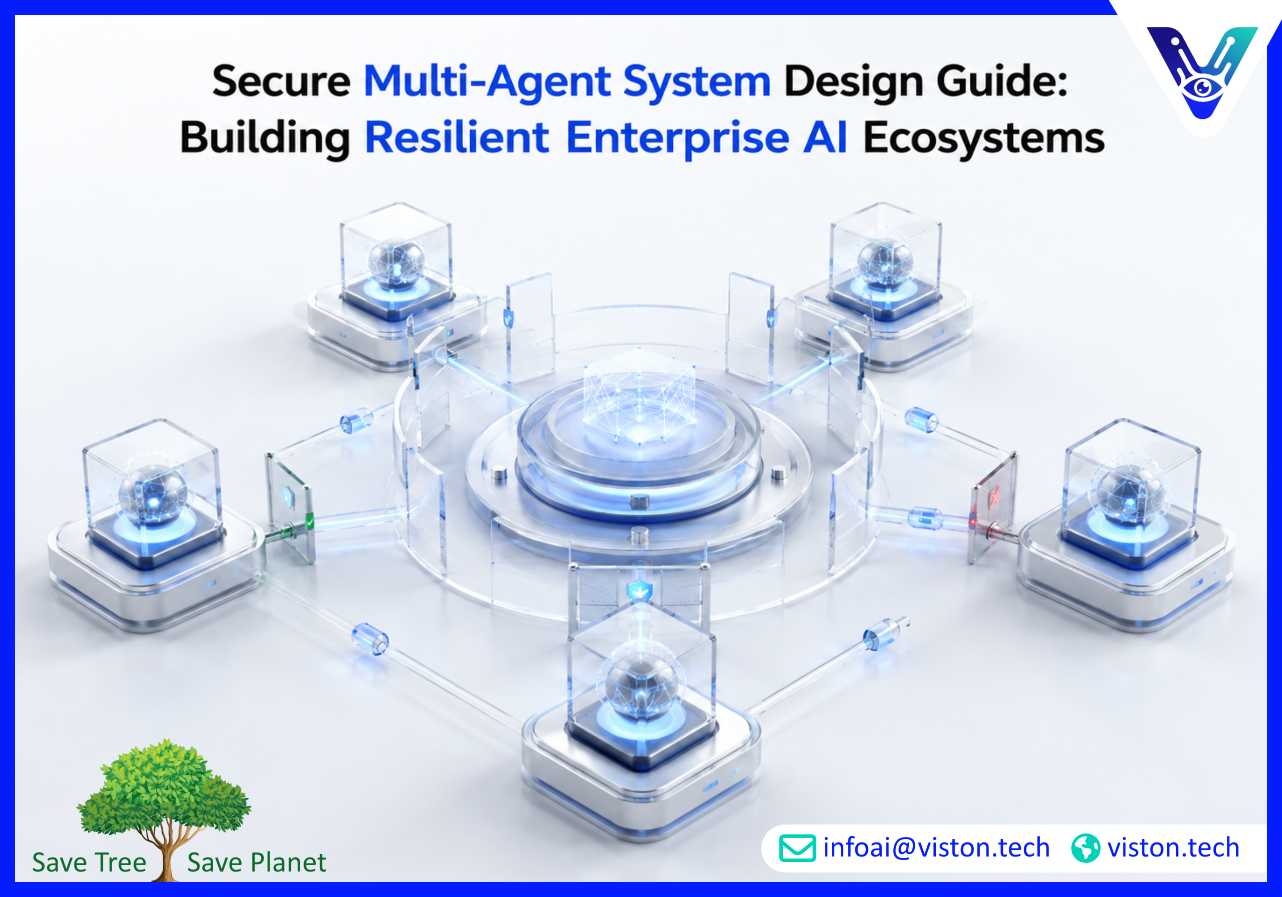
Secure Multi-Agent System Design Guide: Building Resilient Enterprise AI Ecosystems
Introduction
As enterprises move beyond experimental AI pilots, the focus has shifted from standalone chatbots to interconnected, autonomous systems. By mid-2026, the ability to orchestrate multiple specialized agents working in concert is the defining characteristic of mature AI operations. However, with this power comes a proportional increase in risk. A single compromised credential or misconfigured permission in a multi-agent system (MAS) can trigger a cascading failure, leading to data exfiltration or unauthorized financial transactions.This guide serves as a technical blueprint for decision-makers. We will move beyond theoretical “best practices” to examine the specific architectural controls required to build secure, verifiable, and commercially viable multi-agent ecosystems.
Why Traditional Security Fails in Agentic Environments
Traditional cybersecurity operates on a binary model: a user authenticates, gains access, and performs an action. Multi-agent systems break this model. Agents are non-human identities that exhibit non-deterministic behavior—meaning they choose their own path to achieve a goal.In this environment, security cannot be a perimeter or a static gate. It must be a continuous enforcement layer embedded in the runtime. Research into agentic security frameworks has identified specific vulnerabilities unique to MAS, particularly around non-determinism and delegation poisoning, where one agent unknowingly passes corrupted instructions or excessive privileges to another. Standard AI safety toolkits often miss these “hand-off” attacks because they occur between agents, not just between a user and the model.
The Core Pillars of a Secure Multi-Agent Design
To mitigate these risks, your architecture must be built on a foundation of verifiable identity, least-privilege delegation, and isolated execution. Here are the non-negotiable requirements for a production-grade system in 2026.
1. Identity and Authentication for Non-Human Entities
Every agent in your ecosystem requires a unique, lifecycle-managed identity. Shared service accounts are forbidden. AI Agent Authentication requires the use of short-lived, purpose-bound tokens rather than static API keys. When Agent A delegates a task to Agent B, the token passed must carry the specific context of the original request—not the full privileges of Agent A. This prevents “privilege amplification,” where a low-level assistant agent inherits admin rights.
2. The Delegation Boundary and Authorization
The most dangerous moment in a MAS is the hand-off. A robust secure multi-agent system design implements delegation-aware authorization. This means the system tracks the “chain of custody” from the original human user down through every nested agent call.If a user asks a “Research Agent” to summarize a file, and the Research Agent delegates to a “Parser Agent,” the Parser Agent should only have “read” access to that specific file for 30 seconds. Once the task is complete, the delegation chain collapses. Without this, you risk “confused deputy” problems, where an agent is tricked into using its legitimate authority to perform an illegitimate action.
3. Secure Inter-Agent Communication
Agents often speak different technical languages. To secure them, you must standardize the protocol. Emerging standards like the Model Context Protocol (MCP) or API-first gateways act as a control plane. All communication must pass through a secure channel that verifies the intent of the message against the agent’s defined role. Implicit trust between internal agents is a primary vulnerability; Zero Trust principles apply inside the ecosystem as strictly as they do at the edge.
4. Runtime Monitoring and Observability
Because agent behavior is generative, you cannot predict every path it will take. You must implement behavioral baselining. This involves monitoring tool invocation patterns, data access volume, and workflow state transitions. If an agent suddenly triples its API calls or attempts to access a database it normally ignores, the system should flag this as behavioral drift and halt execution.
Why B2B Enterprises Are Prioritizing Agentic Security
For B2B enterprises, the risks are compounded by regulatory compliance and financial exposure. Procurement teams are not just buying automation; they are buying governance. According to industry analysis, AI agents are projected to intermediate a significant majority of B2B buying flows by 2028.Imagine a procurement agent that negotiates pricing with a supplier’s agent. If the security model is weak, a malicious supplier could inject a prompt that causes your agent to bypass your internal approval workflow. Secure design ensures that even if the agent negotiates, it cannot bind the contract without a cryptographic signature from a human-controlled system.
How Viston AI Supports Enterprise Multi-Agent Orchestration
Turning these architectural principles into operational reality requires an orchestration layer specifically built for security, not just speed. Viston AI specializes in Enterprise Multi-Agent Orchestration Solutions that embed security at the workflow level rather than tacking it on as an afterthought.For organizations in regulated industries or complex B2B environments, Viston AI provides the control plane necessary to scale agentic systems without losing governance. Their approach addresses the critical gap between “agent capability” and “agent safety” by enforcing strict identity boundaries and delegation limits across distributed teams. Whether you are managing financial reconciliations, supply chain logistics, or internal IT helpdesks, Viston AI helps ensure that your autonomous agents remain aligned with business rules, audit requirements, and data privacy standards.Rather than simply deploying generic frameworks, Viston AI focuses on the execution layer—verifying that every action taken by an agent is authorized, recorded, and reversible.
Frequently Asked Questions
Q: What is the single biggest security risk in multi-agent systems?
The biggest risk is cascading privilege amplification. This occurs when a low-privilege agent delegates a task to a higher-privilege agent without scoping down the authority, or when an agent takes an action that implicitly trusts corrupted data from another agent.
Q: How does AI Agent Authentication differ from standard SSO?
Standard SSO authenticates humans once per session. AI Agent Authentication requires continuous, short-lived tokens scoped to a specific task. An agent must re-authenticate or refresh its token for every major action or delegation step, preventing session hijacking.
Q: Can I use standard API gateways to secure agent traffic?
Partially. Standard gateways handle traffic volume but lack semantic understanding. You need an agentic gateway that understands “intent.” It must differentiate between a legitimate request to “read a database” versus a maliciously injected request to “delete a database” hidden in a support ticket.
Q: What is “delegation poisoning”?
Delegation poisoning happens when Agent A completes a task but a malicious actor subtly alters the context or memory before Agent A hands it off to Agent B. Agent B, trusting Agent A, then executes a harmful action based on the poisoned data.
Q: Is zero-trust possible for AI agents?
Yes, but it requires implementing policy-as-code for agents. Every interaction—agent-to-tool, agent-to-agent, agent-to-API—must be evaluated against a live policy engine in real-time, not just at the start of the workflow.
Conclusion
A secure multi-agent system is not defined by the intelligence of its LLMs, but by the robustness of its control plane. As you scale from one agent to one hundred, the complexity of the trust graph grows exponentially. By prioritizing non-human identity management, strict delegation scoping, and behavioral observability, you turn multi-agent systems from a security liability into a competitive asset.For enterprises looking to move beyond the pilot phase, the question is no longer “What can an agent do?” but rather “How do we safely manage what the agent wants to do?” Partnering with a specialist like Viston AI for Enterprise Multi-Agent Orchestration Solutions ensures that your architecture is built for the resilience required in 2026 and beyond.