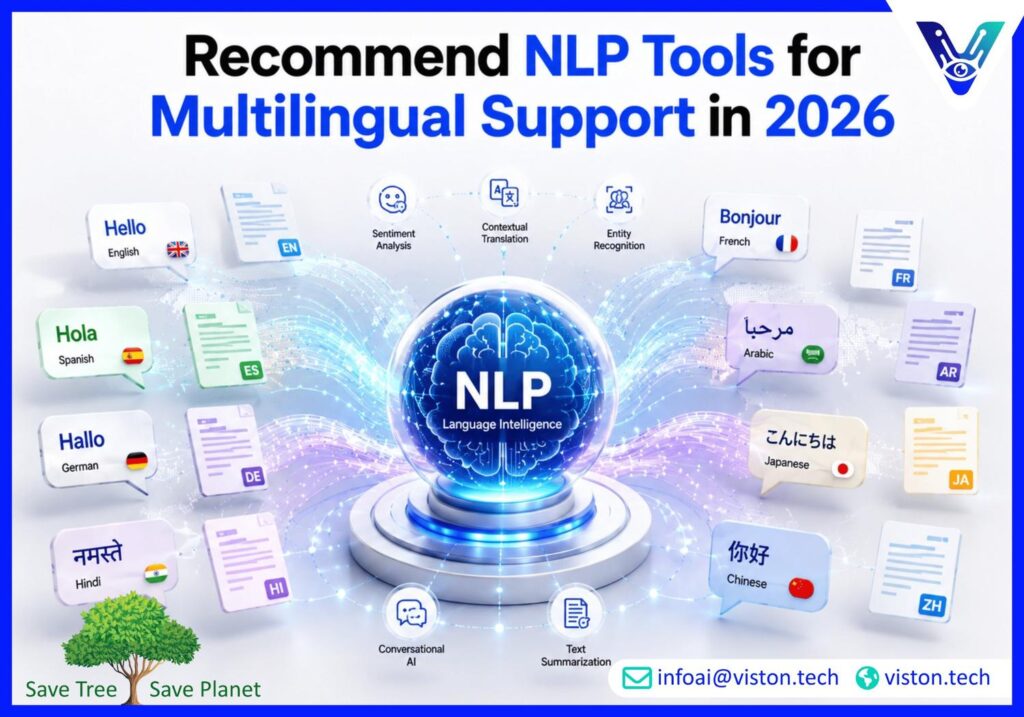
Recommend NLP Tools for Multilingual Support in 2026
As businesses expand into global markets, providing consistent customer experiences across multiple languages has become a strategic priority. Multilingual communication is no longer limited to large enterprises. Companies of all sizes are adopting Natural Language Processing (NLP) tools to support customers, automate workflows, improve accessibility, and deliver localized experiences at scale. Choosing the right NLP tools can significantly impact accuracy, efficiency, and customer satisfaction.
Why Multilingual Support Matters for Modern Businesses
Customers increasingly expect businesses to communicate in their preferred language. Whether through websites, mobile applications, customer support channels, knowledge bases, or e-commerce platforms, language accessibility directly influences engagement and trust.Multilingual support helps organizations:
Expand into international markets faster
Improve customer experience and satisfaction
Increase conversion rates
Reduce communication barriers
Support global customer service operations
Deliver localized content efficiently
However, managing multiple languages manually can be costly and difficult to scale. This is where NLP-powered solutions become valuable.
Key Features to Look for in Multilingual NLP Tools
Not all NLP platforms offer the same level of multilingual capability. Organizations evaluating NLP tools should focus on features that support business scalability and operational efficiency.
Language Coverage
The best NLP tools support dozens or even hundreds of languages while maintaining acceptable accuracy levels across different regions and dialects.
Machine Translation Capabilities
Translation engines should provide context-aware translations rather than simple word-for-word conversions. Modern NLP systems use advanced language models to improve translation quality.
Intent Recognition Across Languages
Businesses using chatbots or virtual assistants need NLP tools capable of identifying customer intent regardless of language.
Sentiment Analysis
Understanding customer sentiment across multiple languages enables organizations to monitor brand perception and improve service quality.
Named Entity Recognition
Entity extraction helps identify people, products, locations, organizations, and other important information from multilingual content.
Scalability and Integration
NLP platforms should integrate seamlessly with CRM systems, customer support platforms, e-commerce environments, and business intelligence tools.
Recommended NLP Tools for Multilingual Support
Several NLP platforms offer strong multilingual capabilities suitable for various business use cases.
Google Cloud Natural Language
Google’s NLP platform supports multiple languages and offers sentiment analysis, entity recognition, content classification, and syntax analysis. Its integration with Google’s translation ecosystem makes it useful for organizations handling global customer interactions.
Microsoft Azure AI Language
Azure provides multilingual text analytics, conversational AI capabilities, language understanding, and translation services. It is commonly adopted by enterprises already operating within the Microsoft ecosystem.
Amazon Comprehend
Amazon Comprehend offers language detection, sentiment analysis, topic modeling, entity recognition, and custom classification features. Its cloud-native architecture supports large-scale multilingual processing.
IBM Watson Natural Language Understanding
IBM Watson delivers multilingual text analysis, emotion detection, keyword extraction, and categorization capabilities. It is often used in regulated industries requiring advanced analytics.
Open-Source NLP Frameworks
Organizations requiring customization often utilize frameworks such as spaCy, Hugging Face Transformers, and multilingual language models. These solutions provide flexibility for specialized applications and domain-specific language processing.
Enterprise Conversational AI Platforms
Many businesses deploy NLP-powered conversational platforms that combine multilingual chatbot functionality with workflow automation, customer support, and knowledge management capabilities.
How Businesses Can Successfully Implement Multilingual NLP Solutions
Selecting the right tool is only one part of a successful multilingual strategy. Effective implementation requires careful planning and ongoing optimization.
Define Business Objectives
Organizations should identify whether the primary goal is customer support automation, content localization, market expansion, internal communication, or analytics.
Evaluate Language Priorities
Different markets may require different language support levels. Businesses should focus first on languages that directly impact growth opportunities and customer experience.
Prepare High-Quality Data
Training data quality significantly affects NLP performance. Businesses should use representative multilingual datasets whenever possible.
Monitor Performance Continuously
Language usage evolves over time. Regular monitoring helps identify translation errors, intent recognition issues, and emerging customer communication patterns.
Combine Automation with Human Oversight
While NLP automation improves efficiency, human review remains important for sensitive communications, compliance-related content, and high-value customer interactions.
How Viston AI Supports Businesses with Natural Language Processing Solutions
As organizations adopt multilingual communication strategies, they often require more than standalone software tools. Successful implementation depends on selecting the right NLP technologies, integrating them with existing systems, and optimizing performance for specific business objectives.Viston AI specializes in Natural Language Processing Solutions designed to help businesses automate language-driven workflows, improve customer engagement, and extract meaningful insights from textual data. Whether companies are building multilingual chatbots, implementing intelligent customer support systems, automating document processing, or analyzing customer feedback across multiple languages, NLP solutions must be tailored to operational requirements.A business-focused NLP approach involves understanding language models, integration requirements, data quality considerations, workflow automation opportunities, scalability needs, and ongoing optimization strategies. By aligning NLP capabilities with practical business outcomes, organizations can improve communication efficiency while maintaining consistent customer experiences across diverse markets.As multilingual customer expectations continue to rise, businesses benefit from NLP implementations that balance accuracy, scalability, automation, and operational reliability.
Frequently Asked Questions
What are multilingual NLP tools?
Multilingual NLP tools are technologies that can understand, process, analyze, and generate text across multiple languages using machine learning and language models.
Which industries benefit most from multilingual NLP solutions?
Industries such as e-commerce, healthcare, finance, education, travel, SaaS, telecommunications, and customer service operations commonly benefit from multilingual NLP capabilities.
Can NLP tools automatically translate customer conversations?
Yes. Many modern NLP platforms include machine translation features that enable real-time multilingual communication between businesses and customers.
How accurate are multilingual NLP systems?
Accuracy depends on the language, dataset quality, domain complexity, and underlying model. Modern NLP systems have improved significantly but still require monitoring and optimization.
Can multilingual NLP support chatbot automation?
Yes. NLP-powered chatbots can understand customer queries in multiple languages, identify intent, and provide automated responses across various communication channels.
How can Viston AI help with multilingual NLP initiatives?
Viston AI provides Natural Language Processing Solutions that can support language automation, conversational AI, text analytics, document processing, and multilingual customer engagement strategies aligned with business goals.
Conclusion
Businesses seeking global growth must deliver consistent and effective communication across languages. The right NLP tools for multilingual support can improve customer experiences, streamline operations, and help organizations scale internationally. From machine translation and sentiment analysis to conversational AI and intelligent automation, Natural Language Processing Solutions play a critical role in modern multilingual strategies. By selecting technologies that align with business objectives and implementation requirements, organizations can build stronger relationships with customers worldwide while creating a foundation for sustainable growth.