
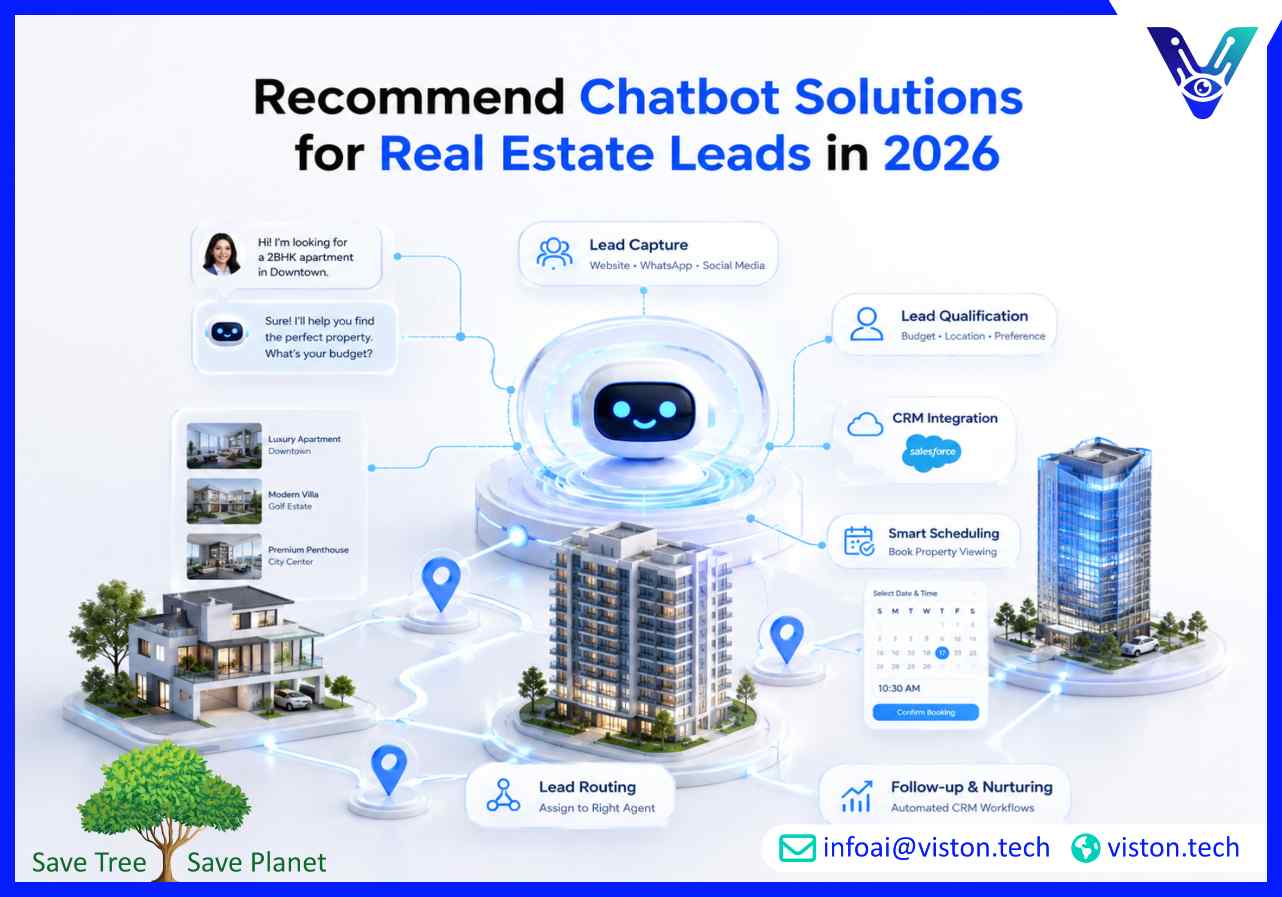
Real estate lead generation has become faster, more digital, and more competitive. Buyers, sellers, tenants, and investors expect instant answers, personalized property guidance, and quick follow-up. The right chatbot solution can help real estate businesses qualify leads, capture intent, schedule viewings, and connect conversations with sales systems.
Real estate leads are rarely simple form submissions anymore. A serious prospect may start on a property listing page, ask questions through WhatsApp, compare prices on a mobile site, return later through a paid ad, and expect the sales team to remember the full context. Without automation, many of these conversations are delayed, incomplete, or lost.
Chatbot solutions for real estate leads help businesses respond at the exact moment a prospect shows interest. Instead of asking users to wait for an agent, a chatbot can answer common questions, collect lead details, identify preferences, and route qualified inquiries to the right sales representative. This is especially valuable for property developers, real estate marketplaces, brokers, rental agencies, and commercial real estate firms handling high inquiry volumes.
In 2026, the strongest real estate chatbots are not basic scripted pop-ups. They are integrated conversational systems that connect with CRM platforms, property databases, calendars, marketing tools, and communication channels. This allows the chatbot to support the full lead journey, from first inquiry to appointment booking and follow-up.
For real estate companies, the value is practical. A chatbot can reduce response gaps, improve lead qualification, support after-hours inquiries, and give sales teams cleaner data. It can also help marketing leaders understand which property types, locations, budgets, and buyer objections appear most often in conversations.
A useful real estate chatbot should be designed around buyer intent, not just generic automation. The goal is not to replace sales teams. The goal is to handle repetitive discovery, provide timely information, and make sure human agents spend more time with serious prospects.
The chatbot should collect essential information naturally during the conversation. This may include name, phone number, email address, preferred location, property type, budget range, purchase timeline, financing status, and whether the prospect is buying, renting, selling, or investing.
The experience should feel conversational rather than like a long form. For example, instead of asking ten questions upfront, the chatbot can first understand the user’s need and then request details at the right moment. This helps increase completion rates and reduces drop-offs.
Not every inquiry should be treated equally. A visitor asking general location questions may need nurturing, while someone requesting a site visit for a specific property may need urgent sales follow-up. A strong chatbot can apply lead qualification logic based on budget, urgency, property match, location preference, and readiness to speak with an agent.
For real estate teams, this improves prioritization. Sales representatives can focus on high-intent prospects while marketing automation continues nurturing early-stage buyers through email, WhatsApp, or CRM workflows.
For real estate marketplaces and agencies with multiple listings, chatbot solutions should help users narrow down options. A chatbot can ask about preferred area, number of bedrooms, price range, amenities, possession timeline, commercial requirements, or investment goals, then suggest suitable properties from the available inventory.
This works best when the chatbot is integrated with an updated property database or CRM. If inventory data is not synchronized, the chatbot may recommend unavailable units, outdated prices, or incorrect viewing slots. That damages trust quickly.
One of the most valuable chatbot use cases in real estate is appointment scheduling. A chatbot can capture a prospect’s preferred date and time, check agent availability, book a viewing, and send confirmation through email, SMS, or WhatsApp.
The system should also route conversations intelligently. Residential buyer leads, rental inquiries, seller valuation requests, commercial leasing inquiries, and investor questions may need different teams. A well-integrated chatbot sends each lead to the right person with the full conversation history.
The best chatbot solution depends on the business model, lead volume, sales workflow, and technology stack. Real estate companies should avoid choosing a chatbot only because it looks simple to launch. The better question is whether it can support lead quality, CRM accuracy, and sales follow-up at scale.
A website chatbot is often the first solution real estate businesses should consider. It can support visitors on listing pages, project pages, landing pages, and campaign pages. The chatbot can answer questions about property availability, pricing range, floor plans, amenities, nearby facilities, financing support, and viewing options.
This solution is useful for developers, brokers, and agencies that receive traffic from organic search, paid ads, property portals, or social media campaigns. The key requirement is integration with CRM and lead tracking tools, so every conversation becomes a structured sales opportunity rather than an isolated chat.
WhatsApp is highly relevant for real estate because buyers and renters often prefer quick mobile conversations. A WhatsApp chatbot can continue the conversation after a website visit, send property brochures, confirm viewing appointments, answer project questions, and notify sales teams when a prospect becomes high intent.
For best results, WhatsApp automation should not feel spammy. It should be permission-based, context-aware, and connected to the same CRM records used by the sales team. This prevents duplicate follow-ups and helps agents understand what the prospect has already asked.
CRM-integrated chatbots are the most valuable option for real estate businesses that manage multiple sales agents, projects, locations, or lead sources. These chatbots can create and update leads, assign prospects to sales representatives, log conversation summaries, trigger follow-up tasks, and sync lead scores.
Common CRM workflows include assigning leads by location, project, property type, budget, campaign source, or agent availability. This level of automation helps reduce manual data entry and ensures that no serious prospect is missed after business hours or during high-volume campaign periods.
Some real estate conversations require more than fixed answers. Buyers may ask about investment suitability, neighborhood comparisons, financing documents, rental yield assumptions, legal steps, maintenance charges, or possession timelines. An AI-powered assistant can understand natural language questions and guide users through complex decisions.
However, real estate businesses should set clear boundaries. The chatbot should not provide unsupported legal, financial, or investment guarantees. It should answer from approved knowledge sources, explain when human assistance is needed, and escalate sensitive questions to qualified team members.
Choosing a chatbot solution should start with the sales process. Real estate businesses need to map how leads arrive, what information prospects need, how agents follow up, and where lead leakage happens. A chatbot that only answers FAQs may be useful, but it will not solve deeper qualification and conversion problems unless it is integrated properly.
Integration is one of the biggest differences between a basic chatbot and a business-ready chatbot. Real estate teams should look for integration with platforms such as Salesforce, HubSpot, Microsoft Dynamics, custom CRMs, property inventory systems, lead management tools, calendars, and marketing automation platforms.
The chatbot should create leads automatically, update records after each conversation, store preferences, track source campaigns, and pass complete context to agents. This gives the sales team a single view of the prospect and reduces the risk of fragmented communication.
A high number of chatbot conversations does not always mean better sales performance. The chatbot should be evaluated by lead quality, appointment bookings, response speed, CRM accuracy, sales acceptance rate, and conversion contribution.
Useful qualification criteria may include budget fit, location match, urgency, property type, financing readiness, investment intent, and willingness to schedule a call or site visit. When these signals are captured consistently, sales managers can make better decisions about staffing, campaign spending, and follow-up priorities.
Real estate is still a high-trust, high-value transaction. A chatbot should support human agents, not block access to them. The handover process must be clear, fast, and contextual. When a prospect asks to speak to a person, the agent should receive the lead profile, conversation summary, preferred property, and next-best action.
This is especially important for premium residential projects, commercial leasing, luxury properties, and investor-focused real estate services where buyers expect consultative support.
Real estate chatbots collect personal information, including contact details, budgets, location preferences, and sometimes financing-related information. Businesses should ensure that chatbot workflows include consent capture, secure data transfer, role-based access, audit logs, and responsible data retention practices.
If the chatbot operates across multiple countries or regions, privacy requirements may vary. Even when a target location is not fixed, secure design should be treated as a core requirement rather than an optional feature.
A successful chatbot implementation starts with a focused use case. Instead of trying to automate everything at once, real estate businesses should begin with the highest-impact lead journeys. These often include property inquiry handling, lead qualification, brochure requests, appointment booking, and CRM lead creation.
The chatbot knowledge base should be built from accurate business information. This may include property descriptions, pricing ranges, amenities, payment plans, possession dates, eligibility criteria, neighborhood highlights, viewing rules, and escalation policies. Content should be reviewed regularly because real estate inventory, availability, and pricing can change quickly.
Conversation design also matters. A chatbot should guide users clearly without forcing them into rigid menus. It should support both structured choices and natural language questions. It should also recognize when the prospect is confused, dissatisfied, or ready to speak with a human.
Testing should include real sales scenarios. For example, teams should test how the chatbot handles a buyer with a fixed budget, a renter looking for immediate move-in, an investor comparing locations, a seller requesting valuation, or a commercial tenant asking about square footage and lease terms.
After launch, chatbot performance should be monitored continuously. Important KPIs include lead capture rate, qualified lead rate, appointment booking rate, handover success rate, response accuracy, drop-off points, CRM completion rate, average response time, and sales team feedback. These insights help improve both the chatbot and the wider sales process.
Viston AI is relevant to real estate lead generation because its AI Chatbot Integration service focuses on connecting conversational AI with business systems rather than deploying isolated chatbot widgets. Its service page describes chatbot integration with CRM, ERP, and core business platforms, including real-time data synchronization, automated workflows, and unified customer experiences.
For real estate businesses, this matters because lead quality depends on accurate data flow. A chatbot should not only answer questions; it should create CRM records, update lead preferences, trigger sales workflows, support appointment routing, and preserve conversation context for agents. Viston AI’s stated integration capabilities include CRM synchronization with Salesforce, HubSpot, Microsoft Dynamics, and custom CRM platforms, along with multi-channel orchestration across web, mobile, WhatsApp, Teams, Slack, and SMS.
This makes the service useful for property developers, real estate agencies, marketplaces, and broker networks that need chatbot automation connected to lead management operations. When implemented carefully, a Viston AI chatbot integration can help real estate teams qualify prospects, reduce manual follow-up work, organize inquiries by intent, and improve the handover between digital channels and human sales teams.
The best solution is usually a CRM-integrated chatbot that can capture inquiries, qualify prospects, recommend properties, schedule viewings, and pass complete lead context to sales teams. Website and WhatsApp chatbots are especially useful when connected to the same CRM workflow.
Yes. A chatbot can qualify buyers by asking about budget, location preference, property type, purchase timeline, financing readiness, and viewing interest. The lead can then be scored or routed to the right agent based on predefined business rules.
Yes. CRM integration is essential for serious lead generation. It allows the chatbot to create leads, update records, log conversations, assign agents, trigger follow-ups, and give sales teams accurate prospect context.
Yes. A chatbot can collect preferred dates and times, check availability, book appointments, send confirmations, and notify the assigned sales representative. This is one of the highest-value chatbot use cases for real estate teams.
An AI chatbot is better for natural language questions, property discovery, and complex buyer journeys. A scripted chatbot can still work for simple FAQs and structured lead capture. Many real estate businesses benefit from a hybrid approach that combines guided flows with AI-powered answers.
Viston AI can support real estate chatbot integration by connecting conversational AI with CRM systems, communication channels, lead workflows, and business data. This helps real estate teams move beyond basic chat automation toward structured lead qualification and sales follow-up.
To recommend chatbot solutions for real estate leads effectively, businesses should focus on more than a chatbot’s front-end appearance. The strongest solution should capture lead intent, qualify prospects, recommend relevant properties, book appointments, and connect every conversation with CRM and sales workflows. AI Chatbot Integration gives real estate teams the structure needed to respond faster, manage lead data cleanly, and support buyers across digital channels. For organizations that need connected, scalable, and business-focused chatbot implementation, Viston AI offers a relevant service approach built around integrated conversational automation.
