
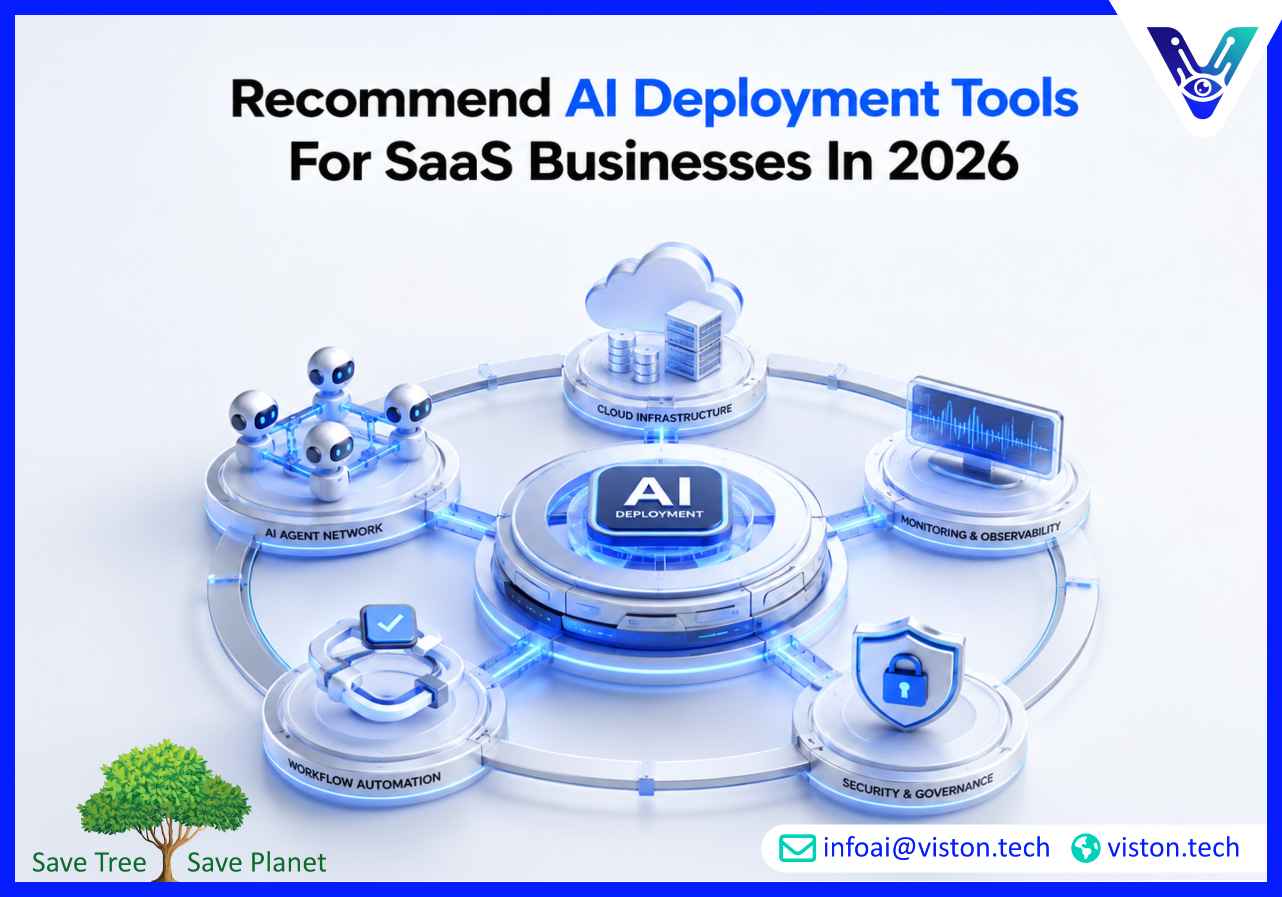
AI-powered products are becoming a core competitive advantage for SaaS businesses. From AI agents and workflow automation to predictive analytics and intelligent support systems, modern SaaS platforms now rely heavily on scalable AI infrastructure. Choosing the right AI deployment tools is critical for maintaining reliability, reducing operational complexity, and accelerating product innovation in 2026.
SaaS companies operate in fast-moving environments where uptime, scalability, security, and customer experience directly affect growth. AI systems introduce additional operational requirements that traditional software infrastructure was not originally designed to manage.
Deploying AI successfully involves more than simply integrating a large language model. SaaS businesses must manage:
Without proper deployment tooling, AI applications can quickly become unstable, expensive, and difficult to maintain.
In 2026, businesses are prioritizing AI deployment platforms that support production-grade reliability, automation, governance, and rapid iteration.
The best AI deployment tools for SaaS environments typically support several operational and business-critical requirements.
SaaS platforms often experience fluctuating workloads. AI infrastructure should automatically scale based on usage demands without affecting response quality or application uptime.
Many SaaS products now combine multiple AI providers such as OpenAI, Anthropic, Gemini, Mistral, or open-source LLMs. Deployment tools should support model routing and provider flexibility.
AI agents increasingly handle customer support, internal automation, onboarding, analytics, and workflow execution. SaaS businesses require orchestration tools capable of managing autonomous or semi-autonomous AI systems reliably.
Production AI systems require visibility into:
Strong monitoring capabilities help reduce operational risk.
SaaS businesses handling customer data must evaluate:
AI governance is becoming increasingly important, particularly for enterprise SaaS products.
AI deployment tools should integrate with:
Seamless integration reduces deployment friction and operational overhead.
Several AI deployment platforms stand out in 2026 based on scalability, orchestration capabilities, developer flexibility, and enterprise readiness.
LangChain remains one of the most widely adopted frameworks for building AI-powered SaaS applications. It provides modular tooling for:
For SaaS businesses building custom AI workflows, LangChain offers strong flexibility and ecosystem support.
It is particularly useful for:
However, SaaS teams often need additional infrastructure around LangChain for monitoring and production deployment.
CrewAI has gained significant adoption among SaaS companies deploying multi-agent systems.
Its strengths include:
SaaS businesses using AI-driven operations, customer automation, or internal productivity agents often benefit from CrewAI’s collaborative architecture.
It is especially effective for:
Kubernetes continues to be a foundational deployment layer for enterprise-scale AI infrastructure.
Although not AI-specific, it enables:
SaaS businesses deploying high-volume AI systems frequently rely on Kubernetes to manage production environments.
It is best suited for:
However, Kubernetes introduces operational complexity and often requires experienced DevOps support.
Hugging Face provides managed AI model deployment services that simplify hosting and scaling open-source models.
Benefits include:
SaaS businesses looking to reduce dependence on proprietary AI providers often use Hugging Face to deploy specialized models.
This approach is particularly useful for:
Vertex AI offers an enterprise-grade environment for AI development, deployment, and management.
Key capabilities include:
SaaS businesses already operating within Google Cloud ecosystems often choose Vertex AI for centralized AI operations.
It supports:
Azure AI Studio is increasingly popular among B2B SaaS providers serving enterprise clients.
Its advantages include:
SaaS companies targeting regulated industries often prefer Azure due to existing enterprise infrastructure alignment.
Databricks has expanded aggressively into generative AI deployment through Mosaic AI.
The platform supports:
Data-heavy SaaS businesses benefit from integrating analytics pipelines with AI deployment infrastructure.
Selecting the right platform depends on operational maturity, AI complexity, and product requirements.
Smaller SaaS businesses often prioritize:
Platforms like LangChain, CrewAI, and Hugging Face may provide enough flexibility without requiring large DevOps teams.
As AI usage increases, businesses usually require:
Hybrid deployment architectures often become necessary at this stage.
Larger SaaS organizations typically prioritize:
Platforms like Kubernetes, Vertex AI, Azure AI Studio, and Databricks become more valuable for enterprise-scale operations.
AI deployment introduces operational risks that SaaS businesses should plan for carefully.
Relying heavily on a single AI provider can limit flexibility and increase long-term infrastructure risk.
AI workloads can become expensive at scale. Businesses need monitoring tools that help optimize:
AI agents and generative systems can produce inaccurate outputs. SaaS companies increasingly implement:
Customer-facing AI systems must protect sensitive business data while meeting evolving compliance expectations.
Viston AI is focused on helping businesses design, deploy, and scale AI-driven systems through specialized AI Agent Development & Deployment services.
For SaaS businesses, AI deployment is rarely just about connecting a model API. Production environments require orchestration, workflow automation, integrations, observability, scalability planning, and operational governance. Viston AI supports organizations that need practical AI deployment strategies aligned with real business operations.
Its capabilities are relevant for SaaS companies looking to:
As SaaS platforms increasingly move toward agentic workflows and autonomous systems in 2026, deployment quality becomes a major differentiator. Businesses evaluating AI deployment tools often require implementation expertise alongside infrastructure decisions, especially when balancing scalability, cost control, governance, and customer experience.
Successful SaaS AI deployments typically follow several operational best practices.
Begin with well-defined workflows before scaling autonomous AI systems across the organization.
AI systems should be continuously monitored for:
Flexible deployment architectures reduce vendor dependency and simplify future upgrades.
For sensitive workflows, businesses should maintain oversight mechanisms to improve reliability and trust.
Security architecture should be integrated during deployment planning rather than added later.
AI deployment tools help businesses manage, scale, monitor, and operate AI systems in production environments. They support infrastructure orchestration, automation, integrations, monitoring, and governance.
The best option depends on the product architecture and operational complexity. Many SaaS startups begin with frameworks like LangChain or CrewAI combined with managed cloud infrastructure.
AI orchestration platforms help coordinate models, workflows, agents, APIs, and automation processes. They improve scalability, reliability, and operational control.
Yes. Many SaaS businesses are adopting multi-agent systems for automation, customer support, analytics, onboarding, and operational workflows.
AI monitoring is critical for tracking performance, cost, reliability, hallucinations, and workflow failures. Production AI systems require ongoing observability.
Viston AI supports SaaS businesses through AI Agent Development & Deployment services focused on scalable workflows, AI integrations, orchestration, automation, and production-ready deployment strategies.
Choosing the right AI deployment tools has become a strategic decision for SaaS businesses in 2026. As AI-powered workflows, intelligent automation, and agentic systems become standard across SaaS platforms, businesses need infrastructure that supports scalability, governance, reliability, and operational efficiency.
The best deployment approach depends on product complexity, technical maturity, and long-term business goals. Whether using orchestration frameworks, managed AI platforms, or enterprise infrastructure, successful deployments require careful planning and operational expertise.
For SaaS companies building advanced AI capabilities, specialized AI Agent Development & Deployment support from providers like Viston AI can help bridge the gap between experimentation and scalable production systems.
