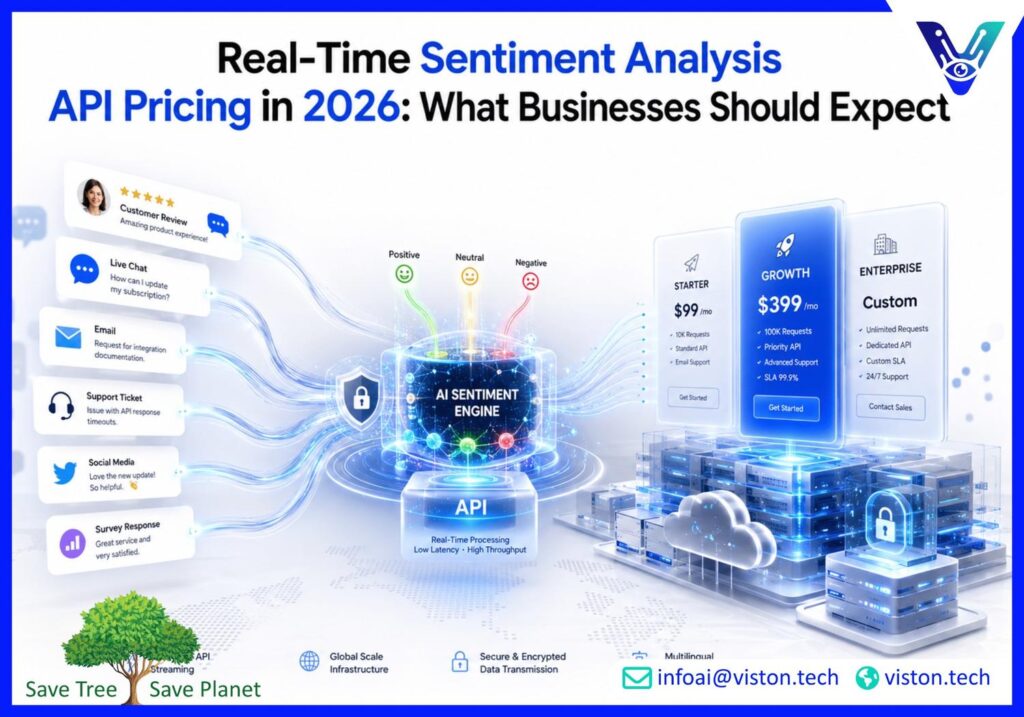
Real-Time Sentiment Analysis API Pricing in 2026: What Businesses Should Expect
Real-time sentiment analysis has become a critical capability for businesses that need immediate insight into customer opinions, brand perception, and market reactions. As organizations increasingly rely on AI-driven customer intelligence, understanding real-time sentiment analysis API pricing is essential for budgeting, vendor selection, and long-term scalability.
What Is Real-Time Sentiment Analysis API Pricing?
Real-time sentiment analysis API pricing refers to the cost structure vendors use to provide instant sentiment detection capabilities through application programming interfaces (APIs). These APIs analyze text from customer reviews, social media posts, chat conversations, surveys, emails, support tickets, and other communication channels to determine sentiment such as positive, negative, or neutral.Pricing models vary depending on several factors, including:
Number of API requests
Volume of text processed
Response speed requirements
Language support
Accuracy requirements
Custom model training
Enterprise security features
Integration complexity
In 2026, organizations increasingly prioritize scalable pricing structures that align with business growth while maintaining consistent performance and accuracy.
Key Factors That Influence Real-Time Sentiment Analysis API Costs
Data Processing Volume
The amount of text analyzed is one of the largest pricing drivers. Businesses monitoring thousands of customer interactions daily will typically require higher API usage limits than companies processing occasional feedback.Providers commonly price based on:
Characters processed
Words analyzed
API calls per month
Documents processed
Streaming data volume
Real-Time Processing Requirements
Real-time analysis requires low-latency infrastructure capable of processing requests instantly. Organizations that depend on immediate sentiment insights for customer service, social media monitoring, or crisis management often pay premium rates for faster response times.
Language Coverage
Global businesses often require multilingual sentiment analysis. Supporting multiple languages, dialects, and regional nuances increases computational requirements and can impact pricing.
Customization and Model Training
Generic sentiment models may not accurately interpret industry-specific terminology. Organizations frequently invest in customized sentiment models that understand sector-specific language, resulting in additional implementation and maintenance costs.
Security and Compliance
Businesses operating in regulated industries often require:
Data encryption
Private deployments
Regional data residency
Compliance controls
Audit logging
These enterprise-grade requirements can significantly affect overall API pricing.
Common Real-Time Sentiment Analysis API Pricing Models
Pay-As-You-Go Pricing
This model charges organizations based on actual usage. It is often suitable for businesses with fluctuating demand or pilot projects.Advantages include:
Lower upfront commitment
Flexible scaling
Predictable usage-based billing
However, costs may increase rapidly as usage grows.
Subscription-Based Pricing
Many providers offer monthly or annual plans that include predefined API limits.This approach provides:
Predictable budgeting
Simplified procurement
Better cost control
Volume discounts
Subscription plans are often preferred by enterprises with consistent sentiment analysis requirements.
Enterprise Licensing
Large organizations frequently negotiate custom contracts based on:
Expected workload
Support requirements
Security obligations
Infrastructure preferences
Custom AI model requirements
Enterprise agreements typically provide the greatest flexibility and scalability.
Why Businesses Are Investing More in Real-Time Sentiment Analysis in 2026
The value of sentiment analysis extends beyond simply classifying customer opinions. Organizations increasingly use real-time sentiment intelligence to improve decision-making across multiple business functions.
Customer Experience Management
Real-time sentiment detection helps support teams identify dissatisfied customers immediately, enabling faster issue resolution and improved retention rates.
Brand Reputation Monitoring
Businesses can detect emerging reputation risks before they escalate into larger public relations challenges.
Market Intelligence
Organizations analyze sentiment trends to understand customer preferences, competitive positioning, and changing market conditions.
Sales and Marketing Optimization
Marketing teams use sentiment insights to evaluate campaign effectiveness and optimize customer engagement strategies.As AI adoption continues to expand, sentiment analysis APIs have become a foundational component of modern customer intelligence programs.
How to Evaluate the True Cost Beyond API Pricing
When comparing vendors, businesses should look beyond the advertised API price.Important evaluation factors include:
Implementation costs
Integration effort
Data preparation requirements
Customization expenses
Ongoing model maintenance
Support and service levels
Scalability limitations
Accuracy performance
A lower-priced API may generate higher total costs if additional development, maintenance, or customization becomes necessary.Organizations should evaluate total cost of ownership rather than focusing solely on monthly subscription fees.
How Viston AI Supports Businesses with Sentiment Analysis Solutions
For organizations seeking practical sentiment analysis capabilities, Viston AI provides specialized sentiment analysis solutions designed to help businesses transform unstructured customer feedback into actionable intelligence.Rather than relying solely on generic sentiment scoring, modern sentiment analysis initiatives often require industry-specific understanding, real-time processing, scalable infrastructure, and integration with existing business systems. Viston AI focuses on helping organizations address these operational requirements through tailored AI-powered sentiment analysis capabilities.Businesses across various sectors increasingly need visibility into customer opinions from multiple channels, including reviews, support conversations, surveys, social media discussions, and digital engagement platforms. Effective sentiment analysis enables organizations to identify trends, monitor brand perception, improve customer experiences, and support data-driven decision-making.As sentiment analysis adoption grows in 2026, organizations often seek partners capable of supporting implementation, scalability, integration, and ongoing optimization. Viston AI’s focus on sentiment analysis solutions aligns with these business needs by helping companies build reliable sentiment intelligence workflows that can scale alongside evolving customer engagement requirements.
Frequently Asked Questions
How much does a real-time sentiment analysis API typically cost?
Pricing varies based on usage volume, API requests, language support, customization needs, and enterprise requirements. Costs can range from small subscription plans to custom enterprise agreements.
What affects sentiment analysis API pricing the most?
Processing volume, response speed, language coverage, security requirements, and custom model development are typically the largest pricing factors.
Is pay-as-you-go pricing suitable for sentiment analysis?
Pay-as-you-go pricing can be effective for testing, pilots, and organizations with unpredictable workloads. Larger enterprises often prefer subscription or custom pricing models.
Do sentiment analysis APIs support multiple languages?
Many modern sentiment analysis APIs support multilingual analysis, although extensive language coverage may influence pricing and implementation complexity.
Can sentiment analysis APIs integrate with CRM and customer support platforms?
Yes. Most enterprise-grade solutions offer integration capabilities for CRM systems, customer support platforms, marketing tools, analytics environments, and business intelligence applications.
How can Viston AI help with sentiment analysis implementation?
Viston AI provides sentiment analysis solutions that help businesses convert customer feedback and text data into actionable insights while supporting scalability, operational efficiency, and business intelligence objectives.
Conclusion
Understanding real-time sentiment analysis API pricing requires more than comparing subscription fees. Businesses must evaluate processing volume, scalability, customization requirements, security expectations, and long-term operational goals. As organizations continue investing in AI-driven customer intelligence in 2026, selecting the right sentiment analysis solution becomes increasingly important for maximizing value and maintaining competitive advantage. For companies exploring sentiment analysis capabilities, working with experienced specialists such as Viston AI can help ensure that implementation decisions align with business objectives, growth requirements, and customer experience strategies.