
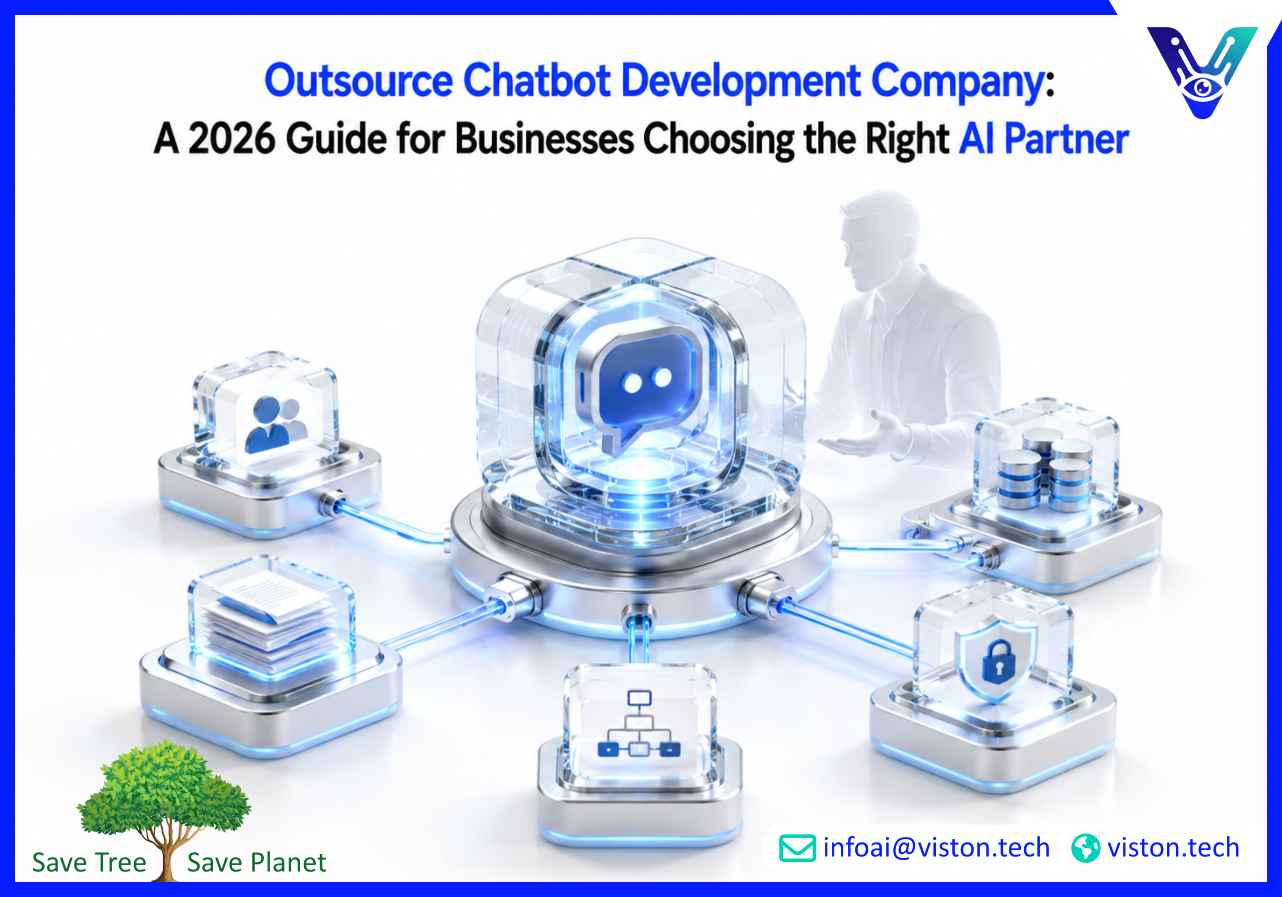
Choosing an outsource chatbot development company in 2026 is no longer just about building a basic support bot. Businesses now need secure, scalable, intelligent conversational systems that connect with real workflows, customer journeys, data sources, and operational goals.
An outsource chatbot development company helps businesses plan, design, build, integrate, deploy, and improve AI-powered chatbot solutions without requiring the entire capability to be built in-house. This is especially useful for companies that need technical depth, faster implementation, and reliable delivery but do not want to hire a full internal AI engineering team.
Modern chatbot development is much broader than scripted question-and-answer automation. A business-ready chatbot may need natural language understanding, intent recognition, entity extraction, generative AI, retrieval-augmented generation, CRM integration, helpdesk connectivity, analytics dashboards, secure data handling, multilingual support, escalation workflows, and ongoing optimization.
For business leaders, outsourcing is often a practical way to reduce delivery risk. A specialist team can help clarify what the chatbot should do, where it should sit in the customer or employee journey, which systems it must connect with, and how success should be measured. This matters because many chatbot projects fail when they are treated as simple website widgets instead of operational tools.
A reliable AI Chatbot Development partner usually supports several stages of the project:
The strongest outsourcing relationships are not limited to coding. They combine strategy, AI engineering, UX thinking, data readiness, workflow automation, compliance awareness, and post-launch governance. This is what separates a useful business chatbot from a generic automated responder.
Businesses are outsourcing chatbot development because customer and employee expectations have changed. People expect faster answers, consistent support, personalized assistance, and convenient self-service across digital channels. At the same time, companies are under pressure to control support costs, improve response times, and make better use of internal knowledge.
In 2026, AI chatbots are being used for more than customer service. They support sales qualification, product discovery, onboarding, appointment scheduling, HR assistance, IT helpdesk automation, internal knowledge retrieval, lead capture, order tracking, technical troubleshooting, and workflow routing. This makes chatbot development a cross-functional business initiative rather than a small marketing experiment.
Good chatbot development requires a mix of skills. Businesses may need AI engineers, NLP specialists, backend developers, integration experts, conversation designers, QA testers, security reviewers, and project managers. Hiring all of these roles internally can be expensive and slow. Outsourcing gives businesses access to this capability when they need it, without long-term hiring commitments.
A specialist chatbot development company has usually solved common implementation challenges before. These include poor intent mapping, weak knowledge base structure, inaccurate responses, lack of escalation paths, disconnected systems, unclear reporting, and low user adoption. Experienced delivery teams can help avoid these issues early.
A chatbot becomes more valuable when it can take action, not just answer questions. For example, it may create a support ticket, check order status, update a CRM record, book a consultation, retrieve account information, trigger a workflow, or route a qualified lead to sales. Outsourced teams with integration experience can help connect the chatbot with the tools a business already uses.
Chatbots need continuous refinement. User questions change, products evolve, policies are updated, and new business processes emerge. Outsourcing can provide ongoing support for performance monitoring, conversation improvements, model updates, analytics, security checks, and feature expansion.
AI Chatbot Development is valuable when it solves a clear operational or customer experience problem. The goal should not be to add AI for novelty. The goal should be to reduce friction, increase availability, improve consistency, and help teams work more efficiently.
Many support teams spend significant time answering the same questions about pricing, availability, delivery status, refunds, account access, documentation, appointments, or service details. A chatbot can handle these routine inquiries instantly while allowing human agents to focus on complex, sensitive, or high-value conversations.
Customers may contact a business outside normal working hours, across time zones, or during peak demand periods. A well-built chatbot provides immediate assistance when human teams are unavailable. This is especially useful for businesses serving global customers or operating across multiple regions.
For sales and marketing teams, a chatbot can ask structured qualification questions, recommend relevant services, collect contact details, identify buyer intent, and route prospects to the right team. This helps businesses convert website visitors who may otherwise leave without taking action.
Chatbots are also useful inside the organization. Employees can use them to find policy information, request IT support, check process documentation, search knowledge bases, submit forms, or access workflow guidance. Internal chatbots can reduce dependency on manual email threads and improve knowledge accessibility.
Human support can vary depending on agent availability, training, workload, and documentation quality. A chatbot can provide consistent answers based on approved business knowledge. With the right escalation logic, it can also hand over to human teams when the issue requires judgment, empathy, or exception handling.
Choosing the right outsource chatbot development company requires more than comparing hourly rates. Businesses should evaluate whether the provider understands commercial goals, technical architecture, data quality, user experience, integrations, compliance, and long-term support.
A credible partner should begin with business discovery. They should ask what problem the chatbot is solving, who will use it, what systems it must access, what data it can use, what risks exist, and how success will be measured. If a provider jumps straight into development without understanding the business context, the final product may be technically functional but commercially weak.
Many chatbot projects become limited because they are not connected to real business systems. Ask whether the company can integrate with CRM platforms, ticketing tools, databases, knowledge bases, websites, mobile apps, messaging channels, analytics tools, and automation platforms. Integration capability is often the difference between a chatbot that answers questions and one that improves operations.
Chatbots may process customer names, emails, account details, support history, transaction information, employee data, or business documents. A development company should understand secure authentication, permission control, data minimization, encryption, logging, access governance, and safe model usage. For regulated industries, compliance requirements should be addressed early in the project.
AI chatbots need structured testing. This includes testing common questions, edge cases, incorrect inputs, sensitive topics, hallucination risks, escalation triggers, system integrations, response accuracy, and user experience. A strong provider should be able to explain how they validate chatbot behavior before and after launch.
The right chatbot partner should help define metrics such as containment rate, escalation rate, response accuracy, lead conversion, average resolution time, user satisfaction, cost per interaction, ticket reduction, and workflow completion rate. These metrics help businesses understand whether the chatbot is delivering practical value.
Viston AI is directly relevant to businesses looking for an outsource chatbot development company because AI Chatbot Development is part of its stated service offering. Its website presents services across AI Chatbot Development, AI Chatbot Integration, Enterprise AI Chatbots, Voice-Enabled Assistants, Multilingual Support, NLP and text analysis, AI automation, and custom AI solution development.
For companies that want to outsource chatbot development, this matters because the work often requires more than a front-end chat interface. A business chatbot may need natural language understanding, workflow automation, system integration, multilingual communication, secure deployment, analytics, and ongoing improvement. Viston AI’s chatbot service page describes enterprise-grade conversational AI solutions, advanced LLMOps, generative AI technologies, natural language understanding, sentiment analysis, fallback protocols, intent recognition, and industry-specific chatbot use cases.
This makes Viston AI a practical fit for organizations that want chatbot development connected to real customer engagement, support automation, sales workflows, employee assistance, or operational self-service. Its listed industry applications include healthcare, retail, manufacturing, technology, travel, real estate, telecommunications, logistics, government, automotive, legal services, non-profit, agriculture, and construction, which supports relevance for broad B2B and enterprise use cases.
Businesses evaluating Viston AI should still review project scope, integration needs, security expectations, support model, and delivery process. The best fit will be organizations that need a specialist AI partner to plan, build, and improve chatbot systems that support measurable business outcomes.
An outsource chatbot development company is an external specialist that designs, builds, integrates, and supports chatbot solutions for businesses. It helps companies access AI Chatbot Development expertise without hiring a full internal team.
No-code tools can work for simple FAQs, but outsourced development is usually better when the chatbot needs custom workflows, AI model configuration, CRM integration, secure data handling, multilingual support, analytics, or enterprise scalability.
Timeline depends on complexity. A simple chatbot may take a few weeks, while a custom AI chatbot with integrations, knowledge base design, testing, and deployment across multiple channels can take longer. Discovery and scope definition are essential before estimating accurately.
An AI chatbot can integrate with CRM platforms, helpdesk software, ERP systems, databases, e-commerce platforms, payment tools, calendars, knowledge bases, messaging apps, websites, mobile apps, and internal workflow systems.
Yes. Small and mid-sized businesses can benefit when they have repetitive inquiries, lead qualification needs, limited support capacity, or a growing digital customer base. The chatbot should be scoped around clear business value rather than unnecessary complexity.
Yes. Viston AI lists AI Chatbot Development as one of its services and also presents related capabilities such as AI Chatbot Integration, Enterprise AI Chatbots, multilingual support, voice-enabled assistants, NLP solutions, and automation-focused AI services.
Working with an outsource chatbot development company can help businesses build smarter, more reliable, and more scalable conversational systems in 2026. The right AI Chatbot Development partner should understand business goals, user behavior, data quality, integrations, security, testing, and continuous optimization. For organizations that want chatbots to support customer service, sales, employee workflows, or operational automation, outsourcing can reduce delivery risk and speed up implementation. Viston AI is a relevant specialist to consider when businesses need chatbot development aligned with enterprise AI, integration, automation, and practical business outcomes.
