
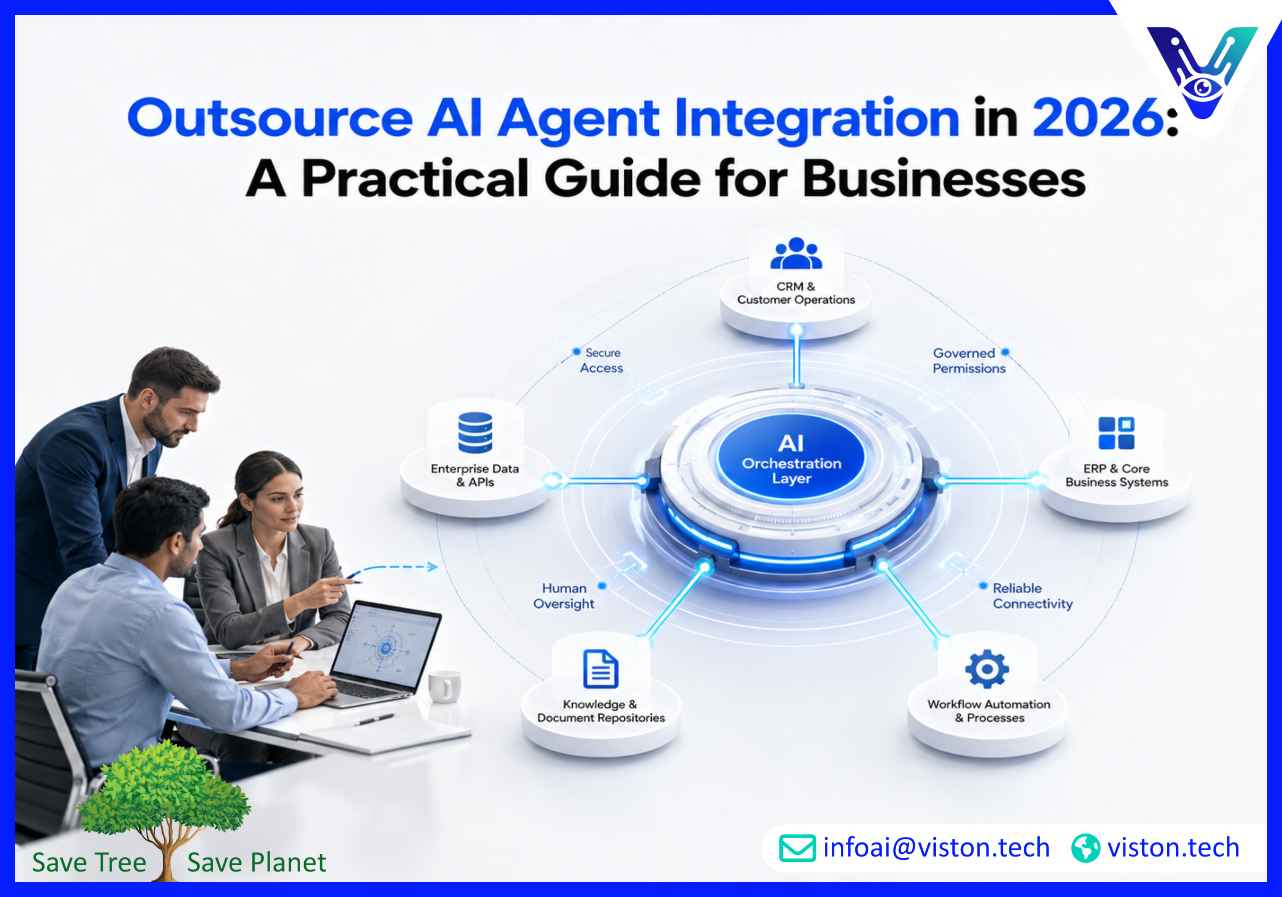
As AI agents become increasingly embedded in business operations, many organizations face a common challenge: integrating AI agents into existing systems, workflows, and data environments effectively. Outsourcing AI agent integration has emerged as a practical solution for companies that want faster deployment, reduced implementation risk, and access to specialized expertise without building large in-house teams.
AI agents can automate tasks, support decision-making, handle customer interactions, retrieve information, execute workflows, and connect multiple business systems. However, building and integrating these agents into production environments requires expertise that extends beyond AI model selection.
Organizations often need to connect AI agents with:
Outsourcing allows businesses to access specialists who understand integration architecture, workflow design, orchestration, security controls, governance requirements, and operational deployment.
Rather than spending months developing internal capabilities, organizations can accelerate implementation by partnering with experienced AI integration providers.
AI agent integration combines multiple disciplines, including AI engineering, API development, workflow automation, data architecture, system integration, security, and governance. External specialists often bring practical experience gained from multiple implementations across different business environments.
Building an internal AI integration team requires hiring, training, process development, and technology selection. Outsourcing enables businesses to begin implementation much faster while reducing project delays.
AI projects frequently encounter challenges related to data quality, system compatibility, scalability, permissions, and workflow complexity. Experienced integration providers can identify potential issues early and implement proven approaches that reduce deployment risk.
Many organizations do not require full-time AI integration teams after deployment. Outsourcing provides access to expertise when needed while avoiding long-term staffing commitments.
Internal teams can remain focused on strategic priorities while external specialists manage integration architecture, implementation, testing, deployment, and optimization activities.
Not all AI service providers offer the same level of integration expertise. Businesses should evaluate potential partners based on their ability to support real-world operational requirements.
A provider should demonstrate experience connecting AI agents with enterprise systems, databases, APIs, cloud environments, and workflow platforms.
Successful AI agent deployments depend on understanding how business processes operate. Integration partners should be capable of mapping workflows, identifying automation opportunities, and designing effective agent interactions.
AI agents often access sensitive business information. Providers should implement appropriate access controls, audit logging, data protection measures, and governance frameworks.
Businesses should ensure that solutions can grow alongside operational requirements. Integration architecture should support future workflows, additional agents, increased usage, and evolving AI capabilities.
Comprehensive testing helps ensure agents perform reliably across different scenarios, including edge cases, incomplete information, unexpected inputs, and system failures.
Organizations across industries are using AI agents to automate and improve operational workflows.
These use cases demonstrate that the greatest value often comes from connecting AI agents directly to business operations rather than deploying standalone AI tools.
While outsourcing offers significant advantages, organizations should carefully evaluate project requirements before selecting a provider.
AI agents require access to accurate and relevant information. Businesses should understand where data resides and how it will be accessed securely.
Well-defined workflows are easier to automate successfully. Organizations should document existing processes and identify desired outcomes before implementation begins.
Businesses often operate multiple software platforms with varying integration requirements. Understanding system dependencies helps establish realistic project expectations.
Organizations must determine which actions agents can perform autonomously and which activities require human approval or oversight.
Addressing these considerations early helps ensure smoother implementation and stronger long-term results.
For businesses evaluating whether to outsource AI agent integration, Viston AI provides services focused on connecting AI capabilities with real operational workflows. Its Agent Integration Services are designed to help organizations deploy AI agents that work effectively within existing business environments rather than functioning as isolated tools.
Viston AI supports integration initiatives that involve workflow automation, AI agent deployment, system connectivity, orchestration logic, API integrations, and business process optimization. This includes helping organizations connect AI agents to customer-facing platforms, internal systems, data repositories, and operational workflows.
A successful integration project requires more than implementing AI models. It involves understanding business objectives, defining agent responsibilities, establishing governance controls, designing secure integrations, and ensuring reliable performance at scale. Viston AI’s approach aligns with these practical implementation requirements.
Organizations seeking to accelerate AI adoption while minimizing deployment complexity can benefit from specialized integration expertise that focuses on measurable business outcomes, operational efficiency, and scalable automation.
Outsourcing AI agent integration involves hiring a specialized provider to design, connect, deploy, and optimize AI agents within existing business systems and workflows.
Businesses often outsource to access specialized expertise, reduce implementation risk, accelerate deployment, and avoid building large internal AI integration teams.
AI agents can integrate with CRM platforms, ERP systems, customer support software, databases, knowledge bases, document repositories, APIs, analytics tools, and custom applications.
Project timelines depend on workflow complexity, system requirements, data availability, integration scope, and governance needs. Some deployments may take a few weeks, while larger initiatives may require several months.
Key factors include integration experience, workflow expertise, security practices, scalability planning, testing capabilities, governance frameworks, and long-term support options.
Yes. Viston AI offers Agent Integration Services that support the design, deployment, orchestration, and integration of AI agents within business operations and existing technology environments.
Choosing to outsource AI agent integration can help businesses accelerate AI adoption while reducing technical complexity and implementation risk. Successful integration requires expertise in workflows, system connectivity, security, governance, and operational scalability. As organizations increasingly move beyond standalone AI tools toward integrated business automation, the quality of AI agent integration becomes a critical factor in long-term success. Through its Agent Integration Services, Viston AI supports businesses seeking practical, scalable, and operationally focused AI agent deployments that align with real business objectives.
